What is NLP and how is it different from Hypnotherapy?
NLP and Hypnotherapy in Ontario: What Both Are, How They Differ, and Why They Work Better Together
TL;DR: Hypnotherapy and NLP are two different approaches to subconscious change, and most people do not know what either of them actually is. Hypnotherapy works through the trance state to access the subconscious directly. NLP works through language, thought patterns, and structured techniques to rewire automatic responses. When used together, they cover more ground than either can alone. Fanis Makrigiannis at Mind Spirit Body Hypnosis in Oshawa, Ontario, holds certifications in both and uses NLP hypnotherapy Ontario techniques in every session.
Quick Answer
NLP hypnotherapy Ontario combines two evidence-informed approaches to subconscious change: Neuro-Linguistic Programming (NLP), which rewires automatic thought patterns and behaviours through language and structured mental techniques, and hypnotherapy, which uses the trance state to access the subconscious directly and update the beliefs, habits, and emotional responses stored there. NLP was originally developed by modelling the language patterns of gifted therapists, including hypnotherapist Milton Erickson, which is why the two approaches share common ground and work naturally together. Fanis Makrigiannis, a Certified Hypnotherapist (ABH, NGH) and NLP Master Practitioner (ABNLP) at Mind Spirit Body Hypnosis in Oshawa, Ontario offers virtual sessions for clients aged 10 and older across Ontario. No referral is required.
Questions This Article Answers
What is NLP and how is it different from hypnotherapy?
What is hypnotherapy and how does it actually work?
Why do NLP and hypnotherapy work better together than separately?
Which problems respond best to NLP, and which respond best to hypnotherapy?
What does a combined session look like at Mind Spirit Body Hypnosis?
In this article:
People often arrive for their first session having done some research and still not quite sure what they have signed up for. They know they want something to change. They are less clear on what hypnotherapy actually is, what NLP is, and how the two are related.
This article answers that clearly.
Both approaches work with the subconscious. Both aim to change automatic patterns. And both are more effective when used together than when used alone. Understanding the difference helps you know what to expect and why the approach works.
In my practice in Oshawa, I use both in almost every session. The specific balance depends on the person and the pattern we are working with. But they are rarely used in isolation.
What Is NLP?
NLP stands for Neuro-Linguistic Programming. The name sounds technical, but the idea is straightforward.
Neuro refers to the mind and nervous system. Linguistic refers to language, including the internal language we use when we think. Programming refers to the automatic patterns and sequences our minds run, often without awareness.
NLP was developed in the 1970s by Richard Bandler and John Grinder. They studied highly effective therapists and communicators to understand what these people were doing that worked so well. One of their main models was hypnotherapist Milton Erickson. What they found was that effective therapists shared certain patterns in how they used language, directed attention, and structured change. NLP is essentially a collection of those patterns, made learnable and repeatable.
In practice, NLP includes techniques like:
Anchoring. Associating a physical gesture or touch with a positive emotional state, so that the gesture can later be used to access that state quickly.
Reframing. Changing the meaning assigned to a situation or experience, so that the emotional response to it changes.
Pattern interrupts. Breaking an automatic thought or behavioural sequence at a specific point, before it completes, so that a new response can be installed.
Submodalities. Changing the internal sensory qualities of a memory or thought (its brightness, size, distance, tone) to change its emotional impact.
Parts integration. Working with the internal conflict between different parts of the self that want different things, so that the conflict is resolved rather than endlessly fought.
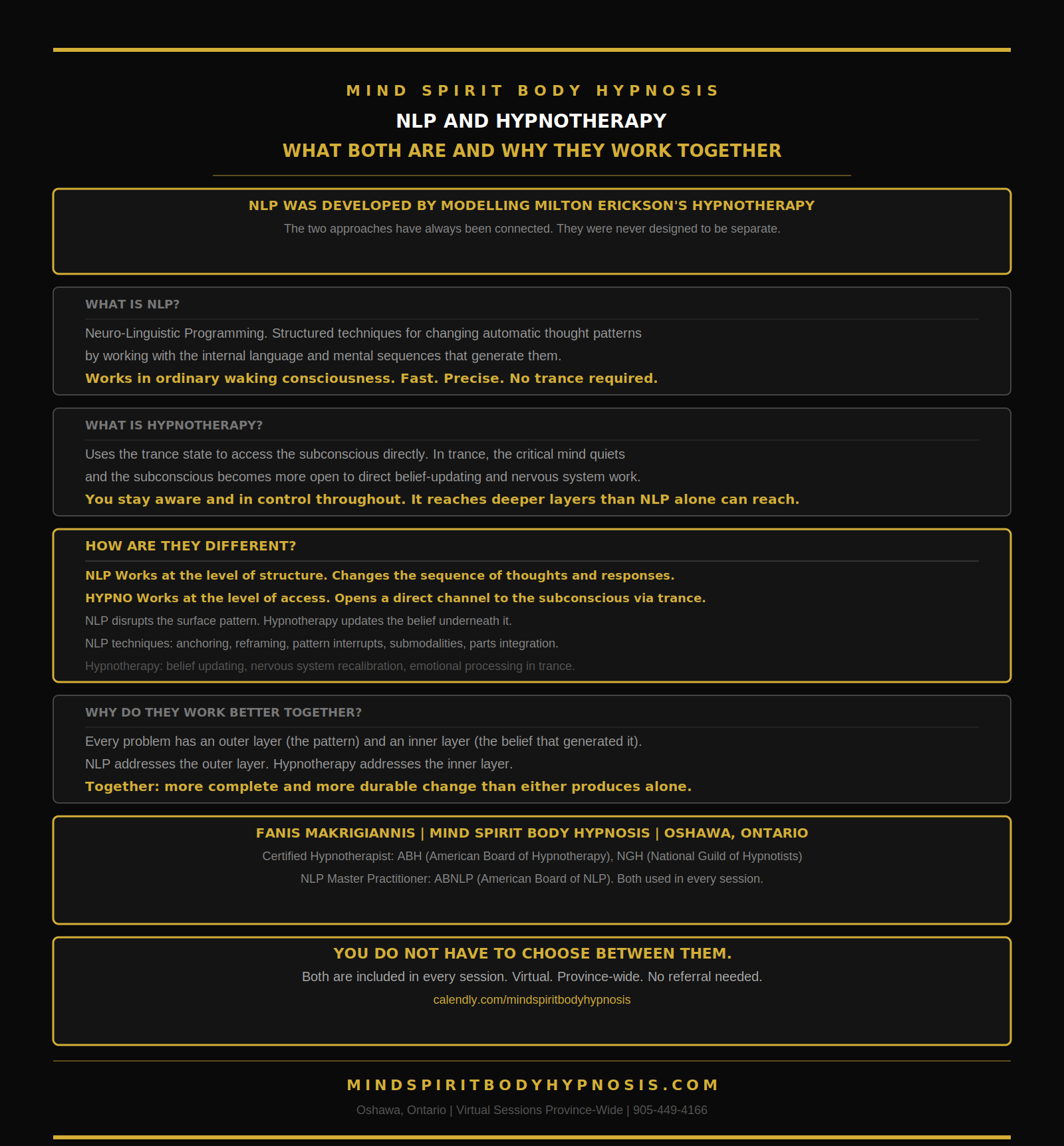
NLP does not require a trance state. It works in ordinary waking consciousness. The client is active and engaged throughout. It is fast, structured, and highly specific.
For more on how NLP patterns are used in anxiety and stress work at Mind Spirit Body Hypnosis, the hypnotherapy for anxiety and stress page describes the combined approach.
What Is Hypnotherapy?
Hypnotherapy uses the trance state to access the subconscious directly.
The trance state is not sleep or unconsciousness. It is a deeply relaxed, focused state of awareness in which the critical, analytical part of the mind becomes quieter and the subconscious becomes more open to direct change work. Most people enter a light version of this state every day, in the moments just before sleep and just after waking.
In the clinical hypnotherapy session, the practitioner guides the client into this state through directed breathing, progressive relaxation, and focused attention. Once in trance, the subconscious can be approached with specific therapeutic suggestions, imagery, and direct belief-updating work that would be filtered out or rejected in ordinary waking consciousness.
Hypnotherapy is particularly good at:
Reaching and updating deeply held beliefs formed in early life
Reducing the emotional charge of stored memories and experiences
Installing new automatic responses at the subconscious level
Recalibrating the nervous system's baseline activation level
Working with physical symptoms that have a psychological dimension (sleep quality, anxiety in the body, psychosomatic tension)
The key distinction from NLP is the trance state itself. Hypnotherapy reaches the subconscious through the relaxed, open channel that trance provides. NLP reaches it through the structure and precision of language and technique.
How Are NLP and Hypnotherapy Different?
The simplest way to understand the difference is this.
NLP works at the level of structure. It identifies the specific sequence of thoughts, images, and sensations that produce an unwanted automatic response, and it changes the structure of that sequence. You do not need to be in a trance for this to work. You need to be engaged, curious, and willing to follow the practitioner's instructions precisely.
Hypnotherapy works at the level of access. The trance state opens a direct channel to the subconscious that is not available in ordinary waking consciousness. Suggestions, imagery, and belief updates can reach deeper layers of the mind than NLP techniques alone can reach.
NLP primarily addresses conscious thoughts, behaviours, and language patterns, while hypnotherapy induces a trance state to access the subconscious directly. In practice, the distinction is not always clean. Many NLP techniques, when applied by a skilled practitioner, produce a light trance-like state as a by-product. And many hypnotherapeutic suggestions use the same linguistic patterns that NLP identifies.
This is why Milton Erickson, the most influential hypnotherapist of the 20th century, was one of the primary models for NLP's development. The two were always connected.
Why Do NLP and Hypnotherapy Work Better Together?
Because they address different layers of the same problem.
Imagine a subconscious pattern as having an outer layer and an inner layer. The outer layer is the automatic sequence: the trigger, the thought, the emotional response, the behaviour. NLP works directly on this outer layer. It can interrupt the sequence, change its structure, and install a new response. This is fast, precise, and often produces noticeable change within a single session.
The inner layer is the underlying belief, the stored emotional experience, the nervous system calibration that generated the outer layer in the first place. This is where hypnotherapy does its deepest work. Accessing it requires the quieting of the critical mind that the trance state provides.
When both are combined, the outer layer is disrupted and restructured through NLP, and the inner layer is updated and recalibrated through hypnotherapy. The result is more complete and more durable than either approach alone.
In this combined model, hypnotherapy induces a relaxed, receptive state while NLP provides tools to reframe how the brain processes information, using techniques like anchoring, submodalities, and pattern interrupts to shift perspectives at the conscious level before the trance work consolidates the change at the subconscious level.
As a Certified Hypnotherapist and NLP Master Practitioner working across Durham Region and Ontario, I find the combined approach consistently produces more durable results than using either in isolation. This is why clients who specifically search for NLP hypnotherapy Ontario and find Mind Spirit Body Hypnosis get both in an integrated programme, not a choice between one or the other. The NLP techniques are often used in the pre-trance conversation to map and disrupt the surface pattern. The hypnotherapy deepens the work and consolidates it at the subconscious level.
Which Problems Respond Best to Each Approach?
This is a useful guide, though in practice most presentations benefit from both.
NLP tends to be the primary tool for:
Specific phobias and immediate fear responses
Performance anxiety and public speaking fear
Changing a specific habitual thought sequence
Communication patterns in relationships
Decision-making blocks and overthinking in the moment
Fast disruption of an acute anxiety pattern
Hypnotherapy tends to be the primary tool for:
Deeply held beliefs from early life
Trauma-related nervous system patterns
Sleep quality and chronic fatigue
Weight and food relationship work
Smoking cessation and behavioural habits with strong physical components
Confidence and identity work at the core level
Both together tend to be used for:
Anxiety and overthinking (NLP to interrupt the loop, hypnotherapy to recalibrate the baseline)
Self-sabotage and fear of success (NLP to disrupt the pattern, hypnotherapy to update the root belief)
Trauma recovery (NLP for immediate stabilization, hypnotherapy for deeper nervous system processing)
Most complex presentations
For more on how self-sabotage and confidence patterns are addressed through this combined approach, the confidence and self-sabotage pillar page covers the full range of work available.
What Do Sessions Look Like at Mind Spirit Body Hypnosis?
Every session at Mind Spirit Body Hypnosis uses NLP hypnotherapy in Ontario as an integrated approach, not two separate techniques applied in sequence.
A typical session:
Conversation and mapping. We talk. I use NLP-informed questioning to identify the specific structure of the pattern: the trigger, the internal sequence, the emotional response, and the believed meaning. This conversation is itself part of the intervention. Precision in mapping produces precision in change.
NLP work (where appropriate). For specific phobias, acute fear patterns, or surface habit structures, NLP techniques may be used in the waking conversational state before or instead of trance work. Pattern interrupts, reframing, and anchoring are common at this stage.
Trance induction and hypnotherapy. The client is guided into the trance state through directed breathing and progressive relaxation. In trance, the deeper beliefs, nervous system calibration, and stored emotional patterns are addressed directly. NLP submodality work is often woven into the trance session itself.
Emergence and integration. The client is brought back to full waking awareness. The session ends with a brief integration conversation, and self-hypnosis or anchoring practice is often assigned for use between sessions.
In my practice, most presentations run between three and five sessions. A specific honest estimate is always given in the free 30-minute strategy session. All sessions are virtual, available to clients aged 10 and older across Ontario. No referral is required. More about my qualifications in both modalities is on the about page.
WHAT MY CLIENTS SAY
“I don’t write many reviews, but Fanis truly earned this one. I came in skeptical. What I got was a practitioner who takes the work seriously while being incredibly supportive. He asked the right questions up front, actually listened to the answers, and explained his approach in plain language before starting. No theatrics, no vague promises. The sessions themselves were comfortable and easy to settle into. I felt a shift after the first one and it held. He also gave me practical things to do between sessions, which made the progress stick rather than fade after a few days. He’s honest about what hypnotherapy can and can’t do, which is exactly why I trusted him. If you’re considering it, go see Fanis. Thank you Fanis for helping me and approaching it in the manner you did!” — Faisal H.
Frequently Asked Questions
What is NLP? Neuro-Linguistic Programming. A set of structured techniques for changing automatic thought patterns, emotional responses, and behaviours by working with the internal language and mental sequences that generate them. Developed in the 1970s by modelling highly effective therapists, including hypnotherapist Milton Erickson.
What is hypnotherapy? A therapeutic approach that uses the trance state to access the subconscious directly. In trance, the critical mind quiets and the subconscious becomes more open to direct belief-updating, emotional processing, and nervous system recalibration.
Are NLP and hypnotherapy the same thing? No, but they are closely related. NLP was partly developed by studying Milton Erickson's hypnotherapy. Both work with the subconscious, but NLP operates primarily in waking consciousness through structured language and technique, while hypnotherapy uses the trance state for direct subconscious access.
Why is combining them better than using one alone? Because they address different layers of the same problem. NLP disrupts and restructures the surface pattern. Hypnotherapy updates the underlying belief, stored experience, and nervous system state that generated the pattern. Together they produce more complete and more durable change.
What qualifications does Fanis Makrigiannis hold in both? Certified Hypnotherapist through the American Board of Hypnotherapy (ABH) and the National Guild of Hypnotists (NGH). NLP Master Practitioner through the American Board of NLP (ABNLP). Both sets of credentials are verifiable on request.
Which problems are better suited to NLP and which to hypnotherapy? NLP tends to be primary for specific phobias, performance anxiety, and acute habit structures. Hypnotherapy tends to be primary for early-life beliefs, trauma patterns, sleep, and deep identity work. Most complex presentations benefit from both.
How long does a typical programme run? Three to five sessions for most presentations. Some complex patterns require more. A specific honest estimate is always given in the free strategy session.
Can I access sessions from anywhere in Ontario? Yes. All sessions are delivered virtually across Ontario, including Durham Region, Toronto, Ottawa, and beyond. No referral is required.
Ready to Take the Next Step?
If you have been curious about NLP, hypnotherapy, or both, the free strategy session is the place to find out whether this combined approach is the right fit for what you want to change.
I offer a free 30-minute virtual strategy session for new clients across Ontario. No trance work. No pressure. Just an honest conversation.
Book your free session: calendly.com/mindspiritbodyhypnosis
Call or text: 905-449-4166
Email: mindspiritbodyhypnosis@gmail.com
Visit: mindspiritbodyhypnosis.com
Serving clients virtually across Ontario, including Durham Region, Toronto, Canada, and beyond.
Disclaimer: This article is for informational purposes only and does not constitute medical or psychological advice. Hypnotherapy, NLP, and EMDR are complementary approaches and are not a substitute for diagnosis or treatment by a qualified healthcare provider. Results vary by individual.
RECOMMENDED READING
Written by Fanis Makrigiannis | Certified Hypnotherapist (ABH, NGH) and NLP Master Practitioner (ABNLP) | Mind Spirit Body Hypnosis, Oshawa, Ontario.