Can Hypnosis Help With Overeating?
TL;DR: Hypnosis for overeating targets the subconscious habit loop that makes you eat before your conscious mind weighs in. Research suggests that adding hypnosis to a weight-loss program produces greater results than the program alone. Fanis Makrigiannis, a Certified Hypnotherapist at Mind Spirit Body Hypnosis in Oshawa, Ontario, offers virtual sessions across Ontario for clients who have tried willpower and found it does not hold.
Quick Answer
Hypnosis for overeating is a subconscious-focused approach that works by updating the automatic habit patterns that trigger eating in response to cues like stress, boredom, habit, or time of day. A 2021 narrative review in the International Journal of Environmental Research and Public Health found that hypnosis added to standard weight-loss programs produced greater results than the programs alone across multiple trials. Fanis Makrigiannis, a Certified Hypnotherapist (ABH) and NLP Master Practitioner at Mind Spirit Body Hypnosis in Oshawa, Ontario, works with clients across Ontario who want to address the subconscious side of overeating rather than just the behavioural surface.
Questions This Article Answers
Why do I keep eating even when I am not hungry?
What is the habit loop behind overeating?
Does hypnosis help with overeating?
What does a hypnotherapy session for overeating focus on?
Is hypnosis for overeating different from emotional eating hypnosis?
How many sessions does hypnotherapy for overeating take?
In this article:
Most people know they are eating more than they need to. That is not the problem. The problem is that they do it anyway, often before they have even thought about it. The hand reaches into the bag. The plate is empty. The moment it registers, the food is already gone.
This is not a failure of understanding. It is a habit running at the subconscious level. And the conscious mind, which is where understanding lives, does not have access to that layer. In my work with clients in Ontario, this is one of the most common patterns I see: people who know exactly what they are doing and still cannot stop it in the moment.
Why Knowing Better Does Not Stop the Habit
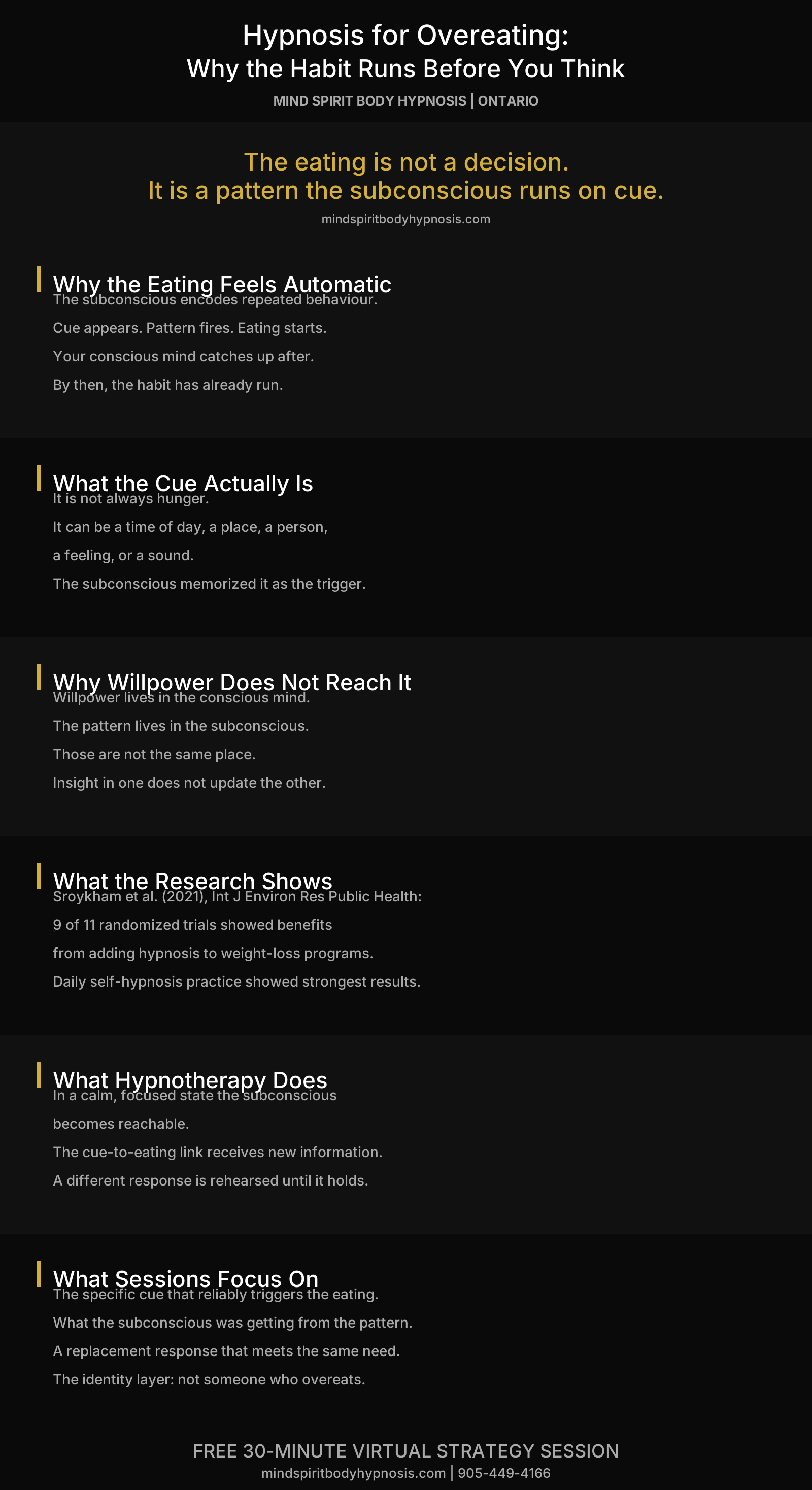
The brain is built to automate repeated behaviour. The more you do something in response to a specific cue, the more it becomes a background process. Eating after dinner while watching television. Grazing every time you walk through the kitchen. Reaching for food when you sit down to work.
These are not decisions in the moment. They are patterns the subconscious has encoded over hundreds of repetitions. By the time the conscious mind notices, the behaviour has already started. Willpower steps in too late. And even when it does step in, it works by resistance, which takes ongoing effort and collapses the moment attention shifts.
This is the gap that hypnotherapy is designed to address. The conscious mind is not the level where the pattern lives. Reaching it requires a different approach.
What the Habit Loop Actually Looks Like
Every automatic eating behaviour follows the same structure. A cue appears. The subconscious runs the pattern. The behaviour follows. The cue is not always hunger. It can be a time of day, a location, an emotion, a sound, or even a smell.
A client might eat every time they sit in a certain chair. Another eats whenever a specific person calls. Another eats right after a stressful email, not because they are hungry, but because the subconscious learned years ago that food briefly mutes the stress signal.
The behaviour worked well enough in the past. It provided some relief, comfort, or reward. The subconscious filed it as a useful response to that cue and has been running it ever since. The pattern does not care whether it is still useful. It just runs.
Understanding this is useful. But it does not update the pattern. The update has to happen at the level where the pattern is stored.
What the Research Shows
A 2021 narrative review in the International Journal of Environmental Research and Public Health looked at hypnosis as a self-help and adjunct strategy for obesity. The review found that of 11 randomized trials, 9 reported benefits from adding hypnosis to standard weight-loss programs. One notable controlled trial found that a hypnotherapy group lost approximately 7.8 kg over six months, while a control group with no intervention gained 0.2 kg.
Meta-analyses by Milling and colleagues, cited in the same review, found that adding hypnosis to a cognitive-behavioural weight-loss program produced an additional 0.80 pounds of weight loss at approximately 12-week follow-up compared to the program alone. Participants who practised self-hypnosis daily showed greater results than those who practised less consistently.
The review noted that the evidence base is growing but still limited by small sample sizes and older study designs. The authors concluded that hypnosis may benefit weight management as a supplement to other approaches. As a certified hypnotherapist, I treat it the same way: a tool that addresses the subconscious level, used alongside behavioural change, not instead of it. Clients across Durham Region and Ontario who have tried purely conscious-level strategies often find this combination produces results that willpower alone did not.
A mid-course check-in is part of how I work. About halfway through, I offer a free virtual conversation to see how things are shifting and whether the focus of sessions needs to adjust.
What happens when you overeat?
What Hypnotherapy for Overeating Addresses
The table below outlines what hypnotherapy for overeating targets and what falls outside its scope.
What Hypnotherapy for Overeating Addresses vs. What It Does Not
Hypnotherapy may help with:
Cue-triggered automatic eating
Eating in response to stress, boredom, or habit
The subconscious associations linking a cue to food
The identity layer ("I am someone who overeats")
The relief function eating has taken on
Outside the scope of hypnotherapy:
Medical or metabolic conditions
Eating disorders requiring clinical treatment
Nutritional planning or meal structure
Caloric tracking or exercise programming
Physical hunger and satiety signalling alone
Hypnotherapy works at the pattern layer. It is useful when the pattern is the problem, not when the issue is nutritional knowledge, medical, or clinical in nature.
What a Session Focuses On
In a hypnotherapy session for overeating, the first goal is to identify the specific cues that trigger the pattern. Not overeating in general, but the specific situation, feeling, or moment that reliably precedes it for that person.
Once that cue is clearly defined, the work shifts to what the subconscious was getting from the pattern. What did eating provide in response to that cue? Comfort? Escape? A brief pause from something overwhelming? The subconscious ran this pattern because it served a function. Replacing it requires offering something that addresses the same need.
In the hypnotic state, the mind is more open to update. The old association between the cue and the eating behaviour can receive new information. A different response can be rehearsed at the subconscious level until it starts to feel as natural as the old one. This is not willpower. It is an update to the background file.
Internal links to supporting pages: clients dealing with weight loss more broadly may find the pillar page helpful as an overview. Those noticing habit patterns across other areas will recognize the same subconscious architecture. And for clients who eat in response to stress, the anxiety and stress page covers the stress layer in more detail.
Is This Different From Emotional Eating Hypnosis?
Yes. Emotional eating hypnosis focuses specifically on the link between a feeling, usually a difficult or uncomfortable one, and reaching for food. The emotion is the trigger. The work centres on what the emotion means and how to meet that need differently.
Hypnosis for overeating covers a broader set of cues. The trigger might not be an emotion at all. It might be a time of day, a habit tied to a place, or an automatic sequence that has nothing to do with how you feel. The architecture is the same: a cue firing a subconscious pattern, but the entry point and the session content differ.
Some clients have both patterns. Sessions can address them. The important thing is identifying which type of cue is driving the behaviour for that person.
WHAT MY CLIENTS SAY
“My cousin told me about Fanis. Short version: she was right. I came in carrying years of complex trauma. The kind that does not have one clean origin story, just layers of things that built up over time and quietly shaped how I moved through the world. I had done therapy on and off and it helped me understand things, but understanding something and actually being free of it are two very different experiences. Fanis works at a level I had never accessed before. He is precise, unhurried, and completely present in a way that makes the whole process feel safe from the very first session. The pace of results genuinely surprised me. By session four I could feel something that had been there my entire adult life simply was not there anymore. I cannot explain the mechanism but I can describe the outcome. I feel lighter. I respond differently. Things that used to hijack me just do not anymore. Highly recommended. Do not wait as long as I did.” — Idi A. via Google
Frequently Asked Questions
Why do I eat even when I am not hungry? Eating is often a trained response to a cue, not only a signal from the body. When the subconscious has linked a particular situation or feeling to eating, it runs that response automatically. Hunger is not required. The cue is enough to start the pattern.
Does hypnosis for overeating actually work? Research suggests it can, especially when used alongside other approaches. A 2021 review in the International Journal of Environmental Research and Public Health found that 9 of 11 randomized trials showed benefits from adding hypnosis to standard weight-loss programs. Results varied, and the strongest findings came from participants who practised regularly.
How is this different from emotional eating hypnosis? Emotional eating hypnosis focuses on a feeling as the trigger. This approach addresses a wider set of cues, including habits tied to time, place, or routine that have nothing to do with how you feel. Both work at the subconscious level, but the session focus differs.
What happens in a session? Sessions in a calm, focused state help identify the specific cue driving the overeating pattern, explore what function the behaviour has been serving, and rehearse a different response at the subconscious level. Most clients report that the urge becomes easier to notice and pause after a few sessions.
How many sessions does it take? Most clients work through the pattern across four to six sessions, though this varies depending on how long the pattern has been running and whether multiple cues are involved. Progress is typically gradual, with the pattern becoming less automatic over time rather than disappearing all at once.
Is hypnosis safe? Yes. Clinical hypnosis involves no loss of control or unconsciousness. You remain aware and can end the session at any point. It is a focused, relaxed state in which the subconscious becomes more open to update.
Can I combine hypnotherapy with other weight-loss approaches? Yes, and the research suggests this tends to produce better results than either approach alone. Hypnotherapy addresses the subconscious layer. Behavioural strategies, nutrition, and exercise address the conscious and physical layers. They work on different parts of the same problem.
Will I have to talk about difficult memories or emotions? Not necessarily. The focus is on the current pattern, the cue and the response, rather than on tracing its history. If relevant history does come up in the course of the work, it is approached gently. Nothing is forced or pushed.
Do I have to be highly hypnotizable for this to work? Most people can enter a useful hypnotic state with practice. High hypnotizability can correlate with stronger effects, but many clients see meaningful shifts at average levels of responsiveness. A strategy session is a good way to assess fit before committing to a program.
How do I get started? The easiest first step is a free 30-minute virtual strategy session. It is a conversation about what you are experiencing, how the pattern tends to show up, and whether hypnotherapy is a good fit. There is no obligation to continue. Book through calendly.com/mindspiritbodyhypnosis or email info@mindspiritbodyhypnosis.com.
RECOMMENDED READING
Ready to Take the Next Step?
If the eating feels automatic, like it is happening before you have a chance to decide, hypnotherapy may be worth exploring.
I offer a free 30-minute virtual strategy session for new clients across Ontario. It is a low-pressure conversation about what you are dealing with and whether hypnotherapy, NLP, or EMDR might help.
Book your free session: calendly.com/mindspiritbodyhypnosis
Call or text: 905-449-4166
Email: info@mindspiritbodyhypnosis.com
Visit: mindspiritbodyhypnosis.com
Serving clients virtually across Ontario, including Durham Region, Toronto, Canada, and beyond.
Disclaimer: This article is for informational purposes only and does not constitute medical or psychological advice. Hypnotherapy, NLP, and EMDR are complementary approaches and are not a substitute for diagnosis or treatment by a qualified healthcare provider. Please consult a licensed professional if you have concerns about your mental or physical health.
Written by Fanis Makrigiannis | Certified Hypnotherapist & NLP Master Practitioner | Mind Spirit Body Hypnosis.