What Is NLP Parts Integration?
TL;DR: NLP Parts Integration is a technique that resolves internal conflict. It brings two opposing subconscious "parts" into agreement. It is used when a person wants to change but keeps getting in their own way. Not because of a lack of motivation, but because one part of the mind is pulling in the other direction. The technique works at the subconscious level, which is where the conflict actually lives.
Quick Answer
NLP Parts Integration is a neuro-linguistic programming technique for resolving internal conflict. It identifies two opposing subconscious drives, finds the positive intention behind each one, and guides them toward a shared response. It is used for self-sabotage, indecision, and patterns where a person knows what they want but cannot follow through. Fanis Makrigiannis is a Certified Hypnotherapist and NLP Master Practitioner at Mind Spirit Body Hypnosis in Oshawa, Ontario. He uses Parts Integration as part of a broader approach for clients across Ontario who feel stuck in their own way.
Questions This Article Answers
What is NLP Parts Integration?
What is an NLP "part" and where does it come from?
How does NLP Parts Integration work step by step?
What is the difference between Parts Integration and regular talk therapy?
What can Parts Integration help with?
Is there research supporting NLP techniques?
How many sessions does Parts Integration take?
Is NLP Parts Integration the same as the Visual Squash technique?
In this article:
There is a particular kind of stuck that is different from not knowing what to do. You know exactly what you want. You have decided, more than once. You may have even started. And then something in you pulls back, stalls, or quietly undoes the progress. You end up back where you started, wondering why you can't just follow through.
That pull is not weakness. It is not laziness. It is a subconscious part of you trying to protect something it values, using the only strategy it learned.
What "Parts" Actually Are
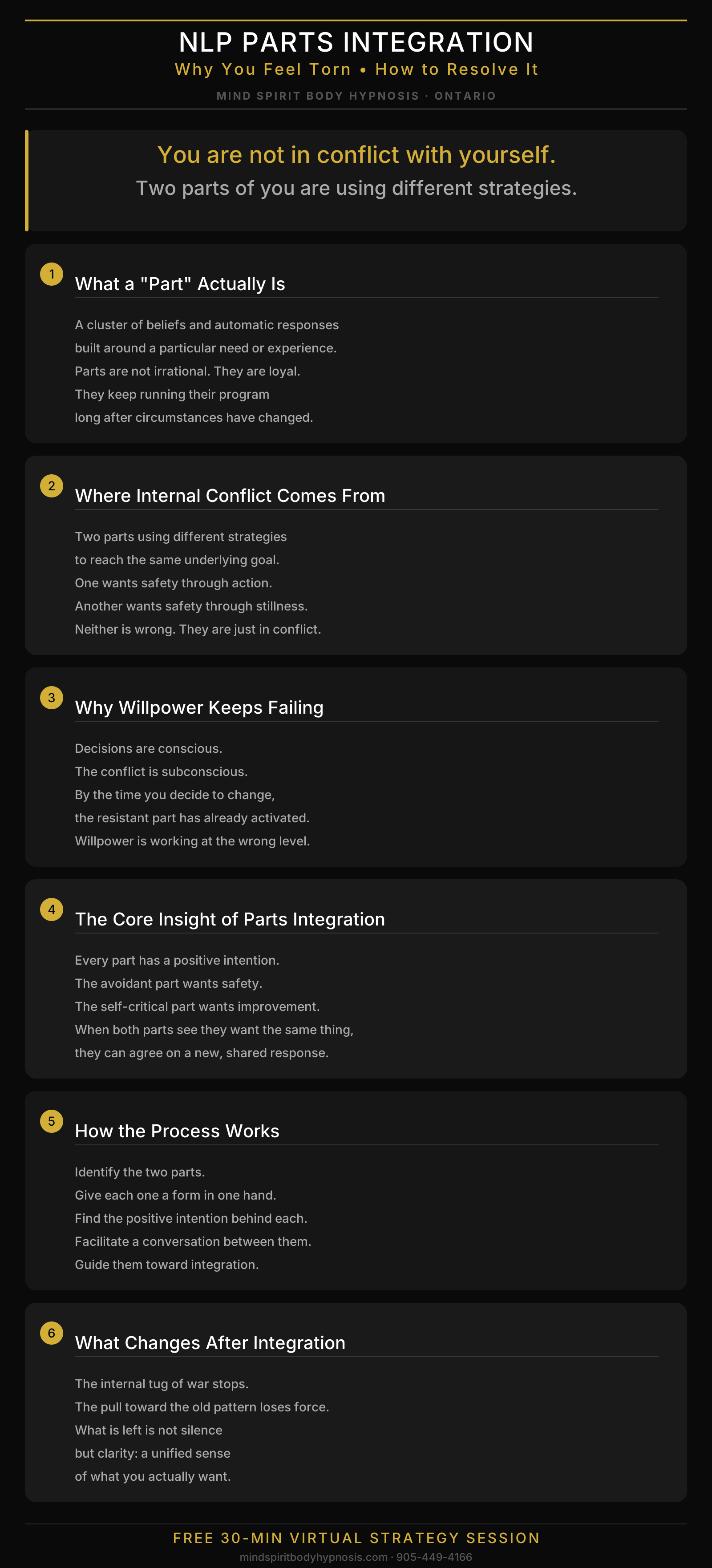
In neuro-linguistic programming, a "part" is a cluster of beliefs, feelings, and behaviours built around a particular need or experience. Parts are not abstract. They are the reason you feel torn. They are what is happening when you say "part of me wants this, but part of me doesn't." You have felt this.
Most people have experienced this directly. Part of you wants to speak up; part of you is afraid of what happens if you do. Part of you wants to move forward; part of you keeps finding reasons to wait. Part of you is committed to the change. Part of you reaches for the old pattern the moment things get hard.
Each of those parts developed for a reason. At some point, the hesitant part learned that holding back kept you safe. The avoidant part learned that staying small prevented certain kinds of pain. The parts are not irrational. They are loyal to whatever they were built to protect, even when that protection is no longer serving you.
Working with clients in Ontario, I have seen this pattern across many presenting issues. Anxiety, self-sabotage, habits, relationships. The specifics differ. The structure is usually the same: one part driving toward change, one part applying the brakes.
Where Internal Conflict Comes From
Parts develop through experience. A child who learned that expressing needs caused conflict might develop a part that suppresses wants to keep the peace. An adult rewarded for overworking might develop a part that equates rest with failure. Someone hurt after taking a risk might develop a part that treats all risk as danger.
None of this is a conscious choice. The part forms and takes on a role. It keeps playing that role long after the original circumstances have changed.
Conflict happens when two parts have incompatible strategies for the same goal. One part wants safety through action. Another wants safety through stillness. Neither is wrong about wanting safety. They are using different methods. Those methods get in each other's way.
This is exactly the kind of pattern that anxiety and stress responses often reinforce. The anxious part has a strategy. The part that wants relief has a different strategy. When they conflict, the system stays frozen.
what is internal conflict?
How the Technique Works
NLP Parts Integration, sometimes called Visual Squash, follows a structured process for bringing two conflicting parts into agreement. Here is what that looks like in practice:
Identifying the two parts. The client names the conflict clearly. "Part of me wants X, part of me wants Y." Each part is acknowledged as real, not as a flaw to eliminate.
Giving each part a form. The client imagines each part taking shape in one hand. This externalizes the conflict. The subconscious engages with it more easily than with abstract language.
Finding the positive intention. This is the core insight of the technique. Every part has a positive intention underneath, no matter how problematic its behaviour. The avoidant part wants safety. The self-critical part wants improvement. The resistant part wants to prevent harm. Finding that intention changes the relationship from conflict to negotiation.
Facilitating a conversation between the parts. The practitioner guides the two parts to communicate and find common ground. Both parts ultimately want something good for the person. They can usually agree on a shared goal. Even when their methods have been in conflict.
Integration. When the parts reach agreement, the client brings their hands together. The integration is not a forced merger. It is a resolution. A new, combined response that serves both intentions without the internal tug of war.
The process works at the subconscious level, which is where the parts live. This is what makes it different from deciding to change. Decisions operate consciously. They tend to hit the same resistance over and over.
What It Can Help With
Parts Integration is most useful when the problem has that "I know what I need to do, but I can't seem to do it" quality. Common applications include:
Self-sabotage patterns in work, relationships, or health goals
Indecision that keeps cycling without resolution
Ambivalence about major life changes
Internal resistance to recovery from habits and compulsions
Confidence issues driven by conflicting beliefs about being seen or succeeding
Procrastination rooted in fear of failure competing with desire for achievement
Relationship patterns where one part wants closeness and another protects against it
The technique is not a fit for every situation. It works best when there is a clear conflict between two drives and the client can access both sides. In sessions, the first step is mapping the structure of the conflict before deciding which tool fits.
What the Research Says
The direct evidence base for this technique as a standalone procedure is limited. It developed through clinical practice rather than laboratory research. Randomised trials specifically on Parts Integration do not currently exist in the peer-reviewed literature.
The broader NLP evidence base is mixed. A systematic review from the University of Lincoln found that existing NLP research is small and inconsistent in quality. The reviewers noted this reflects a gap in research. It is not evidence that NLP is ineffective. A 2022 randomised controlled trial by Dogan et al. found that NLP application significantly reduced depression, anxiety, and stress scores in a clinical population (DASS-21 mean dropped from 38.95 to 25.21, p < 0.05), with the control group showing no comparable improvement.
What the research does support clearly is the underlying mechanism. Subconscious patterns drive behaviour in ways that conscious decision-making cannot easily override. This is consistent across the hypnotherapy, NLP, and cognitive research fields. Parts Integration works within that framework. It targets the subconscious conflict directly rather than managing the behaviour the conflict produces.
In practice, the technique is used alongside hypnotherapy and other NLP tools. This makes isolating its specific contribution difficult to study, but also less important than the overall outcome for the client.
How It Differs from Therapy
Talk therapy typically approaches internal conflict by helping the client understand it. The goal is insight. Naming the parts, tracing where they came from, developing a more compassionate relationship with the conflict over time.
Parts Integration approaches the same conflict experientially. The goal is resolution. Getting the parts to actually reach agreement in the session, rather than building a framework for why they disagree. For certain stuck patterns, this tends to work faster than insight-based approaches. It bypasses the analytical mind and works with the parts directly.
This is not a criticism of therapy. For many people, insight and relationship are exactly what is needed. Parts Integration is a specific tool for a specific kind of problem: the conflict that insight alone has not shifted.
My training as an NLP Master Practitioner through ABNLP included Parts Integration as a core technique for this exact category of presentation. When a client has tried to change something for a long time without success, the structure of that pattern is worth examining. More strategies rarely help until the conflict underneath is resolved.
A Simple Exercise to Try
Before a session, it can be useful to map the conflict you are carrying.
Take a blank page and draw a line down the middle. On the left side, write everything the part that wants to change is saying. What does it want? What does it believe will happen if the change happens? What does it value?
On the right side, write everything the part that resists the change is saying. What is it afraid of? What does it believe will happen if the change goes ahead? What is it trying to protect?
Do not try to argue with either side. Just write what is there.
When you read both sides back, you will often notice that the resistant part is not against you. It is trying to protect something it values just as much as the other part does. That is the starting point. Two parts that both want something good, using strategies that have put them at odds.
In a session, we go much further than the mapping. But the mapping alone can shift something in how you see the conflict.
What my clients say
“I came to Mind Spirit Body Hypnosis carrying years of trauma and a deep struggle with self-worth. I had tried other approaches before but nothing had created lasting change. What caught me off guard was how quickly the results came. After just a handful of sessions with Fanis, something shifted. I started feeling more grounded, more confident, and less defined by the things that had held me back for so long. Fanis creates a space where you feel genuinely heard without any judgment. The sessions are virtual, which makes it easy to access support from home in Ontario on my own terms. If you have been carrying something heavy for a long time and are not sure anything will work, I would encourage you to try this. The change came sooner than I ever expected. Highly recommended, Thank you Fanis!” — Arif A. via Google
Frequently Asked Questions
What is NLP Parts Integration? It is a neuro-linguistic programming technique for resolving internal conflict. It identifies two opposing subconscious parts and finds the positive intention each one is trying to serve. Then it guides them toward a shared response. It is used when a person feels caught between two drives and cannot move forward through willpower alone. The process works experientially, engaging the subconscious directly rather than talking about the conflict from the outside.
What is an NLP "part"? In NLP, a part is a cluster of beliefs, feelings, and automatic responses. It developed around a particular need or experience. Parts form when the mind learns that a certain behaviour serves a function, such as keeping you safe, avoiding pain, or earning approval. Once formed, a part keeps running its program even when circumstances have changed. Most people know parts through the experience of feeling torn, or of acting against their own intentions.
What is the difference between Parts Integration and the Visual Squash? They are the same technique with different names. Visual Squash refers to the visual element of the process, where the client imagines each part taking form in one hand and eventually brings the hands together as the parts integrate. Parts Integration is the broader name for the same procedure. Some practitioners use one name, some use the other, and some use both interchangeably depending on their training lineage.
What can NLP Parts Integration help with? It is most useful for self-sabotage, indecision, ambivalence about change, internal resistance to habits, procrastination driven by competing fears, and confidence issues rooted in conflicting beliefs about success or visibility. The common thread is a clear felt sense of internal conflict. Wanting something and also not wanting it. Unable to resolve it through thinking alone.
How is NLP Parts Integration different from talk therapy? Talk therapy typically aims for insight into the conflict. Parts Integration aims for resolution within the session. The process works experientially, not analytically. It engages the subconscious parts directly rather than developing a framework for understanding them. For patterns that insight alone has not shifted, this approach often reaches the problem more directly.
Is there research supporting NLP Parts Integration? Direct research on Parts Integration as a standalone technique is limited. The broader NLP literature is mixed in quality, though a 2022 randomized controlled trial found NLP significantly reduced anxiety, depression, and stress scores compared to a control group. The underlying mechanism that Parts Integration works with, specifically that subconscious patterns drive behaviour in ways conscious decision-making cannot easily override, is well supported across multiple research fields. Parts Integration is used clinically as part of a broader approach rather than as an isolated intervention.
How long does NLP Parts Integration take? It is typically conducted within a single session. The groundwork may be laid across earlier sessions depending on the complexity of the conflict. It is not a technique that requires weeks of repetition. The integration tends to feel complete in the room when it lands. Later sessions usually consolidate the new unified response and work with any remaining material that surfaces once the primary conflict is resolved.
Can Parts Integration be combined with hypnotherapy? Yes, and in practice the two are often used together. Hypnotherapy creates a focused, receptive state where the subconscious is more accessible. Parts Integration from that state tends to go deeper. The client is less likely to intellectualize and more able to engage with the parts directly. This combination is part of my standard approach at Mind Spirit Body Hypnosis for clients with self-sabotage or persistent internal conflict.
Who is a good fit for NLP Parts Integration? Clients who do best are those who can identify a felt sense of internal conflict. Who have tried to change something through willpower without success. And who are open to working experientially rather than analytically. It is particularly useful for people who say "I know what I need to do, but I keep getting in my own way" and mean it literally.
What does a session that includes Parts Integration feel like? Most clients describe it as surprisingly natural once it begins. The initial step of imagining each part in one hand can feel unusual. Once the parts begin to communicate, most clients find what they say feels genuinely true rather than invented. Integration often feels like a release of tension. Clients often leave feeling less pulled in multiple directions, with a clearer sense of what they actually want.
Recommended reading
Ready to Take the Next Step?
If you have been trying to move forward on something and keep finding yourself pulled back, the conflict may not be a motivation problem. It may be a parts problem. And that is exactly the kind of thing that can be worked with directly.
I offer a free 30-minute virtual strategy session for new clients across Ontario. No pressure. Just a conversation about what you are carrying and whether this kind of work is a good fit.
Book your free session: calendly.com/mindspiritbodyhypnosis
Call or text: 905-449-4166
Email: info@mindspiritbodyhypnosis.com
Visit: mindspiritbodyhypnosis.com
Serving clients virtually across Ontario, including Durham Region, Toronto, Canada, and beyond.
Disclaimer: This article is for informational purposes only and does not constitute medical or psychological advice. Hypnotherapy, NLP, and EMDR are complementary approaches and are not a substitute for diagnosis or treatment by a qualified healthcare provider. Please consult a licensed professional if you have concerns about your mental or physical health.
Written by Fanis Makrigiannis | Certified Hypnotherapist & NLP Master Practitioner | Mind Spirit Body Hypnosis.