Can Hypnotherapy Help With Your Inner Critic?
TL;DR: The inner critic is not a personality flaw. It is a habitual pattern of self-directed language the subconscious learned and kept running. Hypnosis for inner critic work addresses that pattern at the level where it was built, giving the subconscious new information so the voice loses its automatic authority. Research shows hypnotherapy significantly improves self-compassion, and those gains hold at follow-up.
Quick Answer
Hypnotherapy for the inner critic is a subconscious-focused approach that addresses the automatic self-critical voice by working directly with the part of the mind where that voice was first formed and rehearsed. Research suggests it may help reduce self-criticism, increase self-compassion, and shift the habitual internal language patterns that conscious effort alone struggles to change. Fanis Makrigiannis, a Certified Hypnotherapist and NLP Master Practitioner at Mind Spirit Body Hypnosis in Oshawa, Ontario, offers virtual sessions across Ontario for clients who want to work with the voice that keeps telling them they are not enough.
Questions This Article Answers
What is the inner critic and where does it come from?
Why does the inner critic feel so automatic and hard to stop?
Can hypnotherapy actually quiet the inner critic?
What does a hypnotherapy session for the inner critic work focus on?
How is hypnosis for the inner critic different from positive thinking?
Is the inner critic the same as anxiety or low self-esteem?
Can hypnotherapy help if the inner critic has been there since childhood?
What does it feel like when the inner critic starts to lose its grip?
In this article:
Most people have tried to talk back to it. They know the voice is not being fair. They can list reasons why it is wrong. And still, the next time they make a mistake, miss an expectation, or try something new, the voice arrives before they have finished the first sentence of their own defence.
"You should have known better." "That was embarrassing." "You are not the kind of person who gets that right."
People often tell me they feel like they are carrying a very harsh judge everywhere they go, one that shows up just when they most need to feel steady.
That judge has a name. It is the inner critic. And it is not a character flaw.
What the Inner Critic Actually Is
The inner critic is a pattern of habitual self-directed language. It is not a random thought. It is a voice the subconscious learned, rehearsed, and eventually automated.
It usually forms early. A child who is frequently criticized, held to high standards without acknowledgement, or exposed to a harsh internal environment begins to internalize that voice. Not as something external, but as something that sounds like their own thinking.
Over time, the subconscious rehearses it enough that it becomes a default. It runs the way any ingrained habit runs: fast, below conscious thought, and without requiring a decision.
By the time most people arrive in my practice, the inner critic has been running for years, sometimes decades. They have tried to reason with it, replace it with affirmations, or simply push it down. None of those approaches has worked for long, because none of them reached the level where the voice actually lives.
Why It Is So Hard to Argue With
This is the part that catches most people off guard. You can know, completely, that the inner critic is not being accurate. You can have a list of evidence that contradicts every claim it makes. And still, in the moment, it lands with more weight than the evidence does.
That is because the inner critic is not operating as a thought. It is operating as a conditioned response. The subconscious has run it so many times that it has become automatic, the way a flinch is automatic, or the way a phrase in your native language comes to mind before a translation in a language you studied.
Think of it like a recording that plays through a speaker wired directly into your nervous system. You can hear the recording. You can know it was made a long time ago. You can disagree with every word on it. But as long as the wiring stays the same, the recording keeps playing.
Changing the wiring is where hypnosis for inner critic sessions begin.
Toxic self-talk
What the Research Shows
A 2023 randomized controlled trial published in the International Journal of Clinical and Experimental Hypnosis tested mindful hypnotherapy in women with depression. One of the outcomes was self-compassion, which is directly linked to how a person relates to their own critical voice. The hypnotherapy group showed a significant improvement in self-compassion compared to the waitlist control, with an effect size of 0.53 at post-treatment. The gain held at two-month follow-up (IJCEH, 2023).
A separate line of research has examined how self-talk patterns affect anxiety and self-efficacy. A 2019 randomized study published in Sports (Walter, Nikoleizig, and Alfermann) found that structured self-talk training over eight weeks significantly improved self-efficacy (η² = 0.10, p = 0.002) and reduced somatic anxiety (η² = 0.08, p = 0.05) compared to a control group, with gains holding at follow-up (Walter et al., 2019).
Together, these findings point to something important. The relationship between how you speak to yourself and how you feel and perform is not fixed. It can be changed. And working at the subconscious level, where the pattern is stored, appears to produce changes that hold.
What Hypnotherapy Does Differently
Most approaches to the inner critic work at the conscious level. Journaling, cognitive reframing, and affirmations all ask you to notice the thought, challenge it, and replace it with something more accurate.
This works for some people some of the time. The difficulty is that the inner critic was not built through conscious reasoning. It was built through repeated experience and subconscious conditioning. Asking the conscious mind to overwrite what the subconscious has been rehearsing for twenty years is a significant mismatch.
Hypnotherapy works at the level where the pattern lives. In a calm, deeply focused state, the subconscious becomes more open and accessible. The specific voice, the tone it carries, the situations that trigger it, and the meaning it has been attaching to those situations can all be addressed directly.
This is why hypnosis for inner critic patterns tends to produce shifts that feel different from conscious approaches. For clients working through confidence and self-sabotage, the inner critic is often the thread that ties everything together. When the voice loses its automatic authority, the behaviour patterns that followed it tend to shift as well.
The change does not usually feel dramatic. Most clients describe it as a quieting rather than a silencing. The voice becomes less immediate. It loses the quality of fact and starts to sound more like what it always was: an old recording that no longer has to run the show.
A free 30-minute strategy session is a good starting point if you are wondering whether this kind of work is the right fit for what you are carrying.
What Sessions Focus On
Sessions for inner critic work are not about silencing a voice forever. They are about changing the relationship between you and that voice so it no longer runs automatically.
Identifying the specific voice. The inner critic sounds different for everyone. Some clients hear it as a sharp, punishing tone. Others as a quiet, steady stream of low-level doubt. Knowing what it sounds like, when it speaks up, and what it tends to say is the starting point for any targeted work.
Tracing where it came from. The inner critic usually has a source. A parent, a teacher, a significant early environment. In hypnotherapy, that origin can often be accessed and updated without requiring you to analyze it at length. The subconscious can revise its relationship to that voice when it has access to more accurate, current information.
Separating the voice from identity. Many clients have lived with the inner critic so long they have started to believe it is simply how they think. It is not. It is a voice they learned. Creating that distinction at the subconscious level is one of the most significant shifts that sessions produce.
Reducing the automatic quality. The goal is not to make the voice disappear but to interrupt the automaticity. When the inner critic loses the quality of a reflex, you have space to respond rather than simply react.
Building a steadier internal voice. The subconscious learns through repetition and rehearsal. Sessions often include rehearsing a calmer, more accurate internal response so that voice becomes familiar and starts to arrive more quickly than the critical one.
If anxiety and stress travel alongside the inner critic, which they often do, sessions can address both as part of the same work. The two are usually closely connected.
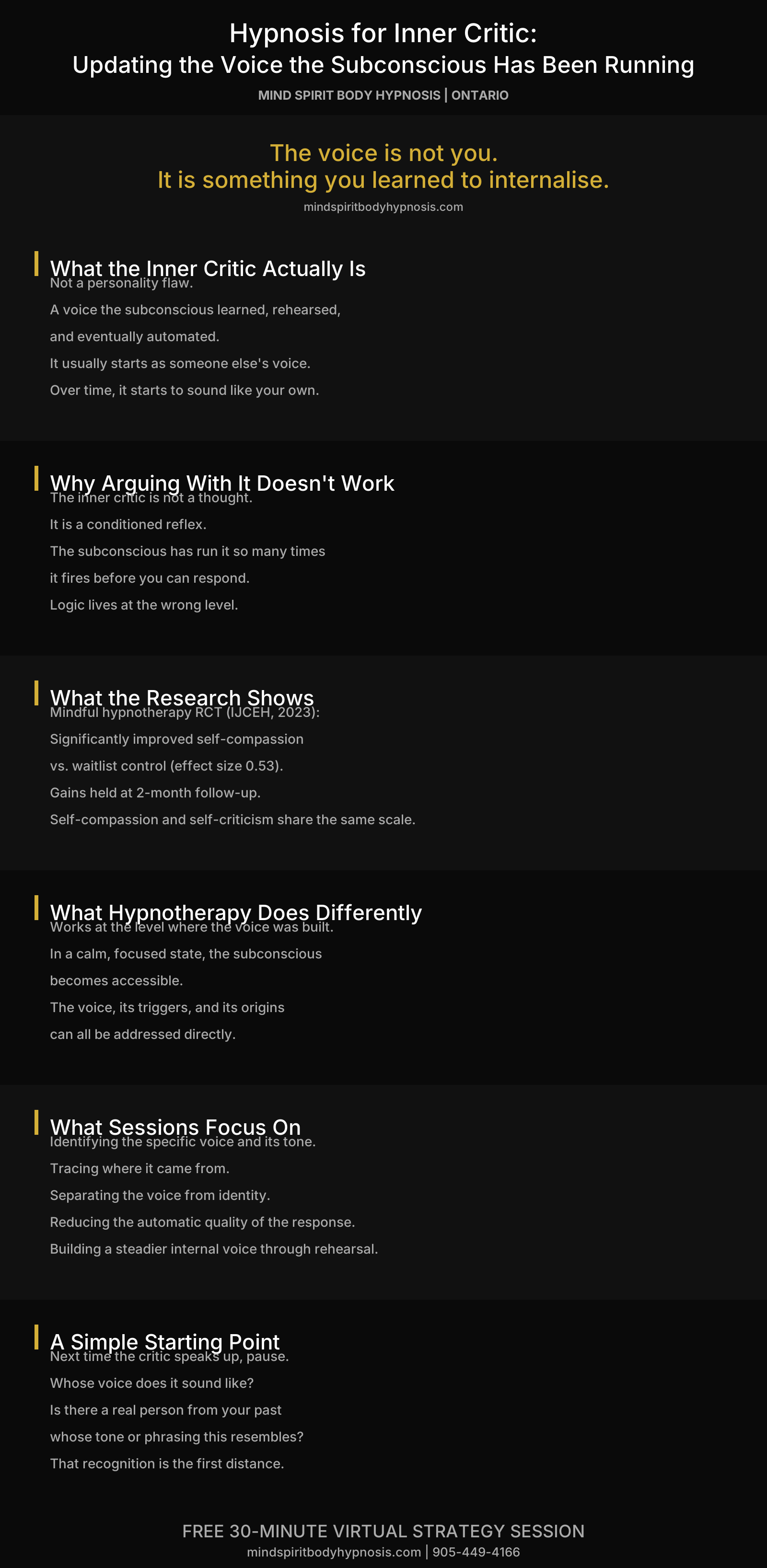
A Simple Exercise to Try
The next time your inner critic speaks up, do not try to argue with it. Instead, pause and notice one thing: whose voice does it sound like?
Not metaphorically. Literally. Is there a real person from your past whose tone or phrasing this resembles? A parent, a teacher, a coach, an older sibling?
Most people find a familiar voice underneath the one they thought was their own. That recognition does not dissolve the pattern, but it creates a small but important distance. The voice is not you. It is something you learned to internalize.
That distance is where the work begins. In sessions, we take it much further, into the subconscious level where the voice was first recorded and where it can receive genuinely new information.
Hypnosis for inner critic work takes that recognition further, into the subconscious layer where the voice can be genuinely updated. Understanding how your automatic habit patterns connect to the critical voice is usually part of the same work. The inner critic and habitual avoidance tend to feed each other in ways that become clearer as the sessions progress.
WHAT MY CLIENTS SAY
“A family friend referred me to Fanis at Mind Spirit Body Hypnosis after I had been smoking for years and couldn’t seem to quit, no matter how hard I tried. What surprised me most was how natural the whole process felt. There was no white-knuckling it, no counting days, no feeling deprived. After four sessions, I stopped. Not because I was forcing myself, but because the urge simply wasn’t there the way it used to be. Fanis was professional, calm, and easy to connect with. The sessions are virtual, so I could access support from home without any disruption to my routine. I am so glad my family friend made that recommendation. I did not expect results this fast, and I would not hesitate to pass his name along to anyone else who is ready to quit. He also created a custom recording for me; every time I listen, I hear something new. Thank you!” — Janette C. via Google
Frequently Asked Questions
What is the inner critic? The inner critic is a pattern of habitual self-directed language the subconscious learned and rehearsed, usually early in life. It is not a personality flaw or a sign of weakness. It is a conditioned voice that formed in response to repeated experiences and has been running automatically ever since. Most people who have a loud inner critic did not choose it. They absorbed it.
Where does the inner critic come from? It almost always has an external source: a parent with high and rarely acknowledged standards, a critical teacher, a peer environment that rewarded performance over presence, or a significant early experience that produced shame. The subconscious internalized that voice over time and eventually made it automatic. By adulthood, it sounds like your own thinking, which is why it feels so hard to separate from.
Why can't I stop it by just thinking more positively? Positive thinking works at the conscious level. The inner critic lives in the subconscious, where it has been rehearsed far longer and far more deeply than any affirmation you have repeated. Layering a positive statement on top of a deeply conditioned pattern does not overwrite the pattern. It just adds a layer the subconscious does not fully accept. That is why the critic tends to come back as soon as the effort stops.
Can hypnosis for inner critic work actually reduce self-criticism? Research suggests yes. A 2023 randomized controlled trial found that hypnotherapy significantly improved self-compassion compared to a waitlist control, with an effect size of 0.53 that held at two-month follow-up. Self-compassion and self-criticism are opposite ends of the same scale. When one improves, the other typically eases.
How is this different from therapy or coaching? Therapy and coaching work primarily through conscious reflection and building new frameworks for understanding the inner critic. That is genuinely useful. Hypnotherapy works at a different level, accessing the subconscious directly in a calm and focused state. For people who have done considerable conscious work on the inner critic and still find it loud, hypnotherapy often reaches something those approaches have not.
Is the inner critic the same as anxiety? They are related but distinct. Anxiety is often a physical and emotional response to perceived threat. The inner critic is a verbal pattern, a voice with specific language and tone. For many people, the inner critic feeds the anxiety: it narrates worst-case scenarios, amplifies mistakes, and interprets ambiguous situations as evidence of inadequacy. Addressing the critical voice often reduces anxiety as a result.
Can hypnotherapy help if the inner critic has been there since childhood? Yes. Childhood is actually when most persistent inner critics form, because the subconscious is most receptive during early development. A voice internalized at age eight can still be running the same script at age forty. The subconscious does not automatically retire old patterns. Hypnotherapy can access and update those patterns regardless of when they were first formed.
What does it feel like when the inner critic starts to lose its grip? Most clients describe it as a gradual quieting rather than a sudden silence. The voice may still appear, but it arrives with less urgency. It starts to sound like what it is, a recording from a long time ago, rather than a real-time commentary on who you are now. Some clients notice they have gone through a difficult moment without the critic being the loudest thing in the room. That gap, however small, is where things start to change.
How many sessions will I need? That varies by person and by how long the pattern has been running. Some clients notice meaningful shifts within a few sessions. Others benefit from continued work, especially when the inner critic is connected to multiple areas of life. There is no fixed number. The goal is not to schedule you indefinitely but to work until the voice no longer runs your decisions automatically.
Is hypnotherapy safe for this kind of work? Yes. Sessions are calm, collaborative, and client-led. You remain aware throughout and can stop at any time. The work is paced to stay within your comfort level. There is no pressure to relive difficult memories in detail. The focus is on updating the subconscious relationship to the critical voice, not on exposing everything that produced it.
RECOMMENDED READING
Ready to Take the Next Step?
If the inner critic has been louder than your own voice for longer than you can explain, I would love to help you look at it differently.
I offer a free 30-minute virtual strategy session for new clients across Ontario. No pressure. Just a conversation about what you are hearing and whether hypnotherapy is the right fit.
Book your free session: calendly.com/mindspiritbodyhypnosis
Call or text: 905-449-4166
Email: info@mindspiritbodyhypnosis.com
Visit: mindspiritbodyhypnosis.com
Serving clients virtually across Ontario, including Durham Region, Toronto, Canada, and beyond.
Disclaimer: This article is for informational purposes only and does not constitute medical or psychological advice. Hypnotherapy, NLP, and EMDR are complementary approaches and are not a substitute for diagnosis or treatment by a qualified healthcare provider. Please consult a licensed professional if you have concerns about your mental or physical health.
Written by Fanis Makrigiannis | Certified Hypnotherapist & NLP Master Practitioner | Mind Spirit Body Hypnosis.