Can Hypnotherapy Help With Compulsive Lying?
TL;DR: Compulsive lying is rarely a moral problem. It is usually a learned pattern the subconscious automated early in life, when honesty felt unsafe. Hypnosis for compulsive lying addresses the original fear that built the pattern, not just the behaviour itself. Research on hypnotherapy shows significant anxiety reduction that holds at follow-up, which matters because compulsive lying is almost always rooted in anxiety about how the truth will land.
Quick Answer
Hypnotherapy for compulsive lying is a subconscious-focused approach that targets the fear and shame patterns that originally made deception feel necessary, working at the level where the habit was first formed. Research suggests hypnotherapy may significantly reduce anxiety and habitual avoidance responses, which are the root mechanisms in compulsive lying. Fanis Makrigiannis, a Certified Hypnotherapist and NLP Master Practitioner at Mind Spirit Body Hypnosis in Oshawa, Ontario, offers virtual sessions across Ontario for clients who want to address this pattern without judgment.
Questions This Article Answers
Why do people lie compulsively even when they don't need to?
Is compulsive lying a character flaw or a learned pattern?
Can hypnotherapy help someone who lies automatically?
What does hypnosis for compulsive lying actually work on?
Is compulsive lying connected to anxiety or fear?
What happens in a hypnotherapy session for this kind of work?
Will hypnotherapy help if I've been lying since childhood?
What's the difference between strategic lying and compulsive lying?
In this article:
People often tell me they do not know why they lied. The situation did not call for it. The stakes were low. The lie came out before they had finished thinking. They felt relief for a moment. Then shame. Then confusion about why their brain keeps doing this.
That confusion is useful. It points to the right question. Not "why am I dishonest?" but "what is my subconscious still trying to protect me from?"
What Compulsive Lying Actually Is
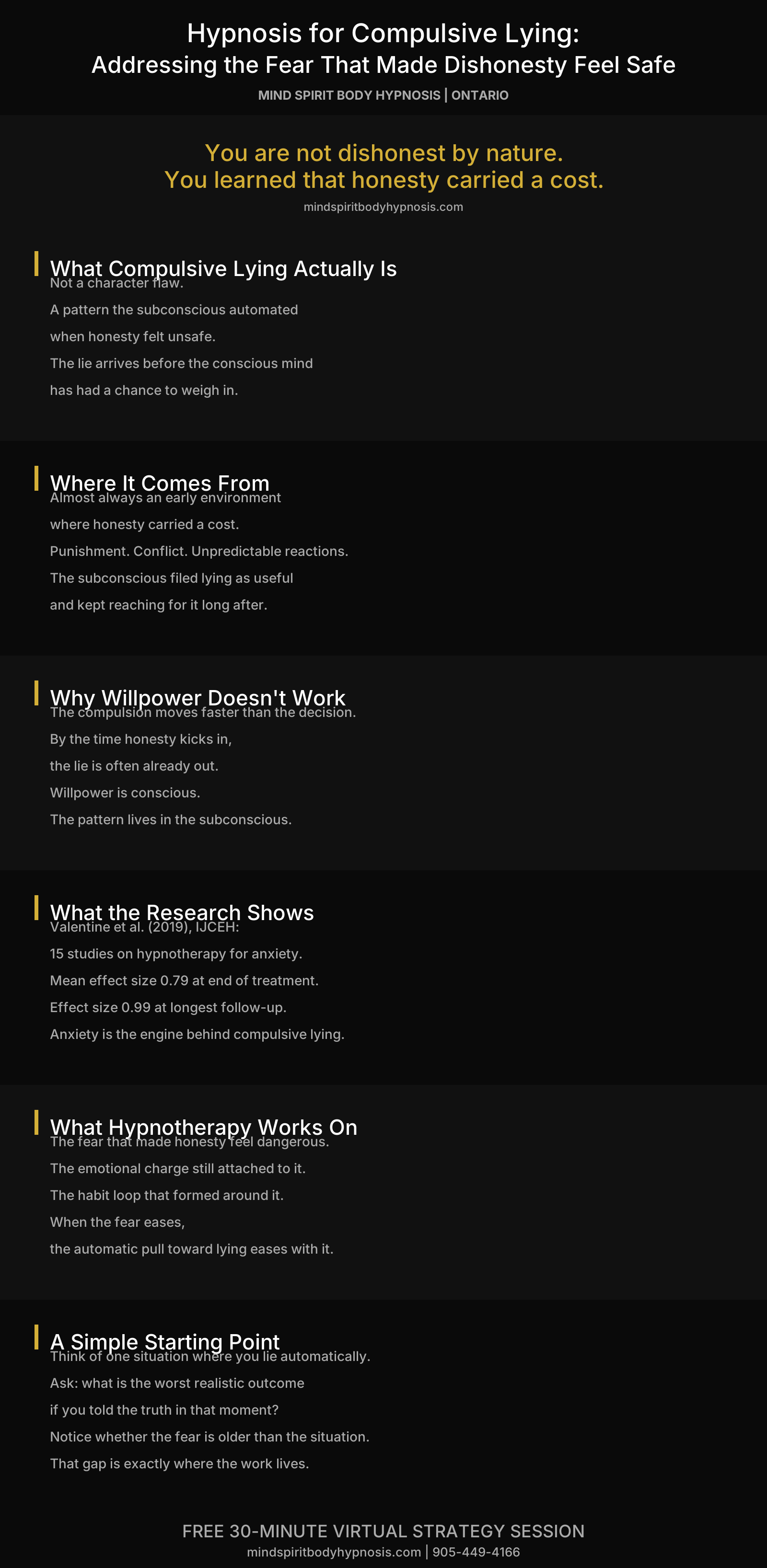
Compulsive lying is not a personality trait. It is a pattern of automatic deception that runs even when lying is pointless or harmful.
It is worth separating this from deliberate dishonesty. Strategic lying is a conscious choice made for a reason. Compulsive lying feels more like a reflex. The lie is out before the conscious mind has caught up. There is often a sense of watching it happen rather than choosing it.
Research published in the Canadian Journal of Behavioural Science (McArthur et al., 2022) found that around 11% of habitual liars report doing so with no clear reason they can identify. That number is likely an undercount. People who lie compulsively often avoid self-reporting because the shame runs deep.
Think of it like a smoke detector that fires every time you make toast. The alarm is real. The mechanism works. It is just wired to the wrong signal. The subconscious built a warning system for a real threat. It has kept running that system long after the threat has passed.
Where the Pattern Comes From
Most compulsive lying begins in environments where honesty carried a cost.
A child who was punished harshly for telling the truth, or who learned that a good story avoided conflict, begins to map deception as a way to stay safe. The subconscious does not judge this. It just notes that lying worked, and files it as the default response.
Over time, that default gets rehearsed until it becomes automatic. By adulthood, the person may not experience a choice at all. The lie arrives as the path of least resistance, wired in over years.
Working with clients in Ontario, I have seen this pattern come up across very different backgrounds. The surface details vary. The underlying structure tends to be the same: an early environment where the truth felt risky, and a subconscious that learned to route around it.
This does not mean the pattern is fixed. It has an origin. That is exactly what hypnosis for compulsive lying work is built to address.
How to spot a pathological liar
Why Willpower Alone Rarely Works
Most people who want to stop lying compulsively try conscious effort. They tell themselves to pause, to check the impulse, to commit to honesty. This helps some of the time.
The difficulty is that the compulsion moves faster than the check. By the time the commitment to honesty enters awareness, the lie is often already out. Willpower is working at the wrong level.
This is not a character failure. It is a timing problem. The subconscious pattern fires in milliseconds. The conscious intention to stop it operates on a slower track. Trying to halt an automatic response with a conscious rule is like trying to stop a sneeze by deciding not to.
To change a pattern that runs below awareness, you need access to the level where it was built. That is where hypnotherapy works.
What the Research Shows
A 2019 meta-analysis in the International Journal of Clinical and Experimental Hypnosis looked at 15 studies on hypnotherapy for anxiety. The mean effect size was 0.79 at the end of treatment. The average person who received hypnotherapy showed more improvement than 79% of control participants. At the longest follow-up point, the effect size rose to 0.99 (Valentine et al., 2019).
This matters for compulsive lying because anxiety is the engine behind almost every case. Fear of rejection, conflict, punishment, and fear of being seen as inadequate are all anxiety responses. When the anxiety that made lying feel necessary is reduced, the pull toward deception tends to ease with it.
The gains in that research held at follow-up. That is key. Short-term relief that fades does not change an ingrained pattern. Lasting change requires the subconscious to update the original rule, not just suppress the behaviour for a while.
What Hypnotherapy Targets
Most approaches to compulsive lying work at the conscious level. Awareness, accountability, reframing. These are useful. But they struggle when the behaviour is truly automatic. The pattern does not live in the part of the mind that responds to those tools.
Hypnosis for compulsive lying works at a different level. In a calm, focused state, the subconscious becomes more open. The specific fear that made honesty feel unsafe, the emotional charge still tied to it, and the habit loop that formed around it can all be addressed directly.
This is not about forcing someone to confess. It is about updating the subconscious view of what honesty actually costs. When the fear that built the pattern gets more current information, the pull toward lying tends to lose its force. For clients also working on confidence and self-sabotage, this work is often closely linked. Compulsive lying and low self-worth tend to share the same root.
The change is rarely dramatic. Most clients describe it as the impulse becoming quieter. A pause appearing where there used to be an automatic response. That pause is where choice can enter.
A free 30-minute strategy session is available if you want to explore whether this kind of work fits what you are carrying.
What Sessions Focus On
Sessions are not about convincing you to be honest. That motivation is almost always already there. The work is about finding what the subconscious is still protecting and updating whether that protection is still needed.
Identifying the fear underneath. Compulsive lying is not random. It tends to show up in specific contexts, with specific people, around specific topics. Mapping those patterns reveals the fear beneath the behaviour.
Tracing the origin. Most patterns have a starting point. In a focused state, that origin can often be accessed and revisited with new information, without requiring prolonged distress.
Reducing the fear response. The anxiety and stress at the root of compulsive lying can be addressed in sessions. When the threat signal quiets, the automatic deception response tends to quiet with it.
Rehearsing honest responses. The subconscious learns through repetition. Sessions often include guided rehearsal of calm, honest responses to the situations that usually trigger lying. Over time, those pathways become more familiar and more available.
Separating the pattern from identity. Many clients have lived with compulsive lying long enough that it feels like who they are. It is not. It is a habit pattern the subconscious learned and kept running. Separating the pattern from identity is often one of the most meaningful shifts the work produces.
A Simple Exercise to Try
Think of one situation where you tend to lie without deciding to. Not a deliberate choice. Just a moment where it happens automatically.
Now ask: what is the worst thing that could realistically happen if you told the truth in that moment?
Sit with the answer. You may notice the fear is older than the situation. It may belong to a different time, a different person, a different set of consequences. That gap between where the fear comes from and where it lands now is exactly where the work lives.
You do not have to resolve it here. Just notice that the fear is specific, and that it is pointing somewhere. That is enough to start. In sessions, this is where hypnosis for compulsive lying work begins: at the level where the fear was first formed and where it can receive genuinely new information.
WHAT MY CLIENTS SAY
“A family friend referred me to Fanis at Mind Spirit Body Hypnosis after I had been smoking for years and couldn’t seem to quit, no matter how hard I tried. What surprised me most was how natural the whole process felt. There was no white-knuckling it, no counting days, no feeling deprived. After four sessions, I stopped. Not because I was forcing myself, but because the urge simply wasn’t there the way it used to be. Fanis was professional, calm, and easy to connect with. The sessions are virtual, so I could access support from home without any disruption to my routine. I am so glad my family friend made that recommendation. I did not expect results this fast, and I would not hesitate to pass his name along to anyone else who is ready to quit. He also created a custom recording for me; every time I listen, I hear something new. Thank you!” — Janette C. via Google
Frequently Asked Questions
What is compulsive lying? Compulsive lying is a pattern of automatic, habitual deception that occurs even when lying is unnecessary or harmful to the person doing it. Unlike strategic lying, it tends to happen without a clear, conscious decision. People who lie compulsively often report feeling like the lie arrived before they could stop it, followed by confusion or shame about why it keeps happening. It is usually a learned survival response rather than a character trait.
Why do people lie compulsively even when there is no reason to? The subconscious does not evaluate honesty in the present moment. It runs the pattern that worked in the past. If lying reduced conflict, punishment, rejection, or shame in an earlier environment, the subconscious files that as a useful tool and keeps reaching for it. Over time, the behaviour becomes automatic. The person may genuinely not know why they lied, because the decision happened below conscious awareness.
Is compulsive lying a moral failing? No. Compulsive lying is almost always a learned pattern built in response to an environment where honesty felt unsafe. It is not a reflection of someone's character or values. Most people who lie compulsively also have a strong desire to stop. The difficulty is that the behaviour runs automatically, faster than conscious intention can catch it. Treating it as a moral problem rather than a learned pattern tends to add shame without producing change.
Can hypnosis for compulsive lying actually help? Research suggests hypnotherapy is effective at reducing the anxiety that drives habitual avoidance patterns. A 2019 meta-analysis in the International Journal of Clinical and Experimental Hypnosis found a mean effect size of 0.79 for anxiety reduction in hypnotherapy, with gains that held at follow-up. Because compulsive lying is almost always driven by fear or shame, reducing that underlying anxiety can significantly reduce the automatic pull toward deception.
How is hypnotherapy different from just deciding to be more honest? Deciding to be more honest is a conscious act. Compulsive lying is a subconscious pattern. The two operate at different speeds and different depths. A conscious commitment to honesty can be in place and still be outrun by a subconscious reflex that fires faster. Hypnotherapy works at the level where the pattern lives, updating the fear response and the habit loop rather than simply adding a conscious rule to override them.
Is compulsive lying connected to anxiety? Almost always yes. The most common drivers of compulsive lying are fear of rejection, fear of conflict, fear of punishment, and fear of being seen as inadequate. These are all anxiety responses. The subconscious learned that lying reduced those fears in the short term and automated that response. Working on the underlying anxiety tends to reduce the lying behaviour, because the trigger that makes deception feel necessary becomes less intense.
Will hypnotherapy help if I have been lying since childhood? Yes. Childhood is often exactly when these patterns form, because the subconscious is most responsive during early development. A pattern that began at age seven can still be running the same logic at age forty, because the subconscious does not automatically retire old strategies. Hypnotherapy can access and update those patterns regardless of how long they have been in place.
What does a session actually look like? Sessions are calm, conversational, and client-led. There is no pressure to disclose anything you are not ready to share. In a focused, relaxed state, the subconscious becomes more accessible and open to new information. The work is collaborative: you are aware throughout, you can stop at any time, and the pace is always set by your comfort. It is less like therapy and more like a focused conversation with a quieter, more receptive part of your mind.
How many sessions will I need? This varies by person and by how long the pattern has been running. Some clients notice meaningful shifts in a few sessions. Others benefit from more extended work, especially when the compulsive lying is connected to multiple areas of fear or when it has been part of daily functioning for many years. The goal is to work until the pattern loses its automatic quality, not to schedule indefinitely.
Is this work confidential? Yes. Sessions are private and confidential. Nothing shared in a session is disclosed to anyone without your consent. Clients sometimes worry that working on this pattern requires them to confess or account for past lies. It does not. The focus is on the pattern itself and where it came from, not on cataloguing past behaviour.
RECOMMENDED READING
Ready to Take the Next Step?
If you recognize this pattern and want to understand what is driving it, I would be glad to help.
I offer a free 30-minute virtual strategy session for new clients across Ontario (and beyond). No pressure. Just a conversation about what you are experiencing and whether hypnotherapy is the right fit.
Book your free session: calendly.com/mindspiritbodyhypnosis
Call or text: 905-449-4166
Email: info@mindspiritbodyhypnosis.com
Visit: mindspiritbodyhypnosis.com
Serving clients virtually across Ontario, including Durham Region, Toronto, Canada, and beyond.
Disclaimer: This article is for informational purposes only and does not constitute medical or psychological advice. Hypnotherapy, NLP, and EMDR are complementary approaches and are not a substitute for diagnosis or treatment by a qualified healthcare provider. Please consult a licensed professional if you have concerns about your mental or physical health.
Written by Fanis Makrigiannis | Certified Hypnotherapist & NLP Master Practitioner | Mind Spirit Body Hypnosis.