Can Hypnotherapy Help With Binge Eating?
TL;DR: Binge eating is not about hunger or willpower. It is a subconscious loop that uses food to manage feelings the nervous system does not know how to process any other way. Hypnosis for binge eating works at the level where that loop was built, addressing the emotional trigger and the shame cycle that keeps it running, not just the eating behaviour itself.
Quick Answer
Hypnotherapy for binge eating is a subconscious-focused approach that targets the emotional regulation patterns and automatic responses driving compulsive eating episodes, rather than focusing on food rules or calorie control. Research shows hypnosis significantly reduces food impulsivity in people with high disinhibition around eating. Fanis Makrigiannis, a Certified Hypnotherapist and NLP Master Practitioner at Mind Spirit Body Hypnosis in Oshawa, Ontario, offers virtual sessions across Ontario for clients who feel stuck in cycles of compulsive eating and shame.
Questions This Article Answers
Why do I keep binge eating even when I want to stop?
Is binge eating a willpower problem?
What is the restrict-shame-binge cycle?
Can hypnotherapy actually break the binge eating cycle?
What does a hypnotherapy session for binge eating focus on?
Is there research on hypnosis and food impulsivity?
What is the difference between binge eating and overeating?
Can hypnotherapy help if I have been binge eating for years?
In this article:
People often describe it the same way. Something happens, or sometimes nothing happens at all. A feeling shows up. And then, almost before they have decided anything, they are eating. Fast, past fullness, past the point they wanted to stop. And then comes the other feeling. The shame that arrives when the food is gone.
That shame is not a motivation to do better next time. It is fuel for the next episode.
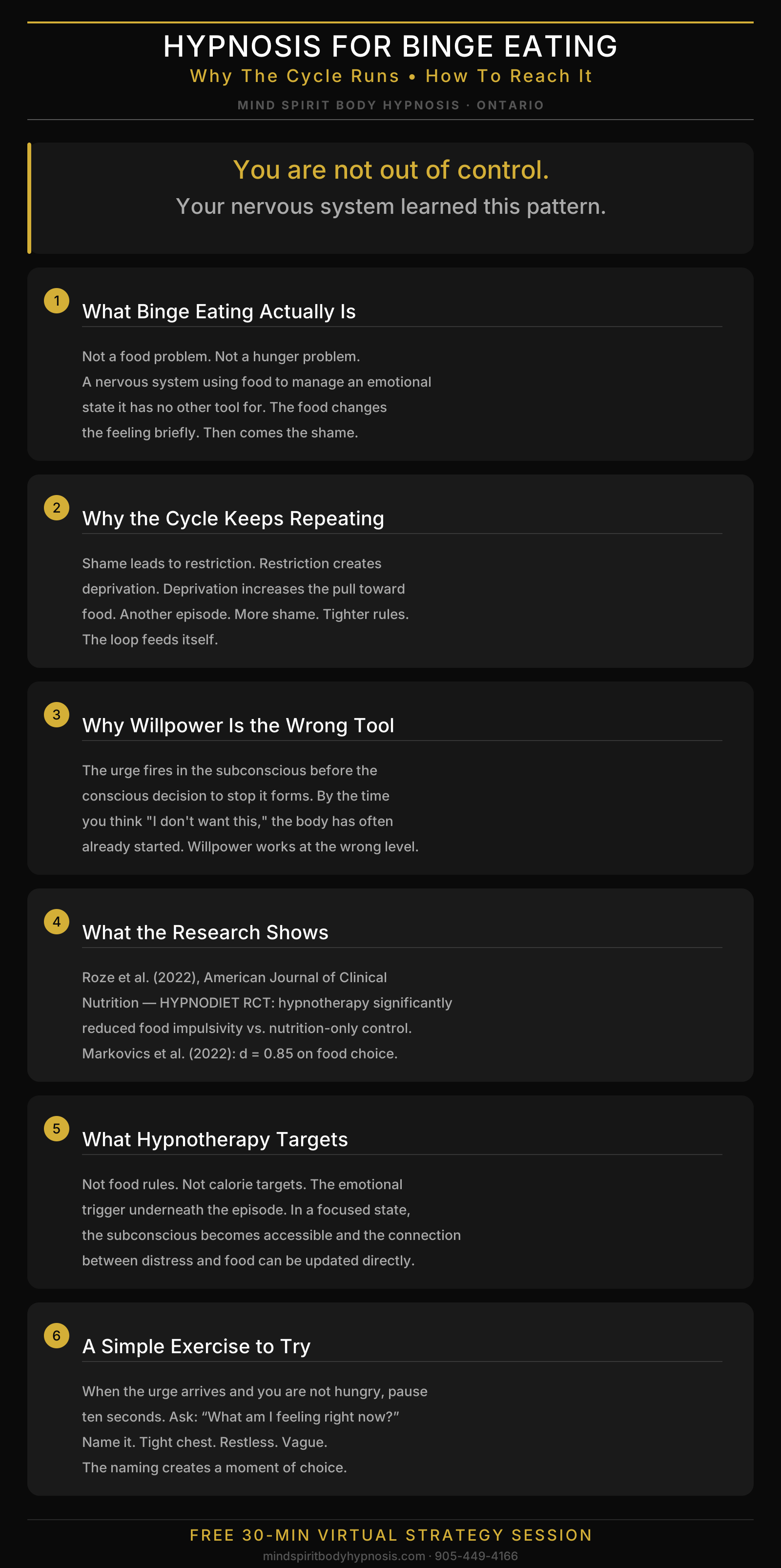
What Binge Eating Actually Is
Binge eating is a pattern of repeated episodes of eating a large amount of food in a short time, often accompanied by a feeling of being out of control during the episode. It is distinct from simply overeating at a holiday meal or going back for a second helping. The defining feature is not the quantity. It is the feeling that something else is running the show.
Most episodes are not triggered by hunger. They are triggered by emotion. Stress, boredom, loneliness, anxiety, or a vague sense of discomfort the person cannot quite name. The food does not fix the feeling. It numbs it, briefly, and then adds shame to it. That shame is precisely what hypnosis for binge eating is built to address at its source, because shame is what turns a single episode into a self-sustaining pattern.
What most people dealing with this pattern have in common is not a lack of discipline. It is a nervous system that learned to use food as its primary tool for managing states it does not know how to handle another way.
That is a subconscious pattern. And that is exactly where hypnosis for binge eating is designed to reach.
Why the Cycle Keeps Repeating
The binge eating cycle has a structure. Understanding it matters because willpower works against the structure rather than changing it.
It usually begins with restriction. A person feels bad about an episode and responds by tightening the rules around food. Fewer calories. Specific foods. A stricter plan. The restriction creates deprivation, both physical and psychological. That deprivation increases the pull toward food. The pull gets strong enough to override the rules. Another episode happens. And then comes the shame, which resets the cycle with a new round of restriction.
This is not weakness. It is a predictable mechanical outcome of the cycle itself. The restriction creates the deprivation that makes the binge more likely. The shame creates the motivation to restrict again. The loop feeds itself.
Working with clients in Ontario, I have seen this pattern across many different backgrounds and histories. The details differ. The cycle tends to have the same shape: an emotional trigger, a loss of control, a shame response, and a tighter rule that sets up the next episode.
The rule-tightening feels like a solution. It is usually part of the problem.
Binge eating disorder.
Why Willpower Is the Wrong Tool
Willpower is a conscious resource. It lives in the prefrontal cortex, the part of the brain that weighs decisions and applies rules. It depletes under stress. It weakens when emotions are running high. And the moments when binge eating is most likely to happen are the exact moments when willpower has the least access.
A binge eating episode is almost always preceded by a state shift. Something emotional changes in the body. The nervous system moves into a different mode. At that point, the subconscious takes over. Food becomes the fastest available route back to a neutral state. By the time the conscious mind catches up and says "you don't want to do this," the body has already started.
Think of it like a fire alarm that is wired to the thermostat. The alarm is real and loud and demands a response. But the response has nothing to do with fire. It has to do with the temperature in the room. Willpower is trying to unhook the alarm. The actual problem is what the thermostat is reading.
The subconscious learned that food changes the reading. It will keep reaching for that tool until something reaches the subconscious and updates the connection.
What the Research Shows
A 2022 randomized controlled trial published in the American Journal of Clinical Nutrition, known as the HYPNODIET trial (Rozé et al.), compared hypnotherapy plus nutrition education against nutrition education alone in adults with obesity and high levels of disinhibition around eating. The hypnotherapy group showed a significant reduction in food impulsivity compared with the control group. The researchers concluded that hypnosis and self-hypnosis training "significantly improve the deep mechanisms of eating behaviours" (Rozé et al., 2022).
A separate 2022 randomized trial published in Behaviour Therapy (Markovics et al.) tested hypnotic suggestions on 88 healthy adults using a food-choice task. Cognitive Rehearsal suggestions produced a large effect on intentions to choose high-calorie foods (Cohen's d = 0.85 compared to control, p < .05), showing that hypnosis can meaningfully shift the automatic pull toward impulsive food choices (Markovics et al., 2022).
Both studies point to the same mechanism. The issue in binge eating is not conscious food preference. It is the automatic, subconscious pull that overrides it. That pull is exactly where hypnotherapy works.
What Hypnotherapy Targets
Most approaches to binge eating focus on the eating. Track it, replace it, plan around it, build in rules to interrupt it. These tools are not useless. They are just trying to work at the level of the behaviour when the behaviour is a symptom.
Hypnosis for binge eating works at the level of the trigger. In a calm, focused state, the subconscious becomes more open and accessible. The emotional pattern that the eating is managing, the state the nervous system is trying to escape when it reaches for food, and the shame loop that keeps the cycle running can all be addressed directly.
This is not about food rules. There are no meal plans, no trigger food lists, no calorie targets. The work is about what the food was doing for the nervous system in the first place, and what else can serve that function.
For clients also carrying anxiety and stress alongside the eating pattern, the two are almost always connected. The anxiety is the state the food is managing. When the anxiety has another route, the pull toward binging tends to ease.
A free 30-minute strategy session is a good first step if you want to understand whether this kind of work fits what you are carrying.
What Sessions Focus On
Sessions for binge eating do not begin with food. They begin with what food has been doing.
Mapping the emotional trigger. Binge eating episodes are rarely random. They cluster around emotional states, specific times of day, certain environments, or particular relationships. Identifying those clusters reveals the emotional need the eating is serving.
Working with the shame loop. Shame is what turns a single episode into a pattern. It is also one of the strongest subconscious drivers of the restrict-binge cycle. Addressing the shame response directly, at the level where it was formed, is often what breaks the loop.
Updating the nervous system's toolkit. The habit of using food to manage emotional states can be updated. Hypnotherapy creates new subconscious pathways for handling the trigger states that food was previously managing.
Reducing the impulsive pull. The automatic pull toward food during an emotional state lives in the subconscious. Sessions work directly with that pull, reducing its urgency and creating space between the trigger and the response.
Addressing the restriction pattern. For clients caught in restrict-binge cycling, the restriction itself is part of the work. The subconscious driver of the tighter rules is often fear, shame, or a need for control that shows up elsewhere too.
If the binge eating is connected to weight and body image, those threads often run through the same subconscious material. The work does not need to separate them.
A Simple Exercise to Try
The next time you notice an urge to eat when you are not physically hungry, pause for ten seconds before doing anything else.
In those ten seconds, ask one question: "What am I feeling right now?"
Not what you ate, not what you should eat. Just: what is the feeling in your body right now, before the food?
You do not have to fix the feeling. You do not have to change it. Just name it. Tight chest. Low energy. Restless. Irritable. Something vague you cannot quite identify.
Naming the feeling does two things. It engages the conscious mind just enough to create a moment of choice. And it starts to build the habit of noticing the trigger before the response arrives. Over time, that moment of noticing is where the work lives.
In sessions, we go much further. The feeling you name is usually pointing to something the subconscious has been managing for a long time, and that is where the bigger change happens.
WHAT MY CLIENTS SAY
“I came to Mind Spirit Body Hypnosis carrying years of trauma and a deep struggle with self-worth. I had tried other approaches before but nothing had created lasting change. What caught me off guard was how quickly the results came. After just a handful of sessions with Fanis, something shifted. I started feeling more grounded, more confident, and less defined by the things that had held me back for so long. Fanis creates a space where you feel genuinely heard without any judgment. The sessions are virtual, which makes it easy to access support from home in Ontario on my own terms. If you have been carrying something heavy for a long time and are not sure anything will work, I would encourage you to try this. The change came sooner than I ever expected. Highly recommended, Thank you Fanis!” — Arif A. via Google
Frequently Asked Questions
What is binge eating? Binge eating is a pattern of repeated episodes of eating a large amount of food in a short time, often with a feeling of being out of control during the episode. It is different from general overeating. The defining feature is not the quantity consumed but the sense that something automatic has taken over. Most episodes are triggered by emotional states rather than hunger, and they are typically followed by shame, guilt, or distress rather than satisfaction.
Is binge eating a willpower problem? No. Willpower is a conscious tool, and binge eating is a subconscious pattern. The urge to eat during an emotional trigger state fires below the level where conscious decision-making operates. By the time the rational mind says "you don't want to do this," the body has often already started the episode. Treating binge eating as a willpower failure adds shame without addressing the actual mechanism, which is usually the nervous system using food to regulate emotional states.
What is the restrict-shame-binge cycle? The restrict-shame-binge cycle is the self-reinforcing pattern that keeps compulsive eating going. After an episode, most people respond by tightening food rules. The restriction creates deprivation, which increases the pull toward food, which makes another episode more likely. The episode produces shame, which motivates more restriction, and the loop continues. The cycle is not driven by lack of discipline. It is a mechanical outcome of the restriction-deprivation dynamic, and willpower alone cannot break it.
Can hypnosis for binge eating actually help? Research supports hypnotherapy's ability to reduce the automatic food impulsivity that drives binge eating episodes. A 2022 RCT published in the American Journal of Clinical Nutrition found that hypnotherapy combined with nutrition education significantly reduced food impulsivity in people with high disinhibition compared with nutrition education alone. A separate 2022 study found that hypnotic suggestions produced large effects (d = 0.85) on automatic food choices. Because binge eating is driven by subconscious emotional patterns, working at the subconscious level tends to reach the mechanism more directly than surface-level behaviour strategies.
What is the difference between binge eating and overeating? Overeating is eating more than you planned or needed, which most people do occasionally. Binge eating involves a loss-of-control quality and tends to be driven by emotional states rather than appetite. Binge eating episodes are typically followed by significant distress or shame, and they often occur as part of a cycle with restriction or rigid food rules. The key distinction is the emotional quality and the sense that something automatic, rather than a conscious choice, was driving the eating.
How is hypnotherapy different from dieting for binge eating? Dieting works at the level of food rules. Hypnotherapy works at the level of the emotional trigger that the eating is responding to. Dieting can inadvertently worsen binge eating by creating restriction, which increases deprivation and the pull toward food. Hypnotherapy does not involve food rules. It focuses on the subconscious patterns that make emotional eating automatic, the shame that sustains the cycle, and the nervous system's learned dependence on food as a regulation tool. Changing those patterns changes the relationship with food from the inside rather than imposing rules from the outside.
What triggers binge eating episodes? Episodes are most commonly triggered by emotional states rather than hunger. Common triggers include stress, anxiety, loneliness, boredom, low mood, or a vague physical restlessness the person cannot name. Situational triggers also play a role: specific times of day, certain environments, being alone, or particular relationship dynamics. Mapping the triggers in a client's specific pattern is one of the first tasks in hypnotherapy sessions, because the trigger reveals the emotional need the eating has been serving.
Can hypnotherapy help if I have been binge eating for years? Yes. A long history of binge eating means the subconscious pattern has had more time to reinforce itself, but it does not make the pattern fixed. The subconscious learns through repetition, and it can also update through new experience. Hypnotherapy creates the conditions for that update. The length of time the pattern has been running may affect how many sessions are helpful, but it does not affect whether change is possible. Clients who have been cycling for decades are still able to interrupt the pattern when the work reaches the level where the cycle is maintained.
Is hypnotherapy safe alongside other treatment for eating concerns? Hypnotherapy is a complementary approach and is not a substitute for medical or psychological treatment. If you are working with a doctor, dietitian, or therapist on eating concerns, hypnotherapy can often run alongside that work. For anyone experiencing significant physical effects from eating patterns, speaking with a healthcare provider first is important. The strategy session is a good place to have that conversation about how hypnotherapy fits into what you are already doing.
What does a session actually feel like? Sessions are calm, conversational, and client-led. You remain aware throughout. In a focused, relaxed state, the subconscious becomes more accessible, which allows the patterns that are driving the eating behaviour to be addressed directly rather than talked about from the outside. It is different from therapy in that the work happens more experientially than analytically. Most clients find the state deeply relaxing and notice a quieter sense of urgency around food after even initial sessions.
RECOMMENDED READING
Ready to Take the Next Step?
If you feel like you have tried everything and the cycle keeps coming back, the missing piece is usually not more rules. It is working with what is underneath them.
I offer a free 30-minute virtual strategy session for new clients across Ontario. No pressure. Just a conversation about what you are experiencing and whether hypnotherapy is the right fit.
Book your free session: calendly.com/mindspiritbodyhypnosis
Call or text: 905-449-4166
Email: info@mindspiritbodyhypnosis.com
Visit: mindspiritbodyhypnosis.com
Serving clients virtually across Ontario, including Durham Region, Toronto, Canada, and beyond.
Disclaimer: This article is for informational purposes only and does not constitute medical or psychological advice. Hypnotherapy, NLP, and EMDR are complementary approaches and are not a substitute for diagnosis or treatment by a qualified healthcare provider. Please consult a licensed professional if you have concerns about your mental or physical health.
Written by Fanis Makrigiannis | Certified Hypnotherapist & NLP Master Practitioner | Mind Spirit Body Hypnosis.