Can Hypnotherapy Help With Overthinking?
TL;DR: Overthinking is not a bad habit or a character flaw. It is what anxiety looks like in a busy mind. The brain is running threat-detection loops because it learned, at some point, that danger needed to be caught in advance. Hypnosis for overthinking addresses that learned pattern at the subconscious level, where the loop was first built, rather than just asking you to think less.
Quick Answer
Hypnotherapy for overthinking is a subconscious-focused approach that targets the anxiety-driven rumination loops behind persistent, circular thinking. Rather than managing thoughts at the surface, it works at the level where the looping pattern was formed. Research suggests interventions targeting repetitive negative thinking produce effect sizes of g = -0.59 to -0.71 on those outcomes. Fanis Makrigiannis, a Certified Hypnotherapist and NLP Master Practitioner at Mind Spirit Body Hypnosis in Oshawa, Ontario, offers virtual sessions across Ontario for clients who feel trapped in their own heads.
Questions This Article Answers
Why do I keep overthinking even when I know it is not helping?
Is overthinking a thinking problem or an anxiety problem?
Can hypnotherapy actually reduce overthinking?
What does a hypnotherapy session for overthinking focus on?
Why does trying to stop overthinking make it worse?
Is there research on hypnosis and rumination?
What is the difference between productive thinking and overthinking?
Can hypnotherapy help if I have been an overthinker my whole life?
In this article:
People often tell me they replay the same conversation for the third night in a row. They know it is done. They know the outcome won't change. And still, somewhere around midnight, their brain picks it back up and runs through every possible version of what they should have said.
That is not a thinking problem. That is an anxiety response that has found a subject to attach to. It is also exactly the kind of pattern that hypnosis for overthinking is designed to work with at its source.
What Overthinking Actually Is
Overthinking is the mind running the same thought in circles, searching for a resolution it cannot find because the actual problem is not the thought itself.
The thoughts feel urgent. They feel productive. They feel like if you just think hard enough, you will arrive at the answer that finally makes you feel safe. But the loop does not end there. It just finds the next thing to circle.
Psychologists call this repetitive negative thinking. It is an umbrella term that covers both rumination (replaying the past) and worry (running scenarios about the future). Both involve the same core mechanism: the mind stuck in an unresolved loop, driven by an underlying sense of threat.
The threat is rarely what the thoughts are about. The thoughts are a symptom. The threat is the anxiety underneath them.
Why the Brain Gets Stuck in Loops
The brain is not malfunctioning when it overthinks. It is doing exactly what it is designed to do. It is scanning for danger.
The nervous system has a built-in threat-detection system. When it senses a risk, it runs simulations. It generates possible scenarios and checks them for safety. Under genuine threat, this is useful. The problem arises when the system learns to treat uncertainty itself as a threat.
A person who grew up in an unpredictable environment, who experienced consequences they did not see coming, or who learned that vigilance was necessary to stay safe, can develop a nervous system that scans constantly. Not because there is a current danger, but because the subconscious has not received the message that the original threat has passed.
Working with clients in Ontario over the years, I have seen this pattern come up across many different presentations. The content of the thoughts varies. The shape of the loop tends to be the same: a nervous system still running a protocol it no longer needs.
The loop is not irrational. It is loyal. It is doing the job it was trained for. The question is whether that training still fits the current situation.
Signs you’re overthinking.
Why Telling Yourself to Stop Doesn't Work
The instruction "just stop thinking about it" is one of the least effective things you can say to an overthinker. Not because they haven't tried it, but because it targets the wrong level.
Overthinking is a subconscious process. The threat-detection loop fires below conscious awareness. It generates the thought and delivers it to consciousness already formed. By the time you notice you are overthinking, the loop has already been running for a while.
Think of it like trying to stop a fan by holding your hand in front of the blades. The blades slow down while your hand is there. The moment you move it, they spin back up. The motor is still running. The problem is not the blades. It is the current driving them.
Conscious effort, distraction, and willpower all work at the blade level. They slow the output temporarily. But as long as the subconscious system is generating the loop, the thoughts return.
That is why the goal is to work with the underlying anxiety that keeps the system running on high, not to hold your hand in front of the blades.
What the Research Shows
A 2024 systematic review and meta-analysis published in Cognitive Behaviour Therapy (Egan et al.) looked at interventions targeting worry and rumination in young people. For repetitive negative thinking outcomes, the effect size ranged from g = -0.59 to g = -0.71, which represents a moderate to large reduction in looping thought patterns. Worry and rumination as specific outcomes showed effect sizes of g = -0.33 and g = -0.36, respectively (Egan et al., 2024).
A broader review by Rosendahl, Alldredge, and Haddenhorst (2024), published in Frontiers in Psychology, examined 49 meta-analyses on hypnosis across mental and physical health outcomes. Across 261 primary studies, 25% of effects were medium (Cohen's d of 0.5 or above) and 29% were large (d of 0.8 or above). The largest effects appeared in areas directly linked to anxiety and threat response (Rosendahl et al., 2024).
What both sets of findings point to is that patterns like repetitive thinking and worry are changeable. They are not fixed features of a person. They are learned responses that can be updated when the right level is addressed.
What Hypnotherapy Targets
Most approaches to overthinking ask you to manage thoughts. Notice them, label them, challenge them, redirect them. These are useful skills. They become difficult when the thoughts are arriving faster than the management can keep up.
This is where hypnosis for overthinking is different from most approaches. Rather than teaching you to manage or redirect the thoughts, it works at the level where the loop is generated. In a calm, focused state, the subconscious becomes more open and accessible. The anxiety patterns that are driving the loop, the threat assessments the nervous system keeps running, and the original conditions that trained the system to stay on alert can all be addressed directly.
This is not about emptying the mind or forcing positive thoughts. It is about updating the subconscious understanding of what actually requires vigilance. When the nervous system receives clearer, more current information about what is and is not a genuine threat, the loop tends to slow on its own.
For clients also carrying anxiety and stress alongside the overthinking, the two are almost always part of the same pattern. Addressing the anxiety is often what finally gives the thoughts somewhere to settle.
The shift most clients describe is not silence. It is space. The thought still comes, but it arrives with less urgency. There is a beat where choice is possible. That beat is what the work creates.
A free 30-minute strategy session is a good first step if you want to understand whether this approach fits what you are carrying.
What Sessions Focus On
Sessions for overthinking are not about teaching you to think differently. They are about reducing the anxiety signal that keeps the loop running in the first place.
Identifying the loop and its triggers. Overthinking is not random. It tends to cluster around specific themes: relationships, performance, the future, decisions. Mapping those themes reveals the fear structure underneath.
Tracing the nervous system's training. Most persistent anxiety responses have an origin. In a focused state, the subconscious can often access and revise the original conditions that taught the nervous system to stay on high alert.
Reducing the threat signal. The habit of anxious thinking runs on a perceived threat. Sessions work directly with the subconscious to lower that threat assessment, which reduces the urgency of the looping thoughts.
Building tolerance for uncertainty. Overthinking is often an attempt to resolve uncertainty before it becomes danger. Sessions can rehearse the experience of sitting with open questions without the nervous system treating them as emergencies.
Rehearsing a calmer internal response. The subconscious learns through repetition. Guided rehearsal of calm, clear responses to the situations that usually trigger looping helps those responses become more available and more automatic over time.
If the overthinking is tied to self-doubt and confidence, which it often is, the two can be addressed in the same work. The loop and the doubt tend to feed each other. When one quiets, the other often follows.
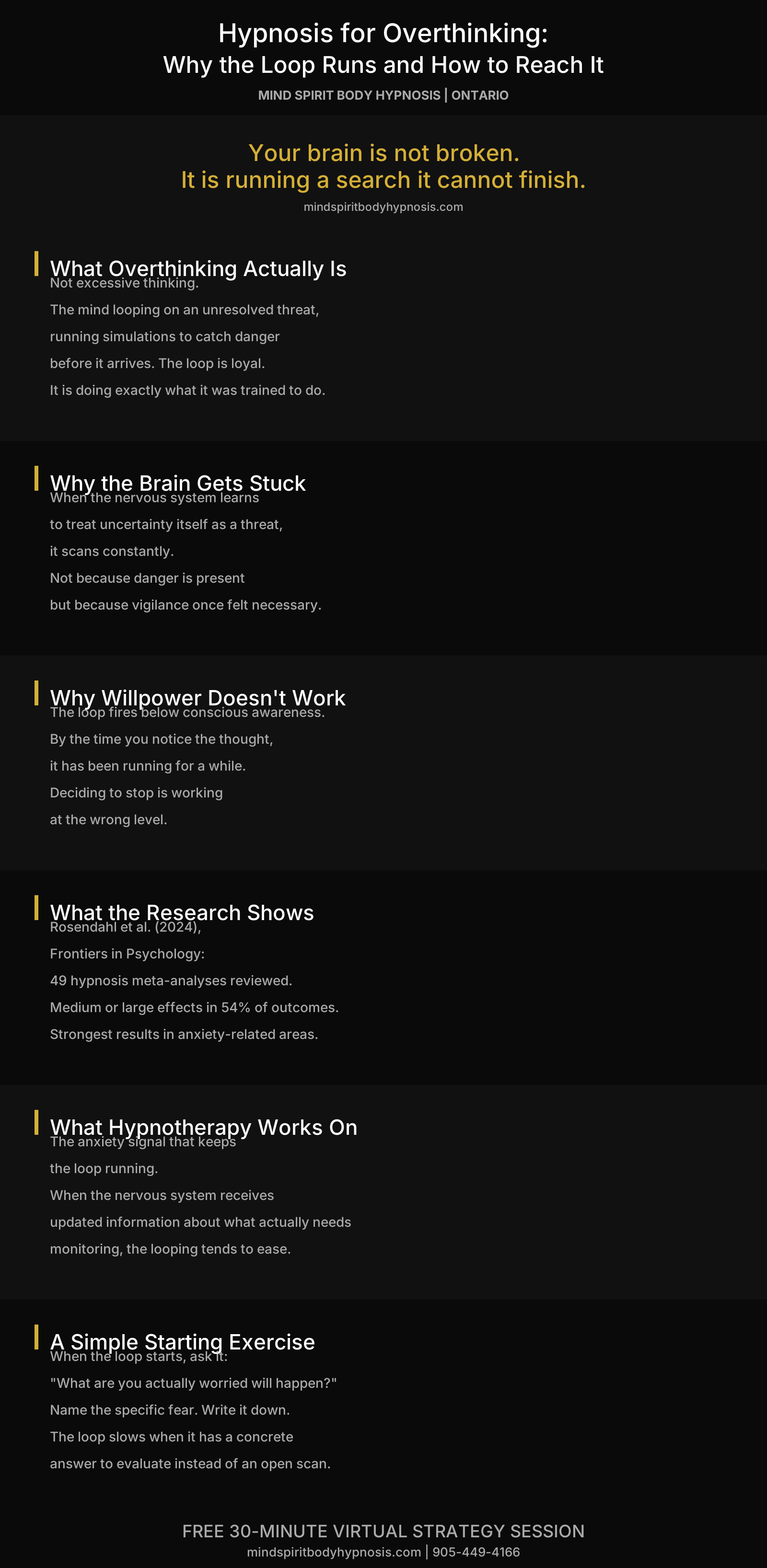
A Simple Exercise to Try
The next time you notice yourself going around in circles, try this instead of trying to stop.
Ask the thought one direct question: "What are you actually worried will happen?"
Not "why am I thinking this" or "how do I stop." Just: what is the worst specific outcome you are scanning for?
Name it as clearly as you can. Write it down if it helps.
Most of the time, when overthinking is forced into a single concrete statement, two things happen. The loop slows, because the brain has been given a specific answer to evaluate rather than an open-ended scan to run. And the actual fear underneath often turns out to be smaller, older, or more manageable than the loop suggested.
You do not have to solve it from there. Just naming the specific fear creates a moment of distance from it. That distance is where change begins. In hypnosis for overthinking work, we go much further into that gap: into the subconscious level where the fear was first learned and where it can receive genuinely updated information.
What my clients say
“I really needed help with pre-operation anxiety, pain, and a very long-standing sugar addiction. I am greatly appreciative that Fanis at Mind Spirit Body Hypnosis has helped me to eliminate both from my life in a very short period of time. I felt desperate to find something to help but I didn’t fully believe in the mechanics of hypnosis. It was extremely successful and I am so very grateful for the experience.” — Donna W. via Google
Frequently Asked Questions
What is overthinking? Overthinking is the mind running the same thoughts in repetitive circles without arriving at a resolution. It typically takes the form of rumination (replaying past events) or worry (running future scenarios). Psychologists call this repetitive negative thinking. It is not a character flaw or a thinking disorder. It is what happens when the nervous system is treating uncertainty or perceived threat as something that needs to be constantly scanned for and managed.
Why do I keep overthinking even when I know it is not helping? Because knowing is a conscious act, and overthinking is a subconscious one. The loop is generated below the level where your awareness of it operates. By the time you notice you are overthinking, the loop has already been running. Deciding to stop does not reach the mechanism that is creating the thought. It only affects what you do with the thought once it has already arrived.
Is overthinking a thinking problem or an anxiety problem? Almost always an anxiety problem. The thoughts are the symptom. The underlying cause is a nervous system that has learned to treat uncertainty as a potential threat and to keep scanning for danger as a result. Managing the thoughts without addressing the anxiety is like treating a fever by cooling the room. The room gets cooler. The fever is still running.
Can hypnosis for overthinking actually reduce rumination? Research on interventions targeting repetitive negative thinking shows moderate to large effect sizes (g = -0.59 to -0.71) on those outcomes. The broader hypnotherapy research base shows significant effects on anxiety-related conditions, which is the root mechanism in overthinking. Hypnotherapy works at the subconscious level where the looping pattern was built, which is why it can produce shifts that conscious approaches alone often cannot.
Why does trying to stop overthinking sometimes make it worse? Because suppression increases awareness of what you are trying to suppress. Research on thought suppression shows that the instruction "do not think about X" tends to increase how often X comes to mind. Trying to stop overthinking is one more thing for the anxious mind to manage, which adds load rather than reducing it. The goal in hypnotherapy is not to stop the thoughts but to reduce the anxiety signal that is generating them.
How is hypnotherapy different from mindfulness or CBT for overthinking? Mindfulness teaches you to observe thoughts without engaging with them, which builds distance. CBT teaches you to evaluate and challenge the content of thoughts, which can update them. Both work at the conscious level. Hypnotherapy works at the subconscious level, where the anxiety pattern that is generating the thoughts lives. For many people, mindfulness and CBT are valuable and hypnotherapy deepens or extends what those approaches have started. For others, hypnotherapy reaches something those approaches have not.
Is there research on hypnotherapy and repetitive thinking? The most direct evidence is on anxiety reduction and repetitive negative thinking. A 2024 meta-analysis in Cognitive Behaviour Therapy found moderate to large reductions in repetitive negative thinking from targeted interventions. A 2024 review in Frontiers in Psychology covering 49 meta-analyses of hypnotherapy found medium to large effects in more than half of outcomes studied, particularly in anxiety-related areas.
Can hypnotherapy help if I have been an overthinker my whole life? Yes. A long history of overthinking means the nervous system has had more time to rehearse the pattern, but it does not mean the pattern is fixed. The subconscious learns through repetition, and it can also update through new experience. Hypnotherapy creates the conditions for that update by accessing the subconscious in a calm, focused state. The length of the pattern may affect how many sessions are useful, but it does not affect whether change is possible.
What does it feel like after hypnotherapy sessions for overthinking? Most clients describe a gradual quieting rather than a sudden change. The thoughts may still come, but they arrive with less urgency. There is more space between the trigger and the loop. Decisions feel less fraught. Sleep comes more easily. The mind is still active but no longer feels like it is running something it cannot turn off. Some clients notice changes quickly. Others experience a more gradual shift over the course of several sessions.
How many sessions will I need? This varies by person and depends on how long the pattern has been running and how many areas of life it touches. Some clients notice meaningful shifts in a few sessions. Others benefit from more extended work. The goal is not to schedule you indefinitely but to work until the loop no longer runs automatically and the underlying anxiety no longer needs that level of monitoring.
recommended reading
Ready to Take the Next Step?
If your mind feels like it cannot switch off, I would be glad to help you understand what is driving it.
I offer a free 30-minute virtual strategy session for new clients across Ontario (and beyond). No pressure. Just a conversation about what you are experiencing and whether hypnotherapy is the right fit.
Book your free session: calendly.com/mindspiritbodyhypnosis
Call or text: 905-449-4166
Email: info@mindspiritbodyhypnosis.com
Visit: mindspiritbodyhypnosis.com
Serving clients virtually across Ontario, including Durham Region, Toronto, Canada, and beyond.
Disclaimer: This article is for informational purposes only and does not constitute medical or psychological advice. Hypnotherapy, NLP, and EMDR are complementary approaches and are not a substitute for diagnosis or treatment by a qualified healthcare provider. Please consult a licensed professional if you have concerns about your mental or physical health.
Written by Fanis Makrigiannis | Certified Hypnotherapist & NLP Master Practitioner | Mind Spirit Body Hypnosis.