Hypnosis for Abandonment Wounds: Why Fear of Rejection Runs So Deep
TL;DR: Abandonment wounds are not about being overly sensitive. They are early-wired responses. The nervous system learned them when closeness felt unsafe or unpredictable. Hypnosis for abandonment wounds works by reaching those patterns at the subconscious level, where they formed. If you have felt your fear of rejection fire faster than logic could catch it, this article explains why, and what can help.
Quick Answer
An abandonment wound is a deep, often subconscious belief that people will leave. It says that closeness is not safe, or that you are not worth staying for. It typically forms in childhood through experiences of emotional distance, loss, or cold caregiving. In adult relationships, it shows up as clinging, pulling away, or patterns that push away the very connection you want. Hypnosis for abandonment wounds addresses the nervous system's learned response directly, in the subconscious state where the original learning happened. Fanis Makrigiannis, a Certified Hypnotherapist and NLP Master Practitioner at Mind Spirit Body Hypnosis in Oshawa, Ontario, works with clients across Ontario who carry this pattern. He helps them shift the response that keeps triggering long after the original wound has passed.
Questions This Article Answers
What is an abandonment wound?
Where does the fear of abandonment actually come from?
Why does the fear of rejection feel so automatic and physical?
What is the difference between an abandonment wound and normal relationship anxiety?
How does hypnosis for abandonment wounds work?
What does a session look like?
Is there research supporting this approach?
What can I do between sessions?
In this article:
There is a particular kind of fear that does not wait to be invited.
You are in a relationship that is going well. Someone takes a few hours to reply to a message. A partner seems quieter than usual. A friend cancels plans. Something in you fires. The tight chest. The scanning. The quiet spiral of "what did I do, are they pulling away, is this ending."
Consciously, you know this is probably nothing. But the feeling is already there. And it is bigger than the moment seems to warrant.
That gap, between what is happening and what the nervous system is responding to, is where the abandonment wound lives.
What an Abandonment Wound Actually Is
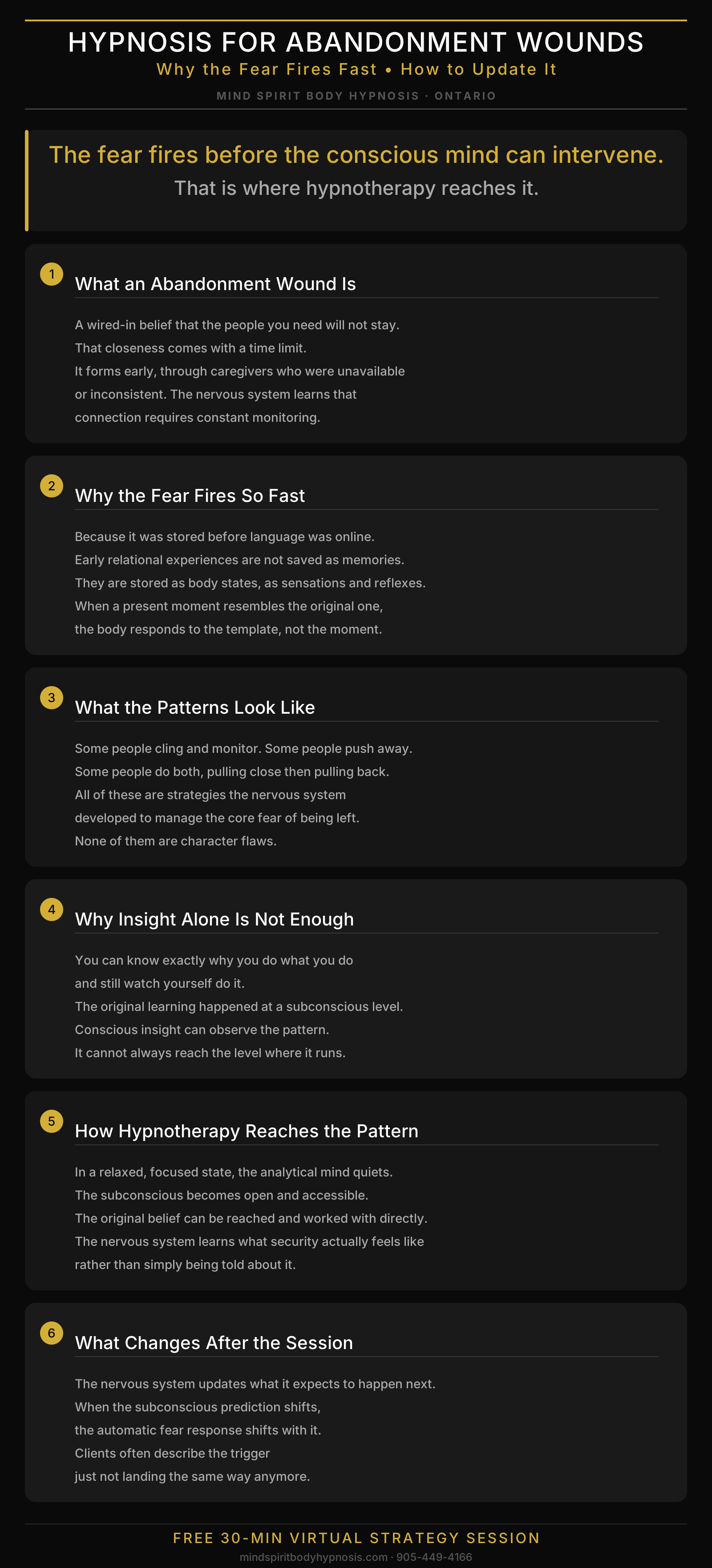
An abandonment wound is not a fear of being alone. It is a wired-in belief that the people you need will not stay. That closeness comes with a time limit. That you are, at some level, not quite enough to keep someone from leaving.
It forms early. The nervous system of a young child is built to monitor caregivers. When that feels consistent, the child develops what researchers call a secure style of attachment. That means a basic sense that connection is safe. That repair is possible after conflict. That being close to someone does not require constant watching.
When availability is inconsistent, cold, or suddenly absent, the system learns something different. It learns that connection requires monitoring. That the other person's mood is a signal to watch closely. That closeness and loss tend to arrive together.
That learning is not a character flaw. It is the nervous system doing exactly what it was built to do. It maps the relational world it was raised in. It prepares for more of the same.
The wound is the map. Maps persist long after the terrain has changed.
Why the Fear Feels So Physical and Fast
One of the most confusing things about an abandonment wound is how quickly it fires. Someone you trust goes quiet for a day. Within minutes, the response is fully activated. The tight chest. The urge to check your phone. The loop of interpretations. The dread.
Consciously, you know better. But the response is already running.
This happens because the original learning happened before language was fully online. Early experiences with caregivers are stored as body states. Sensations. Tensions. Automatic responses. Not as memories you can replay and examine. When a present moment resembles the original one even faintly, the body responds to the resemblance. Not to what is actually happening.
The person who takes a few hours to reply is not your parent who was emotionally unavailable. But if the felt sense is similar, the nervous system responds to the template, not the person.
This is not weakness. It is the design of a system built for speed. The same mechanism that kept you alert to genuine danger in childhood is the one that now fires at a delayed text message. It is accurate to its original context. It is just operating in a world that has changed.
7 Signs of Abandonment
How the Wound Shapes Relationship Patterns
Abandonment wounds do not look the same in everyone. The nervous system develops different strategies for managing the core fear. Those strategies produce very different outward patterns.
Some people become hypervigilant. They track the other person's mood closely. They adjust their own behaviour to stay close. They experience great distress at any perceived distance. These patterns look like clinginess or neediness. They are better understood as a system running on high alert.
Some people go the other direction. They push away before they can be left. They create distance when connection deepens. They choose partners who are unavailable, or find reasons to withdraw from ones who are not. This pattern can be harder to spot. It looks like independence rather than fear.
Some people move between the two. They pull close, then feel trapped. They pull away, then feel abandoned. The push-pull that leaves partners confused and worn out is often this wound cycling through its two default moves.
Working with clients in Ontario who carry trauma from earlier in life, I often see these patterns presented as personality traits. As evidence that the person is "too much" or "not enough." They are neither. They are adaptive strategies. They made sense in their original context. The work is not to shame them out of existence. It is to update the belief system underneath.
Why Talking About It Is Not Always Enough
Many people with abandonment wounds have done significant work in therapy or coaching. They understand where the fear comes from. They can name the pattern. They can see it happening in real time. And then they watch it happen anyway.
This is one of the most frustrating experiences in anxiety-related work: the gap between insight and change. You know why you do what you do. You just cannot seem to stop doing it.
The reason is not a failure of insight. It is a question of access. The original learning happened at a subconscious level. It is maintained there. Conscious understanding can observe the pattern. It cannot always reach the level where the pattern is stored and running.
Think of it like a smoke alarm wired to go off when the temperature drops, not when there is actual smoke. You can tell yourself that the temperature dropping is not a fire. The alarm still goes off. The wiring needs to be updated, not explained.
Hypnotherapy works at the level of the wiring.
How Hypnotherapy Reaches the Pattern
In a relaxed, focused state, the analytical mind quiets. The subconscious becomes more open. This is not a loss of control. It is more like the difference between trying to hear something over loud noise and listening in a quiet room. The material is easier to work with when the conscious mind is not drowning it out.
This is where hypnosis for abandonment wounds becomes a different kind of tool. It does not help you understand the pattern from the outside. It lets you reach the original belief directly. The core sense of "I am not enough to be stayed for." The assumption that "connection always ends." You can work with those beliefs at the level where they live.
This might involve regression to the original experience where the belief formed, and offering a different response. It might involve installing a new felt sense of safety. The body learns what secure attachment actually feels like. Rather than simply being told about it. It might involve NLP techniques such as Parts Integration. The part that monitors for abandonment and the part that wants to relax into connection are brought into agreement.
The goal is not to erase the history. It is to update what the nervous system expects will happen next. When that prediction shifts, the automatic response shifts with it.
What the Research Says
The direct evidence base for hypnosis for abandonment wounds specifically is limited. This is an emerging area of practice rather than a heavily researched one.
What is well supported is the broader framework. A 2026 meta-analysis by Li et al. examined 211 studies and over 82,000 participants. It found that childhood maltreatment was significantly associated with adult attachment anxiety (r = 0.23) and avoidance (r = 0.20). The strongest associations were for emotional maltreatment. This confirms what clinicians observe: the wound is real, it is relational in origin, and it persists into adulthood.
On the hypnotherapy side, a 2019 meta-analysis by Valentine, Milling, Clark, and Moriarty in the International Journal of Clinical and Experimental Hypnosis reviewed 15 studies. They found a weighted mean effect size of 0.79 for hypnosis treating anxiety. At the longest follow-up, the effect size reached 0.99. The average hypnosis participant improved more than 84% of control participants at follow-up.
Abandonment wounds are, in significant part, an anxiety response rooted in relational history. The research supports hypnotherapy as an effective tool for the anxiety component. The clinical work addresses the attachment-based material underneath. The integration of hypnotherapy with attachment-informed practice is what I apply with clients at Mind Spirit Body Hypnosis for clients who carry this kind of wound.
A Simple Exercise to Try
This exercise will not replace hypnosis for abandonment wounds. But it can help you recognize the moment the response activates. That is the first step toward working with it rather than being swept along by it.
The next time you notice the fear firing, pause before acting on it. It might be a tightening in the chest. A sudden pull to check in with someone.
Place one hand on your chest and take three slow breaths. With each breath out, say silently: "This feeling is old. This moment is new."
Do not try to argue with the feeling. Do not tell yourself it is irrational. Just name it as a signal from the past landing in the present. Then ask: "What do I actually know about this moment, not what do I fear?"
You will not always be able to hold the distinction. But the practice of noticing the gap between the old signal and the current moment is exactly the kind of awareness that hypnotherapy builds on.
What my clients say
“A family friend referred me to Fanis at Mind Spirit Body Hypnosis after I had been smoking for years and couldn’t seem to quit, no matter how hard I tried. What surprised me most was how natural the whole process felt. There was no white-knuckling it, no counting days, no feeling deprived. After four sessions, I stopped. Not because I was forcing myself, but because the urge simply wasn’t there the way it used to be. Fanis was professional, calm, and easy to connect with. The sessions are virtual, so I could access support from home without any disruption to my routine. I am so glad my family friend made that recommendation. I did not expect results this fast, and I would not hesitate to pass his name along to anyone else who is ready to quit. He also created a custom recording for me; every time I listen, I hear something new. Thank you!” — Janette C. via Google
Frequently Asked Questions
What is an abandonment wound? An abandonment wound is a deep, often subconscious belief that people will leave, that you are not worth staying for, or that closeness is unsafe. It typically forms through early experiences of emotional unavailability, inconsistency, or loss in childhood. In adult relationships, it shows up as hypervigilance, withdrawal, clinging, or patterns that push away connection even when it is what you want most. It is not a character flaw, and it is not permanent. It is the nervous system running a map it learned early, in a world that has since changed.
What is the difference between an abandonment wound and normal relationship anxiety? Most people feel some anxiety around connection and loss. An abandonment wound is distinguished by its speed, its intensity relative to the trigger, and its consistency across relationships. If a minor cue, like a delayed reply or a cancelled plan, reliably produces a full-body fear response, that is a signal worth paying attention to. And if this pattern has shown up across multiple relationships, it is likely more than situational anxiety. It is a nervous system response rooted in earlier learning.
Where does an abandonment wound come from? Most abandonment wounds trace back to early relational experience. A caregiver who was emotionally unavailable, cold, or who left. A parent who was present physically but absent emotionally. Loss through death, divorce, or placement that happened before the child had the tools to process it. The wound does not require dramatic trauma. Chronic neglect, persistent unpredictability, or the quiet absence of care can shape the same response as more visible events.
Why does the fear fire so fast, before I can think? Because it was stored before language was fully developed. Early relational experiences are stored as body states, not stories. When a present moment resembles the original one, the body responds to the template before the conscious mind has time to assess what is happening. This is the same mechanism that makes all early learning fast and automatic. It was built for survival, not reflection.
How is hypnotherapy different from talk therapy for this kind of wound? Talk therapy works with the story of the wound. It builds insight, helps you name the pattern, and develops a new relationship with your history. This is real and valuable work. Hypnotherapy works with the felt sense of the wound. Rather than viewing the pattern from the outside, it reaches the subconscious belief where the pattern lives and works with it there. The two are compatible. Many clients find that using both moves the work further than either alone.
What does a hypnotherapy session for abandonment wounds look like? Sessions typically begin with a conversation about the patterns you have noticed and the relational experiences that may have shaped them. From there, hypnotic induction creates a relaxed, focused state. The work in that state might involve regression to early experiences where the belief formed. It might involve installing a new felt sense of relational safety. Or NLP techniques that address the conflicting parts of a person. Sessions are conversational and collaborative. You remain aware throughout.
Is there research supporting hypnotherapy for abandonment wounds? Direct research on hypnotherapy for abandonment wounds specifically is limited. The broader evidence base is stronger. A 2026 meta-analysis of over 82,000 participants found that childhood maltreatment is significantly associated with adult attachment anxiety and avoidance. A 2019 meta-analysis in the International Journal of Clinical and Experimental Hypnosis found hypnosis produced a weighted mean effect size of 0.79 for anxiety treatment, with follow-up effects reaching 0.99. Abandonment wounds are substantially an anxiety response with a relational origin, and hypnotherapy is well supported for anxiety. The clinical application to attachment-based material is an active area of practice.
How is this different from what is already on your site about trauma? My existing trauma page covers the broader landscape of how hypnotherapy supports trauma recovery. This article addresses a specific pattern. It focuses on the relational wound that forms around early experiences of loss or emotional unavailability. This wound shows up in adult relationships as fear of rejection or being left. The focus here is relational, not trauma in the broader sense.
Can I work on this in virtual sessions? Yes. All sessions at Mind Spirit Body Hypnosis are conducted virtually. Many clients find this actually lowers the initial barrier to doing this kind of work. You are in your own space. The work is the same as it would be in person. Virtual clients come from across Ontario, including Durham Region, Toronto, Ottawa, and beyond.
recommended reading
Ready to Take the Next Step?
If the fear of losing people runs faster than logic can catch, you do not have to keep managing it from the outside. And if this pattern has shown up across more than one relationship, something deeper is worth looking at.
The wound was formed in relationship. It can be updated in relationship, including the focused, careful work of a hypnotherapy session.
I offer a free 30-minute virtual strategy session for new clients. No pressure. Just a conversation about what you are carrying and whether this kind of work is a good fit.
Book your free session: calendly.com/mindspiritbodyhypnosis
Call or text: 905-449-4166
Email: info@mindspiritbodyhypnosis.com
Visit: mindspiritbodyhypnosis.com
Serving clients virtually across Ontario, including Durham Region, Toronto, Canada, and beyond.
Disclaimer: This article is for informational purposes only and does not constitute medical or psychological advice. Hypnotherapy and NLP are complementary approaches and are not a substitute for diagnosis or treatment by a qualified healthcare provider. If you are experiencing significant distress, please consult a licensed professional.
Written by Fanis Makrigiannis | Certified Hypnotherapist and NLP Master Practitioner | Mind Spirit Body Hypnosis.