Can Hypnosis help Heal My Inner Child?
Inner Child Hypnotherapy in Ontario: Why Childhood Wounds Still Run Your Adult Life
TL;DR: Many of the patterns that are hardest to change in adult life were not formed in adulthood. They were formed before the age of seven or eight, when the brain was still developing, and the experiences of childhood were being filed as permanent facts about the world and about you. This part of the mind is what therapists call the inner child. It is not a metaphor. It is a real subconscious structure holding beliefs, emotional responses, and automatic behaviours formed in early life that continue to drive adult patterns. A 2025 systematic review confirmed that childhood experiences continue to shape behaviour, emotions, and relationships in adulthood. Fanis Makrigiannis at Mind Spirit Body Hypnosis in Oshawa, Ontario, offers virtual inner child hypnotherapy Ontario sessions for clients aged 10 and older across the province.
Quick Answer
Inner child hypnotherapy Ontario is a subconscious approach that helps adults access and update the emotional beliefs and responses formed during childhood, which continue to drive anxiety, low self-worth, relationship difficulties, and self-defeating patterns in adult life. A 2025 systematic review published in the Indonesian Journal of Counselling and Development confirmed that childhood experiences continue to shape adult behaviour, emotions, and social relationships, with hypnotherapy identified as one of the most effective approaches for accessing and healing these early patterns. Clinical hypnotherapy provides a structured way of exploring emotional material that is difficult to access through ordinary conscious reflection, which is precisely what early childhood wounds require. Fanis Makrigiannis, a Certified Hypnotherapist (ABH, NGH) and NLP Master Practitioner (ABNLP) at Mind Spirit Body Hypnosis in Oshawa, Ontario, offers virtual sessions for clients aged 10 and older across Ontario. No referral is required.
Questions This Article Answers
What is the inner child and is it a real thing?
Why do childhood experiences still affect adult life decades later?
How do I know if my adult patterns are being driven by childhood wounds?
What does inner child hypnotherapy actually look like in a session?
How many sessions does it take to notice a real shift?
In this article:
A lot of people arrive for this work saying the same thing in different words. They know their reaction to a situation is bigger than the situation warrants. They can see that the anxiety, the self-criticism, or the pattern of pushing people away does not match what is actually happening right now. And yet they cannot stop it.
That gap between what the adult mind knows and what the body and emotions continue to do is often the signature of an unhealed childhood wound. Not necessarily a dramatic or visible one. Often something quiet: a recurring sense of not being enough, a deep difficulty asking for help, a pattern of staying small when the opportunity to step forward arrives.
In my practice in Oshawa, this is some of the most meaningful work I do. And some of the most transformative.
What Is the Inner Child?
The inner child is not a soft concept or a metaphor. It is a description of something specific and neurologically real.
Before the age of seven or eight, the brain has not yet developed the capacity for the kind of rational, contextual thinking that adults use to process experience. The prefrontal cortex is still forming. Young children cannot step back from an experience, evaluate it in context, and file it as one thing that happened. They experience things directly, emotionally, and totally. And they conclude from those experiences that feel, to the developing mind, like facts.
A child who is repeatedly criticized concludes: I am not good enough. A child whose needs are consistently unmet concludes: my needs are a burden. A child who witnesses conflict concludes: the world is unsafe. A child who is praised only for performance concludes: I am only lovable when I am achieving.
These conclusions are not filed as opinions or possibilities. They are filed as truths. And because they were formed before the capacity for contextual adult reasoning, they are not easily updated through adult reasoning either. You can know, intellectually, that you are good enough. The subconscious belief formed at age five says otherwise. And in moments of stress, tiredness, or vulnerability, the subconscious belief wins.
The inner child is the part of the subconscious mind still holding these early filed truths. It is the emotional and psychological residue of early experience, operating automatically in the present.
For more on how the nervous system holds the effects of early experiences and how this is addressed at Mind Spirit Body Hypnosis, the trauma therapy page covers the broader picture.
What is the inner child?
Why Do Childhood Wounds Continue to Run Adult Patterns?
Because they were never updated.
The subconscious mind is not like a hard drive that overwrites old files when new information arrives. It accumulates. The early beliefs and emotional patterns remain in the system, running alongside everything that has been learned since. In low-stress conditions, the adult mind can override them. Under pressure, in unfamiliar situations, in moments of emotional activation, or when something in the present matches the original experience, the early pattern fires.
This is why intelligent, self-aware adults find themselves reacting to situations in ways they immediately recognize as disproportionate. The intellectual adult is present and watching. The subconscious child is running the response.
A 2025 systematic review confirmed that childhood experiences continue to shape behaviour, emotions, and social relationships in adulthood. The review found these effects are particularly persistent for beliefs about self-worth, safety, and interpersonal relationships because they formed so early that they predate the capacity to question or contextualize them.
The most important thing to understand is that this is not weakness and it is not a failure of self-knowledge. It is the entirely predictable result of how the developing brain works. The wound does not heal just because time has passed. It heals when it receives the kind of direct, subconscious attention that formed it. For more on how the anxiety patterns that often accompany these wounds are addressed, the hypnotherapy for anxiety and stress page covers the nervous system dimension.
How Do I Recognize Inner Child Patterns in Adult Life?
The most common signs that adult patterns are being driven by childhood wounds include the following.
Reactions that feel bigger than the situation. When a criticism, a rejection, a moment of conflict, or a sense of being excluded produces an emotional response that the adult part of you recognizes as disproportionate, this is often an early wound being activated.
Persistent self-criticism. The voice that says you are not good enough, not smart enough, too much, or not enough is usually formed in childhood. It was often originally the voice of a parent, teacher, or peer, internalized as self-talk.
Difficulty receiving love or praise. When positive attention feels uncomfortable, disbelieved, or anxiety-producing, this often reflects a childhood environment where love was conditional, inconsistent, or absent.
Patterns in relationships. Repeatedly attracting or staying in dynamics that replicate early attachment wounds (the critical partner, the unavailable one, the relationship where love has to be earned) is a very common expression of unhealed inner child material.
Fear of taking up space. Apologizing for existing. Shrinking before others notice you. Making yourself small so as not to inconvenience anyone. This often originates in a childhood environment where the child's needs were treated as burdensome.
Difficulty with self-trust. When your own perceptions, feelings, or judgements feel unreliable, this often traces back to early experiences where your perceptions were denied, dismissed, or ridiculed.
None of these patterns mean something is permanently wrong with you. They mean the subconscious is still running a programme that was appropriate to an environment that no longer exists. When people searching for inner child hypnotherapy Ontario arrive at Mind Spirit Body Hypnosis, this is almost always the pattern we are working with.
What Does Inner Child Hypnotherapy Specifically Do?
As a Certified Hypnotherapist with ABH and NGH credentials and NLP training through ABNLP, working with clients across Durham Region and Ontario, I approach inner child work through a four-stage protocol.
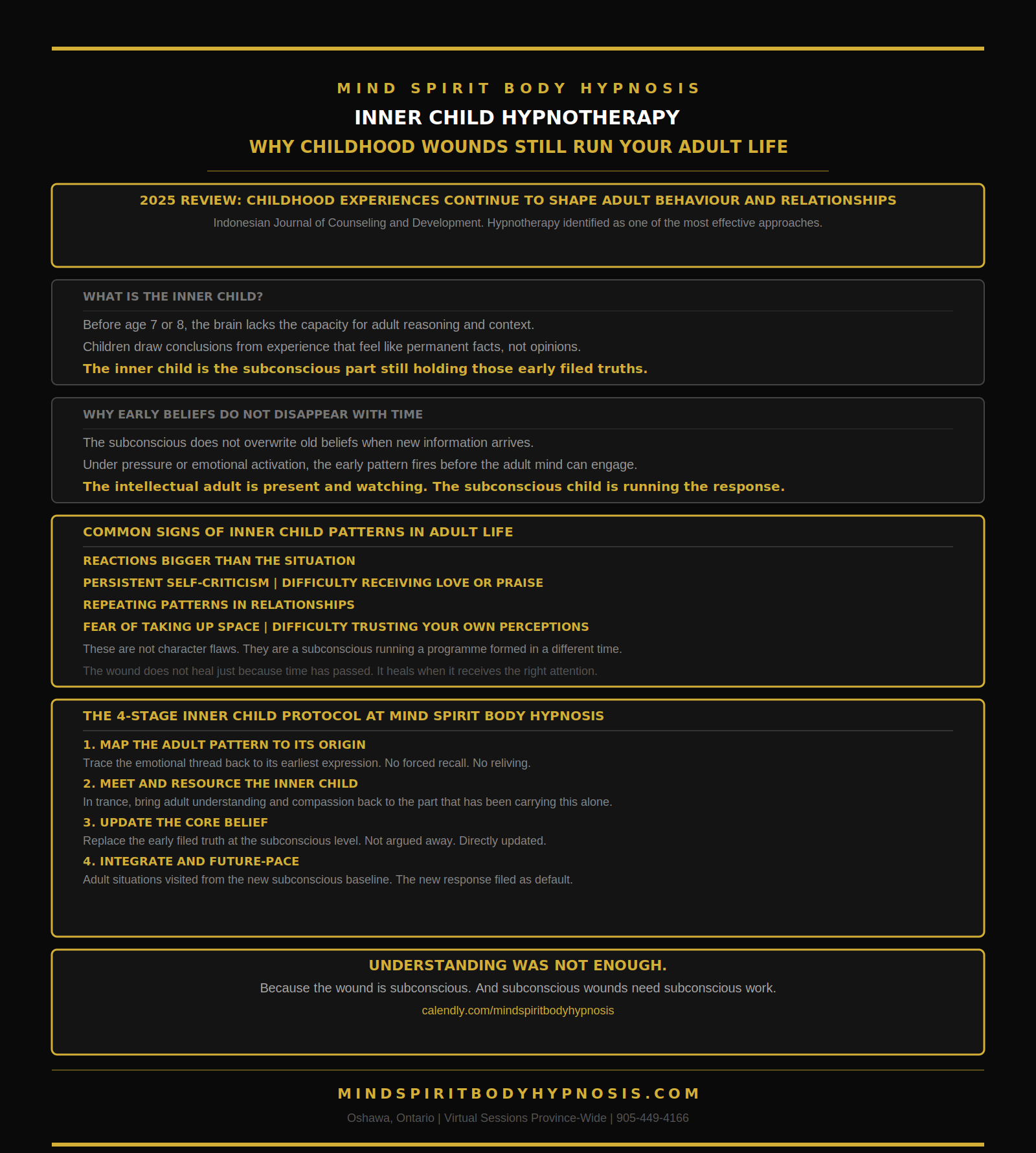
Stage 1: Map the adult pattern to its origin. The first session identifies the specific adult pattern causing difficulty and traces the emotional thread back toward its earliest expression. What does this feel like? When did this first feel familiar? What did the child who learned this believe? This mapping is done through conversation, not through forced recall or re-experiencing.
Stage 2: Meet and resource the inner child. In trance, the adult client meets the younger version of themselves that formed the wound. This is not about reliving the past. It is about bringing adult understanding, compassion, and resources back to a part of the self that has been carrying something alone for a very long time. The child receives what was missing: acknowledgement, safety, protection, or the clear message that what happened was not their fault and did not make them less.
Stage 3: Update the core belief. The belief that the child formed from their experience is directly updated in the trance state. This is the most important part of the work. The belief is not argued with or reasoned away. It is replaced at the subconscious level with something more accurate: I am enough. I am allowed to be here. It is safe to need things. My worth is not conditional on performance.
Stage 4: Integrate and future-pace. The adult version of the client is walked forward through specific situations that have previously triggered the inner child wound, experiencing them from the updated subconscious baseline. The new response is filed as expected. The old pattern loses its automatic quality.
Clinical hypnotherapy provides structured access to emotional material that is difficult to reach through ordinary conscious reflection. This is exactly what makes it effective for inner child work. The early beliefs were not formed through conscious reasoning. They cannot be fully updated through it either.
What Do Sessions Look Like at Mind Spirit Body Hypnosis?
A typical programme for inner child hypnotherapy in Ontario at Mind Spirit Body Hypnosis:
Session 1: Conversation and pattern mapping. A thorough, gentle conversation about the adult pattern and its emotional signature. No pressure to describe specific childhood events. The focus is on what is happening now and what you want to be different.
Sessions 2 and 3: Meeting the inner child and belief updating. The core inner child work. Safe, paced, and always within what feels manageable. You stay in control throughout. Nothing is forced or rushed.
Sessions 4 and 5: Integration and future-pacing. The updated belief is consolidated. Adult life situations are visited from the new subconscious baseline. The automatic pattern begins to feel optional.
In my practice, inner child work typically runs between four and six sessions, with some people noticing a meaningful shift within the first two or three. All sessions are virtual, available to clients aged 10 and older across Ontario. No referral is required. More about my credentials and approach is on the about page.
WHAT MY CLIENTS SAY
“I had a wonderful experience working with Fanis and his hypnosis program to help me work through anxiety, fears, and past traumas. The results have been incredibly positive. I felt comfortable, supported, and understood throughout the entire process and noticed a meaningful shift in how I feel and respond to things that once caused me anxiety. I am very grateful for the experience and would highly recommend Fanis and his services.” — Tracy D
Frequently Asked Questions
What is the inner child? The part of the subconscious mind still holding the beliefs, emotional responses, and conclusions formed in early childhood, before the brain had developed the capacity for adult reasoning and context. It is neurologically real, not metaphorical.
Why do childhood wounds still affect me as an adult? Because the subconscious does not overwrite old beliefs when new information arrives. Early beliefs about self-worth, safety, and relationships remain in the system and continue to drive automatic responses, especially under stress or emotional activation.
Do I have to describe or relive my childhood experiences in detail? No. Sessions map the emotional pattern and its origin through conversation, not through forced recall or reliving. The trance work approaches childhood material gently and from a position of safety. Nothing is rushed or forced.
How do I know if my adult patterns are driven by childhood wounds? Common signs include emotional reactions that feel bigger than the situation warrants, persistent self-criticism, difficulty receiving love or praise, repeating patterns in relationships, fear of taking up space, and difficulty trusting your own perceptions.
What is the difference between inner child work and regular therapy? Traditional therapy works primarily at the conscious level. Inner child hypnotherapy works at the subconscious level where the early beliefs are actually stored. It is not a replacement for therapy. Many clients find hypnotherapy most useful for the early material that conscious therapeutic work has acknowledged but not fully shifted.
Is this approach appropriate for people who had difficult childhoods? Yes. The work is always paced to what feels safe and manageable. The first sessions are dedicated to establishing a genuine sense of safety before any deeper material is approached. Nothing moves forward until the foundation is solid.
How many sessions will I need? In my practice, inner child work typically runs four to six sessions. A specific honest estimate is always given in the free 30-minute strategy session, with no commitment required.
Can I access sessions from anywhere in Ontario? Yes. All sessions are delivered virtually across Ontario, including Durham Region, Toronto, Ottawa, and beyond. No referral is required.
Ready to Take the Next Step?
If you recognize yourself in what this article describes, the work does not have to stay stuck at the level of understanding. Something can actually change.
I offer a free 30-minute virtual strategy session for new clients across Ontario. No pressure. Just a gentle, honest conversation about what you have been carrying and whether this approach can help you set it down.
Book your free session: calendly.com/mindspiritbodyhypnosis
Call or text: 905-449-4166
Email: mindspiritbodyhypnosis@gmail.com
Visit: mindspiritbodyhypnosis.com
RECOMMENDED READING
Serving clients virtually across Ontario, including Durham Region, Toronto, Canada, and beyond.
Disclaimer: This article is for informational purposes only and does not constitute medical or psychological advice. Hypnotherapy, NLP, and EMDR are complementary approaches and are not a substitute for diagnosis or treatment by a qualified healthcare provider. If you are experiencing significant distress related to childhood experiences, please also consider speaking with a registered mental health professional. Results vary by individual.
Written by Fanis Makrigiannis | Certified Hypnotherapist (ABH, NGH) and NLP Master Practitioner (ABNLP) | Mind Spirit Body Hypnosis, Oshawa, Ontario.