Can Hypnotherapy Help With Panic Attacks? What the Evidence Says
TL;DR: Hypnotherapy for panic attacks in Ontario works by calming the nervous system at a subconscious level and interrupting the fear cycle that keeps attacks coming back. Unlike approaches that manage symptoms in the moment, hypnotherapy targets the pattern underneath. Research supports it as an effective complement to other treatments, and most clients notice a meaningful shift within a few sessions.
Quick Answer
Hypnotherapy for panic attacks in Ontario is a subconscious-focused approach that helps the nervous system learn that the body is safe, interrupting the cycle of anticipatory fear and physical alarm that drives recurring attacks. A 2024 meta-analysis published in Frontiers in Psychology (Leo, Keller and Proietti) found that patients treated with hypnosis achieved greater anxiety reduction than 84% of control group participants across 17 trials. Fanis Makrigiannis, a Certified Hypnotherapist and NLP Master Practitioner at Mind Spirit Body Hypnosis in Oshawa, Ontario, offers virtual sessions across Ontario for clients who want to address panic at the root rather than manage it session to session.
Questions This Article Answers
Can hypnotherapy actually help with panic attacks?
Why does hypnotherapy reach something that other approaches don't?
What happens in a hypnotherapy session for panic attacks?
How many sessions does it take to see a difference?
Who is hypnotherapy for panic attacks best suited to?
In this article:
Why Panic Attacks Keep Coming Back
A panic attack feels like a physical emergency. Racing heart, tightness in the chest, shortness of breath, dizziness, a sudden overwhelming sense of dread. And it can come out of nowhere.
What makes panic attacks so difficult to manage is not just the attacks themselves. It is everything that builds around them. The fear of having another one. The hyper-vigilance. The way the body starts scanning for signs of danger even on quiet days. Over time, this creates a cycle where panic anxiety becomes its own trigger.
In my practice at Mind Spirit Body Hypnosis, I work with clients across Ontario who have often tried breathing techniques, medication, and even therapy before reaching out. The surface tools help in the moment. But the subconscious is still running a programme that says: something is wrong, something is coming, stay alert. And that programme does not switch off because you have learned to breathe through an attack.
That is where hypnotherapy comes in.
What Hypnotherapy Does That Other Approaches Often Miss
Most approaches to panic attacks work at the conscious level. You learn to recognize triggers, challenge anxious thoughts, or use breathing to calm the physical response mid-attack.
These are genuinely useful tools. But they work on the output of a system that generates the panic, not the system itself.
The subconscious mind is where threat responses are stored. It is where the associations live between a particular setting, a body sensation, or a memory and the alarm signal that fires. Consciously, you may know you are safe. But the subconscious does not respond to logic. It responds to learning, to repetition, and to experience.
Hypnotherapy works in the state where that subconscious learning happens. In a relaxed, focused state, the mind becomes more open to updating its associations. Instead of rehearsing danger, it rehearses safety. Instead of linking certain sensations to threat, it begins to link them to calm.
A meta-analysis published in the International Journal of Clinical and Experimental Hypnosis (Valentine and Milling, 2019) found that the average person receiving hypnosis for anxiety outperformed 79% of control group participants at the end of treatment, rising to 84% at follow-up. This held across different anxiety presentations, including panic-related anxiety.
What causes panic attacks?
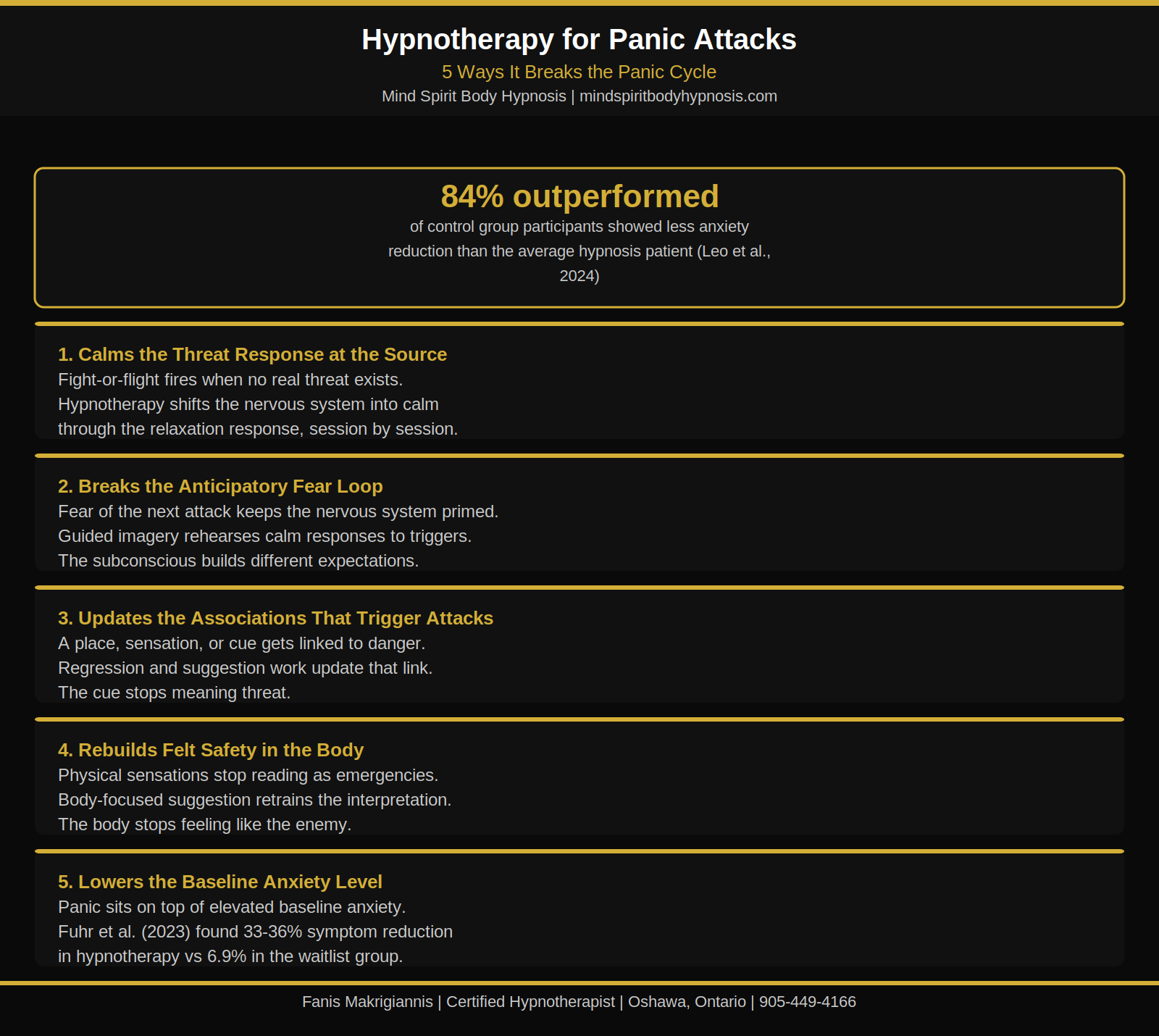
5 Ways Hypnotherapy Addresses the Panic Cycle
Here are the five most important ways hypnotherapy targets what keeps panic going, and what is actually happening in each case.
1. Calming the Threat Response at the Source
Panic attacks are driven by the fight-or-flight response: the body's alarm system firing when no real threat is present. Over time, that alarm becomes sensitised, firing more easily and for longer.
Hypnotherapy's deep relaxation response directly counteracts this. In a clinical hypnotic state, the nervous system shifts out of alert mode. Heart rate slows, breathing deepens, and the physiological patterns associated with calm become reinforced through repetition. Research from the University of Liverpool, published in Frontiers in Psychology (Leo, Keller and Proietti, 2024), found that hypnosis reduces sympathetic nervous system activity while increasing parasympathetic tone, the physical shift from alert to calm.
2. Breaking the Anticipatory Fear Loop
One of the most debilitating parts of recurring panic is the fear of the next attack. This anticipatory anxiety keeps the nervous system primed, which actually makes attacks more likely.
Hypnotherapy uses guided imagery and suggestion work to interrupt this loop. In session, clients rehearse calm responses to the situations or sensations they have come to associate with panic. The subconscious begins to build a different set of expectations around those triggers.
3. Updating the Associations That Trigger Attacks
Many panic attacks are not random. They are triggered by a specific sensation, a place, a memory, or even a time of day. The subconscious has formed an association between that cue and danger, and it fires the alarm every time the cue appears.
As a Certified Hypnotherapist trained through the American Board of Hypnotherapy, I work with clients to identify those associations and use regression and suggestion techniques to update them. The cue stops meaning danger. The alarm stops firing. The hypnotherapy for anxiety page covers more on how subconscious associations with threat are addressed across anxiety presentations.
4. Building Felt Safety in the Body
Many people who experience panic attacks have lost the ability to feel safe in their own body. A racing heartbeat, a flush of warmth, or a slight dizziness becomes a threat signal rather than a neutral sensation.
Hypnotherapy works to rebuild a felt sense of safety from the inside. Through body-focused suggestion work, clients begin to reinterpret physical sensations as manageable rather than dangerous. Over sessions, the body stops feeling like the enemy.
5. Reducing the Baseline Anxiety Level
Panic attacks rarely exist in isolation. They sit on top of a baseline level of anxiety that has often been elevated for months or years. When that baseline comes down, attacks become less frequent and less intense.
A 2023 pilot randomized controlled trial published in Frontiers in Psychology (Fuhr et al.) found that participants receiving hypnotherapy for panic-related agoraphobia achieved a median symptom reduction of 33 to 36% on the Panic and Agoraphobia Scale, compared to just 6.9% in the waitlist group. Clients working on baseline anxiety alongside panic often find the hypnotherapy for confidence and self-sabotage page useful as well, since anxiety and self-doubt frequently run together.
How Hypnotherapy Compares to Other Approaches
Breathing and grounding techniques target immediate symptom management during an attack. Hypnotherapy reduces the baseline anxiety that makes attacks more likely in the first place.
Cognitive Behavioural Therapy (CBT) works with conscious thought patterns and beliefs. Hypnotherapy reaches the subconscious associations that CBT cannot directly access.
Medication addresses neurochemistry and physical symptoms. Hypnotherapy addresses the underlying fear pattern, not just the chemical response.
Hypnotherapy targets subconscious associations and threat responses directly, and works alongside all of the above.
What a Session Looks Like
Sessions at Mind Spirit Body Hypnosis are calm, comfortable, and held virtually so you can access support from anywhere in Ontario.
A typical session for panic attacks includes:
Intake conversation: understanding when your attacks occur, what sensations or situations precede them, and what the fear underneath is telling you
Guided relaxation: bringing the nervous system into a calm, receptive state where subconscious work can happen effectively
Suggestion and imagery work: building new associations between triggers and calm, and rehearsing felt safety in the body
Regression or association work where needed: identifying and updating the subconscious source of the alarm, whether that is a memory, a belief, or a pattern
A take-home anchor: a simple technique you can use between sessions to reinforce the work when anxiety starts to build
Most clients notice a shift in how their nervous system responds within two to three sessions. The goal is not just to manage attacks when they come. It is to reduce how often they come and how intense they are when they do. For clients whose panic is tied to sleep disruption, the hypnotherapy for sleep page covers how poor sleep and elevated anxiety reinforce each other.
Who Is the Best Fit for This Approach?
Hypnotherapy for panic attacks Ontario works especially well for people who:
Have recurring panic attacks that do not seem to have a clear external trigger
Feel anxious about the next attack even between episodes
Have tried breathing techniques or therapy but still feel stuck
Notice that certain places, sensations, or situations consistently trigger attacks
Have a high level of baseline anxiety that makes daily life feel effortful
Prefer a drug-free approach or want to complement existing treatment
Virtual sessions mean you do not have to travel to get support. Clients across Durham Region, Toronto, Ottawa, Kingston, and the rest of Ontario can access sessions from home.
WHAT MY CLIENTS SAY
“Fanis was referred to me by a family friend. I had been carrying something heavy for a long time, a trauma I had buried so deep I barely acknowledged it anymore, but that was quietly affecting everything. My sleep, my relationships, my ability to feel settled in my own skin. I was not expecting much. What happened surprised me completely. Fanis got to the core of it faster than I thought was possible, and the sessions felt nothing like the therapy I had tried years ago. Within two weeks, I noticed things shifting real shifts, not just feeling temporarily better after a good conversation. I felt past it in a way I genuinely did not think was available to me anymore. Highly recommended. If someone in your family or friends has pointed you here, listen to them.” — Abdia A,
Frequently Asked Questions
Can hypnotherapy really help with panic attacks? Research suggests it can, particularly for the anxiety and anticipatory fear that keep panic attacks recurring. A 2024 meta-analysis published in Frontiers in Psychology found that patients treated with hypnosis achieved greater anxiety reduction than 84% of control participants across 17 trials. Hypnotherapy is most effective when it addresses the subconscious associations that are driving the pattern, rather than just managing symptoms after the fact.
What causes a panic attack to keep coming back? A combination of a sensitized nervous system, anticipatory anxiety about the next attack, and subconscious associations between certain cues and danger usually drives recurring panic attacks. Each attack reinforces the cycle. Hypnotherapy works to interrupt that cycle at the subconscious level, where the pattern is being maintained.
Is hypnotherapy safe to use for panic disorder? Yes. Hypnotherapy is a well-established complementary approach with a strong safety record. A large meta-analysis published in Frontiers in Psychology (Rosendahl et al., 2024) found zero serious adverse events attributable to hypnosis across registered clinical trials. It is not a substitute for medical care, but it works safely alongside other treatments.
How many sessions will I need? Most clients working on panic attacks notice a real shift within two to three sessions. A full programme is typically four to six sessions. During your free strategy session, Fanis will give you a clearer timeline based on how long the pattern has been running and what is underneath it.
Does hypnotherapy work if I have had panic attacks for years? Duration alone does not predict outcome. Long-standing patterns can absolutely change with the right approach. In some ways, the subconscious roots of panic that have been running for years respond well to hypnotherapy because that is exactly the level of the mind it works with.
Will I still be in control during a session? Yes. Hypnotherapy is a focused, aware state, similar to being absorbed in a book or a film. You are relaxed but present. You cannot be made to say or do anything against your will. Most clients feel calm and in control throughout.
Can I use hypnotherapy alongside medication or CBT? Yes. Hypnotherapy does not interact with medication and works well alongside other therapeutic approaches. Many clients find that combining hypnotherapy with CBT or other support gives them the best of both: conscious-level tools and subconscious-level change.
What if I cannot be hypnotized? Most people can enter a relaxed hypnotic state with the right guidance. Skepticism does not prevent it. What matters most is a willingness to participate and a genuine desire to feel better. Fanis adapts the approach based on how you respond in session.
Is virtual hypnotherapy as effective as in-person? Yes. Being in your own home or a familiar environment can actually support the work, particularly for clients who have developed anxiety around leaving home or being in certain places. All sessions at Mind Spirit Body Hypnosis are virtual and available across Ontario.
Is hypnotherapy for panic attacks covered by insurance in Ontario? Some extended health benefit plans in Ontario cover hypnotherapy under complementary mental health services. It is worth checking your policy. A receipt can be provided after sessions for submission based on your coverage.
RECOMMENDED READING
Ready to Take the Next Step?
If panic attacks are affecting your daily life and you want to get to the root of what is keeping the cycle going, I would love to help.
I offer a free 30-minute virtual strategy session for new clients across Ontario. There is no pressure, just a conversation about what you are going through and how hypnotherapy or NLP might support you.
Book your free session: calendly.com/mindspiritbodyhypnosis
Call or text: 905-449-4166
Email: info@mindspiritbodyhypnosis.com
Visit: mindspiritbodyhypnosis.com
Serving clients virtually across Ontario, including Durham Region, Toronto, Canada, and beyond.
Disclaimer: This article is for informational purposes only and does not constitute medical or psychological advice. Hypnotherapy and NLP are complementary approaches and are not a substitute for diagnosis or treatment by a qualified healthcare provider. Please consult a licensed professional if you have concerns about your mental or physical health.
Written by Fanis Makrigiannis | Certified Hypnotherapist & NLP Master Practitioner | Mind Spirit Body Hypnosis.