Can hypnosis help with my low self-esteem?
6 Root Causes of Low Self-Esteem (And How Hypnotherapy Addresses Each One)
TL;DR: Low self-esteem is not a personality flaw. It is a learned pattern stored in the subconscious mind. Hypnotherapy for low self-esteem in Ontario works by updating those stored beliefs at the root level, so you stop repeating the same critical inner dialogue no matter how hard you try to think positively. If affirmations and self-help books have not shifted how you feel about yourself, the subconscious is likely where the work needs to happen.
Quick Answer
Hypnotherapy for low self-esteem in Ontario is a subconscious-focused approach that helps people identify and update the core beliefs driving self-doubt, people-pleasing, and chronic self-criticism. A randomized controlled trial published in Quality of Life Research (Gregoire et al., 2021) found that participants who received a group self-hypnosis intervention reported significantly better self-esteem compared to the control group, with mindfulness accounting for 33% of that improvement. Fanis Makrigiannis, a Certified Hypnotherapist and NLP Master Practitioner at Mind Spirit Body Hypnosis in Oshawa, Ontario, offers virtual sessions across Ontario for clients who want to change how they feel about themselves at a deeper level.
Questions This Article Answers
Why do I keep feeling like I am not good enough no matter what I achieve?
Can hypnotherapy actually improve self-esteem?
What causes low self-esteem in the first place?
How is hypnotherapy different from positive thinking or therapy?
Who is a good candidate for self-esteem hypnotherapy in Ontario?
In this article:
Why Positive Thinking Falls Short
You have probably been told to "love yourself more." You may have tried journaling, affirmations, or reading every self-help book on the shelf. And for a moment, it almost worked. Then the old voice came back.
This is not a failure of effort. It is a feature of how the mind works.
The subconscious stores beliefs formed early in life as operating programmes. If you grew up being told you were too much, not enough, or simply overlooked, those messages became encoded below the level of conscious thought. Repeating "I am worthy" over a programme that says otherwise is like painting over a cracked wall without fixing what is underneath.
In my practice, I work with clients across Ontario who are high-functioning, successful, and deeply self-critical at the same time. They know logically they are capable. They do not feel it. That gap between knowing and feeling is exactly where hypnotherapy operates.
Low self-esteem
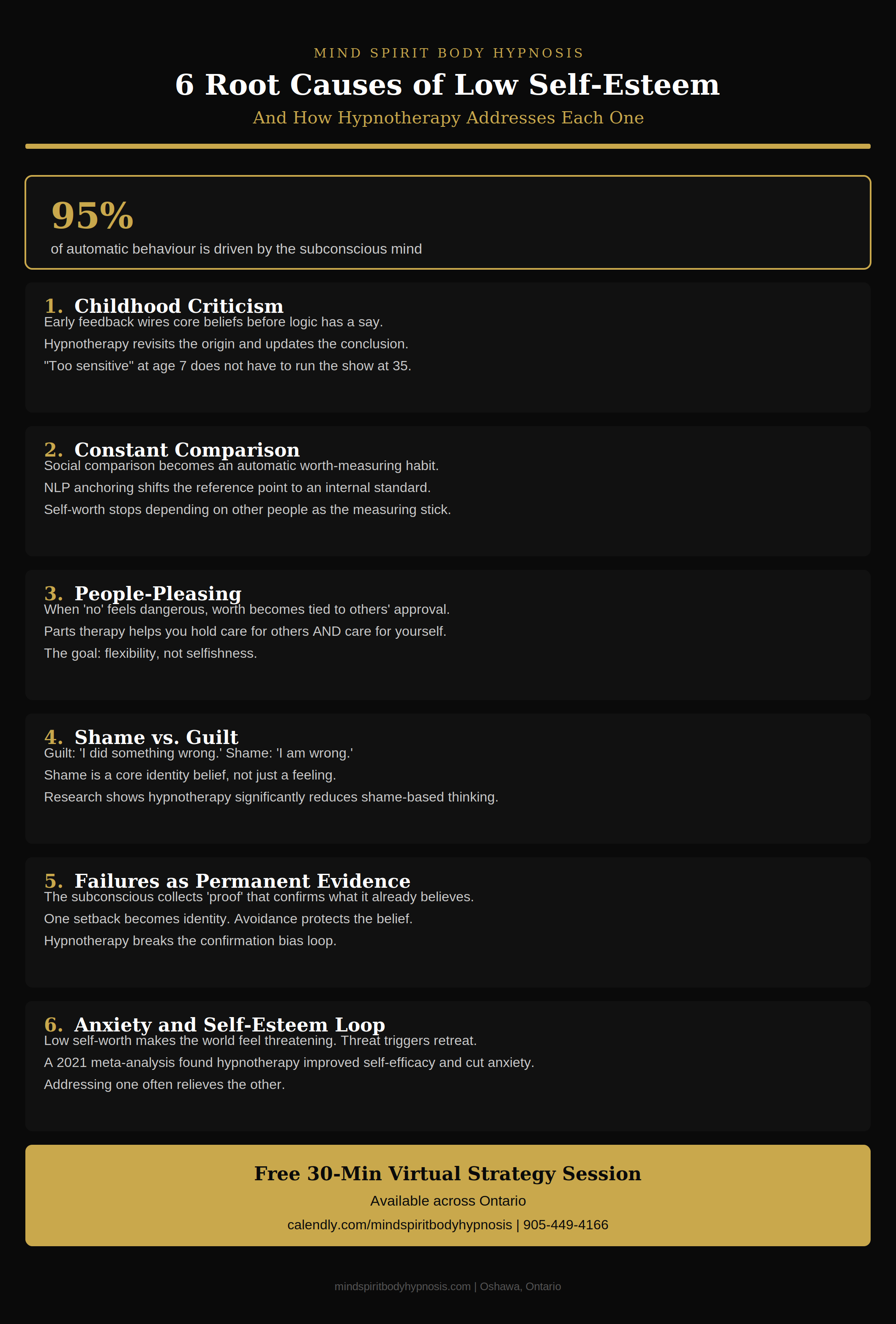
6 Root Causes of Low Self-Esteem and How Hypnotherapy Addresses Each One
Here are the six most common drivers of low self-esteem, and what subconscious-level work does about each one.
1. Childhood Criticism Becomes a Core Belief
Early feedback from parents, teachers, and peers does not stay in the past. The young mind absorbs it as fact. A child told "you are too sensitive" or "why can’t you be more like your sister" does not grow up and forget. They grow up filtering every experience through that conclusion.
Hypnotherapy uses regression and reframing techniques to revisit the origin of these beliefs. Not to relive them painfully, but to update what the subconscious concluded. That critical comment from a parent in 1994 does not have to define how you feel in 2026.
2. Comparison and Social Pressure Lock In Inadequacy
Constantly comparing yourself to others is a modern epidemic, and social media has made it worse. But the comparison habit usually predates any phone. It starts as a survival strategy: reading the room, assessing where you stand. Over time, it becomes an automatic way of measuring your worth.
As a Certified Hypnotherapist trained through the American Board of Hypnotherapy, I use suggestion work and NLP anchoring to shift the reference point from external comparison to internal standard. The goal is not arrogance. It is self-assessment that does not require other people's approval as a measuring stick.
3. People-Pleasing Erodes the Sense of Self
When saying no feels dangerous, when disappointing someone feels catastrophic, when your needs always come last, the pattern is not kindness. It is a survival strategy from an environment where your worth depended on keeping others happy.
Hypnotherapy addresses the underlying fear driving people-pleasing. Using parts therapy, sessions can bring the part of you that learned to shrink into dialogue with the part that knows your needs matter. The result is not suddenly becoming selfish. It is developing the capacity to hold both: care for others and care for yourself.
4. Shame Runs Deeper Than Guilt
Guilt says "I did something bad." Shame says "I am bad." Shame is a core identity belief, and it is one of the most painful drivers of low self-esteem. It often has nothing to do with anything you actually did wrong. It comes from being made to feel like a burden, a problem, or an embarrassment.
Research published in the Journal of Consulting and Clinical Psychology found that hypnotherapy significantly reduced shame-based cognition and improved self-concept scores in participants dealing with chronic self-criticism. Hypnotherapy can access and update the shame narrative directly, replacing it with something more accurate and more liveable.
5. Past Failures Get Stored as Permanent Evidence
One bad presentation becomes proof you are terrible at speaking. One relationship ending becomes proof you are unlovable. The subconscious does not evaluate evidence objectively. It collects examples that confirm what it already believes.
Hypnotherapy for confidence and self-sabotage in Ontario works to break this confirmation bias. Clients begin to see past failures as events rather than identity. That shift changes everything, because you stop avoiding new opportunities to protect yourself from more "evidence."
6. Anxiety and Self-Esteem Feed Each Other
Low self-esteem and anxiety are closely linked. When you do not feel good enough, the world feels threatening. When you feel threatened, you retreat, avoid, and over-prepare, which produces more self-critical evidence. It is a loop.
A meta-analysis published in the International Journal of Clinical and Experimental Hypnosis (Valentine et al., 2019) found that hypnosis produced significantly greater anxiety reduction than control conditions, with treated participants outperforming approximately 79% of controls at the end of treatment. Clients in Ontario who come in for anxiety often discover that self-worth is the deeper issue. And clients who come in for self-esteem often find their anxiety dropping as a side effect. The hypnotherapy for anxiety and stress page covers more on how that pattern works.
What Happens in a Self-Esteem Hypnotherapy Session?
Sessions are relaxed and conversational. There is no performance, no need to be vulnerable immediately, and no loss of control.
A typical session at Mind Spirit Body Hypnosis includes:
Intake conversation: understanding the history and specific patterns driving your self-esteem struggles
Guided relaxation: helping the conscious, critical mind step back so the subconscious becomes more receptive
Belief updating: using suggestion and imagery work to introduce more accurate, more compassionate beliefs at the subconscious level
NLP techniques: reshaping the internal voice and the mental pictures that drive self-criticism
A take-home anchor: a simple cue to use between sessions so the new patterns get reinforced in daily life
Most clients notice a shift in their internal dialogue within two to three sessions. The inner critic does not disappear, but it quiets. And for many people, that quiet is something they have wanted for years. The hypnotherapy for trauma and EMDR page covers how deeper wounds connected to self-worth are addressed when trauma is part of the picture.
Who Benefits Most?
Hypnotherapy for low self-esteem Ontario works especially well for people who:
Know logically they are capable but cannot seem to feel it
Have a harsh inner critic that narrates their every move
People-please constantly and feel resentful or depleted afterward
Avoid new opportunities because failure feels unbearable
Carry shame that seems out of proportion to anything they have done
Have tried therapy, journaling, and affirmations without lasting change
Virtual sessions are available across Ontario, whether you are in Durham Region, Toronto, Hamilton, or anywhere in between (including the US and Europe).
WHAT MY CLIENTS SAY
“I don’t even know where to begin! Fanis saved my life! I have battled over 5 decades of trauma. After 5 sessions and a final negative moment in my life I felt the shift. I can’t thank you enough Fanis. I have tried therapy and felt it was not really helping too much. Hypnosis was the answer. I am SO happy. I feel better than ever. I will be recommending Fanis to so many people I know struggling with different issues. A++” — Helen R.
Frequently Asked Questions
Can hypnotherapy really improve self-esteem? Research suggests it can. A randomized controlled trial published in Quality of Life Research (Gregoire et al., 2021) found that a group self-hypnosis intervention produced significantly better self-esteem outcomes compared to a control group, with a medium effect size. Hypnotherapy is most effective for self-esteem when it addresses the specific origin of low self-worth rather than applying generic positive suggestion.
How is this different from just thinking more positively? Positive thinking works at the conscious level. Hypnotherapy works at the subconscious level, where beliefs are actually stored and run. If your subconscious is running a programme that says "I am not enough," conscious affirmations are working against that current. Hypnotherapy changes the programme, not just the thought on top of it.
What causes low self-esteem in adults? Low self-esteem in adults most commonly traces back to childhood experiences: criticism, neglect, comparison, bullying, or conditional love. These experiences created beliefs that became automatic. Adult experiences like failed relationships or setbacks at work can reinforce those beliefs, but they rarely created them from scratch.
Will I have to talk about painful memories? Not necessarily. Hypnotherapy can work with the pattern without requiring detailed verbal accounts of past events. During the intake conversation, Fanis will ask enough to understand what is happening and will let you know what, if anything, would be helpful to explore. Many clients are relieved to find the process is far less emotionally heavy than they expected.
How many sessions will I need? Most clients notice real shifts in their inner dialogue and how they feel about themselves within two to three sessions. A full programme is typically four to six sessions. During your free strategy session, Fanis will give a clearer picture based on your specific history and goals.
Is virtual hypnotherapy effective for self-esteem work? Yes. Many clients find that being in their own environment actually supports the process. There is no commute, no waiting room, and the familiar setting often helps with relaxation. All sessions at Mind Spirit Body Hypnosis are delivered virtually and are available to anyone in Ontario.
What if my low self-esteem has been there my whole life? Long-standing patterns are absolutely something hypnotherapy can address. In fact, deep-rooted beliefs often respond well to hypnotherapy precisely because the subconscious is where those beliefs live. Length of time does not determine whether a pattern can change. What matters more is willingness to engage with the process.
Is this covered by insurance in Ontario? Some extended health benefit plans in Ontario cover complementary mental health services, including hypnotherapy. It is worth checking your policy directly. Fanis can provide a receipt after sessions for you to submit based on your coverage.
Do I have to believe hypnotherapy will work for it to help? No. Skepticism is common and does not prevent results. What matters is a genuine desire to change and a willingness to participate in the process. Many clients arrive unsure and still experience meaningful shifts within the first few sessions.
How is NLP used alongside hypnotherapy for self-esteem? NLP (Neuro-Linguistic Programming) offers tools to reshape the mental patterns that drive low self-esteem: the tone of the internal voice, the mental movies of failure, and how the mind represents "who I am." Fanis uses NLP alongside hypnosis so the subconscious belief and the mental pattern built on top of it are both addressed. The two approaches complement each other well.
Ready to Take the Next Step?
If you are tired of knowing you are capable but not being able to feel it, I would love to help.
I offer a free 30-minute virtual strategy session for new clients across Ontario. There is no pressure, just a conversation about what you are going through and how hypnotherapy, NLP, or EMDR might support you.
RECOMMENDED READING
Book your free session: calendly.com/mindspiritbodyhypnosis
Call or text: 905-449-4166
Email: info@mindspiritbodyhypnosis.com
Visit: mindspiritbodyhypnosis.com
Serving clients virtually across Ontario, including Durham Region, Toronto, Canada, and beyond.
Disclaimer: This article is for informational purposes only and does not constitute medical or psychological advice. Hypnotherapy and NLP are complementary approaches and are not a substitute for diagnosis or treatment by a qualified healthcare provider. Please consult a licensed professional if you have concerns about your mental or physical health.
Written by Fanis Makrigiannis | Certified Hypnotherapist & NLP Master Practitioner | Mind Spirit Body Hypnosis.