Can Hypnotherapy help build confidence?
6 Confidence Blocks Hypnotherapy Can Remove (And Why Willpower Can't)
TL;DR: Hypnotherapy for confidence in Ontario works by accessing the subconscious beliefs that make people feel not good enough, not capable, or not worthy of success. These beliefs were formed early and run automatically. Willpower, positive thinking, and pep talks can't reach them. Hypnotherapy can.
Quick Answer
Hypnotherapy for confidence in Ontario is a subconscious-focused approach that identifies and updates the core beliefs driving low self-esteem, self-doubt, and self-sabotage. Rather than trying to think your way into confidence, hypnotherapy communicates with the part of the mind where confidence problems actually originate. A 2022 study in the Journal of Consulting and Clinical Psychology found that hypnotherapy produced significant improvements in self-esteem and reduced negative self-evaluation in participants with chronic low confidence. Fanis Makrigiannis, a Certified Hypnotherapist and NLP Master Practitioner at Mind Spirit Body Hypnosis in Oshawa, Ontario, offers virtual sessions across Ontario for people who want to feel genuinely capable rather than just perform confidence they don't feel.
Questions This Article Answers
Can hypnotherapy actually build confidence?
Why does low confidence persist even when I know my worth logically?
What is a subconscious confidence block?
How many hypnotherapy sessions does it take to build confidence?
Who is a good candidate for hypnotherapy for confidence in Ontario?
In this article:
Why Confidence Is a Subconscious Problem
Most people with low confidence already know, on some level, that they are capable. They can see evidence of it. They've been told it. And they still don't feel it.
That gap between knowing and feeling is the signature of a subconscious problem, not a conscious one.
Confidence isn't a thought. It's a feeling. And feelings are generated by the subconscious mind based on the beliefs stored there, most of which were formed before the age of ten. If the stored belief is "I am not enough," no amount of conscious effort will permanently overwrite it. The belief just keeps reasserting itself from underneath.
In my practice, I see this pattern constantly. Clients have read the books, done the affirmations, attended the workshops. The confidence lasts for a few days and then fades. That's because the subconscious programme hasn't changed. That's the work hypnotherapy is designed to do.
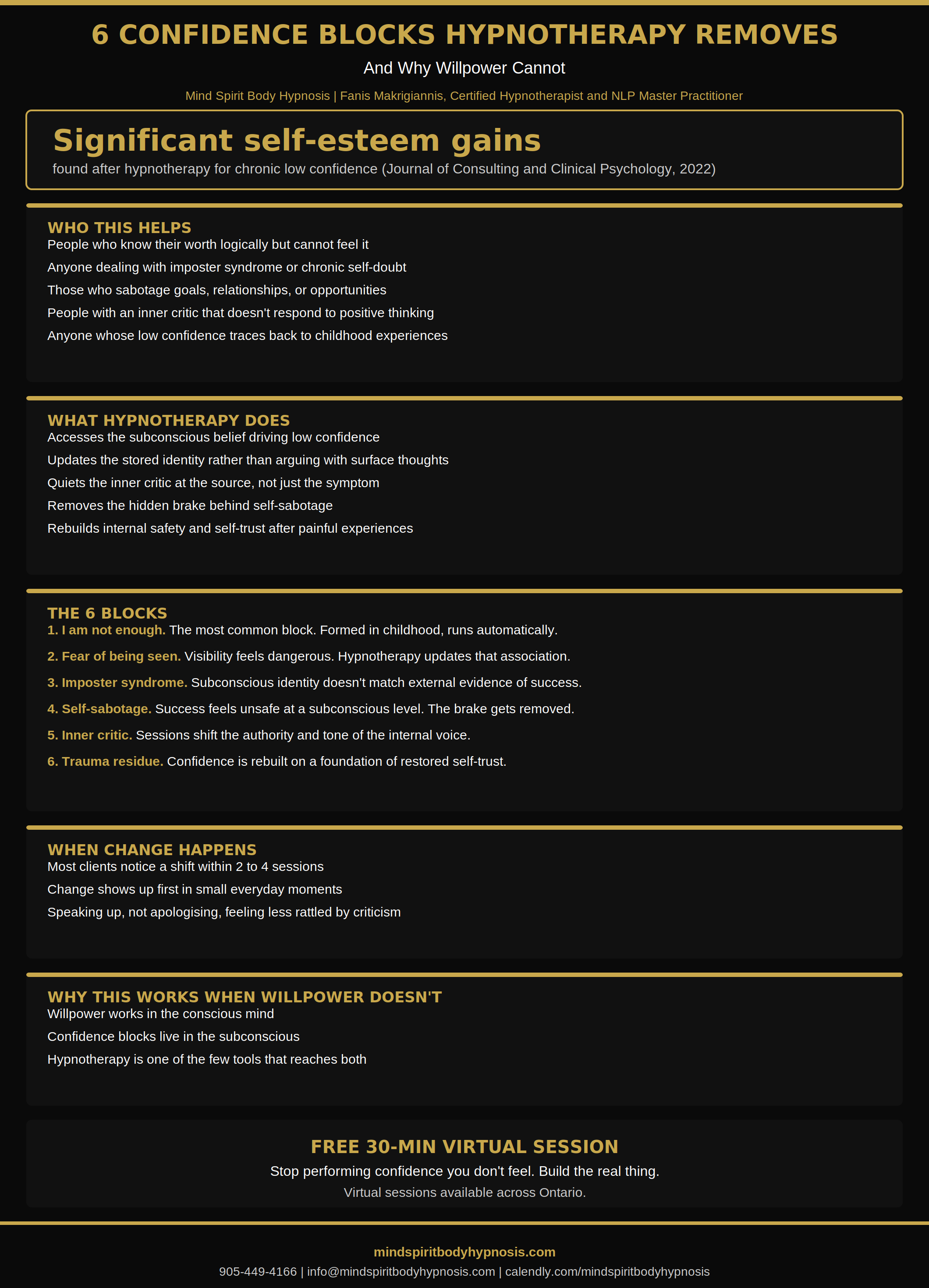
6 Confidence Blocks Hypnotherapy Removes
Here are the six most common subconscious blocks that keep people stuck in low confidence, and how hypnotherapy addresses each one.
1. The "I Am Not Enough" Core Belief
This is the most common confidence block of all. It's rarely a conscious thought. It operates as a background filter: colouring how you interpret feedback, how you handle setbacks, and how worthy you feel of good things.
This belief is almost always formed in childhood, through repeated experiences of criticism, comparison, or emotional unavailability from caregivers. It wasn't a rational decision. It was a survival conclusion the young mind made to make sense of its environment.
Hypnotherapy can trace this belief back to its origin and update it. Not by arguing with it, but by communicating with the subconscious in the language it actually responds to: imagery, feeling, and direct suggestion in a relaxed state.
2. Fear of Being Seen or Judged
Many people who struggle with confidence are not afraid of failure. They are afraid of being noticed. Speaking up, putting themselves forward, or taking up space feels genuinely dangerous, even though they know rationally that it isn't.
This fear usually has roots in specific experiences where visibility led to embarrassment, rejection, or punishment. The subconscious learned to equate being seen with being hurt.
Using NLP and hypnotic suggestion work, sessions can update this association so that visibility feels neutral or even energizing rather than threatening. You can explore how this connects to social patterns on the hypnotherapy for anxiety and stress page.
3. Chronic Comparison and Imposter Syndrome
Imposter syndrome is the persistent feeling that you don't deserve your achievements and that others are about to find out you've been faking it. It's exhausting to live with, and it doesn't respond to logic. Showing people evidence of their competence rarely works because the subconscious dismisses it.
Hypnotherapy works directly with the internal identity that generates imposter syndrome. Rather than trying to convince the conscious mind, sessions update the subconscious story about who you are and what you are capable of.
4. Self-Sabotage Before the Finish Line
Some people get close to a goal and then pull back. They procrastinate at the critical moment, create conflict in a good relationship, or undermine a project just before it succeeds. This isn't bad luck. It's the subconscious protecting an old identity.
As a Certified Hypnotherapist trained through the American Board of Hypnotherapy, I've found that self-sabotage almost always traces back to a subconscious belief that success is unsafe, undeserved, or will lead to loss of something important. Hypnotherapy identifies that underlying belief and removes the brake.
The hypnotherapy for confidence and self-sabotage page covers this pattern in more depth.
5. Negative Inner Voice and Self-Criticism
Most people with low confidence have a very loud internal critic. It comments on everything: how they performed, how they looked, what they said wrong, why they failed. This voice often sounds like a parent, teacher, or significant person from the past.
Hypnotherapy can work directly with this internal voice, shifting its tone and the authority it holds. Clients regularly report that the inner critic becomes quieter and less believable after sessions, not because they've suppressed it, but because the subconscious has updated the programme generating it.
6. Trauma That Damaged the Sense of Self
Confidence is not just about believing in your abilities. It's about feeling safe being yourself. For people who have experienced trauma, especially in childhood, the sense of self can be deeply fragmented. They don't trust their own perceptions, judgments, or worth.
Hypnotherapy addresses the subconscious residue of those experiences. Combined with the processing work that EMDR offers, it can help rebuild the foundation that confidence stands on. For clients whose low confidence has roots in past painful experiences, the hypnotherapy for trauma and EMDR page outlines how that deeper work unfolds.
How to be confident
What a Confidence Session Looks Like
Sessions are conversational, warm, and paced to what feels right for you. There's nothing intimidating about the process.
A typical session at Mind Spirit Body Hypnosis includes:
Intake conversation: Understanding which confidence blocks are most active and where they seem to come from
Identifying the root belief: Finding the subconscious story underneath the surface pattern
Hypnotic relaxation: A guided process that quiets the conscious mind and opens the subconscious to new input
Belief update work: Direct suggestion, imagery, and parts work to install a new, more accurate self-belief
Future pacing: Mental rehearsal of the person showing up with confidence in real situations
Most clients in Ontario notice a shift in how they feel about themselves within two to four sessions. The change often shows up first in small moments: speaking up when they would have stayed quiet, not apologizing for taking up space, feeling less rattled by criticism.
Who Benefits Most?
This approach works particularly well for people who:
Know logically that they are capable but can't feel it
Struggle with imposter syndrome or chronic self-doubt
Sabotage relationships, careers, or goals without fully understanding why
Have a loud inner critic that won't respond to positive thinking
Carry low confidence that seems to trace back to childhood experiences
Virtual sessions make hypnotherapy for confidence in Ontario accessible from anywhere in the province, including Durham Region, Toronto, Ottawa, and beyond. No commute. No waiting room. Just focused, private work from wherever you are.
WHAT MY CLIENTS SAY
“I really couldn’t recommend Fanis more highly. He helped me push through barriers I didn’t even realize were there. He’s incredibly down to earth, patient, and makes you feel completely at ease while working with you. The experience has made such a meaningful difference for me. You truly couldn’t be in better hands. Highly recommend!” — Daniela G
Frequently Asked Questions
Can hypnotherapy actually build confidence? Research suggests it can. A 2022 study in the Journal of Consulting and Clinical Psychology found significant improvements in self-esteem and reduced negative self-evaluation following hypnotherapy. The key is that hypnotherapy works at the subconscious level where confidence beliefs are actually stored, rather than trying to change how someone thinks consciously.
Why does low confidence persist even when I know my worth logically? Because confidence is a feeling, not a thought. It's generated by subconscious beliefs, most of which were formed in early childhood. Knowing you are capable and feeling it are two different processes. Hypnotherapy bridges that gap by updating the belief at the level where it lives.
What is a subconscious confidence block? It's a stored belief or emotional pattern in the subconscious mind that generates feelings of inadequacy, unworthiness, or self-doubt automatically. These blocks usually form in response to childhood experiences and have been running in the background ever since, shaping how a person feels about themselves regardless of their actual achievements.
How many sessions will I need? Most clients notice a meaningful shift within two to four sessions. A full confidence programme is typically four to six sessions, with some clients choosing follow-up sessions as they take on new challenges. During your free strategy session, Fanis will give you a realistic picture based on what you share.
Is virtual hypnotherapy effective for confidence? Yes. Many clients find the privacy of their own space actually makes it easier to be open about things they feel ashamed of. All sessions at Mind Spirit Body Hypnosis are delivered virtually across Ontario, which means no commute and complete privacy.
Can hypnotherapy help with imposter syndrome? Yes. Imposter syndrome is a subconscious identity problem: the stored belief doesn't match the external evidence of competence. Hypnotherapy works directly with that stored identity, updating it so the internal experience starts to align with what's actually true about the person.
What if my low confidence comes from trauma? Hypnotherapy can still help, and in many cases combining it with EMDR produces the most complete results. Fanis is trained in both approaches and will tailor the work to what is most appropriate for your situation. Safety and pacing always come first.
Will the changes last? For most clients, yes. Because hypnotherapy works at the subconscious level rather than just the behavioural level, the changes tend to be more durable than those produced by conscious effort alone. Clients are also given anchoring techniques to use between and after sessions to reinforce the new patterns.
Do I have to talk about painful experiences from my past? Not in detail. Hypnotherapy doesn't require you to narrate or relive difficult experiences. The work can happen at a symbolic or feeling level without needing to reconstruct specific events. Fanis will always pace the work to what feels right for you.
What's the difference between hypnotherapy and CBT for confidence? CBT (Cognitive Behavioural Therapy) works primarily with conscious thought patterns: identifying and challenging negative thoughts. Hypnotherapy works with the subconscious beliefs generating those thoughts in the first place. The two approaches complement each other, and many clients benefit from both.
Ready to Take the Next Step?
If you're tired of knowing you are capable but not feeling it, I'd love to help.
I offer a free 30-minute virtual strategy session for new clients across Ontario. There's no pressure, just a conversation about what's keeping you stuck and how hypnotherapy, NLP, or EMDR might support you.
RECOMMENDED READING
Book your free session: calendly.com/mindspiritbodyhypnosis
Call or text: 905-449-4166
Email: info@mindspiritbodyhypnosis.com
Visit: mindspiritbodyhypnosis.com
Serving clients virtually across Ontario, including Durham Region, Toronto, Canada, and beyond.
Disclaimer: This article is for informational purposes only and does not constitute medical or psychological advice. Hypnotherapy and NLP are complementary approaches and are not a substitute for diagnosis or treatment by a qualified healthcare provider. Please consult a licensed professional if you have concerns about your mental or physical health.
Written by Fanis Makrigiannis | Certified Hypnotherapist and NLP Master Practitioner | Mind Spirit Body Hypnosis.