Can Hypnotherapy Help With Trauma Triggers?
TL;DR: A trauma trigger is not a choice or a weakness. It is a conditioned alarm response the subconscious learned during a threatening experience. Hypnosis for trauma triggers works by reaching that alarm directly, in a calm and focused state, and giving the subconscious new information about which signals actually mean danger. Research suggests hypnotherapy produces significant effects on trauma-related symptoms, with one meta-analysis finding an effect size of d = 1.17 at post-treatment.
Quick Answer
Hypnotherapy for trauma triggers is a subconscious-focused approach that addresses the automatic alarm responses the nervous system learned during threatening experiences by working directly with the part of the mind that stores and runs those learned reactions. Research suggests it may help reduce trigger intensity, decrease avoidance behaviour, and support calmer responses to previously activating cues. Fanis Makrigiannis, a Certified Hypnotherapist and NLP Master Practitioner at Mind Spirit Body Hypnosis in Oshawa, Ontario, offers virtual sessions across Ontario for clients seeking relief from trauma trigger responses.
Questions This Article Answers
What is a trauma trigger and why does it happen?
Why do trauma triggers feel so physical, not just emotional?
Can hypnotherapy help with trauma triggers?
What does a hypnotherapy session for trauma triggers actually involve?
How is hypnosis for trauma triggers different from talk therapy?
Is hypnotherapy for trauma triggers safe?
Can hypnotherapy help with triggers from childhood trauma?
What should I expect in the first session?
In this article:
One moment you are fine. A sound, a smell, a tone of voice, and your heart is pounding. Your chest tightens. Part of you wants to run, and part of you freezes. You did not choose that. It happened in under a second.
People often tell me they feel embarrassed by how strongly they react to things that seem small. A car backfiring. A certain cologne. Someone raising their voice slightly. They know, logically, that they are safe. But knowing that does not stop the physical response.
That gap, between what you understand and what your body does, is exactly what hypnosis for trauma triggers is designed to work with.
What a Trauma Trigger Actually Is
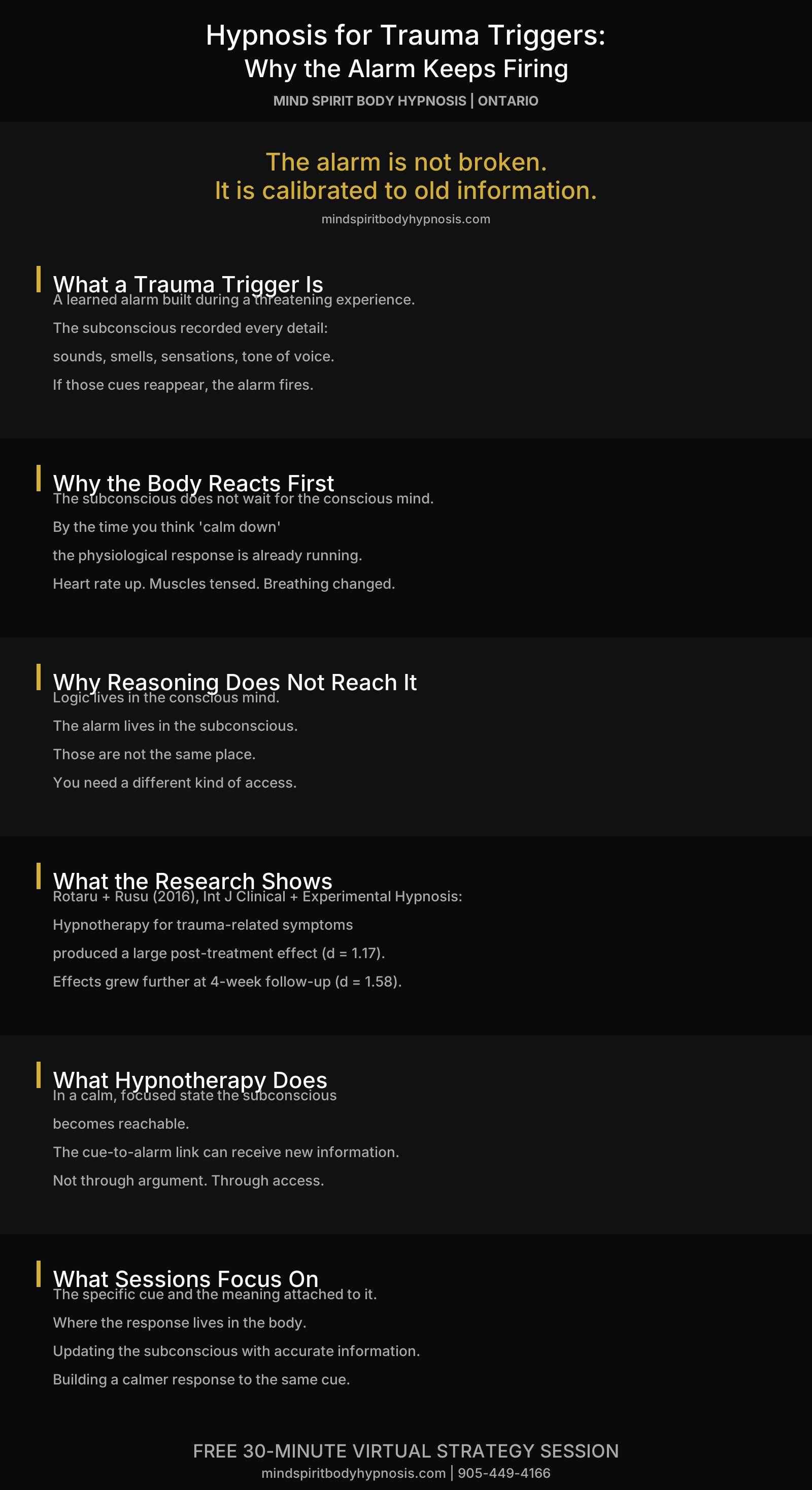
A trigger is a learned alarm. During a threatening experience, the subconscious records every detail it can: sounds, smells, lighting, physical sensations, the words spoken, the time of day. It does this in case those details appear again. If they do, it wants to alert you as fast as possible.
So it builds an association. Smell A once meant danger. Now smell A equals alarm. The association can form from a single intense experience. It can build gradually over repeated events. Either way, the subconscious is doing its job, which is to keep you safe.
The problem is the threat is no longer present. But the alarm is still connected to the same cues.
Think of it like a house alarm calibrated during a break-in. The alarm did the right thing. But now it goes off every time the wind moves in a certain way, because the wind once resembled a window opening. The alarm is not broken. It is calibrated to old information.
Why the Body Reacts Before the Mind Catches Up
Trauma triggers are fast because they are meant to be. The subconscious does not wait for the conscious mind to evaluate the situation. By the time you think "I should calm down," the physiological response is already running: heart rate up, muscles tensed, breathing changed.
This is not a character flaw. It is a built-in survival feature. The subconscious pattern operates below the level of conscious thought, which is precisely why reasoning your way through it is so difficult.
Clients I work with in Ontario often describe feeling like two different people: the part that knows they are safe, and the part reacting as if the original threat is happening right now. Both are real. They are operating from different levels of the mind.
As a certified hypnotherapist working with trauma responses, I have found this distinction matters a great deal. Trying to reason with a subconscious alarm from the conscious level is like calling a phone that is already in use. The line is busy. You need a different kind of access.
The psychology of PTSD
What the Research Shows
A 2016 meta-analysis published in the International Journal of Clinical and Experimental Hypnosis (Rotaru and Rusu) analysed studies examining hypnosis-based treatments for PTSD symptoms. The analysis found a large post-treatment effect of d = 1.17 favouring hypnotherapy, with effects maintaining and growing at four-week follow-up (d = 1.58). The authors concluded that hypnosis appears effective in reducing trauma-related symptoms (Rotaru & Rusu, 2016).
Earlier research published in Psychotherapy: Theory, Research, Practice, Training found that adding hypnosis to cognitive-behavioural therapy for acute stress disorder produced significantly greater symptom reduction than CBT alone, with hypnosis-augmented treatment leading to fewer PTSD diagnoses at follow-up (Bryant et al., 2005).
The research base on hypnosis for trauma triggers specifically, as distinct from PTSD broadly, is still developing. But the evidence on the mechanism is consistent: hypnotherapy works at the subconscious level where trigger associations are stored, which is where they need to be updated.
What Hypnotherapy Does Differently
Talk therapy works with what you can consciously access. You describe the experience, examine your thoughts about it, and build new frameworks for understanding what happened. This is genuinely useful for many people.
Hypnotherapy works at a different level. In a calm, focused state, the subconscious becomes more reachable. The association between a specific cue and a threat response can receive new information. Not through argument or analysis, but through direct access.
This is the part that surprises most people. You do not have to relive the traumatic experience in detail. The focus in sessions is on the learned association, not the full memory. The subconscious can update its records without reopening every file it holds.
For people who have done talk therapy and made progress cognitively but still find the body reacting, hypnosis for trauma triggers offers a route through hypnotherapy for trauma to the layer that language-based work has not yet reached. This is one reason why many clients find hypnotherapy most useful after, or alongside, other approaches rather than instead of them.
If you are curious about whether this might apply to your situation, a free 30-minute virtual strategy session is a good place to start.
What Sessions Focus On
Sessions for trauma triggers differ from general relaxation hypnotherapy. They focus on specific elements:
The cue itself. What is the specific trigger? A sound, a smell, a physical sensation, a type of person, a situation? The more clearly it can be identified, the more targeted the work can be.
The learned meaning. The subconscious attached a meaning to that cue: this equals danger, this means I am powerless, this means it is happening again. That meaning is what drives the response, not the cue itself.
The update. In a deeply calm state, the subconscious receives new, accurate information about the cue. When the meaning attached to a cue changes, the cue no longer carries the same charge.
The body's response pattern. Trigger reactions often include a predictable physical sequence: tension in a specific area, a shift in breathing, a pulling inward. Sessions address where the response lives in the body, not just what started it.
Calm anchoring. A calm internal state can be paired with the cue over time, so the cue begins to access calm rather than alarm. This is a rehearsed response, not a suppressed one.
If anxiety and stress are layered on top of the trigger responses, sessions can address those together. They often travel in tandem.
A Simple Exercise to Try
This will not resolve a deep trigger, but it can give you a small window of awareness.
Think of a specific trigger, a mild one to start. Notice where you feel it in your body first. Where does the reaction land before you even name it?
Most people find it lands consistently in one place: the chest, the throat, the stomach, the shoulders. That location is the body's way of marking the stored response.
Now notice: what would that place need to feel safe? Not "what should I think?" but "what does this part of the body actually need right now?" The answers are often simple: more space, warmth, stillness, breath.
This is the beginning of working with the trigger rather than bracing against it. In hypnotherapy sessions, we go much deeper into this process, but the starting point is the same: locating where the response lives, not just what activates it.
Understanding your trigger responses is one part of the work. Breaking the automatic patterns that develop around them is another layer sessions can address.
WHAT MY CLIENTS SAY
“I really needed help with pre-operation anxiety, pain, and a very long-standing sugar addiction. I am greatly appreciative that Fanis at Mind Spirit Body Hypnosis has helped me to eliminate both from my life in a very short period of time. I felt desperate to find something to help but I didn’t fully believe in the mechanics of hypnosis. It was extremely successful, and I am so very grateful for the experience.” — Donna W. via Google
Frequently Asked Questions
What is a trauma trigger? A trauma trigger is a cue, such as a sound, smell, image, phrase, or situation, that the subconscious has linked to a threatening past experience. When the cue appears, the subconscious automatically fires an alarm response, often before the conscious mind registers what is happening. The trigger itself is usually harmless in the present. The alarm is the subconscious working from old information.
Why do I react so strongly to things that seem small? The strength of the reaction has nothing to do with the size of the current cue. It reflects the intensity of the original experience the cue was linked to. A soft sound that resembles one from a traumatic moment can produce a full alarm response. The subconscious is following its original instructions. It is not overreacting from your perspective; it is doing exactly what it learned to do.
Can hypnosis for trauma triggers actually help? Research suggests it can. A 2016 meta-analysis in the International Journal of Clinical and Experimental Hypnosis found a large effect size of d = 1.17 for hypnotherapy on trauma-related symptoms. Hypnotherapy reaches the subconscious level where trigger associations are stored, which is where they can be updated. Results vary by person, but for many clients, working at this level produces changes that reasoning and willpower alone have not.
How is hypnotherapy for trauma triggers different from talk therapy? Talk therapy works primarily through the conscious mind: examining thoughts, building understanding, and developing new frameworks. Hypnotherapy works through a different route, accessing the subconscious in a calm and focused state. The two approaches are not opposites. Many clients find hypnotherapy reaches something that talk therapy did not, especially when the cognitive work is already done but the body keeps reacting.
Do I have to relive the traumatic experience? No. Sessions focus on the trigger response, the specific cue and the learned alarm it fires, not on revisiting the full traumatic memory. Some clients choose to share context, but detailed re-experiencing is not required and is not the goal of the work.
Is hypnotherapy for trauma triggers safe? Yes, when conducted by a certified practitioner. Sessions are collaborative and client-led. You remain aware throughout and can stop at any time. The work is paced to stay within your comfort level. Sessions are not about forcing access to difficult material; they are about building a calmer internal relationship with the cues that currently cause distress.
Can hypnotherapy help with triggers from childhood trauma? Yes. The subconscious does not distinguish between recent and old triggers. An association formed in childhood is stored the same way as one formed recently. Childhood triggers may carry more layers since they often formed during formative years, but the approach is the same: working with the learned association in a safe, calm state.
What should I expect in the first session? The first session typically focuses on understanding your specific triggers: when they happen, what they feel like, and what meaning the subconscious seems to have attached to the cue. There is no pressure to share more than you are comfortable with. The session is calm and collaborative, and some light hypnotherapy may be introduced near the end to begin building a sense of inner safety.
How is this article different from the existing trauma content on this site? The existing trauma content addresses how the subconscious holds unprocessed traumatic memories without resolution. This article focuses specifically on the trigger response: the automatic conditioned alarm that fires when a particular cue appears. The distinction matters because some people have already processed the memory cognitively, but the trigger response is still running. That is the group this article is written for.
What if my triggers are unpredictable or hard to name? That is common. Many triggers operate below conscious awareness, meaning the reaction happens before you can identify what set it off. Part of the early work in sessions is mapping the triggers more clearly: noticing patterns in timing, setting, sensory input, and physical response. That mapping itself tends to reduce some of the disorientation that comes with unpredictable reactions.
RECOMMENDED READING
Ready to Take the Next Step?
If trauma triggers are getting in the way of your daily life, I would love to talk about what is happening and how hypnotherapy might help.
I offer a free 30-minute virtual strategy session for new clients across Ontario. No pressure. Just a conversation about what you are experiencing and whether this approach fits.
Book your free session: calendly.com/mindspiritbodyhypnosis
Call or text: 905-449-4166
Email: info@mindspiritbodyhypnosis.com
Visit: mindspiritbodyhypnosis.com
Serving clients virtually across Ontario, including Durham Region, Toronto, Canada, and beyond.
Disclaimer: This article is for informational purposes only and does not constitute medical or psychological advice. Hypnotherapy, NLP, and EMDR are complementary approaches and are not a substitute for diagnosis or treatment by a qualified healthcare provider. Please consult a licensed professional if you have concerns about your mental or physical health.
Written by Fanis Makrigiannis | Certified Hypnotherapist & NLP Master Practitioner | Mind Spirit Body Hypnosis.