Can Hypnosis Help With Fear of Failure?
TL;DR: Hypnosis for fear of failure works by reaching the subconscious protection pattern that makes avoidance feel safer than trying. Research on hypnosis for anxiety shows a strong effect across multiple randomized trials. Fanis Makrigiannis, a Certified Hypnotherapist at Mind Spirit Body Hypnosis in Oshawa, Ontario, works with clients across Ontario who have tried motivation and mindset work and still find themselves holding back.
Quick Answer
Hypnosis for fear of failure is a subconscious-focused approach that works by updating the protection pattern that drives avoidance, procrastination, and self-sabotage. The subconscious learned that not trying fully protects you from a specific kind of pain. Motivation and positive thinking work at the conscious level and cannot update that pattern. A 2009 meta-analysis across 26 randomized trials found hypnosis produced a significant, large effect on anxiety and fear-based distress (effect size g=0.88). Fanis Makrigiannis, a Certified Hypnotherapist (ABH) and NLP Master Practitioner at Mind Spirit Body Hypnosis in Oshawa, Ontario, offers virtual sessions across Ontario for clients ready to address the layer below the surface.
Questions This Article Answers
Why does fear of failure make me avoid things I actually want?
What is the subconscious mechanism behind fear of failure?
Does hypnosis help with fear of failure?
How is fear of failure different from low confidence?
What does a hypnotherapy session for fear of failure focus on?
Why doesn't motivation fix fear of failure?
In this article:
Most people with fear of failure are not afraid of working hard. They are afraid of working hard and still coming up short. The fear is not about effort. It is about what a specific kind of outcome would mean for them, about what others would think, about what they would have to face.
The problem is that the subconscious has found a solution. If you never fully try, you never fully fail. You stay safe. In my practice in Ontario, this is one of the most common patterns I work with: intelligent, capable people who want something and consistently find a reason not to go all in. The reason is not laziness. It is protection.
Why Motivation Does Not Reach It
Motivation is a conscious-level tool. It works well for tasks where the obstacle is energy or direction. But fear of failure is not an energy problem. It is a protection pattern running at the subconscious level.
The subconscious is not trying to hold you back. It is trying to keep you safe from a pain it has learned to anticipate. It learned this across experiences, possibly early ones where a specific kind of outcome felt devastating. Criticism that landed hard. A failure that changed how someone important looked at you. A moment where giving your best and still falling short felt unbearable.
The subconscious filed that pattern and has been running it ever since. Every time the conditions look similar, it fires the protection response: hesitate, delay, reduce effort, find a reason to wait. This does not feel like fear. It feels like being realistic, or busy, or not quite ready.
What the Subconscious Is Actually Protecting
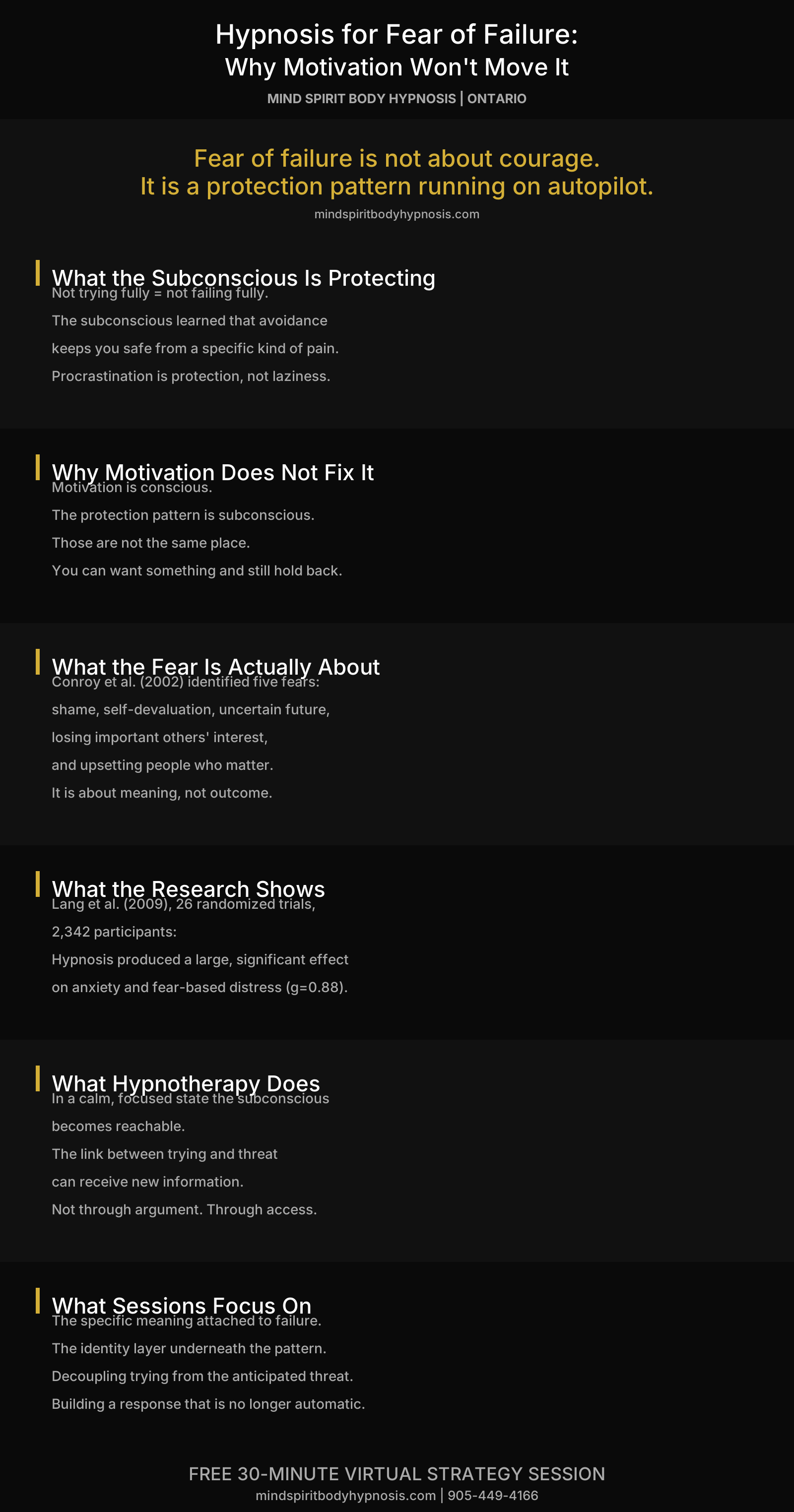
Researcher David Conroy and colleagues identified five specific things people fear when they fear failure: shame and embarrassment, a drop in how they see themselves, an uncertain future, losing the interest of people who matter to them, and upsetting those people (Conroy et al., 2002).
What these have in common is that they are all about meaning, not outcome. The subconscious is not afraid of the failed project itself. It is afraid of what failure would mean. That distinction matters for treatment. You cannot talk the subconscious out of a protection pattern by explaining that the outcome would probably be fine. It is not running a logical calculation. It is running a learned response to a perceived threat.
Think of it like a smoke detector that goes off when you make toast. The detector is not broken. It is doing exactly what it was designed to do. The problem is that it cannot tell toast from a fire. The response is real. The threat it is responding to is no longer the right one.
Fear of failure
What the Research Shows
A meta-analysis published in PMC (Lang et al., 2009) looked at 26 randomized controlled trials involving 2,342 participants and found that hypnosis produced a significant, large effect on anxiety and distress (effect size g=0.88, 95% CI 0.57-1.19, p<0.0001). The effect was consistent across different settings and populations.
Fear of failure is driven by an underlying anxiety response, specifically, the anticipation of a painful outcome. Hypnotherapy reaches that layer. In a focused, relaxed state, the subconscious becomes more open to new information. The pattern that linked "trying fully" to "potential devastation" can receive an update. Not through argument or positive thinking, but through direct access to where the pattern lives.
As a certified hypnotherapist, I use this approach alongside NLP techniques to work with both the pattern and the identity layer underneath it. Clients across Durham Region and Ontario often tell me that after a few sessions, the hesitation is still noticeable, but it no longer has the same grip. There is a gap between the cue and the response where there was none before.
A free virtual strategy session is available for anyone who wants to explore whether this is the right fit before committing to a program. There is no pressure to continue.
What Fear of Failure Looks Like in Practice
Fear of failure rarely presents as obvious fear. It shows up in patterns that look like something else entirely.
What fear of failure looks like vs. what it actually is:
Looks like: Procrastination on important projects.
Actually is: The subconscious delaying exposure to potential failure
Looks like: Perfectionism that prevents finishing.
Actually is: If it is never done, it can never be judged
Looks like: Underperforming just before a goal.
Actually is: Reducing effort so a shortfall has an explanation
Looks like: Avoiding opportunities that could lead somewhere.
Actually is: Not trying = not failing
Looks like: Feeling suddenly exhausted when it is time to act.
Actually is: The protection response arriving as a physical sensation
These patterns are not character flaws. They are learned responses that once made sense. The subconscious is not the enemy. It is running an outdated file.
What a Session Focuses On
In a hypnotherapy session for fear of failure, the work begins with identifying the specific meaning the subconscious has attached to failure. Not failure in general, but the specific version that is most active for that person. What would it mean? Who would know? What would it confirm about them?
Once that is clear, the session moves into the hypnotic state, where the subconscious is more open to update. The old association between "trying fully" and "specific painful outcome" can receive new information. A different response can be rehearsed, one that decouples trying from that threat.
The identity layer also matters. Many clients carry a version of themselves that "always falls short" or "is not someone who succeeds at things like this." That identity is not a fixed truth. It is a subconscious conclusion drawn from past evidence. Sessions work to update both the pattern and the story underneath it.
Clients working on confidence and self-sabotage more broadly will find the pillar page a useful overview. For clients whose fear of failure comes with significant anxiety, the anxiety and stress page covers the anxiety layer in more detail. And for those noticing the same avoidance pattern showing up in habits across different areas, the habits and addictions page addresses the same subconscious architecture.
How This Differs From Low Confidence
Low confidence and fear of failure can look similar but have different roots. Low confidence is often about a gap between where someone is and where they want to be. The solution is to build competence and evidence over time.
Fear of failure is not a competence gap. People with fear of failure are often highly capable. The issue is that their subconscious has made trying feel more dangerous than not trying. More evidence of competence does not fix that. The protection pattern is still running.
This is why some high-achievers still experience strong fear of failure. The competence is there. The subconscious protection response is also still there. Both things can be true at once.
WHAT MY CLIENTS SAy
“I don’t even know where to begin! Fanis saved my life! I have battled over 5 decades of trauma. After 5 sessions and a final negative moment in my life I felt the shift. I can’t thank you enough Fanis. I have tried therapy and felt it was not really helping too much. Hypnosis was the answer. I am SO happy. I feel better than ever. I will be recommending Fanis to so many people I know struggling with different issues. A++” — Helen R. via Google
Frequently Asked Questions
Why do I avoid things I actually want to do? Avoidance is the subconscious's solution to anticipated pain. If trying fully leads to a specific kind of outcome that feels devastating, not trying fully feels safer. The subconscious is protecting you from something it learned to dread. The avoidance is not a character flaw. It is a learned response running automatically.
What is the difference between fear of failure and low confidence? Low confidence usually involves a real gap between current skill and where someone wants to be. Fear of failure is different; it is a protection pattern that makes trying feel dangerous, regardless of actual ability. Many capable people have a strong fear of failure. Building competence does not resolve a protection pattern.
Does hypnosis for fear of failure actually work? Research supports hypnosis for fear of failure because the pattern is rooted in an anticipatory anxiety response, and hypnosis has a strong evidence base for reducing fear and distress. A 2009 meta-analysis of 26 randomized trials found hypnosis produced a large, significant effect on anxiety and distress (effect size g=0.88, p<0.0001). Hypnotherapy reaches the subconscious layer where the protection pattern is stored.
Why doesn't positive thinking fix it? Positive thinking is a conscious-level tool. The protection pattern runs at the subconscious level. You can hold a positive belief and still have the protection pattern firing underneath it. The two systems are not directly connected. Changing the surface does not change what is running below it.
What happens in a session? Sessions identify the specific meaning the subconscious has attached to failure for that person, then work in a focused, relaxed state to update the association between trying and threat. The identity layer how the person sees themselves in relation to success and failure is also addressed. Most clients notice a shift in how the hesitation feels after a few sessions.
Is this the same as hypnosis for anxiety? There is overlap. Fear of failure involves an anticipatory anxiety response, with the body and mind preparing for a feared outcome. Hypnotherapy for fear of failure works with that response directly, alongside the specific meaning and protection pattern that drives it. It is more targeted than general anxiety work.
How many sessions does it take? Most clients see meaningful shifts across four to six sessions, though this depends on how long the pattern has been active and how many areas of life it is affecting. The goal is not to eliminate the awareness of risk, but to remove the automatic grip of the protection response.
Can I combine hypnotherapy with coaching or therapy? Yes. Hypnotherapy works at the subconscious level. Coaching and therapy tend to work at the conscious level: beliefs, goals, behaviour. They address different layers of the same pattern. Many clients find the combination more effective than either approach alone.
What if I have tried everything and it keeps coming back? If the pattern keeps returning despite conscious effort, that is a sign the work needs to happen at the subconscious level. The protection response is still active. Hypnotherapy is designed specifically to reach and update that layer.
How do I get started? The first step is a free 30-minute virtual strategy session. It is a conversation about what you are experiencing, how the pattern shows up, and whether hypnotherapy is a good fit. There is no obligation to continue. Book through calendly.com/mindspiritbodyhypnosis or email info@mindspiritbodyhypnosis.com.
RECOMMENDED READING
Ready to Take the Next Step?
If you keep finding reasons not to go all in on something you actually want, hypnotherapy may be worth exploring.
I offer a free 30-minute virtual strategy session for new clients across Ontario. It is a low-pressure conversation about what you are dealing with and whether hypnotherapy, NLP, or EMDR might help.
Book your free session: calendly.com/mindspiritbodyhypnosis
Call or text: 905-449-4166
Email: info@mindspiritbodyhypnosis.com
Visit: mindspiritbodyhypnosis.com
Serving clients virtually across Ontario, including Durham Region, Toronto, Canada, and beyond.
Disclaimer: This article is for informational purposes only and does not constitute medical or psychological advice. Hypnotherapy, NLP, and EMDR are complementary approaches and are not a substitute for diagnosis or treatment by a qualified healthcare provider. Please consult a licensed professional if you have concerns about your mental or physical health.
Written by Fanis Makrigiannis | Certified Hypnotherapist & NLP Master Practitioner | Mind Spirit Body Hypnosis.