Can Hypnotherapy Help With Limiting Beliefs?
TL;DR: A limiting belief is not just a negative thought. It is a conclusion the subconscious formed early in life and stored as a rule for how you behave. Hypnosis for limiting beliefs works by reaching those stored rules directly, in a calm and focused state, and giving the subconscious new information to work from. Research shows hypnotherapy significantly increases self-efficacy, and its effects hold at follow-up.
Quick Answer
Hypnotherapy for limiting beliefs is a subconscious-focused approach that addresses the stored conclusions shaping your automatic behaviour by working directly with the part of the mind where those conclusions were first formed and filed. Research suggests it may help increase self-confidence, reduce avoidance, and shift the identity-level rules that conscious effort alone cannot reach. Fanis Makrigiannis, a Certified Hypnotherapist and NLP Master Practitioner at Mind Spirit Body Hypnosis in Oshawa, Ontario, offers virtual sessions across Ontario for clients working to move past beliefs that have kept them stuck.
Questions This Article Answers
What is a limiting belief and where does it come from?
Why do limiting beliefs affect behaviour even when you know they are not true?
Can hypnotherapy actually change a limiting belief?
What does a hypnotherapy session for limiting beliefs focus on?
How is hypnosis for limiting beliefs different from positive thinking or affirmations?
How long does it take to see results?
Can hypnotherapy help with beliefs formed in childhood?
What is the difference between a limiting belief and low self-esteem?
In this article:
People often tell me they know, logically, that they are capable. They can list the evidence. They have done hard things before. And yet, when the moment comes to apply for the role, ask for the raise, start the business, or speak up in the room, something pulls them back.
It is not fear, exactly. It is more like a quiet certainty that it will not work out. That they are not quite ready. That someone will eventually discover they are not as capable as they appear. That wanting something too much, and not getting it, will hurt more than never attempting it at all.
That certainty is a limiting belief. And it is not originating from the part of the mind that can list the evidence. It is coming from somewhere considerably older and deeper than that.
What a Limiting Belief Actually Is
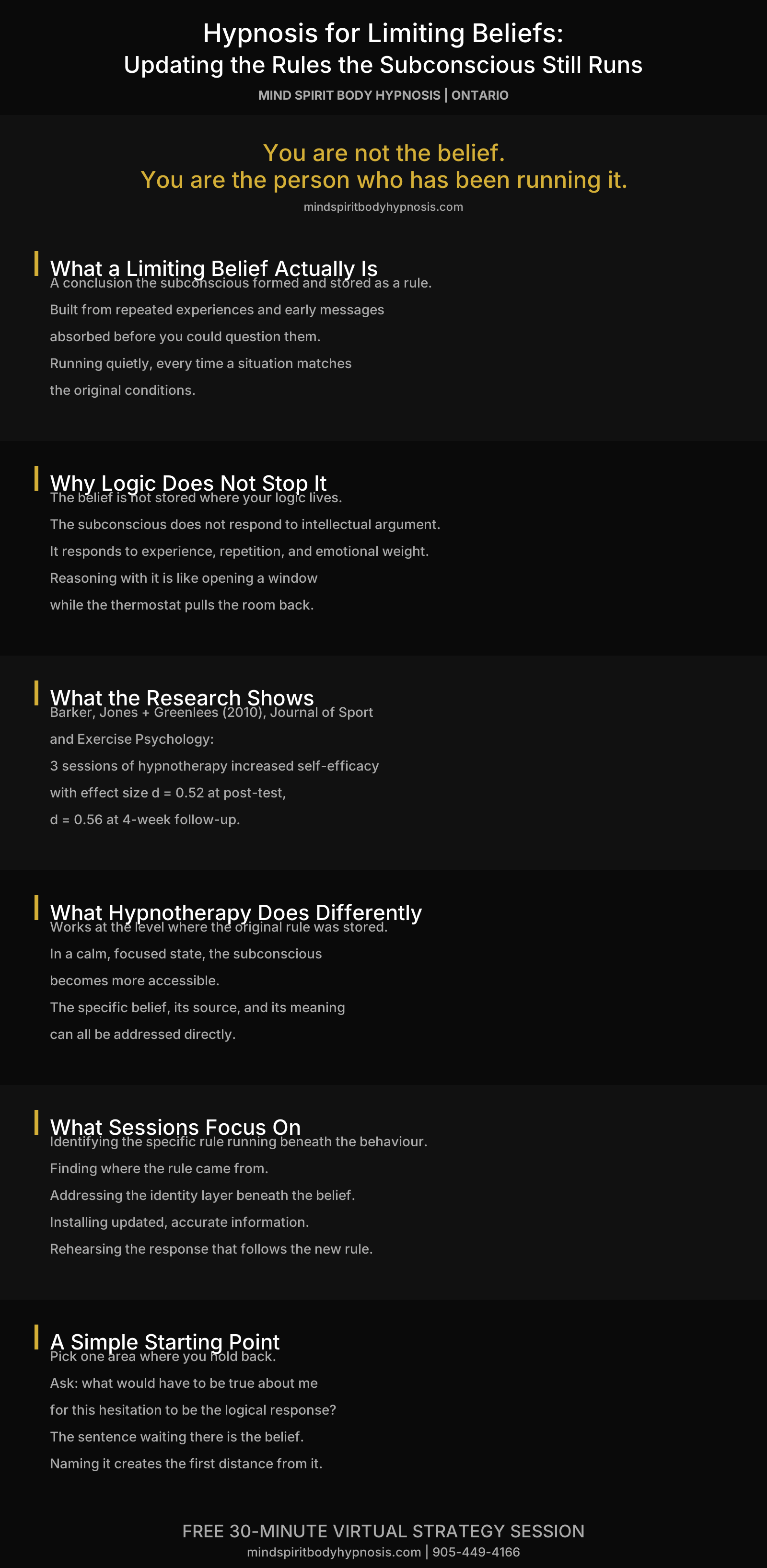
A limiting belief is a conclusion the subconscious formed and stored as a rule. It is usually not a thought you deliberately chose. It is a pattern built from repeated experiences, significant moments, and messages absorbed before you had the vocabulary or the perspective to evaluate them.
"I am not intelligent enough." "People like me do not get opportunities like that." "Wanting something and not getting it is more painful than not attempting it." "I have to work twice as hard and stay twice as quiet to deserve a place in the room."
These are not character flaws. They are operating instructions the subconscious adopted to keep you safe and oriented. The difficulty is that they were written for a much earlier version of your life, by a version of you who did not have all the available information.
The subconscious does not automatically update them as you develop. It continues running them, quietly and consistently, every time a situation appears to match the original conditions.
Why Knowing a Belief Is False Does Not Stop It
This is the part that frustrates most people. You can know, intellectually, that a belief is not accurate. You can have a therapist, a coach, a mentor, and a shelf full of books all telling you the same thing. And still the behaviour does not change.
That is because the belief is not stored where your logic lives. It is stored in the subconscious, and the subconscious does not respond to intellectual argument. It responds to what it has learned through experience, repetition, and emotional significance.
Think of it like a thermostat programmed to a particular temperature years ago. You can open the window. You can turn on a fan. But the thermostat will keep pulling the room back to the temperature it was originally set to maintain. To change the temperature permanently, you have to access the thermostat directly.
That gap, between what you know and what you automatically do, is exactly what hypnosis for limiting beliefs is designed to work with.
Examples of limiting beliefs
What the Research Shows
A 2010 randomized controlled trial published in the Journal of Sport and Exercise Psychology (Barker, Jones, and Greenlees) found that three sessions of hypnotherapy using ego-strengthening suggestions produced significantly higher self-efficacy than a control group, with an effect size of d = 0.52 at post-test and d = 0.56 at four-week follow-up. Performance improvements followed the self-efficacy gains and also held at follow-up (Barker et al., 2010).
Self-efficacy is the psychological measurement of whether someone genuinely believes they are capable of a particular task. A meaningful shift in self-efficacy following hypnotherapy, one that persists weeks later, suggests that the subconscious relationship to capability actually changed, not merely the conscious narrative surrounding it.
The mechanism matters here. In a calm, focused state, the subconscious becomes more open to new input. Ego-strengthening suggestions, delivered in that state, can update the stored conclusions the subconscious has been treating as settled facts.
What Hypnotherapy Does Differently
Positive thinking asks you to layer a new belief on top of the old one. Affirmations repeat a preferred statement until it starts to feel true. Both approaches work at the conscious level, which means they are always competing with what the subconscious already holds.
Hypnotherapy works at the level where the original conclusion was stored. In a deeply relaxed, focused state, the subconscious becomes more accessible. The specific belief, the rule it is running, and the memory or pattern it was built from can all be addressed directly.
For clients working with confidence and self-sabotage, this is often the missing piece. Not more motivation. Not more information. A direct conversation with the subconscious about the rules it has been running without your permission.
This is why hypnosis for limiting beliefs tends to produce changes that feel different from other approaches. The shift is not effortful. It arrives more like a quiet recalibration than a conscious decision.
Hypnosis for limiting beliefs is not about suppressing the belief or forcing a new one in. It is about giving the subconscious accurate, updated information and allowing it to revise its own conclusions. That revision tends to feel quiet and natural, rather than effortful and forced.
What Sessions Focus On
Sessions for limiting beliefs are specific, not general. They work with what is actually running, not a broad goal like "be more confident."
Identifying the belief precisely. Not just "I don't believe in myself" but the specific rule: "I am not the kind of person who is taken seriously" or "wanting things leads to disappointment." The more specific the belief, the more directly the session can address it.
Finding where it came from. Limiting beliefs almost always have an origin: a moment, a repeated experience, a message absorbed before you had the capacity to question it. In hypnotherapy, that origin can sometimes be accessed and recontextualized without requiring you to analyze it at length.
The identity layer. Many limiting beliefs are not just thoughts about what you can do. They are beliefs about who you are. "I am someone who struggles." "I am not the type." Addressing the identity level beneath the belief tends to produce more durable change than addressing the belief alone.
Installing the update. In a calm, focused state, the subconscious can receive new, accurate information about what is possible. The goal is not to replace one rigid rule with another but to give the subconscious more flexibility and more current data to work from.
Rehearsing the new response. The subconscious learns through repetition. Sessions often include rehearsing the feeling and behaviour of a version of you that is not running the old rule, so that response becomes familiar and available.
If anxiety and stress are attached to the belief, for example, if the belief generates fear around failure or judgment, those threads are addressed as part of the same work.
A Simple Exercise to Try
Pick one area where you repeatedly hold back or second-guess yourself. A role you have not applied for. A conversation you keep postponing. Something you want but do not reach for.
Now ask: what would have to be true about me for this to make sense?
Not what you fear. Not what might go wrong. What would have to be true about you, specifically, for the hesitation to be the logical response?
Most people find a sentence waiting there. "I am not ready." "People like me don't get that." "It would fall apart anyway." That sentence is the belief. It is not a fact. It is a rule the subconscious has been running as if it were a fact.
Naming it, even just once, creates a small amount of distance between you and the rule. You are not the belief. You are the person who has been running it. That distinction is where the work begins.
In sessions, we take that process much further, into the subconscious level where the rule was first written. Understanding your automatic habit patterns around avoidance and self-protection is often part of the same work.
WHAT MY CLIENTS SAY
“Found Fanis through a Google search when I was at my wit’s end with insomnia. The nail biting was a bonus issue I figured I would mention. Honestly, I didn't expect much for either. Three sessions (three hours only) in and I am sleeping. Like actually sleeping. The nail biting is basically gone too. Fast results, great experience, highly recommended.” — Kennedy O. via Google
Frequently Asked Questions
What is a limiting belief? A limiting belief is a conclusion the subconscious formed and stored as a rule about what you are capable of, what you deserve, or what is possible for you. It is not a conscious choice. It forms from repeated experiences, significant moments, and messages you absorbed before you had the context to evaluate them. The subconscious runs it automatically, which is why it shapes behaviour even when you know, logically, that it is not accurate.
Why don't positive affirmations fix limiting beliefs? Affirmations work at the conscious level. They ask the mind to accept a new statement. But the limiting belief lives in the subconscious, which does not update through repetition of a preferred thought alone. The subconscious updates through experience, emotional charge, and direct access, which is what hypnotherapy provides. Affirmations can be a useful complement to deeper work, but they rarely shift a belief that has been running for years.
Can hypnosis for limiting beliefs actually change how I behave? Research suggests yes. A 2010 randomized controlled trial found that hypnotherapy significantly increased self-efficacy, the belief in one's own capability, with effects holding at four-week follow-up. Self-efficacy changes are directly linked to behavioural changes: when the subconscious updates what it believes is possible, the automatic hesitation, avoidance, and self-sabotage that followed the old belief tend to shift as well.
How is this different from therapy or coaching? Therapy and coaching primarily work through the conscious mind: building awareness, developing new frameworks, and practising different responses. This is valuable, and many clients combine it with hypnotherapy. Hypnotherapy works at a different level, accessing the subconscious directly in a calm and focused state. For people who have done significant conscious work on a belief but find the behaviour unchanged, hypnotherapy often reaches the layer that other approaches have not.
Do I have to know where a belief came from? No. Many clients do not have a clear memory of when a belief formed, and that is not required. Sessions work with the belief as it is running now: what it says, what it triggers, and what it costs. The origin can sometimes become clearer during the process, but accessing a specific memory is not necessary for the belief to update.
Can hypnotherapy help with beliefs formed in childhood? Yes. Childhood is actually when many of the most persistent limiting beliefs form, because the subconscious is particularly receptive during early development. A belief formed at age seven can still be running the same rule at age forty. The subconscious does not automatically expire old conclusions. Hypnotherapy can access and update those conclusions regardless of when they were formed.
What is the difference between a limiting belief and low self-esteem? Low self-esteem is often the cumulative result of multiple limiting beliefs operating together. A limiting belief is more specific: a particular rule about a particular domain, such as capability, worthiness, or likability. Sessions tend to work with specific beliefs rather than self-esteem as a whole, because a specific belief can be identified, located, and updated in a way that a broad sense of low worth cannot. Addressing the specific beliefs tends to move the overall sense of self in the process.
How many sessions will I need? That varies by person and by how deeply the belief is embedded. Some clients notice significant shifts within a few sessions. Others benefit from ongoing work, especially when multiple interlocking beliefs are running. There is no set number. The goal is not to declare the belief gone but to notice that it is no longer running the same way, and that the behaviour it used to produce is starting to change.
Is hypnotherapy safe for this kind of work? Yes. Sessions are calm, collaborative, and client-led. You remain aware throughout and are not compelled to go anywhere you do not want to go. The work is paced according to your comfort. There is no confrontation, no forced re-experiencing of difficult events. The focus is on updating what the subconscious holds, not on exposing or reliving what produced it.
What if I am not sure what my limiting belief actually is? That is very common. Most people feel the effects of a limiting belief: the hesitation, the pull-back, the sense that something is stopping them, without being able to name the rule clearly. Part of the early work in sessions is identifying the belief with more precision. The feeling of being stuck is usually a clear enough starting point.
RECOMMENDED READING
Ready to Take the Next Step?
If a belief has been quietly running the show and you are ready to look at it from a different angle, I would love to help.
I offer a free 30-minute virtual strategy session for new clients across Ontario. No pressure. Just a conversation about what you are carrying and whether hypnotherapy is the right fit.
Book your free session: calendly.com/mindspiritbodyhypnosis
Call or text: 905-449-4166
Email: info@mindspiritbodyhypnosis.com
Visit: mindspiritbodyhypnosis.com
Serving clients virtually across Ontario, including Durham Region, Toronto, Canada, and beyond.
Disclaimer: This article is for informational purposes only and does not constitute medical or psychological advice. Hypnotherapy, NLP, and EMDR are complementary approaches and are not a substitute for diagnosis or treatment by a qualified healthcare provider. Please consult a licensed professional if you have concerns about your mental or physical health.
Written by Fanis Makrigiannis | Certified Hypnotherapist & NLP Master Practitioner | Mind Spirit Body Hypnosis.