Hypnosis for an Overactive Nervous System: Why Your Body Won't Stand Down
TL;DR: An overactive nervous system is not just a mental state. It is a body-level pattern where the fight-or-flight response stays active long after the threat has passed. Hypnosis for an overactive nervous system works by shifting the body out of sympathetic (threat) mode and into parasympathetic (rest) mode, and by updating the subconscious signals that keep the alarm running. If you feel wired, tense, or on edge even when life is calm, this article explains what is happening and what can actually change it.
Quick Answer
An overactive nervous system is what happens when the body's threat-detection system gets stuck in the on position. The sympathetic nervous system, which drives the fight-or-flight response, is designed to fire in short bursts. When it stays active chronically, the result is a body that feels tense, restless, and on guard even without an obvious reason. Research shows that hypnosis can reduce sympathetic activation and shift the body toward parasympathetic tone, the calmer, rest-and-repair state. A 2019 meta-analysis found that people who received hypnosis showed greater anxiety reduction than 84 percent of control participants. Fanis Makrigiannis, a Certified Hypnotherapist and NLP Master Practitioner at Mind Spirit Body Hypnosis in Oshawa, Ontario, works with clients virtually across Ontario whose nervous systems have been running too hot for too long.
Questions This Article Answers
What is an overactive nervous system?
Why does the nervous system get stuck in fight-or-flight?
What does a chronically activated nervous system feel like day to day?
Why can't I relax even when everything is fine?
How does hypnotherapy help calm the nervous system?
What does a session involve?
What can I try right now?
In this article
You have finished work. The day is done. There is no crisis happening. And your body still feels like something is about to go wrong.
Your jaw is tight. Your shoulders are up near your ears. Your mind keeps cycling through the same two or three things even though none of them need solving right now.
You are not under threat. But your nervous system did not get the message.
This is not a character flaw. It is not a productivity problem. It is a physiological state: the body running a threat response with no active threat to respond to.
What an Overactive Nervous System Actually Is
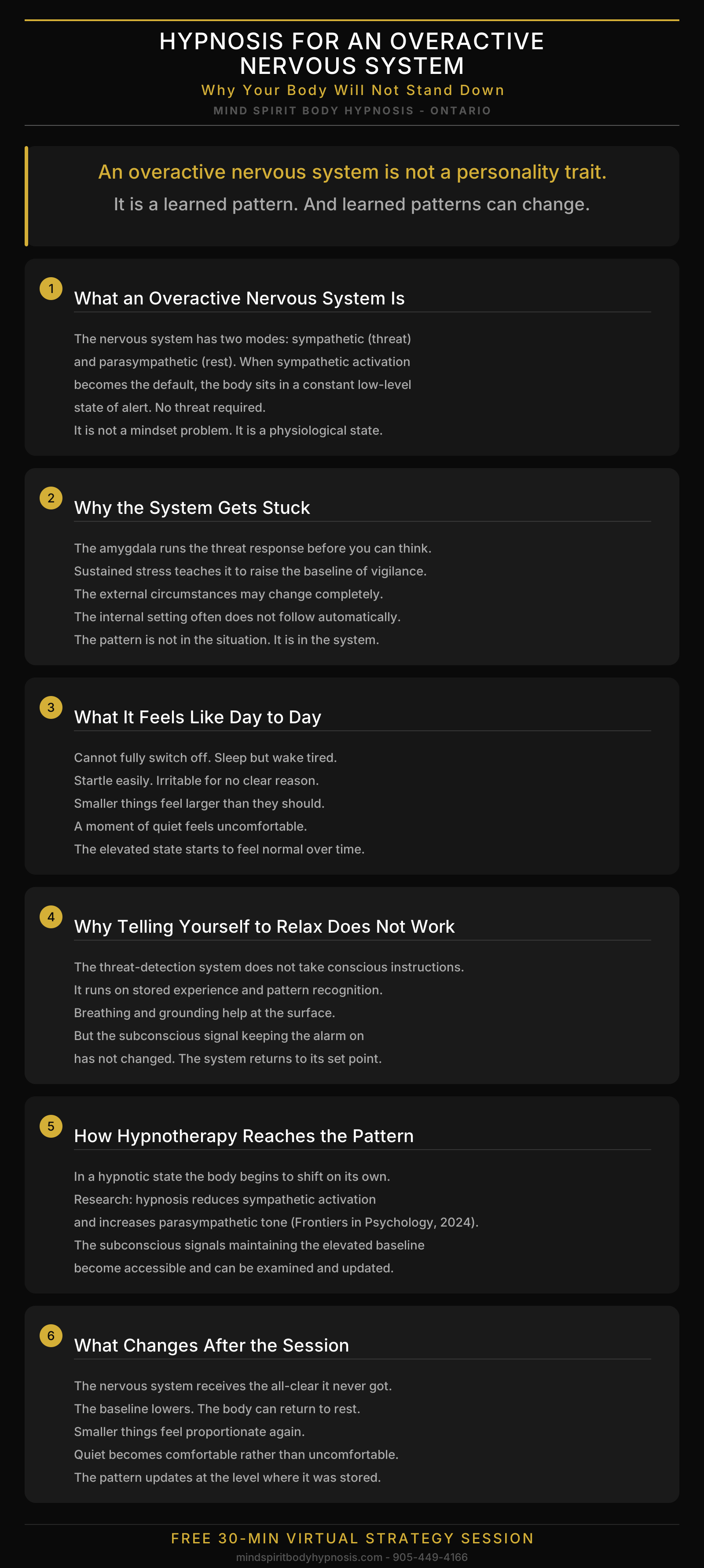
The nervous system has two main modes. The sympathetic mode drives the fight-or-flight response: heart rate up, muscles primed, digestion paused, attention narrowed to the threat. The parasympathetic mode drives rest, repair, and digestion: heart rate down, muscles loose, digestion active, attention broad.
Both are essential. The problem happens when sympathetic activation becomes the default state.
The fight-or-flight response was designed for short, intense bursts. A predator appears. The body fires. The threat passes. The system returns to baseline. This is how the nervous system is meant to work.
For many people, the return to baseline does not happen cleanly. The sympathetic system stays primed. Not at full activation, but elevated. The body sits in a low-level state of alert that never fully switches off. This is what an overactive nervous system feels like from the inside.
Why the System Gets Stuck
The fight-or-flight response is not controlled by conscious thought. It is run by older, faster parts of the brain, including the amygdala, which flags threat and triggers the response before the thinking mind has time to weigh in.
The amygdala learns from experience. If you have lived through a period of sustained stress, unpredictability, or threat, whether that was a difficult childhood, a high-pressure job, a relationship that kept you on edge, or a prolonged health scare, the amygdala updates its baseline. It raises the threshold for what counts as safe.
The result is a nervous system that fires earlier, recovers more slowly, and is harder to bring back to rest. The external circumstances may change completely. The internal setting often does not follow automatically.
This is also why anxiety can persist long after the original stressor is gone. The pattern is not in the situation. It is in the system.
Calm nervous system
What It Feels Like Day to Day
An overactive nervous system is not always dramatic. It often shows up quietly, in ways that are easy to attribute to personality or just being busy.
People often tell me they feel like they cannot fully switch off. They sleep, but do not wake rested. They sit down to relax and immediately feel restless. They feel irritable for no reason they can point to. They startle easily. Their digestion is unreliable. They grind their teeth at night.
Smaller things feel larger than they should. A mildly difficult email feels like an emergency. A moment of quiet feels uncomfortable rather than peaceful. The body is treating ordinary situations as if they carry more weight than they do.
Over time, this takes a toll. Chronic sympathetic activation is linked to elevated cortisol, disrupted sleep, impaired immune function, and cardiovascular strain. The body is not designed to run in this mode continuously. And the longer it runs, the more the elevated state starts to feel normal, which makes it harder to recognize and harder to reach.
Why Telling Yourself to Relax Does Not Work
Knowing you are safe does not automatically tell the nervous system the same thing. The threat-detection system does not take instructions from the logical mind. It runs on pattern recognition and stored experience, not on reasoning.
Think of a smoke alarm wired not to the actual temperature in the room, but to a recording of what the temperature felt like three years ago during a fire. You can tell the alarm the room is fine. It will keep sounding until someone reaches the wiring.
Breathing exercises, grounding techniques, and mindfulness can help at the surface level. They give the body a moment of relief. But for many people, the system returns to its elevated baseline soon after, because the subconscious signal that keeps it elevated has not changed.
This is where hypnosis for an overactive nervous system works differently. It goes below the level of conscious instruction and directly addresses the signal.
How Hypnotherapy Calms the Pattern
In a relaxed, focused hypnotic state, two things happen simultaneously. First, the body itself begins to shift. Research published in Frontiers in Psychology shows that hypnosis can reduce tonic sympathetic activation and shift cardiac autonomic tone toward greater parasympathetic modulation. The body moves toward rest-and-repair mode, not because you are deciding to relax, but because the nervous system is responding to the depth of the state.
Second, the subconscious signals that have been maintaining the elevated baseline become accessible. These are not always memories with clear narratives. They are often body-level imprints: a stored sense that vigilance is required, that it is not safe to fully put your guard down, that something could go wrong if you let the alert drop.
In that state, those signals can be examined and updated. Not argued with. Not analyzed to death. Reached directly, in the state where they are stored, and given something new to hold.
This is what most people with an overactive nervous system have not been able to access through other methods. Not because those methods are wrong, but because they are working at the wrong level.
If the pattern has roots in earlier experiences, the session work takes that into account. The entry point varies by person. The goal is the same: a nervous system that can return to baseline when the threat is genuinely gone, and stay there. This is what hypnosis for an overactive nervous system makes possible at the level where the pattern actually runs.
If sleep is part of what the overactive system is affecting, the work for that is covered on the sleep page.
A Simple Exercise to Try
This is not a fix. But it is a way to introduce the nervous system to what downregulation actually feels like, which can make deeper work more effective.
Sit or lie down. Place one hand on your chest and one on your stomach. Take a slow breath in through your nose for a count of four. Let your stomach rise first, then your chest. Hold for one count. Exhale slowly through your mouth for a count of six.
The longer exhale is the key. The exhale activates the vagus nerve, which signals the parasympathetic system to engage. You are not forcing relaxation. You are sending a physical signal through the body's own wiring.
Do this for two minutes. Notice whether the body softens even slightly. That softening is the parasympathetic system responding. It is not a trick. It is physiology.
If the body does not soften at all, or returns immediately to tension, that is information. It tells you the baseline is elevated enough that surface-level techniques are having limited effect. It is a reason to go deeper, not a reason to give up.
If you would like to explore a free strategy session to talk through what this might look like for you, contact us at info@mindspiritbodyhypnosis.com or book directly at calendly.com/mindspiritbodyhypnosis.
What my clients say
“Fanis has been a huge help to me. His work is top notch and he has helped me reach where I need to be. I highly recommend his services to anyone!”— Connor R. via Google
Frequently Asked Questions
What is an overactive nervous system? It is a state in which the sympathetic nervous system, the part that drives the fight-or-flight response, stays chronically elevated. The body remains in a low-level state of alert even when no actual threat is present. The result is persistent tension, restlessness, and difficulty switching off, even when circumstances are calm.
Can hypnotherapy actually change the nervous system? Research suggests yes. A 2024 review published in Frontiers in Psychology found that hypnosis can reduce sympathetic nervous system activity and shift the body toward greater parasympathetic tone. A 2019 meta-analysis of 17 trials found that people receiving hypnosis showed greater anxiety reduction than 84 percent of control participants. The hypnotic state itself appears to support the kind of physiological downregulation that an overactive nervous system cannot reach on its own.
Why does my body feel on edge even when life is fine? Because the nervous system's threat-detection system learns from experience. If you have lived through a sustained period of stress, the amygdala raises its baseline level of vigilance. That baseline does not automatically reset when circumstances improve. The body has learned to stay alert. That learned pattern is what hypnotherapy works with.
Is this the same as anxiety? An overactive nervous system is the physiological state that anxiety often runs on. Anxiety is the experience of that state, including the thoughts, the dread, and the anticipation of threat. Many people with anxiety describe a nervous system that is chronically activated. Addressing the underlying nervous system pattern can reduce anxiety significantly, because you are reaching the source rather than managing the symptoms.
Why do breathing exercises only help temporarily? Because they work at the surface level. Breathing activates the vagus nerve and briefly engages the parasympathetic system. For many people, the relief is real but short-lived, because the subconscious signal maintaining the elevated baseline has not changed. The system returns to its set point. Hypnotherapy aims to change the set point itself.
What does a session look like? Sessions begin with a conversation about when the pattern started, what triggers it, and how it shows up in daily life. Hypnotic induction then creates the relaxed, focused state. The work in that state is tailored to your specific pattern. You remain aware throughout. Sessions at Mind Spirit Body Hypnosis are virtual and available across Ontario, including Durham Region.
How is this different from your anxiety page? The anxiety page covers the experience of anxiety broadly, including its triggers, thought patterns, and how hypnotherapy addresses the mental side. This page focuses specifically on the physiological state underneath: the sympathetic nervous system running above its baseline. The two overlap, but the entry point here is the body, not the thoughts.
Can an overactive nervous system affect sleep? Yes, significantly. A sympathetically activated body cannot move easily into the deeper stages of sleep that allow full rest and repair. Many people with an overactive nervous system sleep but wake up tired. If sleep is a primary concern, the sleep page covers that work specifically.
Recommended reading
Ready to Take the Next Step?
If your body has been running too hot for too long, you do not have to keep managing it at the surface.
I offer a free 30-minute virtual strategy session for new clients. No pressure. Just a conversation about what you are experiencing and whether this kind of work is a good fit.
Book your free session: calendly.com/mindspiritbodyhypnosis
Call or text: 905-449-4166
Email: info@mindspiritbodyhypnosis.com
Visit: mindspiritbodyhypnosis.com
Serving clients virtually across Ontario, including Durham Region, Toronto, Canada, and beyond.
Disclaimer: This article is for informational purposes only and does not constitute medical or psychological advice. Hypnotherapy and NLP are complementary approaches and are not a substitute for diagnosis or treatment by a qualified healthcare provider. If you are experiencing significant distress, please consult a licensed professional.
Written by Fanis Makrigiannis | Certified Hypnotherapist and NLP Master Practitioner | Mind Spirit Body Hypnosis.