Hypnosis for Losing Yourself in a Relationship: When You Forget Who You Are
TL;DR: Losing yourself in a relationship is not a character flaw. It is what happens when the nervous system learns that self-erasure keeps the peace. Hypnosis for losing yourself in a relationship works by reaching the subconscious pattern underneath the behaviour, the belief that says you are only safe when you disappear, and updating it at the level where it runs. If you feel like a stranger to yourself inside your relationship, this article explains what is happening and what can actually change it.
Quick Answer
Losing yourself in a relationship happens when the nervous system learns to suppress your own needs, opinions, and identity in order to maintain connection or avoid conflict. This pattern often begins long before the current relationship and runs below conscious awareness. Hypnosis for losing yourself in a relationship addresses the subconscious belief driving the behaviour, not just the behaviour itself. Fanis Makrigiannis, a Certified Hypnotherapist and NLP Master Practitioner at Mind Spirit Body Hypnosis in Oshawa, Ontario, works with clients virtually across Ontario who feel like they have disappeared inside their relationships.
Questions This Article Answers
Why do I keep losing myself in relationships?
What is the difference between compromise and self-erasure?
Is losing yourself in a relationship a trauma response?
Why do I not know what I want anymore?
How does hypnotherapy help you find yourself again?
What can I try right now?
In this article
You remember having opinions. Preferences. Things you liked, things you would not put up with. And then, somewhere inside this relationship, those things got quieter. And quieter. Until now, you are not sure what you actually think about anything, because you have been thinking about what they think for so long.
This is not what love is supposed to feel like. But it also does not feel like a choice. It happened gradually, almost invisibly. And now you feel like a stranger to yourself inside the relationship you are in.
What Losing Yourself in a Relationship Actually Means
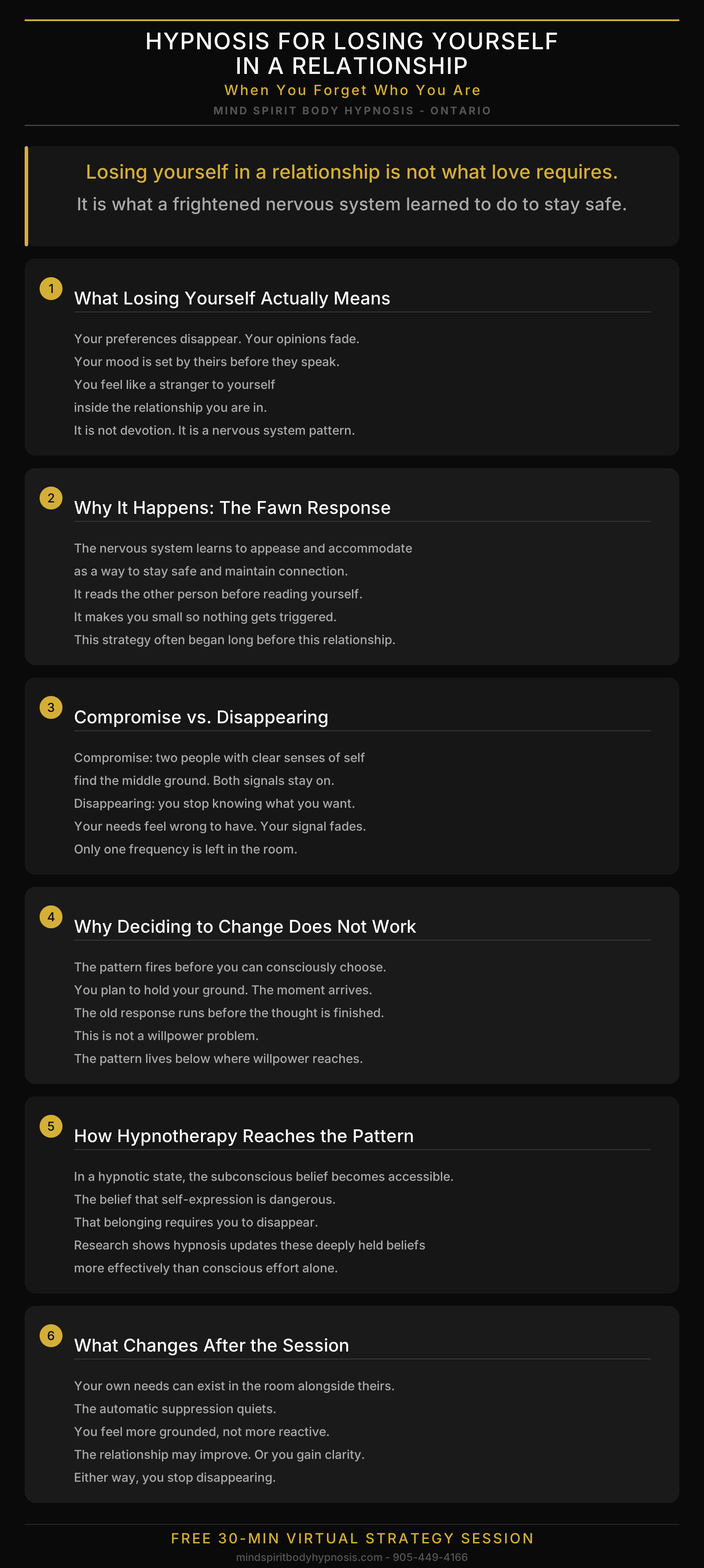
Losing yourself in a relationship is not the same as being devoted or selfless. It is the experience of your own identity becoming less and less present over time: your preferences disappear, your boundaries dissolve, your sense of what you want feels fuzzy or completely gone.
It often shows up quietly. You stop suggesting where to eat because it is easier than the tension. You agree when you disagree because the argument is not worth it. You stop mentioning things that matter to you because they were not received well once. You shape your mood around theirs before they have even spoken.
Over time, this adds up. The relationship fills the space where you used to be. And the question that starts to surface, usually when you are alone or exhausted, is: who was I before this?
Why This Happens at a Nervous System Level
Most advice on this topic treats losing yourself as a habit or a mindset problem. It is not. It is a nervous system response.
The fawn response is what happens when the nervous system decides the safest move is to become what the other person needs. Rather than fighting or fleeing, it learns to appease and accommodate. To read their emotional state before your own. To make yourself small enough that nothing gets triggered.
This response is not weakness. It is an adaptation. For many people, it began long before the current relationship. It may have started in a home where conflict was unpredictable, where one parent's mood determined the safety of the room, or where being too visible brought criticism or withdrawal. The nervous system learned early: disappear and you are safe. Show up fully and something bad happens.
That lesson does not stay in the past. It travels into every significant relationship you have as an adult. Research on anxious attachment has found that people who suppress their own needs and opinions in relationships, what researchers call self-silencing, consistently report lower relationship satisfaction and a diminished sense of self. The University of Dayton study on anxious attachment and self-silencing found that self-silencing mediated the link between insecure attachment and relationship dissatisfaction. The pattern runs between relationships, not just inside them.
This is also why anxiety often spikes when people begin to reconnect with their own needs. The nervous system interprets self-expression as a threat. It has been in the habit of treating your own preferences as dangerous.
The Difference Between Compromise and Disappearing
Relationships require real compromise. This is not what we are talking about.
Compromise is when two people with clear senses of self find the middle ground. It involves knowing what you want, saying it, and then adjusting together. The self stays present throughout.
Disappearing is different. It is when you do not know what you want anymore, or you do know, but it feels wrong or dangerous to say it. It is when your emotional state is entirely regulated by the other person's emotional state. When you feel like a different version of yourself around them than you do when you are alone.
Think of it like a radio tuned to your own frequency. At the start of the relationship, your signal is clear. But over time, you keep adjusting the dial to match theirs, a little more this way, a little less that way, until your own signal has faded out entirely and all that is coming through is theirs.
Compromise keeps both signals alive. Disappearing means only one signal remains.
When you feel stuck.
Why Willpower and Self-Help Advice Do Not Reach It
If you have read about this pattern and tried to fix it consciously, you already know how hard it is. You tell yourself you will speak up next time. You will hold your ground. You will not apologize for things that are not your fault. And then the moment arrives, and the old response fires before you have finished thinking.
This is because the pattern is not stored at the conscious level. It lives in the subconscious, where it runs automatically, faster than deliberate thought. Trying to change it through willpower is like trying to override your heartbeat by deciding to.
This is where hypnosis for losing yourself in a relationship works differently from advice or talk-based approaches. It goes below the level of conscious intention and directly addresses the signal that keeps the pattern running.
Research in Psychological Science (Van Dessel and De Houwer, 2019) found that hypnotic suggestion helped people update deeply held beliefs that resist conscious change. The subconscious, in a hypnotic state, becomes more open to updating what it has been protecting.
How Hypnotherapy Helps You Come Back to Yourself
In a relaxed, focused hypnotic state, the analytical mind quiets. The subconscious becomes more accessible. This is the same level where the original pattern was formed, which makes it the right level to work with it.
Working with clients in Ontario, I often find that the feeling traces back to something specific. A family dynamic. A moment of being shut down or overlooked. A time when being invisible felt like the only safe option. The current relationship is not where the pattern began. It is where it is showing up most clearly.
The session work might involve revisiting that earlier experience with the awareness of an adult. It might involve building a genuine felt sense of self in the subconscious state. Something the nervous system can hold when the old pull to disappear starts. It might involve updating the belief directly. Not arguing it out of existence. Replacing it at the level where it lives.
The goal is not to become someone who never compromises or who finds conflict easy. It is for the nervous system to stop treating self-expression as a threat, so that your own preferences, opinions, and needs can exist in the room alongside someone else's.
If the pattern connects with what you know about trauma responses or confidence and self-sabotage, it is because the same subconscious architecture is involved. The entry point is different. The depth of work is the same.
A Simple Exercise to Try
This is not a fix. But it is a way to begin re-establishing contact with your own signal.
Once a day, before you interact with your partner, take two minutes alone and ask yourself three questions. Write the answers down if you can.
What do I actually want right now? Not what would make things easier. What do you genuinely want?
What am I actually feeling right now? Not what you think you should feel. What is actually present?
What would I say if I were not worried about the response?
You do not have to act on any of these answers immediately. The exercise is not about confrontation. It is about hearing your own signal again, even faintly, before the other person's frequency takes over the room.
If the answers come easily, that is useful information. If they feel difficult or impossible to access, that is equally useful information. It tells you how thoroughly the pattern has run. And that is not a reason to give up. It is a reason to go deeper.
If you would like to explore a free strategy session to talk through what this might look like for you, reach out at info@mindspiritbodyhypnosis.com or book directly at calendly.com/mindspiritbodyhypnosis.
What my clients say
“I came to Mind Spirit Body Hypnosis carrying years of trauma and a deep struggle with self-worth. I had tried other approaches before but nothing had created lasting change. What caught me off guard was how quickly the results came. After just a handful of sessions with Fanis, something shifted. I started feeling more grounded, more confident, and less defined by the things that had held me back for so long. Fanis creates a space where you feel genuinely heard without any judgment. The sessions are virtual, which makes it easy to access support from home in Ontario on my own terms. If you have been carrying something heavy for a long time and are not sure anything will work, I would encourage you to try this. The change came sooner than I ever expected. Highly recommended, Thank you Fanis!”— Arif A, via Google
Frequently Asked Questions
Why do I keep losing myself in relationships? Because the nervous system learned, usually long before the current relationship, that suppressing your own needs and preferences keeps the peace and maintains connection. This is known as the fawn response. It is a threat-management strategy, not a character flaw. The pattern tends to repeat across relationships because it is not stored in the relationship. It is stored in the nervous system.
Is losing yourself in a relationship a trauma response? Yes, in many cases. The fawn response, which involves self-erasure and hypervigilance to another person's emotional state, is one of the four recognized responses to perceived threat, alongside fight, flight, and freeze. It develops when direct resistance or escape felt unsafe, often in early relationships with caregivers or authority figures. It is not a sign of weakness. It is a sign the nervous system once had to work very hard to keep you safe.
What is the difference between self-sacrifice and losing yourself? Self-sacrifice is a conscious choice made from a secure sense of self. You know what you want, and you choose to give it up for someone you love. Losing yourself is different. It is when you stop knowing what you want. When your preferences feel wrong to have. When your mood is entirely regulated by the other person's mood. The self has not stepped aside. It has disappeared.
Why do I not know what I want anymore? Because you have been reading and responding to another person's emotional state for so long that your own signal has faded. The question of what you want has been answered, over and over, by what keeps the peace. The good news is that the signal has not gone. It has just been quiet for a long time. It can come back.
Can hypnotherapy help if I am still in the relationship? Yes. Hypnotherapy does not require the relationship to end or to change. It works with your internal pattern, the nervous system habit that fires before you can consciously choose. As that pattern changes, your experience of the relationship changes. Some people find the relationship improves significantly. Others find clarity about what they actually want from it. The work is about you, not about the other person.
Will this make me more confrontational? No. The goal is not to become someone who fights or who finds conflict easy. It is for your own needs and opinions to be able to exist in the room alongside someone else's. Many clients describe it as feeling more grounded rather than more reactive. You are not adding aggression. You are subtracting the automatic suppression.
What does a session look like? Sessions begin with a conversation about when the pattern started, what triggers it, and how it shows up in your current relationship. Hypnotic induction then creates a relaxed, focused state. The work in that state is tailored to your specific pattern. You remain aware throughout. Sessions at Mind Spirit Body Hypnosis are virtual and available across Ontario, including Durham Region.
How is this different from couples therapy? Couples therapy works with the dynamic between two people. This work focuses on the internal pattern one person is carrying. These can complement each other, but they address different things. If you feel like you have lost yourself, the work starts with you, with the nervous system habit running underneath the relationship dynamic.
recommended reading
Ready to Take the Next Step?
If you have been disappearing inside your relationship and you are ready to find your way back to yourself, I would like to help.
I offer a free 30-minute virtual strategy session for new clients. No pressure. Just a conversation about what you are experiencing and whether this kind of work is a good fit.
Book your free session: calendly.com/mindspiritbodyhypnosis
Call or text: 905-449-4166
Email: info@mindspiritbodyhypnosis.com
Visit: mindspiritbodyhypnosis.com
Serving clients virtually across Ontario, including Durham Region, Toronto, Canada, and beyond.
Disclaimer: This article is for informational purposes only and does not constitute medical or psychological advice. Hypnotherapy and NLP are complementary approaches and are not a substitute for diagnosis or treatment by a qualified healthcare provider. If you are experiencing significant distress, please consult a licensed professional.
Written by Fanis Makrigiannis | Certified Hypnotherapist and NLP Master Practitioner | Mind Spirit Body Hypnosis.