Hypnosis for Feeling Disconnected: When More People Isn't the Answer
TL;DR: Feeling disconnected from people is not always a circumstance problem. For many people, it is a subconscious pattern: the nervous system has learned to scan for signs of rejection and finds them everywhere, even when they are not there. Hypnosis for feeling disconnected works at the level where that pattern runs, updating the belief that makes connection feel unsafe or out of reach. If you have tried putting yourself out there and still feel like an outsider, this article explains why, and what does reach the pattern.
Quick Answer
Feeling disconnected from people often stems from a subconscious belief, formed early, that you are somehow separate from others: too different, too much, or not enough. That belief filters how you read social situations, causing the nervous system to flag neutral interactions as signs of rejection. More social contact does not fix this because the problem is not the number of people around you. It is the lens through which you see them. Hypnosis for feeling disconnected addresses the belief and the threat-scanning pattern directly, in the subconscious state where both were formed. Fanis Makrigiannis, a Certified Hypnotherapist and NLP Master Practitioner at Mind Spirit Body Hypnosis in Oshawa, Ontario, works with clients virtually across Ontario who feel like outsiders in their own lives.
Questions This Article Answers
Why do I feel disconnected from people even when I am not alone?
Can feeling disconnected become a subconscious pattern?
What does chronic disconnection do over time?
Why does trying harder to connect not always work?
How does hypnotherapy help with feeling disconnected?
What does a session involve?
What can I try right now?
In this article:
There is a particular kind of loneliness that has nothing to do with being alone.
You can be in a room full of people, at a table with friends, in a relationship that looks fine from the outside, and still feel like there is glass between you and everyone else. You are there. They are there. But something is not reaching.
Most people assume this is a circumstances problem. That the right people, the right setting, or more social effort will close the gap.
For many, it does not. And the reason is that the gap is not on the outside.
What Feeling Disconnected Actually Means
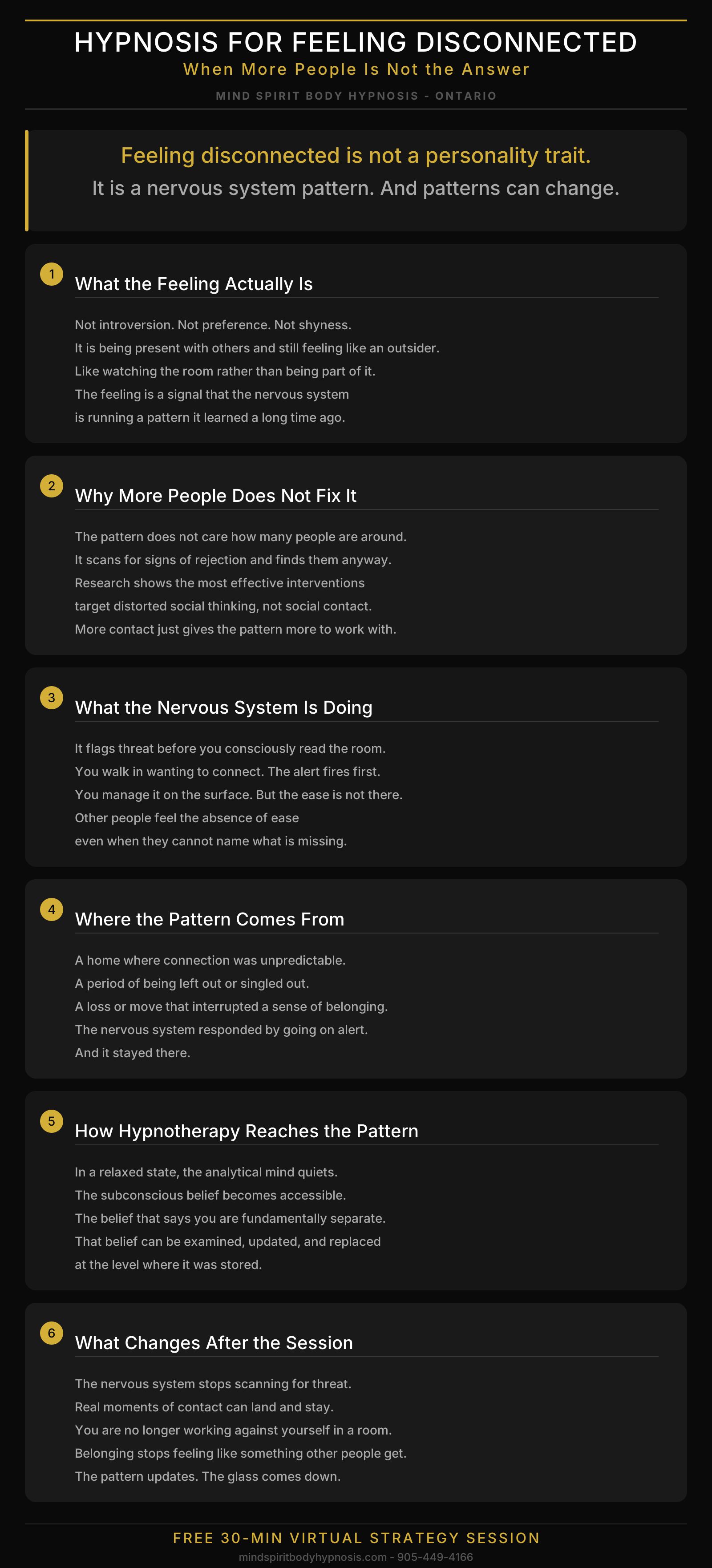
Feeling disconnected from people is not the same as being introverted or preferring quiet. It is the experience of being present with others and still feeling like an outsider. Like you are watching the room rather than being part of it. Like everyone else got a manual you never received.
This feeling often surfaces in moments that should feel easy. A conversation that goes well on the surface but leaves you emptier than before. A party where you smile and nod but cannot land anywhere real. A relationship where you are physically close but emotionally far.
The feeling is not about preference. It is not a choice. And it is not evidence that something is wrong with you. It is a signal that the nervous system is running a pattern it learned a long time ago.
Why More People Is Not Always the Answer
Here is what most advice on loneliness misses: putting yourself in more social situations does not fix the pattern. It just gives the pattern more material to work with.
Researchers studying chronic loneliness have found something important. The nervous system of a chronically lonely person does not read social situations the same way as others. It scans for threat. It is primed to notice signs of rejection, indifference, or exclusion, and to find them even in neutral interactions.
A 2011 meta-analysis by Masi and colleagues, examining decades of loneliness interventions, found that the most effective approaches targeted distorted social thinking, not simply increasing social contact. Joining more groups, attending more events, putting yourself out there more: these help less than changing the lens through which you read the room.
This is where hypnosis for feeling disconnected does something that social strategies cannot. The lens is not conscious. It was set early, and it runs before you decide how to interpret a moment. That is exactly the level where hypnotherapy works.
Break through dissociation.
What Disconnection Does Over Time
Chronic disconnection is not just uncomfortable. It has a real cost.
According to a Statistics Canada survey, about 13 percent of Canadians aged 15 and older report feeling lonely always or often. The health effects are significant. Chronic loneliness is linked to higher rates of anxiety, depression, cardiovascular disease, and cognitive decline. It is not a soft problem. It is a physical one.
There is also a subtler effect that most pages on this topic skip entirely. The nervous system in a state of chronic disconnection begins to treat social situations as sources of threat rather than comfort. It becomes harder to relax around people. Harder to let your guard down. And the more guarded you are, the less real connection becomes possible, which confirms the original belief that you are on the outside.
This is the loop. And the loop is self-maintaining, which is why deciding to be more open does not break it.
Why Trying Harder Does Not Always Work
Most people who feel chronically disconnected have already tried the obvious things. They have gone to events, joined groups, initiated plans, downloaded apps. And they have often found that nothing quite sticks.
The reason is that the effort is happening at the wrong level.
Think of it this way. Imagine you are trying to have a conversation in a room where the smoke alarm keeps going off. Not because there is smoke, but because someone wired it to respond to the sound of voices. You can try to speak more clearly, more warmly, more often. The alarm still goes off. You need to reach the wiring.
Chronic disconnection works like that alarm. The subconscious pattern fires before conscious effort can change the outcome. You walk into a room wanting to connect. The nervous system reads threat before you have said a word. You manage it on the surface, but the ease is not there, and other people can feel the absence of ease even when they cannot name it.
This is not a failure of social skill. It is a question of where the pattern lives.
How Hypnotherapy Reaches the Pattern
In a relaxed, focused state, the analytical mind quiets. The subconscious becomes more open to examination and change. This is where the original belief about connection was formed, and it is where it can be updated.
This is where hypnosis for feeling disconnected does its most useful work. Rather than coaching you to behave differently in social situations, it reaches the belief that is running the behaviour. The belief that says you are fundamentally separate. That closeness comes with a catch. That belonging is something other people get.
Working with clients in Ontario, I often find that the feeling of disconnection traces back to a specific early experience or set of experiences: a home where emotional connection was unpredictable, a time of being left out or singled out, a period of moving or loss that interrupted the natural formation of belonging. The nervous system responded by going on alert. And it stayed there.
The session work might involve revisiting that original experience with the perspective and resources of an adult. It might involve building, in the subconscious state, a genuine felt sense of belonging, something the nervous system can store as a reference point. It might involve updating the belief directly: not arguing it out of existence, but replacing it at the level where it runs.
The goal is not to become someone who never feels lonely. It is for the nervous system to stop treating connection as a threat, so that real moments of contact can land, and stay. This is what hypnosis for feeling disconnected makes possible: not forced extroversion, but a nervous system that is no longer working against you.
If this connects with what you know about trauma patterns or self-sabotage, it is because the same subconscious architecture is involved. The entry point is different. The level of work is the same.
A Simple Exercise to Try
This will not resolve the pattern on its own. But it can interrupt the loop, which is worth something.
The next time you are in a social situation and feel the glass coming down, do not try to push through it. Instead, pause and ask yourself: "What am I expecting to happen here?"
Not what you hope will happen. What you are actually expecting.
Most people who feel disconnected are surprised to find that underneath the surface, they expect to be misread, overlooked, or judged. The expectation is so automatic it does not feel like an expectation. It feels like just the way things are.
That gap, between what you hope and what you expect, is where the subconscious belief lives. And noticing it is the first step toward being able to work with it.
What my clients say
“I came to Fanis for help processing trauma that had been affecting my daily life for years. I was genuinely surprised by how quickly I noticed positive changes. After just a few sessions, I felt calmer, more in control, and no longer overwhelmed by memories that used to trigger me. Fanis created a safe, supportive environment and explained every step of the process. I’m grateful for the progress I’ve made and highly recommend his services to anyone looking for compassionate, professional support.”— Lameck K. via Google
Frequently Asked Questions
Why do I feel disconnected from people even when I am surrounded by them? Because the feeling of disconnection is not primarily about how many people are around you. It is about what your nervous system expects from them. If the subconscious pattern is set to scan for signs of rejection or exclusion, it will find them, or imagine them, even in warm and welcoming environments. The gap you feel is the pattern running, not an accurate reading of the room.
Is feeling disconnected from society the same as social anxiety? They often overlap but are not the same. Social anxiety tends to show up as fear of specific situations: speaking in groups, being judged, making mistakes in front of others. Feeling disconnected is broader. It is a persistent sense of not quite belonging, even in situations that feel unthreatening on the surface. Some people experience both. The underlying subconscious belief is often similar: that you are somehow not quite like everyone else.
Can feeling disconnected become a habit? Yes, in the sense that the nervous system becomes practiced at running the pattern. The more often the threat-scanning response fires, the more automatic it becomes. Over time, it starts to feel like personality, like you are simply someone who does not connect easily. That is not accurate. It is a learned pattern, and learned patterns can change.
Why do I feel more disconnected after spending time with people? This is very common and rarely talked about. If you are spending social time managing the pattern, performing connection rather than feeling it, the effort is real even when it is invisible. Coming away from a social situation feeling emptier than before usually means the nervous system was working hard underneath the surface. That exhaustion is not a sign that people drain you. It is a sign that the pattern is costly to manage.
How does hypnotherapy help with feeling disconnected specifically? It works with the subconscious belief that is maintaining the pattern. Rather than coaching new social behaviours at a conscious level, it reaches the expectation, stored below deliberate thought, that connection is unsafe, temporary, or not available to you. When that belief updates, the nervous system stops scanning for threat, and real moments of contact become easier to receive.
What does a session look like? Sessions begin with a conversation about when the feeling started, what triggers it, and what you have already tried. From there, hypnotic induction creates a relaxed, focused state. The work in that state is tailored to your specific pattern. You remain aware throughout. Sessions at Mind Spirit Body Hypnosis are virtual and available across Ontario, including Durham Region.
Is this different from therapy for loneliness? Hypnotherapy works at the subconscious level where the pattern is maintained, rather than primarily at the conscious level where it is experienced and discussed. Talking about the pattern and understanding it is valuable. It does not always reach the level where the pattern runs. Hypnotherapy aims to reach that level directly, in the state where the original belief was stored.
Can I do this work if I am not sure where the disconnection comes from? Yes. Many clients arrive without a clear narrative about where the feeling originated. The session work does not require a conscious explanation. The subconscious holds the material, and the session provides a way to access and work with it without needing to have the full story worked out in advance.
Can I work on this in virtual sessions? Yes. All sessions at Mind Spirit Body Hypnosis are conducted virtually. Clients come from across Ontario, including Durham Region, Toronto, Ottawa, and beyond.
recommended reading
Ready to Take the Next Step?
If you have been putting yourself out there and the feeling of disconnection is still there, that is not a reflection of your effort. It is a signal that the work needs to go to a different level.
I offer a free 30-minute virtual strategy session for new clients. No pressure. Just a conversation about what you are experiencing and whether this kind of work is a good fit.
Book your free session: calendly.com/mindspiritbodyhypnosis
Call or text: 905-449-4166
Email: info@mindspiritbodyhypnosis.com
Visit: mindspiritbodyhypnosis.com
Serving clients virtually across Ontario, including Durham Region, Toronto, Canada, and beyond.
Disclaimer: This article is for informational purposes only and does not constitute medical or psychological advice. Hypnotherapy and NLP are complementary approaches and are not a substitute for diagnosis or treatment by a qualified healthcare provider. If you are experiencing significant distress, please consult a licensed professional.
Written by Fanis Makrigiannis | Certified Hypnotherapist and NLP Master Practitioner | Mind Spirit Body Hypnosis.