Hypnosis for Guilt: Why Carrying It Longer Doesn't Make It Right
TL;DR: Chronic guilt is not a sign that you are a good person working hard to do better. It is often a nervous system habit, a pattern that keeps generating the same feeling long after the original event has passed. Hypnosis for guilt works by reaching the subconscious belief that keeps the pattern running, rather than trying to reason your way out of a feeling that does not respond to reason. If you have ever noticed that carrying guilt longer never actually resolves it, this article explains why, and what does.
Quick Answer
Guilt is a healthy emotion when it is proportionate and leads to change. It becomes a burden when it runs on a loop, long after the event has passed, any repair has been made, and the person who was hurt has moved on. At that point, guilt is no longer a moral signal. It is a maintenance system: a subconscious pattern that keeps you in a state of self-punishment without a clear end point. Hypnosis for guilt addresses this pattern at the subconscious level, where it is maintained, rather than at the conscious level, where you have already done the reasoning. Fanis Makrigiannis, a Certified Hypnotherapist and NLP Master Practitioner at Mind Spirit Body Hypnosis in Oshawa, Ontario, works with clients virtually across Ontario who carry guilt that has long outlived its purpose.
Questions This Article Answers
What is the difference between healthy guilt and chronic guilt?
Why does guilt keep returning even after you have apologized or made things right?
What does chronic guilt actually do to your mental and physical health?
Why do people hold onto guilt even when it is no longer helping anyone?
How does hypnosis for guilt work?
What does a session involve?
What can I try right now?
In this article:
There is a particular kind of guilt that does not leave when it should.
You said the wrong thing. Or made a choice you now regret. Or let someone down. And somewhere along the way, you apologized, or changed your behaviour, or simply grew into a person who would not make the same call again.
But the guilt is still there. Not loudly, all the time. Just present. Resurfacing when you are quiet. Making its case again at night.
Most people assume that if guilt sticks around, it must mean something important. That it is proof of a conscience, or the appropriate cost of a past mistake. That carrying it longer is somehow the right thing to do.
It is not. Carrying it longer does not repair the past. It just makes you smaller in the present.
The Difference Between Guilt That Helps and Guilt That Stays
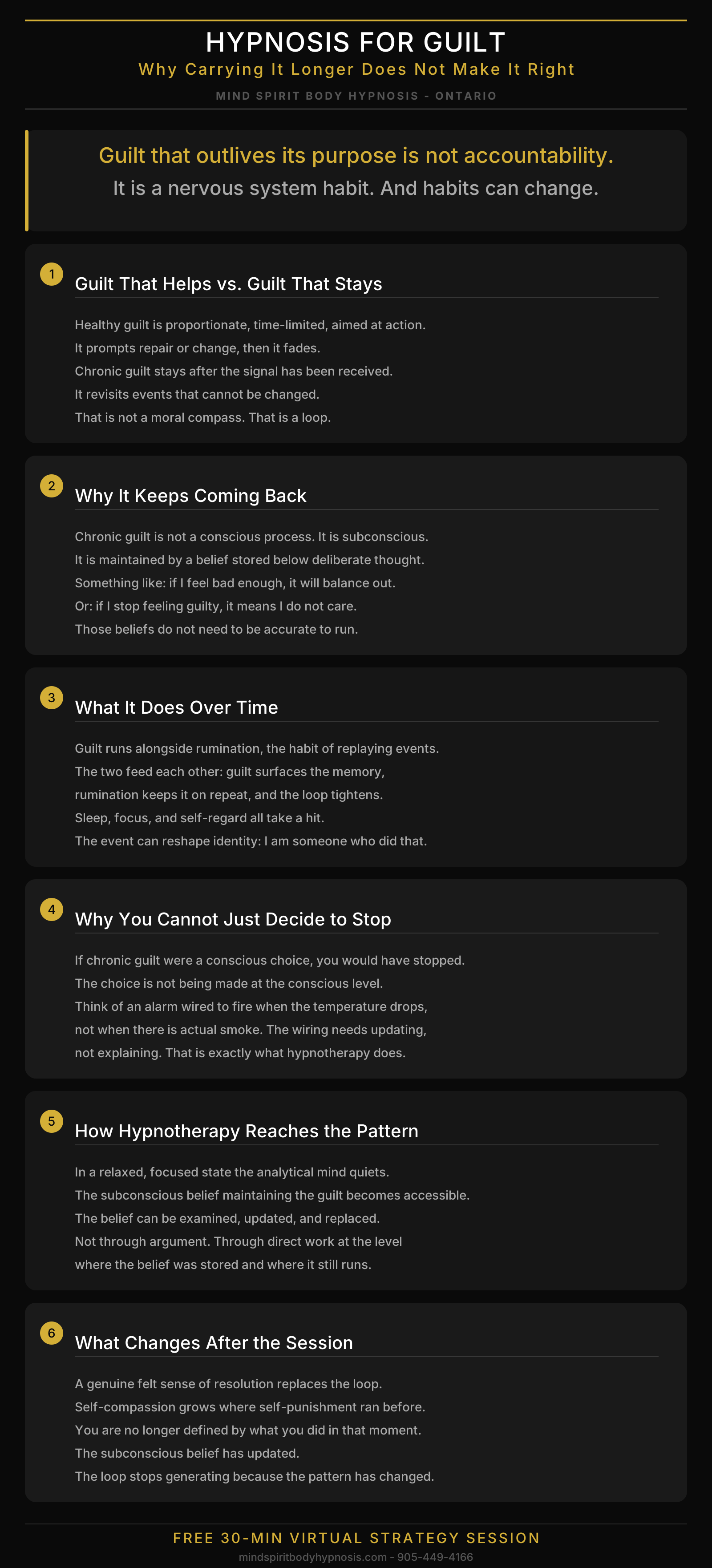
Guilt, in its healthy form, is a signal. It tells you that your actions went against your own values. It prompts repair, apology, or a behaviour change. And once those things have happened, it fades. The signal has done its job. The system moves on.
This is guilt working the way it is meant to. It is proportionate, time-limited, and aimed at something you can actually do.
Chronic guilt is different. It stays after the signal has been received and acted on. It revisits events that cannot be changed. It applies the same emotional weight to minor oversights as it does to genuine harm. And it rarely asks what you can actually do now. It just replays what happened then.
This is not a moral compass. It is a loop.
The distinction matters, because the two types of guilt call for very different responses. Healthy guilt asks you to act. Chronic guilt asks you to suffer. And the problem with suffering as a strategy is that it does not help anyone. Not the person you feel you have wronged. Not the relationship. Not you.
Why Guilt Keeps Returning
The question most people ask when they first consider hypnosis for guilt is: why can I not just let it go?
The answer is that "letting go" is a conscious act, and chronic guilt is not a conscious process. It is subconscious. It is maintained below the level of deliberate thought, by a belief system that formed, often early in life, around what it means to have done something wrong.
For many people, that belief system says something like: "If I feel bad enough, for long enough, it will balance out what I did." Or: "If I stop feeling guilty, it means I do not care." Or: "Carrying this is the least I can do."
None of these beliefs is accurate. But they do not need to be accurate to run. They just need to be stored. And they were stored early, in a subconscious system that does not update simply because you have read something or talked through it enough.
This is the same reason that self-sabotage persists even when you understand it. The pattern is not running from the part of the mind that processes insight. It is running from the part that runs before insight gets a turn.
What is guilt?
What Chronic Guilt Does Over Time
Guilt that is not resolved does not simply idle in the background. It has a cost.
It tends to run alongside rumination, the mental habit of replaying events. The two feed each other: guilt surfaces the memory, rumination keeps it on repeat, and the loop tightens over time.
Over time, this pattern becomes its own kind of anxiety. The nervous system stays primed. The body holds the tension of unresolved emotion. Sleep, concentration, and self-regard all take a hit.
There is also a subtler effect. Chronic guilt tends to reshape identity. People who carry it long enough start to describe themselves as "someone who did that thing." The event becomes part of how they understand who they are, rather than something they did in a chapter that has since closed.
This is where the work becomes important. Not because the past event was nothing. But because a person is not the sum of their worst moments. And a subconscious belief that says otherwise is not telling the truth.
Why You Can't Just Decide to Stop Feeling It
If chronic guilt were a conscious choice, you would have made a different one already. You have, not because you lack willpower, but because the choice is not being made at the conscious level.
Think of it like this. Imagine a house with a smoke alarm that goes off every time the temperature drops, not when there is actual smoke. You can explain to yourself, as many times as you like, that cold air is not a fire. The alarm still goes off. The wiring is responding to its own programming, not to your reasoning.
Chronic guilt works the same way. The nervous system has a template, stored early, about what guilt means and how long it should last. Present-day events trigger that template. The feeling runs. And conscious thought, however clear, cannot reach the level where the template lives.
This is not a failure of character. It is a question of access.
How Hypnotherapy Reaches the Pattern
In a relaxed, focused state, the analytical mind quiets. The subconscious becomes more open to examination and change. This is not a loss of awareness. It is more like turning down the volume on the conscious mind so the material beneath it can be heard.
This is where hypnosis for guilt does its most useful work. Rather than helping you think about the guilt differently, it allows you to reach the subconscious belief that is maintaining it. The belief that carrying it is proof of a conscience. The belief that relief would mean you do not care. The belief that you are, fundamentally, the kind of person who does things like that.
Each of those beliefs can be examined, updated, and replaced with something more accurate. Not through argument. Through direct work with the system where the belief lives.
This might involve regression to the original experience that taught you what guilt should feel like. It might involve a reframe of the event itself. What you were capable of then, the information you had, the person you were at that time. It might involve building a new and genuine internal sense of resolution, one the nervous system can recognize as complete.
The goal is not to feel nothing about the past. It is to reach a felt sense of closure that the conscious mind has wanted, and the subconscious has not yet granted. This is what hypnosis for guilt makes possible: not erasure, but resolution at the level where the pattern lives.
A Simple Exercise to Try
This exercise will not resolve chronic guilt on its own. But it can interrupt the loop, which is the first step toward working with it.
The next time you notice guilt arising, resist the urge to review the event again. You have reviewed it enough. It has not helped, or you would not be here reading this.
Instead, ask yourself one question: "If a person I love had done exactly this, how would I want them to feel about it now?"
You will likely find that you would not want them to feel what you feel. You would want them to have learned from it, made whatever repair was possible, and moved forward. You would not want them to carry it forever as a kind of ongoing punishment.
What you would offer them is what you are not yet offering yourself.
Sit with that gap for a moment. The gap between what you would extend to someone you care about and what you extend to yourself. That gap is where the subconscious belief lives. And it is exactly where hypnotherapy works.
What my clients say
“I had a wonderful experience working with Fanis and his hypnosis program to help me work through anxiety, fears, and past traumas. The results have been incredibly positive. I felt comfortable, supported, and understood throughout the entire process and noticed a meaningful shift in how I feel and respond to things that once caused me anxiety. I am very grateful for the experience and would highly recommend Fanis and his services.” — Tracy D. via Google
Frequently Asked Questions
What is the difference between healthy guilt and chronic guilt? Healthy guilt is proportionate, time-limited, and aimed at something you can do. It prompts repair or a behaviour change, and then it fades. Chronic guilt continues after you've received the signal and acted on it. It revisits events that cannot be changed. It applies the same emotional weight to minor oversights as to genuine harm. And it rarely connects to anything you can actually do in the present. It is a loop, not a signal.
Does carrying guilt longer mean I am a good person? Not necessarily. Guilt can feel morally appropriate because it looks like accountability. But chronic guilt is not accountability. It is self-punishment that persists after accountability has already happened. The person who wronged you does not benefit from your continued suffering. Ongoing guilt does not heal relationships. At a certain point, carrying it is not about them at all. It is a subconscious system running a pattern it learned long ago.
Why does guilt keep coming back even after I have apologized? Because the apology was a conscious act, and the guilt is maintained subconsciously. Saying sorry to another person addresses the interpersonal dimension of what happened. It does not automatically update the subconscious belief that says you must keep paying for it. That belief was stored separately, often earlier, and it does not update through external resolution alone.
Is it possible to feel too guilty, even about something genuinely bad? Yes. The intensity and duration of guilt are not always proportionate to the seriousness of what happened. People with certain early experiences, particularly those that taught them that mistakes were catastrophic or that love was conditional on being perfect, often carry disproportionate guilt for relatively minor events. The feeling is real. Its weight is not always calibrated to the event.
How does hypnotherapy help with guilt specifically? It reaches the subconscious belief that is keeping the loop running. Rather than helping you think about the guilt differently at a conscious level, it works with the belief directly in the state where it lives. This might involve revisiting the original event with new perspective, building a genuine internal sense of closure, or developing the capacity for self-compassion that chronic guilt consistently blocks.
What does a session look like? Sessions begin with a conversation about what you are carrying, how long you have carried it, and what you have already tried. From there, hypnotic induction creates a relaxed, focused state. The work in that state is tailored to the specific pattern. You remain aware throughout. Sessions are virtual and available to clients across Ontario.
How is this different from your pages on self-sabotage or the inner critic? The self-sabotage page focuses on the patterns that keep you from moving forward in spite of yourself. The inner critic work focuses on the internal voice that judges and attacks. This article focuses specifically on the feeling of guilt: the belief that carrying it longer is the right thing to do, the loop it creates, and what it takes to reach a genuine felt sense of resolution. The three topics overlap, but the entry point and the central question are different.
Can I work on this in virtual sessions? Yes. All sessions at Mind Spirit Body Hypnosis are conducted virtually. Clients come from across Ontario, including Durham Region, Toronto, Ottawa, and beyond.
recommended reading
Ready to Take the Next Step?
If you have done the conscious work, understood the event, made whatever repair was possible, and the guilt is still there, that is not a failure of insight. It is a signal that the work needs to go deeper.
I offer a free 30-minute virtual strategy session for new clients. No pressure. Just a conversation about what you are carrying and whether this kind of work is a good fit.
Book your free session: calendly.com/mindspiritbodyhypnosis
Call or text: 905-449-4166
Email: info@mindspiritbodyhypnosis.com
Visit: mindspiritbodyhypnosis.com
Serving clients virtually across Ontario, including Durham Region, Toronto, Canada, and beyond.
Disclaimer: This article is for informational purposes only and does not constitute medical or psychological advice. Hypnotherapy and NLP are complementary approaches and are not a substitute for diagnosis or treatment by a qualified healthcare provider. If you are experiencing significant distress, please consult a licensed professional.
Written by Fanis Makrigiannis | Certified Hypnotherapist and NLP Master Practitioner | Mind Spirit Body Hypnosis.