Hypnosis for Always Fearing the Worst: Why Your Brain Keeps Predicting Danger
TL;DR: Always fearing the worst is not a thinking problem. It is a nervous system pattern: the brain running a threat prediction built from experience rather than current reality. Hypnosis for always fearing the worst works by reaching that prediction pattern at the subconscious level where it runs, not by challenging the thoughts it produces. If you know your fears are irrational but cannot stop them, this article explains what is actually happening and what it means.
Quick Answer
Always fearing the worst, known as catastrophizing, happens when the brain's threat-prediction system is calibrated to expect danger even when no danger is present. This is not a character flaw or a thinking error. It is the nervous system running a pattern built from stored experience, and that pattern fires before conscious thought can intercept it. Research shows hypnosis reduced anxiety beyond the level of 79 percent of control participants at the end of treatment, and 84 percent at follow-up (Valentine et al., 2019). Fanis Makrigiannis, a Certified Hypnotherapist and NLP Master Practitioner at Mind Spirit Body Hypnosis in Oshawa, Ontario, works virtually with clients across Ontario whose nervous systems have learned to default to the worst-case scenario.
Questions This Article Answers
Why do I always assume the worst will happen?
Is catastrophizing a thought problem or a nervous system problem?
Why does knowing my fears are irrational not make them stop?
Why do breathing exercises and positive thinking only help temporarily?
How does hypnotherapy reach the catastrophizing pattern?
What can I try right now?
In this article
The phone rings and your stomach drops before you have even looked at the screen. A friend takes a few hours to reply, and your mind has already written the story of what that means. Your partner seems quiet, and you spend the rest of the evening braced for a conversation that never comes.
You know, on some level, that the worst probably will not happen. You know it in your head. And yet your body has already responded as if it has.
What Always Fearing the Worst Actually Is
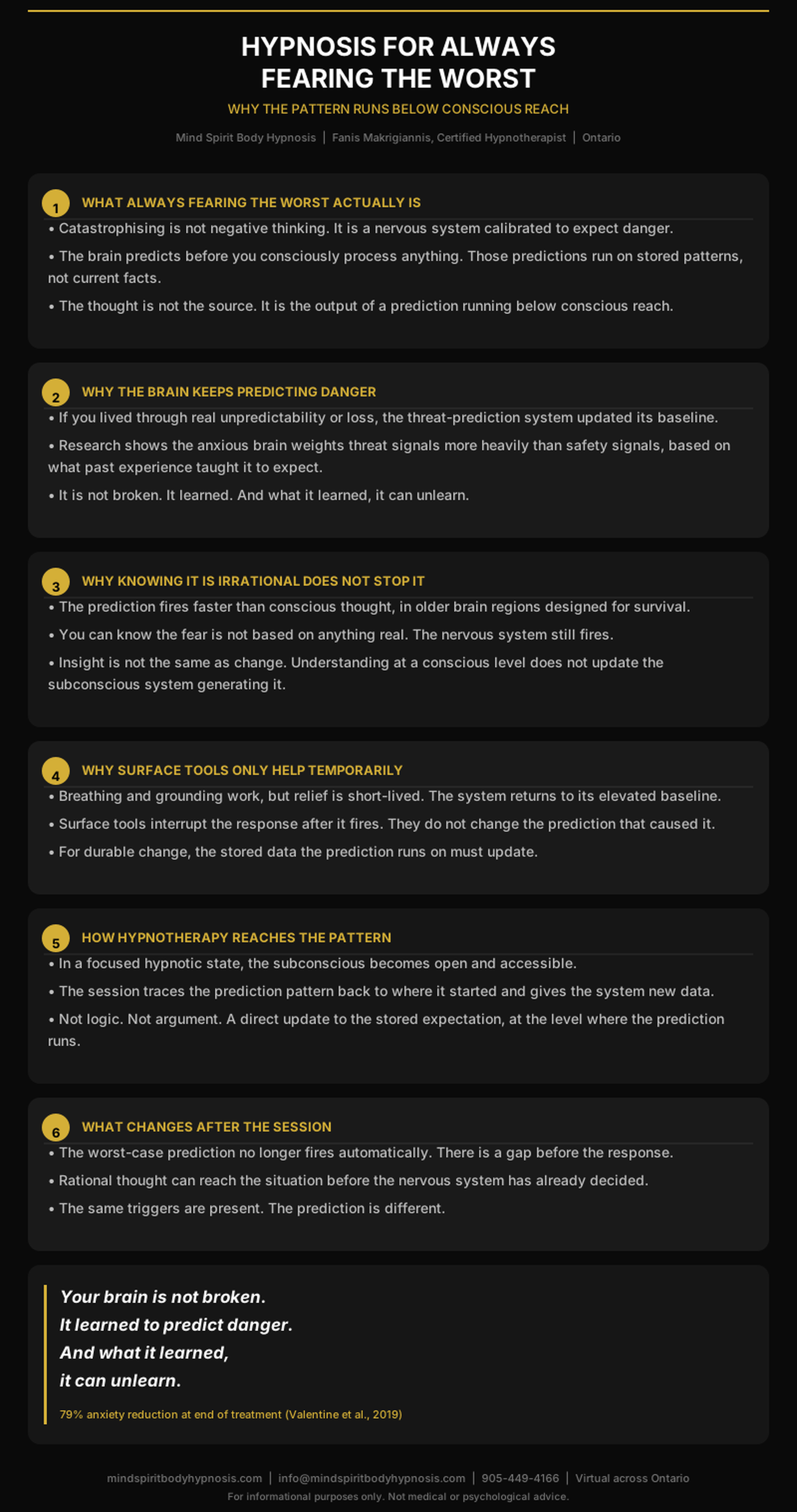
Always fearing the worst, or catastrophizing, is not a habit of negative thinking. It is the experience of a nervous system that has been calibrated to expect danger.
The brain is a prediction machine. Before you consciously process a situation, deeper, faster systems have already scanned it for threat, matched it against stored patterns, and decided how to respond. When those stored patterns say that bad things tend to follow quiet evenings, or that good things do not last, or that you need to be ready for the worst, the prediction fires. Every time.
Most advice on this topic focuses on the thought: challenge it, replace it, write a more balanced version. What most pages miss is that the thought is not the source of the problem. It is the output. The prediction that generated it runs at a level that conscious effort cannot directly reach.
Why the Brain Keeps Predicting Danger
The brain's threat-prediction system learns from experience. If you have lived through a period of genuine unpredictability, loss, or danger, the system updates its baseline. It raises the threshold for what counts as safe. It becomes faster at flagging threat and slower to lower the alert once it fires.
Research into predictive coding and anxiety shows that the anxious brain does not simply overreact. It has learned to weight threat signals more heavily than safety signals. This is based on what experience taught it to expect (Cornwell et al., Biological Psychiatry, 2017). The brain is not being irrational. It is doing exactly what it learned. It is predicting the future based on the past.
Think of it like a weather app still pulling forecasts from data recorded during the worst storm of your life. The storm passed years ago. The app keeps predicting rain. The problem is not the forecast. It is the data the app is running on.
This is the information gain most pages on catastrophizing do not give you: challenging the thought is working on the forecast. Hypnotherapy works on the data.
Always fearing the worst.
Why Knowing It Is Irrational Does Not Stop It
This is the question most people with this pattern have already asked themselves. If I know the fear is not based on anything real, why does knowing that not make it stop?
Because the prediction system does not take instructions from the logical mind. It runs faster than conscious thought, in older, deeper parts of the brain that were designed for survival, not for reasoning.
You can know that your partner's quiet mood is probably tiredness. And the nervous system will still fire the threat response. It is not running on what you know. It is running on what it was trained to expect.
This is also why people with good insight into their own patterns can still feel trapped by them. Insight is not the same as change. Understanding something at a conscious level does not update the subconscious system generating it. Working with clients in Ontario who have done years of therapy, I often find the insight is fully there. The nervous system has simply not received the update.
This connects directly to chronic anxiety, where the same mechanism runs: the brain on alert, the conscious mind unable to override it.
Why Surface-Level Tools Only Help Temporarily
Breathing exercises, grounding techniques, and thought records work. They are not useless. They give the nervous system a moment of relief, and they build a skill over time.
But for many people with a deep catastrophizing pattern, the relief is short-lived. Within minutes or hours, the system returns to its elevated baseline. The same fears come back. The same stomach drop happens the next time the phone rings.
This is because surface-level tools work at the output level. They interrupt the response after it has already fired. They do not change the prediction that caused it.
For the pattern to change durably, the stored data the prediction system is running on has to update. That data is not stored in thoughts. It is stored in the subconscious, in body-level imprints and learned expectations that formed before conscious reasoning was running the show.
If sleep is part of what the constant anticipatory dread is affecting, the connection between catastrophizing and disrupted sleep is real and worth addressing alongside this work.
How Hypnotherapy Reaches the Prediction Pattern
In a relaxed, focused hypnotic state, the analytical mind steps back. The subconscious becomes more open and accessible. This is the same level where the threat prediction pattern was formed, and it is the right level to work with it.
A 2019 meta-analysis of 17 trials found that hypnosis reduced anxiety beyond the level seen in 79 percent of control participants, rising to 84 percent at follow-up (Valentine et al., International Journal of Clinical and Experimental Hypnosis). This is not the hypnosis of stage shows. It is a focused, conversational state in which the nervous system can revise what it has learned to expect. This is what hypnosis for always fearing the worst makes possible at the level where the prediction actually runs.
The session work traces the prediction pattern back to where it started. For many people, the catastrophizing began at a specific time: a period of real instability, a loss with no warning, a relationship where bad news arrived without pattern. The nervous system learned to stay braced. That lesson is still running.
In the hypnotic state, that original experience can be revisited with the awareness of an adult. The subconscious is given new data. Not logic. Not argument. A direct update to the stored expectation. The prediction system does not need to be convinced. It needs to be retrained.
If earlier experiences are part of what trained the system, that is where the session work goes. The entry point is always the pattern itself, wherever it started.
A Simple Exercise to Try
This is not a fix. But it is a way to begin interrupting the prediction loop in real time.
The next time you notice a worst-case scenario forming, pause and ask yourself one question: "What would have to already be true for this to be the most likely outcome?"
Not "is this really going to happen?" That question engages the same prediction system and usually just produces more evidence for the worst case.
This question is different. It asks the prediction system to show its work. To name the specific evidence that justifies the specific fear.
Most of the time, the evidence is thin. The prediction is running on pattern, not on current information. And naming that gap, even briefly, is a way of introducing current reality into a system that has been running on old data.
Do this once, calmly, without trying to argue yourself out of the fear. Just notice what the prediction system is actually claiming, and whether the current situation actually supports it. That noticing is not the same as change. But it is the beginning of one.
If you would like to explore a free strategy session to talk through what this looks like for you specifically, reach out at info@mindspiritbodyhypnosis.com or book at calendly.com/mindspiritbodyhypnosis.
Self-Assessment: Is This Catastrophising?
Is This Catastrophising or a Real Signal?
5 questions. Takes about 60 seconds. No sign-up needed.
Five questions. No sign-up. Instant result with a personalized next step based on your score.
WHAT MY CLIENTS SAY
“I really needed help with pre-operation anxiety, pain, and a very long-standing sugar addiction. I am greatly appreciative that Fanis at Mind Spirit Body Hypnosis has helped me to eliminate both from my life in a very short period of time. I felt desperate to find something to help but I didn’t fully believe in the mechanics of hypnosis. It was extremely successful and I am so very grateful for the experience.”— Donna W. via Google
Frequently Asked Questions
Why do I always assume the worst will happen? Because the brain's threat-prediction system learned to weight danger signals heavily based on experience. It is not irrational. It is doing exactly what it was trained to do. The problem is that the data it runs on may no longer match current reality.
Is always fearing the worst the same as anxiety? Catastrophizing is one of the most common patterns inside anxiety. Anxiety is the broader experience. Catastrophizing is the specific prediction that feeds it: the automatic assumption that the worst outcome is most likely. Many people with anxiety do this without recognizing it as a pattern.
Why can I not just think more positively? Because the prediction fires before conscious thought gets involved. Positive thinking works at the level of deliberate reasoning. The catastrophizing pattern runs faster and deeper. Telling yourself to think positively is trying to change the weather by arguing with the forecast. The prediction system does not update through argument.
Why do I still catastrophize even after years of therapy? Insight is valuable, but it operates at the conscious level. The prediction pattern is stored subconsciously, in body-level imprints and learned expectations. Knowing why you do something does not automatically update the system doing it. This is not a failure of therapy. It is what happens when the work stays at the conscious level.
How does hypnotherapy reach the catastrophizing pattern? In a hypnotic state, the subconscious becomes more open. The session work reaches the stored prediction pattern directly, in the state where it was formed, and gives the nervous system new data. Rather than challenging the thought it produced, it updates the expectation that produced it. The result is a prediction system closer to current reality.
What does a session look like? Sessions begin with a conversation about when the pattern started, what triggers it, and how it shows up day to day. Hypnotic induction then creates a relaxed, focused state. In that state, the work is tailored to your specific pattern. You remain aware throughout. Sessions at Mind Spirit Body Hypnosis are virtual and available across Ontario, including Durham Region.
Can this pattern affect sleep? Yes. A nervous system running worst-case predictions at night cannot settle into sleep. Many people describe the same thing: the mind is quiet when they are busy, then fills with fears the moment the lights go off. The same prediction mechanism runs with nothing to interrupt it. Addressing the pattern tends to improve sleep as well.
Is this different from your anxiety page? The anxiety page covers the experience of anxiety broadly. This page focuses specifically on the catastrophizing pattern that often drives it: the automatic threat prediction, why it resists conscious effort, and how hypnotherapy reaches it at the level where it runs.
RECOMMENDED READING
Ready to Take the Next Step?
If your brain has been running worst-case scenarios for as long as you can remember, that is not just how you are wired. It is a pattern. And patterns can change.
I offer a free 30-minute virtual strategy session for new clients. No pressure. Just a conversation about what you are carrying and whether this kind of work is a good fit.
Book your free session: calendly.com/mindspiritbodyhypnosis
Call or text: 905-449-4166
Email: info@mindspiritbodyhypnosis.com
Visit: mindspiritbodyhypnosis.com
Serving clients virtually across Ontario, including Durham Region, Toronto, Canada, and beyond.
Disclaimer: This article is for informational purposes only and does not constitute medical or psychological advice. Hypnotherapy and NLP are complementary approaches and are not a substitute for diagnosis or treatment by a qualified healthcare provider. If you are experiencing significant distress, please consult a licensed professional.
Written by Fanis Makrigiannis | Certified Hypnotherapist and NLP Master Practitioner | Mind Spirit Body Hypnosis.