Hypnosis for Childhood Emotional Neglect: Healing the Wound of What Was Never There
TL;DR: Childhood emotional neglect is not what happened to you. It is what did not happen. No one reflected your feelings to you, taught you that your inner world mattered, or showed you how to need things without shame. That absence leaves a wound with no clear memory attached to it, which is exactly why it is so hard to name and so hard to reach with talk alone. Hypnosis for childhood emotional neglect works by going beneath the story to the felt sense of not mattering, and updating it at the level where it was formed.
Quick Answer
Childhood emotional neglect occurs when a child's emotional needs are consistently unmet, not through abuse but through absence: no one attuned to their feelings, validated their inner world, or taught them that needing was acceptable. The result is an adult who functions well on the outside and feels empty, disconnected, or quietly ashamed on the inside, often without knowing why. Research shows hypnosis reaches subconscious belief systems more directly than conscious reasoning alone, making it well-suited to patterns formed before language (Valentine et al., 2019). Fanis Makrigiannis, a Certified Hypnotherapist and NLP Master Practitioner at Mind Spirit Body Hypnosis in Oshawa, Ontario, works virtually with clients across Ontario who are living with the long shadow of emotional neglect.
Questions This Article Answers
What is childhood emotional neglect and how is it different from abuse?
Why do people with emotional neglect often not know what happened to them?
Why does childhood emotional neglect feel like emptiness rather than pain?
Why is insight alone not enough to heal it?
How does hypnotherapy reach a wound with no clear memory?
What can I try right now?
In this article
You grew up in a house where nothing terrible happened. No one hit you. No one said you were worthless. The lights stayed on, and there was food on the table. And yet something has always felt missing. Not dramatically. Just quietly. A low hum of not quite belonging to yourself.
You are good at getting on with things. You know how to look fine. But intimacy feels strange, your own emotions feel like a foreign language, and there is a part of you that wonders if you are even allowed to call what you carry a wound at all.
You are. And it has a name.
What Childhood Emotional Neglect Actually Is
Childhood emotional neglect is not about what your parents did. It is about what they did not do.
It happens when a child's emotional world is consistently unacknowledged. Not in a dramatic way. In the small, repeated, ordinary way of a parent who was too busy, too shut down, too overwhelmed, or too focused on survival to notice that their child had an inner life that needed tending.
No one asked how you felt. Or when they did, the answer did not really land anywhere. Your tears were managed rather than met. Your excitement was tolerated rather than matched. Your fear was dismissed or explained away. The message, never spoken, was: your inner world is not important here.
Most pages on childhood emotional neglect focus on the symptoms in adult life. What they miss is what actually happened neurologically: the developing brain needed emotional attunement to build the circuitry for self-worth, emotional regulation, and the felt sense that needing is safe. When that attunement was absent, those circuits did not fully develop. The wound is not a memory. It is an absence in the architecture.
Why It Is So Hard to Name
This is the thing that makes childhood emotional neglect uniquely difficult: there is nothing to point to.
Trauma is easier to identify when there is an event. When there is a thing that happened. Emotional neglect leaves no event. It leaves a gap. And gaps are almost impossible to report on because the mind cannot retrieve what was never stored.
Many people who grew up with emotional neglect spend years in therapy before anyone names it. They know something is wrong. They cannot find the wound. They assume the problem is them: too sensitive, too needy, fundamentally broken in a way they cannot trace.
Working with clients in Ontario, I often find that the moment emotional neglect is named, something shifts. Not because the name fixes anything, but because the absence finally becomes visible. The wound was not inside an event. It was inside the space where attunement should have been.
This is also why the common advice to "think of a specific memory" does not reach emotional neglect. The pattern was not formed in a single moment. It was formed in ten thousand small moments of nobody being home for you emotionally. And that is a different kind of imprint entirely.
Childhood trauma.
What It Feels Like in Adult Life
The long-term effects of childhood emotional neglect tend to show up not as obvious distress but as a quiet, persistent flatness.
People with this pattern often describe:
Feeling like they are watching their own life from a slight distance
Not knowing what they feel until someone else names it for them
Difficulty asking for help or believing they deserve support
A sense of being an imposter in their own emotions
Relationships that feel close on paper but hollow in the body
A core belief, rarely spoken, that their needs are a burden
The outside life often looks functional. The inside life feels like a room where the furniture is all there, but no one has ever really lived in it.
This connects directly to the patterns of low confidence and self-worth that many adults carry without knowing where they came from.
Why Understanding It Does Not Make It Go Away
Naming emotional neglect is a beginning. It is not the same as healing it.
The pattern was not formed through ideas. It was formed through repeated felt experience: the experience of reaching for connection and finding absence. That experience is stored not in the story-telling part of the brain but in the body, in the felt sense of self, in the deeper circuitry that runs below conscious reasoning.
You can understand fully, at an intellectual level, that your parents were doing their best with what they had. That their own emotional neglect shaped their inability to attune. That their distance was not a verdict on your worth. You can hold all of that and still feel, in your body, in your chest, in the way you move through the world, like someone who was not worth attending to.
This is not a failure of insight. It is what happens when the wound lives below the level where insight operates.
The same mechanism drives the anxiety and hypervigilance that many adults with emotional neglect carry: a nervous system still scanning for the absence, still waiting to be unseen.
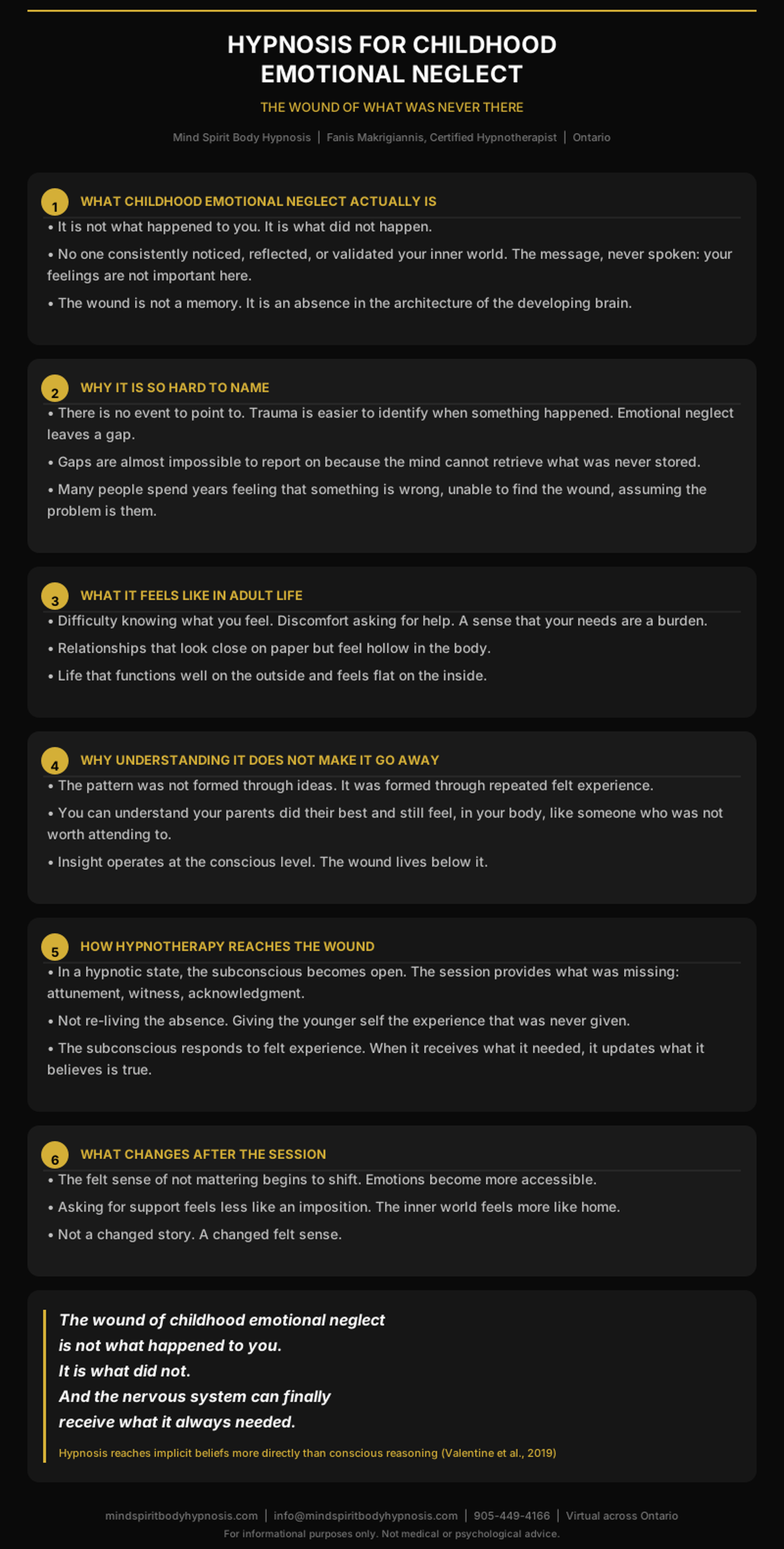
How Hypnotherapy Reaches the Wound Beneath the Story
Hypnosis for childhood emotional neglect is well-suited to this wound precisely because it does not live in a story. It lives in a felt sense. And the hypnotic state works at the felt level.
In a relaxed, focused hypnotic state, the analytical mind steps back. The subconscious becomes accessible. This is the same level where the original experience was encoded: not as a narrative, but as a body-level sense of what it meant to be you in that house, what it meant to need something, what it meant to feel something with nowhere for it to go.
Research shows that hypnosis reaches implicit belief systems more directly than conscious reasoning, which is why it can update patterns that years of insight-based work have not shifted (Valentine et al., International Journal of Clinical and Experimental Hypnosis, 2019).
The session work for emotional neglect is not about confronting a memory. It is about giving the younger self the experience that was missing. Not re-living the absence. Providing the attunement, the witness, the acknowledgment that was never given. The subconscious does not distinguish between a real experience and a vividly felt one. When the younger self receives what it needed, the nervous system updates its sense of what is true.
The result is not a changed story. It is a changed felt sense. The difference between knowing you matter and finally, in your body, feeling that you do. This is what hypnosis for childhood emotional neglect makes possible at the level where the absence was first felt.
If the trauma patterns underneath the neglect run deep, that is where the session work goes. The entry point is always the felt sense, wherever it lives.
A Simple Exercise to Try
This is not a fix. It is a small act of attunement toward yourself.
Once a day, before you get up or before you go to sleep, ask yourself three questions:
What am I feeling right now? Name it, even roughly. Not to fix it. Just to acknowledge it is there.
What do I need right now? Not what you should need. Not what would be reasonable to need. What you actually need.
Is there anything I can give myself right now? Even something small. A glass of water. Five minutes outside. A moment of not pushing through.
For people who grew up with emotional neglect, these questions can feel surprisingly uncomfortable. The discomfort is information. It is the felt sense of a system that was never taught that this kind of attention was allowed.
Do it once. Notice what comes up. That noticing is the beginning of learning to be home for yourself in the way that no one was home for you then.
If you would like to explore a free strategy session, reach out at info@mindspiritbodyhypnosis.com or book at calendly.com/mindspiritbodyhypnosis.
Self-Assessment: Signs of Childhood Emotional Neglect
Signs of Childhood Emotional Neglect
5 questions. Takes about 60 seconds. No sign-up needed.
Five questions. No sign-up. Instant results with a personalized next step based on your score.
What my clients say
“I really couldn’t recommend Fanis more highly. He helped me push through barriers I didn’t even realize were there. He’s incredibly down to earth, patient, and makes you feel completely at ease while working with you. The experience has made such a meaningful difference for me. You truly couldn’t be in better hands. Highly recommend!” — Daniela G. via Google
Frequently Asked Questions
What is childhood emotional neglect? Childhood emotional neglect happens when a child's emotional needs are consistently unmet. Not through abuse or cruelty, but through absence: no one reliably noticed, reflected, or validated the child's inner world. The result is an adult who learned to suppress or dismiss their own emotional experience, often without knowing why.
How is emotional neglect different from emotional abuse? Emotional abuse is active: criticism, humiliation, or manipulation. Emotional neglect is the absence of what should have been there: attunement, validation, emotional responsiveness. Both leave lasting patterns, but neglect is harder to identify because there is no specific event to point to. Many people with emotional neglect dismiss their own experience because nothing bad happened, not realizing that the absence of what they needed was the wound.
Why do I not remember anything specific? Because emotional neglect was not a single event. It was a pattern of repeated absence across years of development. The brain stores emotional patterns differently from episodic memories. What you carry is not a specific scene. It is a felt sense: a body-level imprint of what it meant to be you in that environment.
Can emotional neglect cause anxiety? Yes. A child who learned that their emotional needs were invisible or unwelcome grows up with a nervous system still scanning for absence, still waiting to be overlooked. This shows up as hypervigilance, difficulty trusting others, a persistent low-level anxiety that has no clear source, and a tendency to manage other people's emotions rather than their own.
Why does therapy sometimes not reach it? Talk therapy works at the conscious, story-based level. Childhood emotional neglect is stored beneath that level, in the felt sense of self and the implicit belief system built from thousands of small unwitnessed moments. Understanding the pattern intellectually does not update the subconscious architecture it left behind. That is not a failure of therapy. It is a limitation of working only at the conscious level.
How does hypnotherapy help with emotional neglect? In a hypnotic state, the subconscious becomes open and accessible. The session work provides the experience that was missing: attunement, witness, acknowledgment given to the younger self at the level where the original absence was felt. The subconscious responds to felt experience, not argument. When the younger self receives what it needed, the nervous system updates its sense of what is true about being you.
What does a session look like? Sessions begin with a conversation about how the pattern shows up in your life now, and what it felt like growing up. Hypnotic induction then creates a relaxed, focused state. The session work is tailored to your specific experience of emotional neglect. You remain aware throughout. Sessions at Mind Spirit Body Hypnosis are virtual and available across Ontario, including Durham Region.
Is this the same as your trauma page? The trauma page covers a broader range of trauma patterns. This page focuses specifically on childhood emotional neglect: the wound of absence, why it is so hard to name, and how hypnotherapy reaches a pattern that has no specific memory attached to it. The two often overlap, and session work addresses both where they do.
Recommended Reading
Ready to Take the Next Step?
If you have spent your life feeling like you are on the outside of your own emotions, that is not just how you are. It is a pattern that formed in the absence of something you needed. And it can change.
I offer a free 30-minute virtual strategy session for new clients. No pressure. Just a conversation about what you are carrying and whether this kind of work is a good fit.
Book your free session: calendly.com/mindspiritbodyhypnosis
Call or text: 905-449-4166
Email: info@mindspiritbodyhypnosis.com
Visit: mindspiritbodyhypnosis.com
Serving clients virtually across Ontario, including Durham Region, Toronto, Canada, and beyond.
Disclaimer: This article is for informational purposes only and does not constitute medical or psychological advice. Hypnotherapy and NLP are complementary approaches and are not a substitute for diagnosis or treatment by a qualified healthcare provider. If you are experiencing significant distress, please consult a licensed professional.
Written by Fanis Makrigiannis | Certified Hypnotherapist and NLP Master Practitioner | Mind Spirit Body Hypnosis.