Does Hypnosis Help with Anger Issues?
Anger Management Hypnotherapy in Ontario: Why Venting Makes It Worse and What Actually Works
TL;DR: Most people believe that venting, exercising hard, or hitting something releases anger. A 2024 meta-analysis of 154 studies and 10,189 participants found the opposite: those activities often make anger worse. What works is reducing arousal at the source. Anger management hypnotherapy in Ontario addresses the automatic triggers and subconscious calibration driving disproportionate reactions, at the level where lasting change is actually possible. Fanis Makrigiannis at Mind Spirit Body Hypnosis in Oshawa, Ontario offers virtual sessions for clients aged 10 and older across the province.
Quick Answer
Anger management hypnotherapy in Ontario is a subconscious approach that works with the automatic triggers, threat responses, and stored beliefs driving disproportionate anger. A 2024 meta-analysis of 154 studies involving 10,189 participants (Kjærvik and Bushman, Clinical Psychology Review) found that arousal-decreasing activities reduced anger and aggression with effect size g = 0.63, while arousal-increasing activities such as venting and hitting a punching bag were not only ineffective but sometimes counterproductive. Hypnotherapy produces deep physiological arousal reduction in the trance state and directly updates the subconscious triggers that generate the anger response. Fanis Makrigiannis, a Certified Hypnotherapist (ABH, NGH) and NLP Master Practitioner (ABNLP) at Mind Spirit Body Hypnosis in Oshawa, Ontario, offers virtual sessions for clients aged 10 and older across Ontario. No referral is required.
Questions This Article Answers
Why does venting anger make it worse instead of better?
What is actually happening in the brain and body during an anger response?
Why does anger become a habit that is hard to break on your own?
How is hypnotherapy different from a standard anger management course?
How many sessions does it take to notice a real and lasting difference?
In this article:
Anger is one of the most misunderstood emotions in popular culture. The advice is everywhere: let it out, express it, do not bottle it up. Punch something. Go for a hard run. Say exactly what you think.
The research says otherwise. And it is now quite clear.
In my practice in Oshawa, the clients who come for anger work are not people who enjoy being angry. They are people who are tired of their own reactions. The anger arrives before they can do anything about it. The reaction is already in motion before the thinking mind has caught up. And the consequences, in relationships, at work, and in their own body, keep accumulating.
That kind of anger is a subconscious pattern. And subconscious patterns require the right level of intervention to change.
Why Does Venting Anger Make It Worse?
The idea that expressing anger releases it is called the catharsis hypothesis. It is one of the most persistent myths in popular psychology.
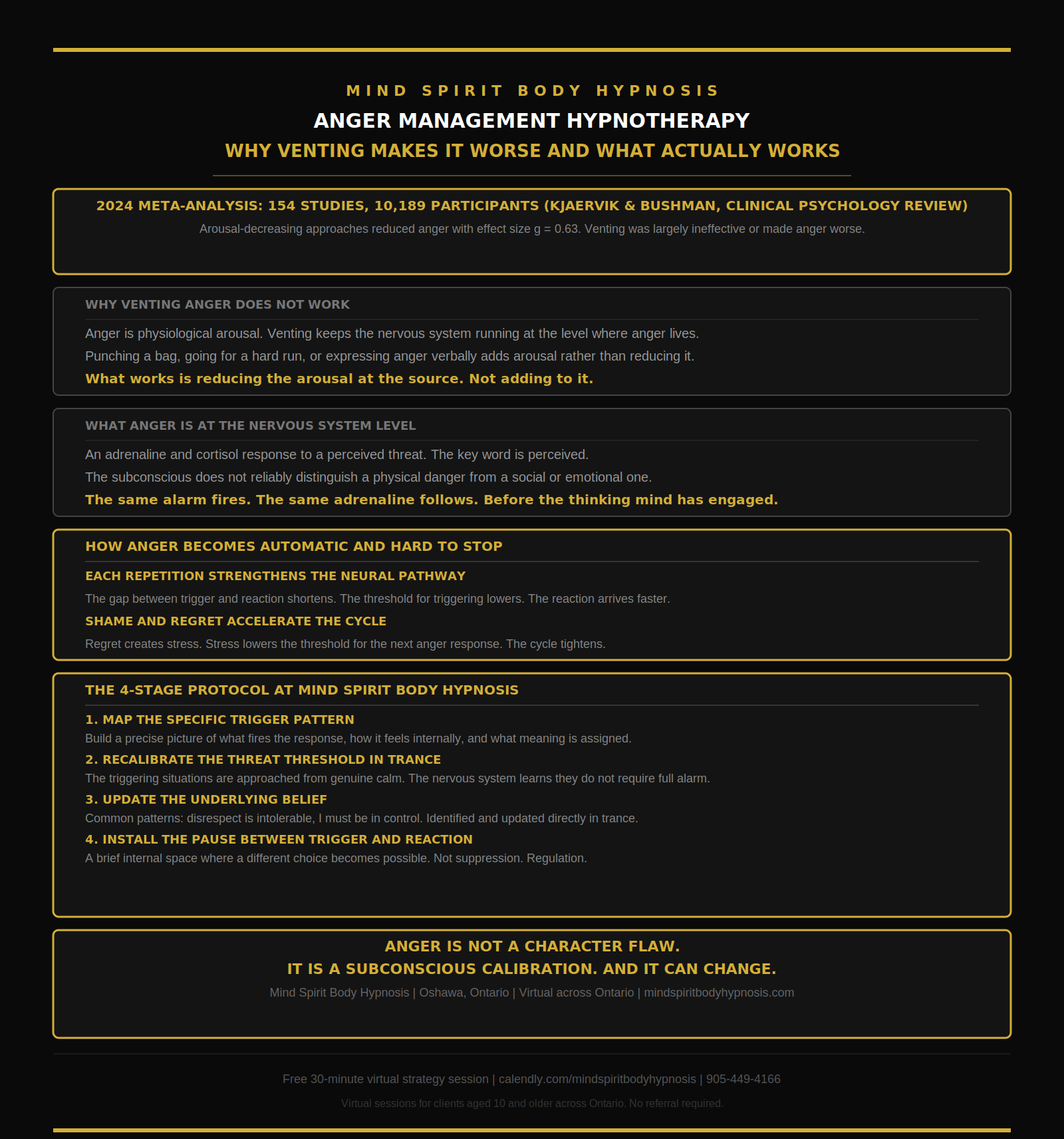
A 2024 meta-analysis of 154 studies involving 10,189 participants (Kjærvik and Bushman) tested this directly. The researchers compared arousal-increasing activities (venting, hitting a punching bag, vigorous exercise) with arousal-decreasing activities (deep breathing, mindfulness, meditation). The results were unambiguous.
Arousal-decreasing activities reduced anger and aggression with an effect size of g = 0.63. Results were stable across all genders, ages, races, and cultures. Arousal-increasing activities were largely ineffective, and in many cases amplified the anger response.
The reason makes physiological sense. Anger is a state of heightened nervous system arousal. Adding more arousal through venting keeps the nervous system running at the level where anger lives. The physiological activation continues. The emotional state is maintained or made worse. The person may feel temporarily relieved for having expressed something, but the underlying arousal level has not dropped.
What actually works is reducing the arousal at the source. And for lasting change, that means reaching the source not just in a single moment of crisis management but at the subconscious level where the anger trigger is calibrated in the first place.
For more on how nervous system arousal and the stress response are addressed at Mind Spirit Body Hypnosis, the hypnotherapy for anxiety and stress page covers the underlying mechanisms in detail.
Processing anger and rage.
What Is Anger at the Nervous System Level?
Anger is an adrenaline and cortisol response to a perceived threat. The key word is perceived.
When the subconscious threat-detection system registers something as dangerous or unfair, it fires the body's alarm response. Adrenaline releases. Heart rate increases. Muscles tense. Breathing becomes faster and shallower. The capacity for nuanced, empathetic reasoning temporarily reduces. The body is preparing to fight or defend.
This response is entirely appropriate when the threat is real and physical. But the subconscious threat system does not always distinguish well between a physical danger and a social or emotional one. A dismissive comment. A tone of voice that matches something from the past. A feeling of being disrespected or ignored. Any of these can trigger the same adrenaline response that would fire for a genuine physical threat.
When this happens repeatedly with the same triggers, the pattern becomes automatic. The trigger fires. The adrenaline follows. The person reacts before they have consciously decided to. And then they manage the consequences of a reaction that arrived before they chose it.
This is not a character flaw. It is a nervous system calibrated to be highly sensitive to a specific category of perceived threat. As a certified hypnotherapist working with clients across Durham Region and Ontario, I can tell you that calibration can be updated, and that updating it is exactly what the trance state is designed for.
Why Does Anger Become a Habit That Is Hard to Break?
Through reinforcement and entrenchment over time.
Each time the anger response fires and the person acts on it, the neural pathway connecting the trigger to the reaction is strengthened. What started as a reaction becomes a reflex. The gap between trigger and response shortens. The threshold for triggering lowers. The reaction arrives faster, with less provocation, and becomes harder to intercept consciously.
At the same time, the subconscious learns from each cycle. If anger once resolved a situation, produced a feeling of power, or simply discharged a stress response, the subconscious files anger as effective. It becomes the first tool the subconscious reaches for when a threat is perceived.
Many people also carry a secondary layer of shame. The anger is followed by regret. The regret creates stress. The stress lowers the threshold for the next anger response. The cycle accelerates.
Anger management hypnotherapy Ontario works with every part of this cycle: the trigger calibration, the automatic association, the underlying beliefs, and the secondary shame loop that keeps the pattern going.
What Does the Research Actually Show About Anger Management Approaches?
Here is what the 2024 Kjærvik and Bushman meta-analysis found for each major approach, drawn from 154 studies and 10,189 participants.
Venting (verbal or physical expression of anger): Often increases anger. Expressing anger keeps the nervous system running at the same arousal level where anger lives. The feeling of relief is temporary. The underlying activation continues or worsens.
Hitting a punching bag or vigorous exercise: Largely ineffective, sometimes counterproductive. These are arousal-increasing activities. They amplify the emotional state rather than discharge it.
Deep breathing and mindfulness: Reduces anger significantly, with effect size g = 0.63 across all genders, ages, races, and cultures. These work because they directly lower nervous system arousal at the physiological level.
Cognitive reappraisal (changing the meaning assigned to a trigger): Moderate effectiveness. Works at the conscious level and is most useful when the gap between trigger and response is still accessible before the full alarm fires.
Hypnotherapy: Combines deep physiological arousal reduction in the trance state with direct subconscious access to the trigger calibration. Works at the level where the automatic response is stored, not just at the surface where it is managed.
The consistent finding across the research is this: approaches that reduce arousal work. Approaches that increase arousal do not. Hypnotherapy combines deep physiological arousal reduction with direct subconscious access to the trigger calibration, making it one of the most thorough arousal-decreasing approaches available.
What Does Hypnotherapy Specifically Do for Anger?
My ABH and NGH credentials, combined with NLP training through ABNLP, give me access to a specific range of tools for anger work that go deeper than surface-level management techniques. At Mind Spirit Body Hypnosis, I approach anger through a four-stage protocol.
Stage 1: Map the specific trigger pattern. The first session builds a precise picture of this person's anger pattern. What situations trigger it most reliably? What does the internal experience feel like in the moment before it fires? What meaning is the subconscious assigning to these situations? Where in the body does the anger first appear? This map tells me exactly what the trance work needs to address.
Stage 2: Recalibrate the threat threshold. In trance, the subconscious threat calibration is directly updated. The situations and triggers currently registering as high-threat are approached at the subconscious level and experienced from a position of genuine calm. The nervous system learns, through direct trance experience, that these situations can be navigated without the full alarm response. The threshold rises. The same situations produce a less extreme initial reaction.
Stage 3: Update the underlying belief. Most persistent anger has a belief underneath it. Common ones include: disrespect is intolerable, I must be in control, people cannot be trusted, my needs will not be met unless I fight for them. Each of these was formed through real experience. In trance, these beliefs are identified and updated to something more accurate and more functional for the current reality.
Stage 4: Install the pause and the new response. One of the most important things hypnotherapy provides for anger is the pause: the internal space between trigger and reaction. In trance, a brief settling moment is established between trigger and response. The person still feels what they feel. They have a moment of choice about what to do with it. This is not suppression. It is regulation. Clients in Ontario who go through this stage often describe it as finally feeling like themselves in moments where they previously felt taken over.
For more on how the confidence and self-worth patterns that sit underneath many anger presentations are addressed, the confidence and self-sabotage page covers the full range.
What Do Sessions Look Like at Mind Spirit Body Hypnosis?
A typical anger programme at Mind Spirit Body Hypnosis in Oshawa:
Session 1: Conversation and mapping. A thorough, honest conversation about the anger pattern. When it fires, what the experience is like, what the consequences have been, and what the person wants to feel and do differently. No judgement. Just clarity.
Sessions 2 and 3: Threshold recalibration and belief updating. Direct trance work on the subconscious threat threshold and the beliefs driving the response. Many clients notice a change in their initial physiological reaction within these sessions.
Sessions 4 and 5 (where needed): Pause installation and future pacing. The pause response is installed and consolidated. Specific triggering situations are visited from the updated baseline. The new response is filed as expected.
In my practice, anger work typically runs between three and five sessions. Many clients notice a meaningful shift in their initial physiological reaction within the first two. All sessions are virtual, available to clients aged 10 and older across Ontario. No referral is required. More about my credentials and approach is on the about page.
Frequently Asked Questions
Why does venting anger make it worse? Because anger is physiological arousal, and venting keeps the nervous system running at the same arousal level. A 2024 meta-analysis of 154 studies found that arousal-increasing activities, including venting and hitting a punching bag, were largely ineffective and sometimes made anger worse. What reduces anger is reducing the arousal at the source, not adding more.
Is being quick to anger a character flaw? No. Anger is a nervous system response to a perceived threat. When the subconscious threat-detection system has been calibrated to be highly sensitive to certain triggers, the anger response fires automatically before conscious deliberation can engage. This is a calibration issue, not a character problem. It formed through real experience and can be updated.
Why does my anger feel automatic and impossible to stop in the moment? Because it is automatic. The neural pathway from trigger to anger response has been strengthened through repeated activation. The gap between trigger and reaction shortens over time. Hypnotherapy works directly at the subconscious level to update the calibration, raise the threshold, and install a brief pause before the reaction fires.
Does hypnotherapy eliminate anger entirely? No, and it should not. Anger is a normal and functional emotion that signals something worth paying attention to. The goal is not to eliminate anger but to make it proportionate, chosen, and actionable, rather than automatic, disproportionate, and damaging.
What beliefs commonly drive persistent anger? Disrespect is intolerable. I must be in control. People cannot be trusted. My needs will not be met unless I push for them. These beliefs were formed through real experience and now operate automatically. In trance, each can be identified and updated to something more accurate for the person's current life.
How is hypnotherapy different from an anger management course? Anger management courses work at the conscious level: building awareness and teaching strategies for managing reactions in the moment. This is useful and produces real results. Hypnotherapy works at the subconscious level, updating the trigger calibration and the underlying beliefs that generate the anger before conscious management even has a chance to engage. The two approaches complement each other well.
How many sessions will I need? In my practice, anger work typically runs three to five sessions, with many clients noticing a meaningful shift in their initial reaction within the first two. A specific honest estimate is always given in the free 30-minute strategy session, with no commitment required.
Can hypnotherapy help younger people with anger patterns? Yes. I work with clients aged 10 and older. Anger patterns often establish early, particularly in environments where control, fairness, or emotional safety were inconsistent.
Can I access sessions from anywhere in Ontario? Yes. All sessions at Mind Spirit Body Hypnosis are delivered virtually across Ontario, including Durham Region, Toronto, Ottawa, and beyond. No referral is required.
WHAT MY CLIENTS SAY
“I don’t write many reviews, but Fanis truly earned this one. I came in skeptical. What I got was a practitioner who takes the work seriously while being incredibly supportive. He asked the right questions up front, actually listened to the answers, and explained his approach in plain language before starting. No theatrics, no vague promises. The sessions themselves were comfortable and easy to settle into. I felt a shift after the first one and it held. He also gave me practical things to do between sessions, which made the progress stick rather than fade after a few days. He’s honest about what hypnotherapy can and can’t do, which is exactly why I trusted him. If you’re considering it, go see Fanis. Thank you Fanis for helping me and approaching it in the manner you did!” — Faisal H.
Ready to Take the Next Step?
If anger has been costing you more than you want to keep paying for it, the pattern does not have to stay automatic.
I offer a free 30-minute virtual strategy session for new clients across Ontario. There's no pressure, just an honest conversation about what you're dealing with and whether hypnotherapy, NLP, or EMDR might help you get in front of it.
RECOMMENDED READING
Book your free session: calendly.com/mindspiritbodyhypnosis
Call or text: 905-449-4166
Email: mindspiritbodyhypnosis@gmail.com
Visit: mindspiritbodyhypnosis.com
Serving clients virtually across Ontario, including Durham Region, Toronto, Canada, and beyond.
Disclaimer: This article is for informational purposes only and does not constitute medical or psychological advice. Hypnotherapy, NLP, and EMDR are complementary approaches and are not a substitute for diagnosis or treatment by a qualified healthcare provider. Results vary by individual.
Written by Fanis Makrigiannis | Certified Hypnotherapist (ABH, NGH) and NLP Master Practitioner (ABNLP) | Mind Spirit Body Hypnosis, Oshawa, Ontario.