Why stress keeps coming back
Why Stress Keeps Coming Back: Stress Management Hypnotherapy in Ontario
TL;DR: Most stress management techniques teach you to cope with stress better. Hypnotherapy does something different: it works with the subconscious operating state that determines how quickly and intensely your nervous system activates in response to demands in the first place. A 2026 study in Scientific Reports found that hypnotic safety suggestions significantly reduced the cortisol awakening response and morning heart rate, two measurable biological markers of anticipatory stress. Fanis Makrigiannis at Mind Spirit Body Hypnosis in Oshawa, Ontario, offers virtual sessions across Ontario for clients whose stress keeps returning regardless of how well they manage it in the moment.
Quick Answer
Stress management hypnotherapy Ontario is a subconscious-focused approach that addresses the nervous system's calibrated threat threshold, the accumulated tension patterns that keep the body in a state of low-grade stress, and the subconscious beliefs that keep demands feeling more dangerous than they actually are. A 2026 study published in Scientific Reports found that hypnotic safety suggestions produced measurable reductions in the cortisol awakening response and morning heart rate in daily life. A large-scale Stanford University analysis of 84,395 users across 282,893 self-hypnosis sessions found consistent reductions in reported stress scores from the first session onward. Fanis Makrigiannis, a Certified Hypnotherapist (ABH, NGH) and NLP Master Practitioner (ABNLP) at Mind Spirit Body Hypnosis in Oshawa, Ontario, offers virtual sessions for clients aged 10 and older across Ontario. No referral is required.
Questions This Article Answers
Why does stress keep coming back even when I manage it well in the moment?
What is the difference between managing stress and changing the stress response?
What does chronic stress actually do to the body over time?
What does hypnotherapy specifically do for stress that other approaches do not?
How many sessions does it take to notice a lasting difference?
In this article:
The people who arrive for stress work at Mind Spirit Body Hypnosis are rarely people who have not tried to manage their stress. They exercise. They meditate, or have tried to. They take the breaks. They know the advice, and they follow it. And the stress keeps coming back. Not because the techniques do not work in the moment, but because the moment keeps passing and the stress keeps returning with the next demand.
The gap between feeling better for a while and feeling genuinely and durably different is the gap this article addresses.
Why Does Stress Keep Coming Back Even When You Manage It Well?
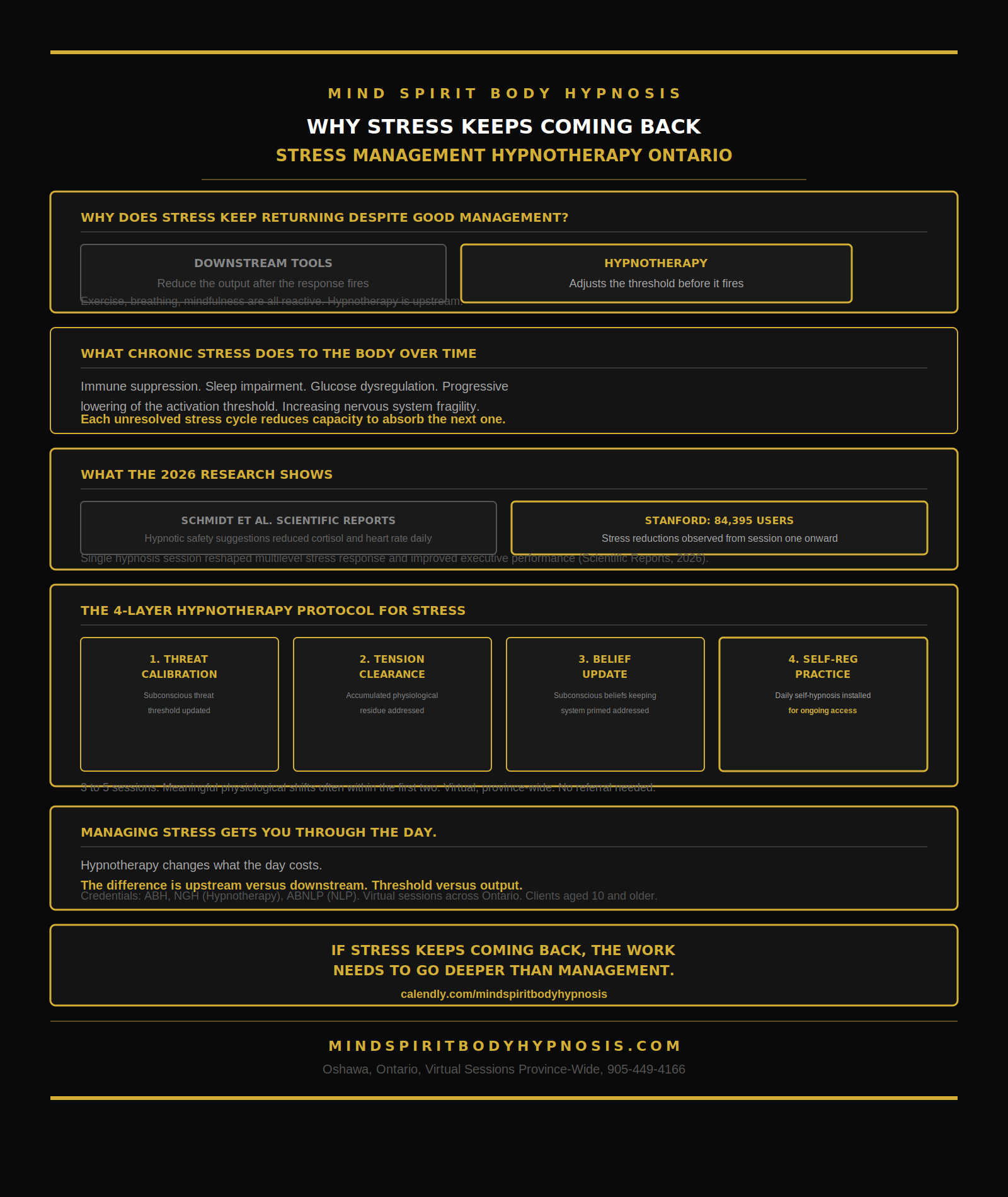
Because most stress management techniques address the stress response after it has fired, not the subconscious calibration that determines how easily and intensely it fires in the first place.
Breathing exercises, progressive muscle relaxation, mindfulness, and exercise are all legitimate tools for reducing the physiological activation of the stress response once it is running. They are downstream interventions: they work on the output of the stress system rather than on the input threshold.
The subconscious threat-detection system that initiates the stress response operates upstream of all of these tools. It scans incoming information and compares it against a stored model of what is safe, manageable, and threatening. When incoming demands exceed what the subconscious has calibrated as manageable, the stress response fires. The threshold at which this happens varies significantly between people and is largely determined by early experience, accumulated unresolved stress, and the subconscious beliefs about self-capacity that have formed over years.
A person whose subconscious threat calibration is set too sensitively will find that ordinary demands regularly exceed the threshold. Every email that requires a response, every conversation that carries uncertainty, every new task added to an already full plate can trigger a partial or full stress activation. The stress management techniques reduce the activation once it arrives, but the next demand triggers it again. The nervous system is working as designed. The calibration is simply off.
Changing this requires working at the subconscious level where the calibration is set, not at the surface level where its outputs are managed.
For more on how the anxiety and nervous system mechanisms underpinning chronic stress are addressed through hypnotherapy at Mind Spirit Body Hypnosis, the hypnotherapy for anxiety and stress page covers the foundational picture.
What Is the Difference Between Managing Stress and Changing the Stress Response?
This distinction is the practical core of why some approaches to stress produce temporary relief and others produce lasting change.
Managing stress means reducing its effects once the stress response is already running. Exercise metabolizes the cortisol and adrenaline that stress has released. Breathing exercises activate the parasympathetic nervous system to counterbalance the sympathetic activation. Mindfulness reduces rumination by redirecting attention. These are all useful. They are all reactive.
Changing the stress response means updating the subconscious operating state that determines how easily the response activates, how intensely it runs, and how quickly it recovers. This is the difference between turning the volume down on a sound that is already playing and adjusting the microphone’s sensitivity in the first place.
The research reflects this distinction clearly. A 2026 controlled study published in Scientific Reports found that a single personalized hypnosis session reshaped the multilevel stress response and enhanced executive performance in stressed medical students, with effects measurable at both the physiological and cognitive levels. The finding is significant because it demonstrates that hypnotherapy is not merely producing relaxation (a downstream change in output) but is altering the stress response system itself.
This is what stress management hypnotherapy in Ontario is designed to do: not teach better coping in the moment, but change what requires coping in the first place.
What Does Chronic Stress Actually Do to the Body Over Time?
Understanding the cumulative physiological cost of chronic stress changes the urgency of addressing it properly.
The cortisol awakening response is one of the most studied biological markers of chronic stress. Cortisol is designed to rise sharply in the first 30 to 45 minutes after waking, helping the body mobilize for the demands of the coming day. In people experiencing chronic stress, this cortisol rise is often dysregulated: either blunted (associated with burnout and exhaustion) or exaggerated (associated with anticipatory anxiety and hypervigilance). Either pattern indicates that the body's stress regulation system is no longer functioning optimally.
Sustained elevation of cortisol suppresses the immune system, impairs memory consolidation during sleep, disrupts glucose regulation, degrades sleep quality, and is associated with accelerated cellular ageing. It also maintains the nervous system at a baseline of activation that progressively lowers the threshold for further stress responses, making the next stressor easier to trigger and more difficult to recover from.
The cumulative effect is a nervous system that is progressively less resilient: less able to absorb demands without activating, less able to recover after activation, and increasingly likely to interpret ordinary challenges as threatening rather than manageable.
Research on the cortisol awakening response by Schmidt et al. (2026) published in Scientific Reports found that hypnotic safety suggestions produced statistically significant reductions in the cortisol awakening response and morning heart rate in daily life, suggesting that hypnotherapy directly affects the biological stress preparedness system rather than simply producing subjective feelings of calm.
What Does Hypnotherapy Specifically Do for Stress That Other Approaches Do Not?
As a Certified Hypnotherapist with ABH and NGH certifications and NLP Master Practitioner training through ABNLP, working with clients across Durham Region and Ontario, I address chronic stress through a four-layer protocol that targets the specific mechanisms maintaining it. This is the approach I use, session by session.
1. Threat calibration update. The subconscious model of what constitutes a genuine threat is identified and directly updated. The demands and situations that are currently triggering a disproportionate stress response are approached in trance, where the critical evaluation system is less active, and the subconscious is more accessible. The updated calibration is installed: these demands are manageable, and the capacity to meet them is genuine.
2. Accumulated tension clearance. Chronic stress deposits residue. Muscle tension patterns, breathing habits, digestive sensitivity, and the general physiological baseline all shift upward with sustained stress. In trance, the accumulated tension is addressed directly through progressive physiological relaxation anchored to specific suggestions. Many clients notice a quality of physical settling in the first session that they have not experienced in months.
3. Subconscious belief updating. The beliefs that amplify the stress response are identified in the intake conversation and addressed directly in trance. Common examples include the belief that everything must be done perfectly to be safe, that asking for help represents inadequacy, that resting before everything is done is irresponsible, or that the current level of demand is simply permanent and normal. Each of these beliefs keeps the stress response primed regardless of the actual demand level.
4. Self-regulation skill installation. I teach a brief self-hypnosis practice for daily use, providing a direct parasympathetic access point the client can use between sessions and beyond. The Stanford research on 84,395 users across 282,893 self-hypnosis sessions found consistent stress score reductions observable from session one, supporting the practical value of this kind of regular brief practice.

What Do Sessions Look Like at Mind Spirit Body Hypnosis?
A typical programme for stress management hypnotherapy in Ontario at Mind Spirit Body Hypnosis:
Session 1: Intake and stress mapping. A thorough conversation about the specific shape of the stress for this person: what triggers it most reliably, what it feels like in the body, how long it has been present, what is still demanding of the nervous system, and what genuinely different would feel like. This map shapes everything that follows.
Sessions 2 and 3: Threat calibration and accumulated tension. Direct trance work on the subconscious threat threshold and the physiological baseline. Self-regulation practice installed. Many clients notice meaningful shifts in sleep quality and physical ease within these two sessions.
Sessions 4 and 5: Belief updating, future pacing, and consolidation. The specific subconscious beliefs maintaining the stress response are addressed. Future scenarios most associated with stress activation are visited from the updated baseline. The new response is filed as expected rather than aspirational.
In my practice, stress management work typically runs between three and five sessions, with many clients noticing meaningful physiological shifts within the first two. All sessions are virtual, available across Ontario, and open to clients aged 10 and older. No referral is required. My full background and credentials are on the about page.
For clients whose chronic stress has significantly affected confidence, motivation, or sense of self, the confidence and self-sabotage work is often incorporated in later sessions.
WHAT MY CLIENTS SAY
“I had a wonderful experience working with Fanis and his hypnosis program to help me work through anxiety, fears, and past traumas. The results have been incredibly positive. I felt comfortable, supported, and understood throughout the entire process and noticed a meaningful shift in how I feel and respond to things that once caused me anxiety. I am very grateful for the experience and would highly recommend Fanis and his services.” — Tracy D.
Frequently Asked Questions
Why does stress keep coming back even when I manage it well? Because most stress management techniques address the stress response after it has fired, not the subconscious calibration that determines how easily and intensely it fires. Good stress management reduces the output. Hypnotherapy adjusts the input threshold. Both matter, but only the second produces durable change.
What is the difference between managing stress and changing the stress response? Managing stress is reactive: it reduces the effects of the stress response once it is running. Changing the stress response means updating the subconscious threat calibration that determines how easily the response activates and how quickly it recovers. The 2026 Scientific Reports study found that hypnotherapy produced measurable changes at both physiological and cognitive levels, not just subjective relaxation.
What does chronic stress do to the body over time? Sustained cortisol elevation suppresses the immune system, impairs memory consolidation, disrupts sleep quality, degrades glucose regulation, and progressively lowers the threshold for further stress activation. The nervous system becomes less resilient with each unresolved stress cycle. Research shows the cortisol awakening response (the body's morning stress mobilization signal) becomes measurably dysregulated in chronically stressed individuals.
Does hypnotherapy actually reduce cortisol? Research published in Scientific Reports (Schmidt et al., 2026) found that hypnotic safety suggestions produced statistically significant reductions in the cortisol awakening response and morning heart rate in participants' daily lives, suggesting a genuine biological effect rather than simply subjective feelings of calm.
How is hypnotherapy different from meditation for stress? Meditation strengthens conscious attention regulation and produces parasympathetic activation during practice. These effects are real and valuable. Hypnotherapy reaches the subconscious directly, updating the threat calibration and accumulated tension patterns that meditation works alongside but does not directly address. The two approaches complement each other well.
Will sessions require me to talk about what is stressing me in detail? The intake conversation maps the pattern and the triggers, but sessions do not require detailed discussion of every stressor. The trance work is aimed at the subconscious operating state rather than the cognitive content of specific stressors. Many clients find this a relief: the work happens at a level below the narrative.
How many sessions will I need? In my practice, stress management work typically runs three to five sessions, with meaningful physiological shifts often noticeable within the first two. A specific honest estimate is always given in the free 30-minute strategy session.
Can this help with stress that is work-related specifically? Yes. The approach addresses the subconscious calibration and accumulated tension that work demands activate, regardless of the specific domain. Clients from a wide range of professional contexts across Ontario, from healthcare workers to executives to caregivers, find the work useful.
Can I access sessions from anywhere in Ontario? Yes. All sessions are delivered virtually across Ontario, including Durham Region, Toronto, Ottawa, and beyond. No referral is required.
Ready to Take the Next Step?
If the stress keeps coming back regardless of how well you manage it in the moment, the work needs to go deeper than moment-to-moment management.
I offer a free 30-minute virtual strategy session for new clients across Ontario. There is no pressure. Just an honest conversation about what the stress has been like and whether this approach might produce something more lasting.
Book your free session: calendly.com/mindspiritbodyhypnosis
Call or text: 905-449-4166
Email: mindspiritbodyhypnosis@gmail.com
Visit: mindspiritbodyhypnosis.com
Serving clients virtually across Ontario, including Durham Region, Toronto, Canada and beyond.
Disclaimer: This article is for informational purposes only and does not constitute medical or psychological advice. Hypnotherapy, NLP, and EMDR are complementary approaches and are not a substitute for diagnosis or treatment by a qualified healthcare provider. If you are experiencing symptoms of burnout or significant physical health effects from chronic stress, please consult your doctor. Results vary by individual.
Written by Fanis Makrigiannis | Certified Hypnotherapist (ABH, NGH) and NLP Master Practitioner (ABNLP) | Mind Spirit Body Hypnosis, Oshawa, Ontario.