Does Caffeine make anxiety worse?
Is Caffeine Making Your Anxiety Worse? Hypnotherapy for Caffeine Dependence in Ontario
TL;DR: Caffeine dependence is real; it worsens anxiety, and it is much harder to break than most people expect. Not because the substance is powerfully addictive in the clinical sense, but because the habit is subconscious, the withdrawal is genuinely uncomfortable, and the underlying fatigue that caffeine is compensating for has not been addressed. Hypnotherapy works with all three of these layers. Fanis Makrigiannis at Mind Spirit Body Hypnosis in Oshawa, Ontario, offers virtual sessions across Ontario for clients who are tired of being wired.
Quick Answer
Hypnotherapy for caffeine dependence is a subconscious-focused approach that addresses the automatic habit loop driving compulsive caffeine use, the anxiety the caffeine is both relieving and worsening, and the underlying fatigue or low energy state that the caffeine is compensating for. A 2026 systematic review in Stress and Health confirmed a dose-dependent anxiogenic effect of caffeine, and the Sleep Foundation reports that 30% of regular caffeine drinkers experience higher anxiety as a result of their use. Fanis Makrigiannis, a Certified Hypnotherapist and NLP Master Practitioner at Mind Spirit Body Hypnosis in Oshawa, Ontario, offers virtual habit change sessions for clients across Ontario who want to change their relationship with caffeine without the misery of going cold turkey.
Questions This Article Answers
Is caffeine actually making my anxiety worse?
Why is it so hard to cut down on caffeine even when I know it is affecting my sleep?
Is caffeine dependence a real thing or just a habit?
What does caffeine withdrawal actually feel like, and how long does it last?
Can hypnotherapy help me reduce caffeine without the misery?
In this article:
Caffeine occupies a strange place in most people's lives. It is the one dependence that is not only socially acceptable but actively encouraged. Colleagues bring it as a gift. Office culture is built around it. The morning ritual of coffee is treated as a personality trait rather than a habit. And yet, for a significant number of people in Ontario and across Canada, the relationship with caffeine has stopped being a pleasant ritual and become something more compulsive: a substance being used to prop up energy that the body stopped generating on its own, creating a cycle that worsens the very fatigue it is trying to fix.
In my practice, caffeine-related work rarely arrives on its own. It almost always arrives with anxiety, poor sleep, and the creeping realization that the caffeine is no longer helping. It is just preventing the withdrawal.
Is Caffeine Actually Making My Anxiety Worse?
For a significant proportion of people who experience anxiety, yes. The relationship between caffeine and anxiety is both direct and well-documented.
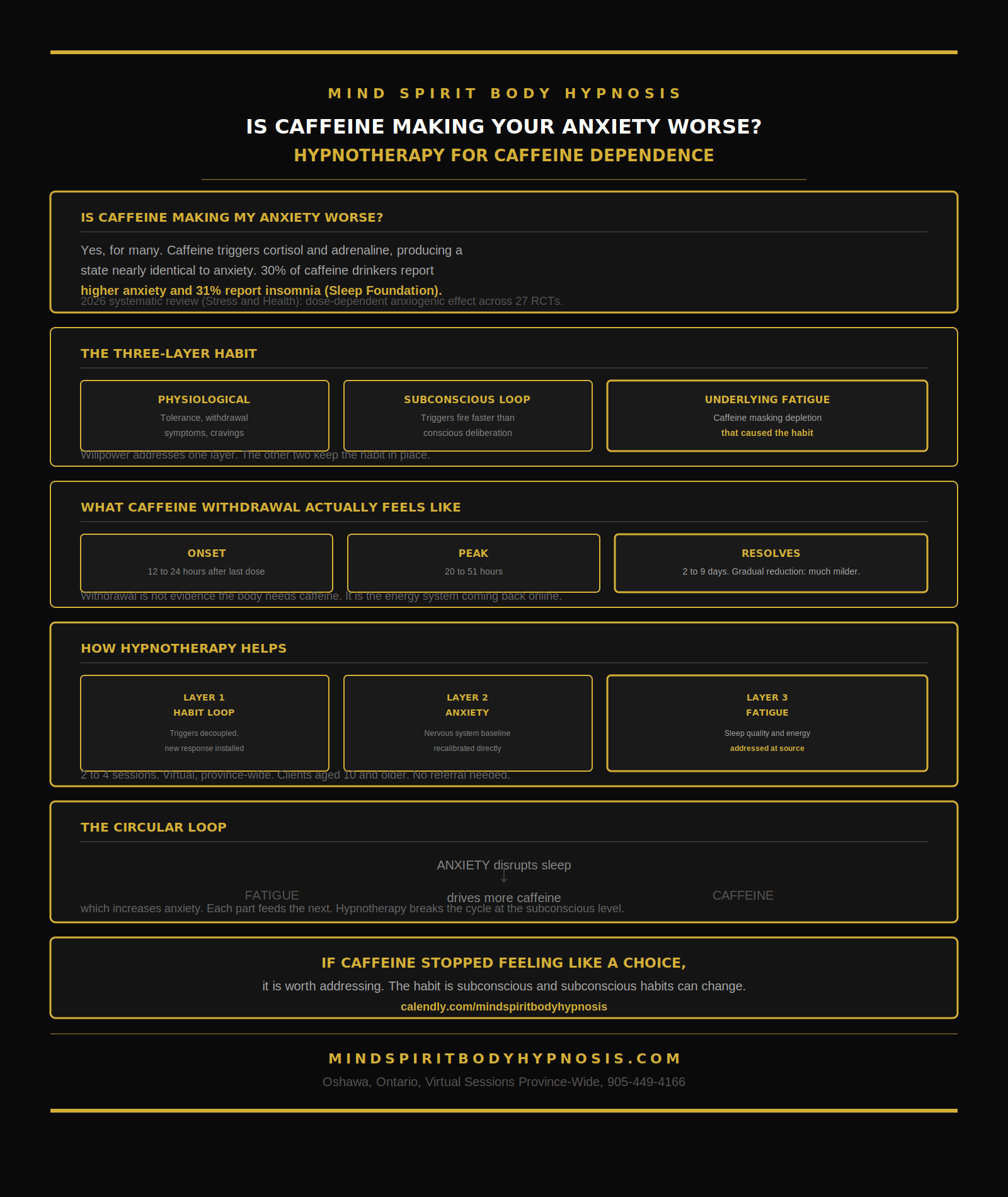
Caffeine works primarily by blocking adenosine receptors in the brain. Adenosine is the chemical that builds up during waking hours and eventually produces the sensation of tiredness. When caffeine blocks these receptors, tiredness is masked, but the underlying physiological state has not changed. The adenosine is still there. The body is still tired. Caffeine has simply made the tiredness temporarily invisible.
At the same time, caffeine stimulates the release of cortisol and adrenaline, the same hormones that constitute the stress response. The heart rate increases. The breathing becomes shallower. The muscles tighten. The state caffeine produces is, physiologically, nearly identical to the state anxiety produces. For someone who is already running an elevated anxiety baseline, caffeine adds physiological activation on top of a nervous system that is already working too hard.
A 2026 systematic review published in Stress and Health confirmed a dose-dependent anxiogenic effect of caffeine across 27 randomized trials. The more caffeine consumed, the more pronounced the anxiety effect. A meta-analysis published in Frontiers in Nutrition (2025) found standardized mean differences of 2.86 for anxiety at high doses (400mg or more daily), one of the larger effect sizes in the anxiety literature. The Sleep Foundation reports that 30% of regular caffeine drinkers experience higher anxiety and 31% experience insomnia as direct consequences of their caffeine use.
The anxiety-caffeine relationship is also circular. Anxiety disrupts sleep. Poor sleep creates fatigue. Fatigue increases the need for caffeine. More caffeine increases anxiety. The loop tightens.
For more on how the anxiety system and nervous system activation are addressed through hypnotherapy, the hypnotherapy for anxiety and stress in Ontario page covers the foundational mechanisms.
Why Is It So Hard to Cut Down Even When You Know It Is Affecting Your Sleep?
Because the caffeine habit has two separate components that both need to be addressed, and most people only attempt to address one of them.
The first component is the physiological dependence. Caffeine produces tolerance relatively quickly, meaning more is needed over time to produce the same effect. It also produces genuine withdrawal symptoms when use is reduced. This physical dimension is real, and it is part of why cutting down feels harder than it theoretically should.
The second component, and the one most people underestimate, is the subconscious habit loop. Caffeine consumption has become an automatic response to specific internal cues: the time of day, the transition between tasks, the moment of tiredness, the familiar morning routine. These cues trigger the reach for caffeine before conscious deliberation can engage. By the time the thinking mind is involved, the cup is already in hand.
This is why willpower-based reduction attempts often fail. The conscious decision to cut down is working against a subconscious habit that fires faster than conscious deliberation, in a context where the withdrawal symptoms make the habit feel genuinely necessary.
The third component, and the deepest, is what the caffeine is compensating for. Most people who develop a problematic relationship with caffeine are not simply caffeine enthusiasts. They are using caffeine to manage fatigue that has a separate cause: poor sleep quality, a nervous system that runs at a depleted baseline, or the exhaustion that comes from chronic low-grade stress. Reducing caffeine without addressing the underlying depletion produces unbearable fatigue, which makes the reduction feel impossible.
Is Caffeine Dependence a Real Thing?
Yes, and the scientific consensus has been clear on this for some time. The Johns Hopkins University School of Medicine describes caffeine dependence as producing genuine physical and psychological symptoms, including tolerance, withdrawal, and cravings. The DSM-5 (the American diagnostic manual) includes caffeine withdrawal as a recognized diagnosis, and a 2025 study published in Frontiers in Nutrition developed and validated a specific scale for caffeine use disorder, confirming that problematic caffeine use exhibits characteristics of substance dependence, including psychological and physical elements.
Caffeine dependence is generally considered mild compared to dependence on alcohol, opioids, or other substances. Most clinicians do not consider it a serious addiction in the conventional sense. What it does produce, for a meaningful subset of people who contact me from across Ontario, is a pattern where:
The caffeine no longer produces genuine energy but merely prevents the withdrawal fatigue
Attempts to reduce produce symptoms severe enough to derail the attempt within a day or two
The relationship with caffeine has stopped feeling like a choice and started feeling like a requirement
The anxiety and sleep disruption the caffeine causes are now significant enough to warrant addressing
When the relationship with caffeine has reached this point, it benefits from the same approach that works for any other automatic subconscious habit: direct work at the level where the habit actually operates.
What Does Caffeine Withdrawal Actually Feel Like and How Long Does It Last?
Understanding what withdrawal involves before it happens is one of the most effective ways to make the reduction attempt actually succeed. Most failed caffeine reduction attempts fail not because the person lacked motivation but because the withdrawal was more uncomfortable than expected and was misinterpreted as confirmation that they need caffeine to function.
Caffeine withdrawal symptoms typically include:
Headaches, usually described as a dull, pressure-like pain across the forehead or behind the eyes
Significant fatigue, often deeper than ordinary tiredness
Difficulty concentrating or a feeling of mental fog
Irritability and a low threshold for frustration
Mild depression or flatness of mood in some people
Nausea in some cases
These symptoms begin within 12 to 24 hours of the last caffeine dose, peak at around 20 to 51 hours, and typically resolve within two to nine days. For most people, reducing gradually rather than stopping abruptly makes the symptoms noticeably milder. A reduction of roughly 10% of total daily intake every week or two produces much less disruptive withdrawal than going cold turkey.
The most important thing to understand about the withdrawal period is what it means. Withdrawal is not evidence that the body needs caffeine to function. It is the body recalibrating after a period of chemical suppression. The adenosine receptors that caffeine has been blocking begin to return to their natural density. The body's own energy regulation system begins to come back online. This recalibration process is uncomfortable, but it is temporary, and on the other side of it is a nervous system that is generating its own energy again rather than requiring external chemical assistance to mask the absence of it.

How Does Hypnotherapy Help With Caffeine Dependence?
As a certified hypnotherapist working with clients across Durham Region and Ontario, I approach caffeine habit change as a three-layer problem: the subconscious habit loop, the anxiety dimension, and the underlying fatigue or depletion the caffeine has been compensating for. All three layers need to be addressed for the change to be sustainable.
Layer 1: The habit loop. The automatic cue-response sequence (the time of day, the morning ritual, the transition between tasks) is identified and directly changed in trance. The specific internal and external triggers that currently initiate the reach for caffeine are decoupled from that response. A new automatic response is installed: something that meets the underlying need (the break, the stimulation, the transition marker) without the caffeine.
Layer 2: The anxiety and nervous system dimension. For most people with high caffeine use and co-occurring anxiety, the caffeine is both worsening and temporarily relieving the anxiety. In trance, the nervous system baseline is addressed directly. Genuine parasympathetic activation is installed as a reference state the body can return to. The anxiety that has been driving increased caffeine use reduces, which reduces the urgency of the habit.
Layer 3: The underlying energy and fatigue dimension. If caffeine has been compensating for chronic fatigue or poor sleep quality, those patterns are addressed directly rather than left as the residue that makes caffeine reduction feel impossible. Sleep quality work and nervous system restoration are incorporated where needed, so that the reduction does not simply produce unbearable fatigue.
In my practice, caffeine dependence and reduction work typically runs between two and four sessions, depending on the depth of the anxiety pattern and whether significant sleep or fatigue work is also needed. All sessions are virtual, available across Ontario, and open to clients aged 10 and older. More about my approach is on the about page.
For more on how the habits and addiction patterns addressed through hypnotherapy are approached across different presentations, the hypnotherapy for habits and addictions in Ontario page covers the full range.
Frequently Asked Questions
Is caffeine actually making my anxiety worse? For many people, yes. Caffeine stimulates the release of cortisol and adrenaline, producing a physiological state almost identical to anxiety. A 2026 systematic review confirmed a dose-dependent anxiogenic effect of caffeine, and the Sleep Foundation reports that 30% of regular caffeine drinkers experience increased anxiety as a result of their use. The relationship is dose-dependent: more caffeine, more anxiety effect.
Why is it so hard to cut down even when I know it is harming my sleep? Because the caffeine habit has multiple components: a genuine physiological dependence with real withdrawal symptoms, a subconscious automatic habit loop that fires faster than conscious deliberation, and a compensatory role the caffeine is playing for underlying fatigue or depleted energy. Willpower-based approaches only address one layer. Hypnotherapy addresses all three.
Is caffeine dependence real or just a strong habit? Both. Johns Hopkins University School of Medicine describes caffeine as producing genuine physical and psychological dependence, including tolerance, withdrawal symptoms, and cravings. The DSM-5 recognizes caffeine withdrawal as a clinical condition. It is generally considered mild compared to other forms of dependence, but for many people the pattern reaches the point where it stops feeling like a choice.
What does caffeine withdrawal feel like? Typically: headaches, significant fatigue, difficulty concentrating, irritability, and sometimes mild depressive symptoms. Symptoms begin within 12 to 24 hours of the last dose, peak around 20 to 51 hours, and resolve within two to nine days. Gradual reduction produces much milder symptoms than stopping abruptly.
Do I have to stop caffeine completely? Not necessarily. The goal is a relationship with caffeine that feels genuinely chosen rather than compulsive. For some people that means complete cessation. For others, it means reducing to a level where the anxiety, sleep disruption, and compulsive quality of the habit are resolved, while still enjoying caffeine as an occasional pleasure. The target is established in the free strategy session based on your specific situation.
How is hypnotherapy different from just cutting down gradually? Gradual reduction addresses the physiological dimension. Hypnotherapy also addresses the subconscious habit loop (the automatic triggers and cravings) and the underlying nervous system state that the caffeine has been compensating for. Clients who combine a gradual reduction plan with hypnotherapy consistently find the process easier and more sustainable than reduction attempts they have made previously.
How many sessions will I need? In my practice, caffeine dependence work typically runs two to four sessions depending on the depth of the anxiety and fatigue patterns involved. An honest estimate for your specific situation is always given in the free strategy session.
Can I access sessions from anywhere in Ontario? Yes. All sessions at Mind Spirit Body Hypnosis are delivered virtually, province-wide, including Durham Region, Toronto, Ottawa, and beyond. No referral is required.
Ready to Take the Next Step?
If caffeine has stopped feeling like a choice and started feeling like a requirement, that is worth addressing. I'd love to help.
I offer a free 30-minute virtual strategy session for new clients across Ontario. There is no pressure, just a conversation about your relationship with caffeine and whether hypnotherapy might help you change it.
Book your free session: calendly.com/mindspiritbodyhypnosis
Call or text: 905-449-4166
Email: mindspiritbodyhypnosis@gmail.com
Visit: mindspiritbodyhypnosis.com
Serving clients virtually across Ontario, including Durham Region, Toronto, Canada, and beyond.
Disclaimer: This article is for informational purposes only and does not constitute medical or psychological advice. Hypnotherapy, NLP, and EMDR are complementary approaches and are not a substitute for diagnosis or treatment by a qualified healthcare provider. If you have concerns about your caffeine use or are experiencing significant withdrawal symptoms, please consult your doctor.
Written by Fanis Makrigiannis | Certified Hypnotherapist and NLP Master Practitioner | Mind Spirit Body Hypnosis.