Why am I always so tired?
Why Am I Always Tired? Hypnotherapy for Chronic Fatigue and Exhaustion in Ontario
TL;DR: When rest stops restoring you, the problem is often not the quantity of sleep but the state of the nervous system underneath it. A chronically activated stress response prevents the deep restorative sleep the body needs, keeping fatigue in place regardless of hours in bed. A 2025 study in the International Journal of Clinical and Experimental Hypnosis found that hypnotherapy significantly reduced fatigue scores and improved sleep quality in patients with chronic exhaustion, and Fanis Makrigiannis at Mind Spirit Body Hypnosis in Oshawa, Ontario, offers virtual sessions across Ontario for clients who are tired of being tired.
Quick Answer
Hypnotherapy for chronic fatigue and exhaustion is a subconscious-focused approach that addresses the nervous system hyperactivation keeping the body in a state of low-grade stress, which prevents the deep restorative sleep and genuine recovery that exhausted people need. A 2025 peer-reviewed study published in the International Journal of Clinical and Experimental Hypnosis found that hypnotherapy reduced fatigue inventory scores by a mean of 8.19 points and improved Pittsburgh Sleep Quality Index scores significantly after ten weeks of treatment. Fanis Makrigiannis, a Certified Hypnotherapist and NLP Master Practitioner at Mind Spirit Body Hypnosis in Oshawa, Ontario, offers virtual hypnotherapy sessions for clients across Ontario who sleep but do not recover, and rest but do not feel rested.
Questions This Article Answers
Why am I always tired even when I sleep enough?
What is the difference between tiredness and nervous system exhaustion?
Why does rest stop working after long periods of stress?
What does hypnotherapy actually do for chronic fatigue?
How many sessions does it take to notice a difference?
In this article:
There is a particular quality to the exhaustion that brings people to hypnotherapy for fatigue. It is not the tiredness that follows a hard week and resolves with a good weekend. It is the tiredness that does not resolve. The person sleeps and wakes tired. They rest and do not feel rested. They take a holiday, and come back just as depleted as when they left.
In my practice, clients with this pattern often say the same thing: I am doing everything right. I am going to bed on time. I am not overworking the way I was. And I am still exhausted.
That gap between doing everything right and still feeling depleted is the gap this article addresses.
Why Does Rest Stop Restoring You?
The answer is almost always the same: the nervous system has not switched off.
Rest restores when the body is able to shift from the sympathetic nervous system state (the activated, alert, stress-response state) into the parasympathetic state (the rest-and-digest, recover, repair state). This shift is not voluntary. It is automatic, regulated by the subconscious. And in a nervous system that has been running high for long enough, the automatic shift stops happening fully.
The result is what many people describe as wired but tired: exhausted but unable to settle, fatigued but with a nervous system that will not quiet down, needing rest but unable to access the physiological state that rest requires.
The cortisol system is part of this. Cortisol, the primary stress hormone, is supposed to rise in the morning and gradually fall through the day, reaching its lowest point at night to allow the body to move into deep recovery sleep. After extended periods of chronic stress, the cortisol curve flattens or inverts: the night-time drop does not happen fully, the body does not reach the physiological low point that deep sleep requires, and the sleep that follows is lighter, more fragmented, and less restorative than the hours spent in bed suggest.
The nervous system stuck in this pattern is not malfunctioning. It has learned, from extended experience of threat or demand, that vigilance is required. It is maintaining the alert state it was trained to maintain. The problem is that this learned vigilance is being applied in the absence of the original threat, perpetuating a physiological state the body no longer needs but cannot exit on its own.
For more on how the anxiety system that drives this nervous system hyperactivation is addressed through hypnotherapy, the hypnotherapy for anxiety and stress in Ontario page covers the foundational mechanisms.
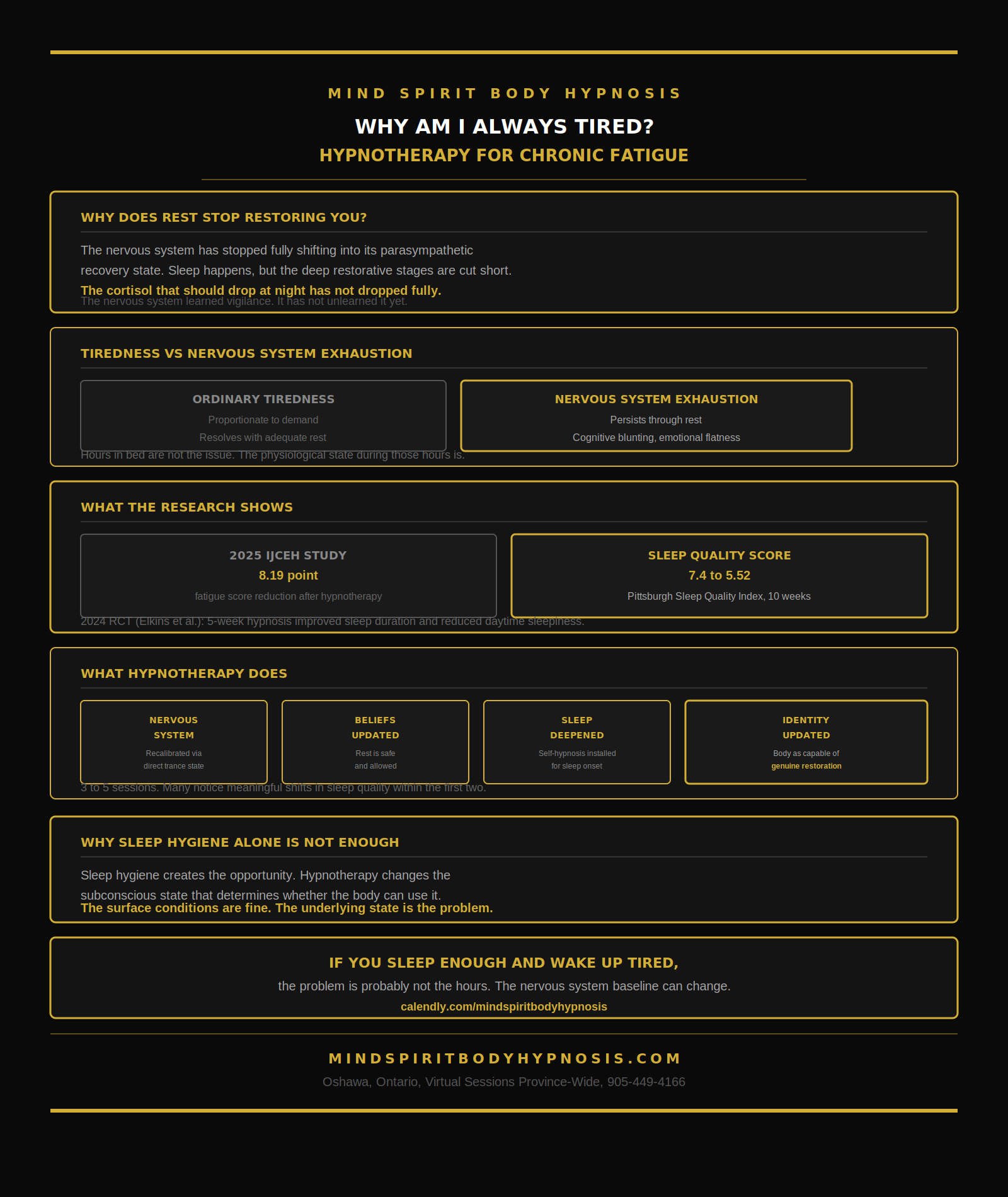
What Is the Difference Between Tiredness and Nervous System Exhaustion?
Ordinary tiredness and nervous system exhaustion feel different, respond to different things, and require different approaches.
Ordinary tiredness is proportionate to demand. A demanding week produces it. Adequate rest resolves it. The tired person who sleeps well wakes up refreshed. Energy is available again after genuine rest.
Nervous system exhaustion has a different character. It is cumulative and non-proportionate. It persists through rest without resolving. It is accompanied by specific features that ordinary tiredness does not produce:
A quality of flatness or emotional blunting alongside the physical fatigue
Difficulty concentrating or sustaining mental effort even after adequate sleep
Low tolerance for additional demands or sensory stimulation
A sense of heaviness or low-level physical discomfort that is present regardless of activity level
Sleep that does not refresh, often accompanied by vivid dreaming or frequent waking
These features point to a nervous system operating at a depleted baseline rather than a body that simply needs more sleep. The distinction matters because the interventions are different. Ordinary tiredness responds to rest. Nervous system exhaustion requires the subconscious operating state to change first, so that the rest that follows can actually work.
Why Do Sleep Hours Not Equal Recovery?
Because sleep quality is determined by the physiological state entered during sleep, not by the number of hours spent in bed.
Deep, restorative sleep requires the body to reach specific physiological conditions: low cortisol, reduced heart rate variability, a cooled core temperature, and the neurological conditions that allow the deepest stages of slow-wave sleep to occur. These conditions depend on the nervous system genuinely shifting into its parasympathetic recovery mode.
A nervous system running chronic low-grade hyperactivation does not reach these conditions fully. Sleep happens, but it is lighter than it should be. The deep restorative stages are shorter. The cortisol that should have dropped by midnight has not dropped fully, and the body's repair and consolidation processes that depend on deep sleep are shortened as a result.
Research supports this mechanism clearly. A 2025 study published in the International Journal of Clinical and Experimental Hypnosis found that hypnotherapy significantly reduced fatigue inventory scores by a mean of 8.19 points and improved Pittsburgh Sleep Quality Index scores from 7.4 to 5.52 after ten weeks of treatment, suggesting that addressing the nervous system state directly produces measurable improvements in both fatigue and sleep quality.
A 2024 randomized controlled trial by Elkins and colleagues, published in the same journal, found that a five-week hypnosis intervention improved subjective sleep quality, increased sleep duration measured by actigraphy, and reduced daytime sleepiness. The mechanism in both studies was the same: the hypnotic state produces genuine parasympathetic activation, giving the nervous system direct experience of the recovery state it has been unable to access on its own.
This is why the person who sleeps eight hours and wakes exhausted is not imagining the problem and is not being lazy. They are sleeping in a physiological state that is not permitting full recovery. The sleep is happening. The restoration is not.
What Does Hypnotherapy Actually Do for Chronic Fatigue?
As a Certified Hypnotherapist working with clients across Durham Region and Ontario, I address chronic fatigue and exhaustion across four specific dimensions. The work is not relaxation in the spa sense. The trance state is used precisely and purposefully.
1. Nervous system recalibration. The trance state is, by its nature, a profound parasympathetic experience. Heart rate slows. Muscle tension releases. The cortisol system quiets. For a nervous system that has forgotten what this state feels like, the trance experience is genuinely novel, and genuinely restorative in a way that ordinary rest has not been.
Repeated across sessions, this experience begins to recalibrate the subconscious baseline. The nervous system learns, through direct experience, that it is possible to operate at a lower activation level without threat arriving. The vigilance that has been the default begins to soften.
2. Subconscious driving belief update. Chronic fatigue in high-demand people is almost always accompanied by a subconscious operating belief that keeps the nervous system activated regardless of external circumstances. Common examples include the belief that rest must be earned, that slowing down is dangerous, or that relaxation is only safe after all responsibilities are met.
In trance, these beliefs are identified and directly updated. A more functional operating assumption is installed: that the nervous system is allowed to rest, that the body is safe in recovery, and that genuine restoration does not require justification.
3. Sleep state deepening. Direct hypnotic suggestion is used to install the specific conditions the nervous system needs to enter deeper sleep stages. This includes suggestion for the cortisol drop, the physical settling, and the mental quieting that restorative sleep requires. Clients are also taught a brief self-hypnosis practice to use at the point of sleep onset, extending the parasympathetic access the session work has begun.
4. Energy and identity update. Long-term exhaustion changes how people see themselves. The person who has been depleted for months or years often begins to identify as someone who is always tired, someone whose body does not work properly. This identity update is addressed directly in trance. A more accurate and more functional sense of the body as capable of genuine restoration is installed.
For more on how the confidence and identity patterns that accompany prolonged exhaustion are addressed, the hypnotherapy for confidence and self-sabotage in Ontario page covers the subconscious belief architecture that keeps these patterns in place.

What Do Sessions Look Like at Mind Spirit Body Hypnosis?
Sessions follow a structured approach tailored to the specific shape of the fatigue for each person.
A typical programme looks like this:
Session 1: Intake and nervous system mapping. A thorough conversation about the history and current pattern of the exhaustion. When it started, what preceded it, what the sleep is like, what the energy levels look like across the day and week, and what is still being demanded of the nervous system. This map shapes the trance work that follows.
Sessions 2 and 3: Nervous system recalibration and baseline work. Deep trance states anchored to the body's natural recovery physiology. Subconscious operating beliefs about rest, safety, and permission to recover addressed and updated.
Sessions 4 and 5: Sleep deepening, self-hypnosis installation, and identity work. The sleep onset practice is taught and installed. The identity-level patterns that have formed around chronic exhaustion are addressed. Future pacing into a rested, restored version of daily life files the new state as expected rather than foreign.
In my practice, chronic fatigue and exhaustion work typically runs between three and five sessions, with many clients noticing meaningful shifts in sleep quality within the first two. All sessions are virtual, available across Ontario, and open to clients aged 10 and older. No referral is required. More about my approach and credentials is available on the about page.
Frequently Asked Questions
Why am I always tired even when I sleep enough? The most common reason is that the nervous system is not fully shifting into its parasympathetic recovery mode during sleep. A chronically activated stress response prevents the body from reaching the deep restorative sleep stages regardless of hours spent in bed. The quantity of sleep is adequate but the quality of recovery it provides is not, because the physiological conditions for deep restoration are not being met.
Is chronic fatigue the same as being lazy or not trying hard enough? No. Chronic fatigue that does not resolve with rest is a nervous system pattern, not a character problem. The person who is always tired despite adequate sleep and rest is not lacking effort or discipline. Their nervous system has been trained to maintain a baseline activation level that prevents genuine recovery. Hypnotherapy addresses the subconscious operating state driving this pattern.
What is the difference between tiredness and nervous system exhaustion? Ordinary tiredness is proportionate to demand and resolves with adequate rest. Nervous system exhaustion persists through rest, is accompanied by cognitive blunting and emotional flatness, and does not respond to sleep hours alone. It requires the subconscious baseline to change before rest can restore fully.
Can hypnotherapy actually improve sleep quality? Yes, and the research is clear. A 2025 peer-reviewed study published in the International Journal of Clinical and Experimental Hypnosis found that hypnotherapy reduced mean fatigue inventory scores by 8.19 points and improved Pittsburgh Sleep Quality Index scores significantly after ten weeks. A 2024 randomized controlled trial found similar improvements in sleep duration and daytime sleepiness after a five-week hypnosis intervention.
How is hypnotherapy different from sleep hygiene advice? Sleep hygiene advice addresses the surface conditions of sleep: the environment, the schedule, the pre-sleep routine. These are useful but limited when the underlying nervous system baseline is too activated for genuine restoration. Hypnotherapy addresses the subconscious state that determines whether the body can actually use the sleep opportunity that hygiene creates.
Is this approach appropriate if I have been diagnosed with a medical condition related to fatigue? Hypnotherapy is a complementary approach and does not replace medical treatment. If you have received a medical diagnosis related to fatigue, please continue working with your healthcare provider. Hypnotherapy may be used alongside medical care to address the nervous system and sleep quality dimensions of the exhaustion. I always recommend consulting your doctor before starting any complementary programme.
How many sessions will I need? In my practice, chronic fatigue and exhaustion work typically runs three to five sessions, with meaningful shifts in sleep quality often noticed within the first two. We provide an honest, specific estimate for your situation in the free strategy session.
Will I learn anything I can use between sessions? Yes. I teach a brief self-hypnosis practice, typically introduced in session three or four, that you can use at sleep onset to extend the parasympathetic access the session work has begun. Clients regularly report that this practice alone produces noticeable improvements in how quickly they fall into deep sleep.
Can I access sessions from anywhere in Ontario? Yes. All sessions at Mind Spirit Body Hypnosis are delivered virtually across the province, including Durham Region, Toronto, Ottawa, and beyond. No referral is required, and no in-person visit is needed.
What if I have been exhausted for years and tried everything? This is the most common presentation for this kind of work. Long-term exhaustion that has not responded to lifestyle changes, sleep hygiene, or general wellbeing approaches is often the result of a subconscious baseline that has not been directly addressed. Hypnotherapy is designed to reach this level, and it is precisely this kind of entrenched pattern that tends to respond well to direct subconscious work.
Ready to Take the Next Step?
If you have been sleeping enough and still waking up tired, the problem is probably not the hours. I'd love to help you find out what is actually keeping the nervous system from resting.
I offer a free 30-minute virtual strategy session for new clients across Ontario. There is no pressure. Just a conversation about what the exhaustion has been like and whether hypnotherapy might be the missing piece.
Book your free session: calendly.com/mindspiritbodyhypnosis
Call or text: 905-449-4166
Email: mindspiritbodyhypnosis@gmail.com
Visit: mindspiritbodyhypnosis.com
Serving clients virtually across Ontario, including Durham Region, Toronto, Canada, and beyond.
Disclaimer: This article is for informational purposes only and does not constitute medical or psychological advice. Hypnotherapy, NLP, and EMDR are complementary approaches and are not a substitute for diagnosis or treatment by a qualified healthcare provider. If you are experiencing persistent fatigue, please consult your doctor to rule out any underlying medical conditions before beginning complementary therapy.
Written by Fanis Makrigiannis | Certified Hypnotherapist and NLP Master Practitioner | Mind Spirit Body Hypnosis.