What is childhood trauma?
What Is Childhood Trauma? Your Questions Answered (Part 1 of 3)
TL;DR: Childhood trauma is not just war or abuse. It is any experience that was too much for a child to process on their own. It changes how the brain develops. And it shows up in adult life in ways that can be hard to connect back to what happened years ago. This is Part 1 of a three-part series on childhood trauma and hypnotherapy at Mind Spirit Body Hypnosis in Oshawa, Ontario.
Quick Answer
Childhood trauma is any event or pattern of events that felt overwhelming, unsafe, or deeply hurtful to a child and that left a lasting mark on how they see themselves and the world. It does not have to be dramatic to be real. Emotional neglect, a parent's unpredictable moods, or growing up in a home where conflict was constant can all be traumatic. At Mind Spirit Body Hypnosis in Oshawa, Ontario, Fanis Makrigiannis, a Certified Hypnotherapist and NLP Master Practitioner, helps adults across Ontario process and heal from childhood trauma through virtual sessions.
Questions This Article Answers
What counts as childhood trauma?
Does it have to be something big to be called trauma?
What does childhood trauma do to the brain?
Why does it follow people into adulthood?
Is it possible to have trauma and not know it?
In This Article:
A lot of people come into their first session and say something like: I do not think what happened to me was bad enough to call it trauma.
They had a roof over their head. Their basic needs were met. No one hit them. So they are not sure they are allowed to use the word.
But trauma is not about how bad something looks from the outside. It is about what it did to the child on the inside.
What Counts as Childhood Trauma?
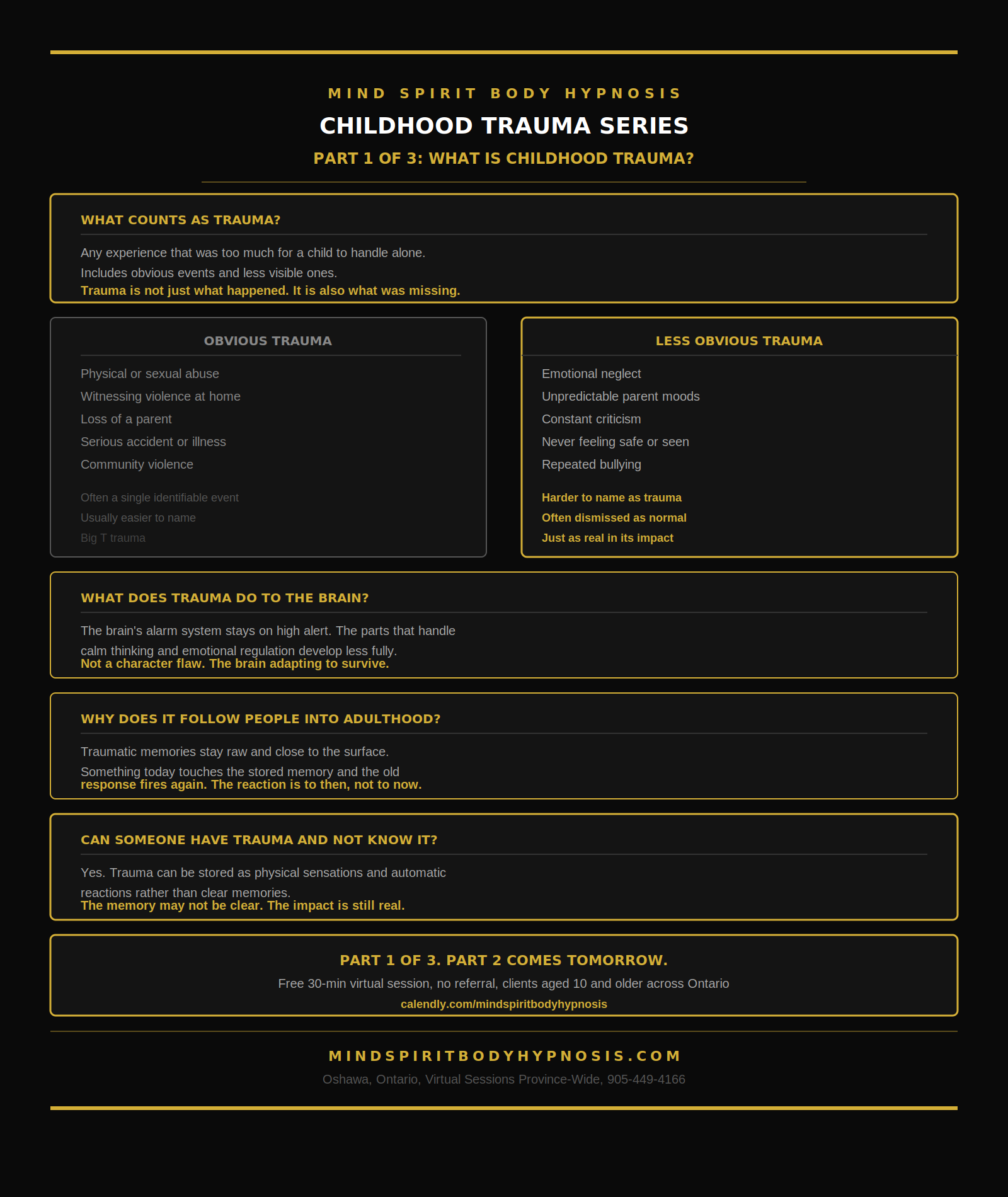
Childhood trauma is any experience that was too much for a child to handle alone.
That can include obvious things:
Physical abuse
Sexual abuse
Witnessing violence at home or in the community
Losing a parent or sibling
A serious accident or illness
But it also includes less obvious things:
Emotional neglect: growing up feeling invisible, unimportant, or like your feelings did not matter
A parent who was depressed, anxious, or struggling with addiction
A home where there was a lot of yelling, tension, or unpredictability
Being bullied repeatedly at school
Moving frequently and losing friendships and stability
Being compared constantly to a sibling
Growing up with a parent who was cold, critical, or hard to please
The key word is overwhelming. If an experience was too big for the child to make sense of, too big for them to feel safe through, that is what creates a traumatic imprint.
⭐ Pro Tip: A useful way to think about trauma is this: it is not just what happened to you. It is also what did not happen. Growing up without someone who made you feel seen, safe, and important even if nothing obviously bad occurred can leave the same kind of mark as something more visible. Absence can be just as wounding as harm.
Does It Have to Be Something Big?
No. And this is one of the most important things to understand.
People often minimize their experience. They say things like: other people had it worse, or it was not that bad, or I should just be over it by now.
But the nervous system of a child does not compare. It does not say "this is only a four out of ten, so I will only respond a little." It responds to what it experiences as threatening or overwhelming, full stop.
An emotionally unavailable parent, who never said I love you, or who criticized everything the child did, is not a small thing to a child. Connection and safety are survival needs for children. When those needs are not met, the nervous system responds accordingly.
Therapists sometimes talk about Big T trauma and Small T trauma.
Big T trauma is a single dramatic event: an accident, an assault, a sudden loss.
Small T trauma is an ongoing pattern: constant criticism, emotional unavailability, growing up walking on eggshells. Small T trauma is often harder to name. But it can leave just as deep a mark.
Both are real. Both can be healed.
What Does Childhood Trauma Do to the Brain?
When a child experiences something threatening or overwhelming, the brain's alarm system fires. This is the part of the brain called the amygdala. It sends the body into fight, flight, or freeze the survival response.
In a safe environment, this alarm settles down once the threat passes. The child is comforted. They feel safe again. The nervous system returns to normal.
But when the threat is ongoing, or when the child has no one to help them feel safe again, the alarm does not settle. The brain stays on high alert. It learns that the world is not safe, that people cannot be trusted, that it needs to stay watchful.
Over time, this changes how the brain develops. The parts of the brain involved in fear and threat detection become more active. The parts involved in calm thinking, decision-making, and emotional regulation develop less fully.
This is not a character flaw. It is the brain doing the best it can with what it was given.
Research using brain imaging has shown that children who experience chronic trauma have measurable differences in brain structure and function compared to those who did not, particularly in areas related to stress response, memory, and emotional regulation (van der Kolk, 2014, The Body Keeps the Score).
Why Does It Follow People Into Adulthood?
Because the brain stores traumatic experiences differently from ordinary memories.
A normal memory gets filed away as something that happened in the past. It might be sad or happy to think about, but it stays in the past.
A traumatic memory is stored differently. It stays raw. It can feel present-tense rather than past-tense. The brain keeps it close to the surface because it has filed it as unresolved, as something that might still be a threat.
This is why something in the present can suddenly make a person feel a rush of fear, shame, or panic that seems out of proportion to what is happening right now. The present moment has triggered the stored trauma. The nervous system responds as if the old event is happening again.
This is not weakness. It is the brain doing its job, protecting the person from something it still sees as dangerous.
For more on how trauma responses develop and how they are addressed through hypnotherapy, the EMDR and trauma therapy page covers the clinical approach in detail.
⭐ Pro Tip: One of the clearest signs that childhood trauma is still active in adult life is a reaction that feels too big for the situation. When something small a tone of voice, a look on someone's face, a particular smell produces a strong emotional response, the present moment has likely touched a stored memory. The reaction is not about now. It is about then.
Is It Possible to Have Trauma and Not Know It?
Yes. This is more common than most people realize.
Some people have no clear memory of what happened. Traumatic experiences, especially from early childhood, are not always stored as clear narrative memories. They can be stored as physical sensations, emotional states, or automatic behaviours instead.
A person may have no idea why they feel anxious in certain situations, why they shut down when someone raises their voice, or why intimacy is difficult because they do not have a clear memory of the event that created those responses.
Others know something difficult happened but do not see it as trauma. They minimized it at the time. They told themselves it was fine, that they coped, that plenty of people had it worse. The minimizing was a way of surviving. But it does not mean the impact was not real.
And some people simply grew up in environments that felt normal to them, even if those environments were not healthy. When something is all you know, it does not always register as wrong until much later.
This is why the question in trauma-informed work is not only "what happened to you" but also "what does it feel like to be you now?" The current experience the anxiety, the difficulty trusting people, the way certain moments hit harder than they should points toward what needs to be healed, even when the original event is not clearly in view.
Part 2 of this series covers how childhood trauma shows up in adult daily life. Part 3 covers how hypnotherapy helps heal it.
For more on how anxiety as a symptom of unresolved childhood trauma is addressed at Mind Spirit Body Hypnosis, the hypnotherapy for anxiety and stress pillar page covers the nervous system foundations.

What My Clients Say
"I began seeing Fanis after a long battle with trauma and grief. I suffered from severe anxiety, panic attacks, insomnia and self-harm. After 3 months of weekly hypnotherapy sessions done online, I no longer suffer from panic attacks, insomnia, or self-harm and have learned how to better regulate my emotions and find peace. Fanis helped me process many childhood traumas and confront my overwhelming grief. I am eternally grateful to Fanis and his wonderful work."
Sara V. | Trauma and Grief | Five Stars
FAQ
What counts as childhood trauma? Any experience that was too much for a child to handle alone. This includes obvious events like abuse or loss, and less visible ones like emotional neglect, a critical parent, or growing up in an unpredictable home.
Does trauma have to be something dramatic? No. Ongoing emotional neglect, constant criticism, or an unstable home environment can leave just as deep a mark as a single dramatic event. The nervous system does not compare it responds to what it experiences as unsafe or overwhelming.
What does childhood trauma do to the brain? It keeps the brain's alarm system more active than it should be. Over time, this affects how the brain develops, particularly in areas related to stress response, emotional regulation, and memory. These are measurable differences, not character flaws.
Why does childhood trauma affect adults? Because traumatic memories are stored differently from ordinary ones. They stay raw and close to the surface. They can feel present-tense rather than past-tense. Something in the present triggers the stored memory, and the old emotional response fires again.
Can someone have trauma and not know it? Yes. Trauma can be stored as physical sensations, emotional states, or automatic behaviours rather than clear memories. Many people minimize what happened or grew up in environments that felt normal even when they were not.
Is it too late to heal from childhood trauma? No. The brain is capable of change at any age. Trauma that has been stored for decades can be processed and its impact reduced through effective therapeutic work.
How do I know if I need help? If you have reactions that feel too big for the situation, difficulty trusting people, patterns in relationships you cannot change, or a general sense of carrying something heavy, these are signals worth exploring.
How do I get started? Book a free 30-minute virtual strategy session at calendly.com/mindspiritbodyhypnosis. No referral needed.
Ready to Take the Next Step?
You do not need to have it all figured out before you reach out. You just need to notice that something is not right.
I offer a free 30-minute virtual strategy session for new clients across Ontario. No pressure. No judgment. Just a conversation.
Book your free session: calendly.com/mindspiritbodyhypnosis
Call or text: 905-449-4166
Email: info@mindspiritbodyhypnosis.com
Visit: mindspiritbodyhypnosis.com
Serving clients virtually across Ontario, including Durham Region, Toronto, Ontario, and beyond.
Disclaimer: This article is for informational purposes only. It is not medical or psychological advice. If you are in crisis, please get in touch with the 988 Suicide Crisis Helpline or go to your nearest emergency room. Results vary by individual.
Written by Fanis Makrigiannis | Certified Hypnotherapist and NLP Master Practitioner | Mind Spirit Body Hypnosis.