How childhood trauma shows up in adult life
How Childhood Trauma Shows Up in Adult Life (Part 2 of 3)
TL;DR: Childhood trauma does not stay in childhood. It travels forward in time. It shows up in how you respond to stress, how you handle relationships, and in reactions that feel bigger than the situation seems to warrant. This is Part 2 of a three-part series. Part 1 covered what childhood trauma is. This part covers how it shows up in daily adult life.
Quick Answer
Childhood trauma can show up as anxiety, difficulty trusting people, emotional numbness, big reactions to small things, people-pleasing, self-criticism, and patterns in relationships that repeat no matter how hard you try to change them. Most people do not connect these daily struggles back to what happened in childhood because the connection is not always obvious. At Mind Spirit Body Hypnosis in Oshawa, Ontario, Fanis Makrigiannis, a Certified Hypnotherapist and NLP Master Practitioner, works with adults across Ontario to understand and address the roots of these patterns through virtual sessions.
Questions This Article Answers
Why do small things trigger big reactions in me?
Why do I find it hard to trust people?
Why do I always expect something bad to happen?
Why do I feel numb or disconnected?
Why do I repeat the same relationship patterns?
In This Article:
You are in a conversation, and someone uses a certain tone of voice. Your stomach drops. Your heart speeds up. You feel a wave of shame or anger or fear that seems way too big for what just happened.
Or someone cancels plans and something in you spirals. You cannot fully explain why it hits so hard. You just know it does.
Or you find yourself exhausted from always trying to make everyone around you okay. You put other people's feelings first constantly. You say yes when you mean no. You are not sure when that started.
These are not personality quirks. They are patterns. And for a lot of adults, they trace back directly to what happened in childhood.
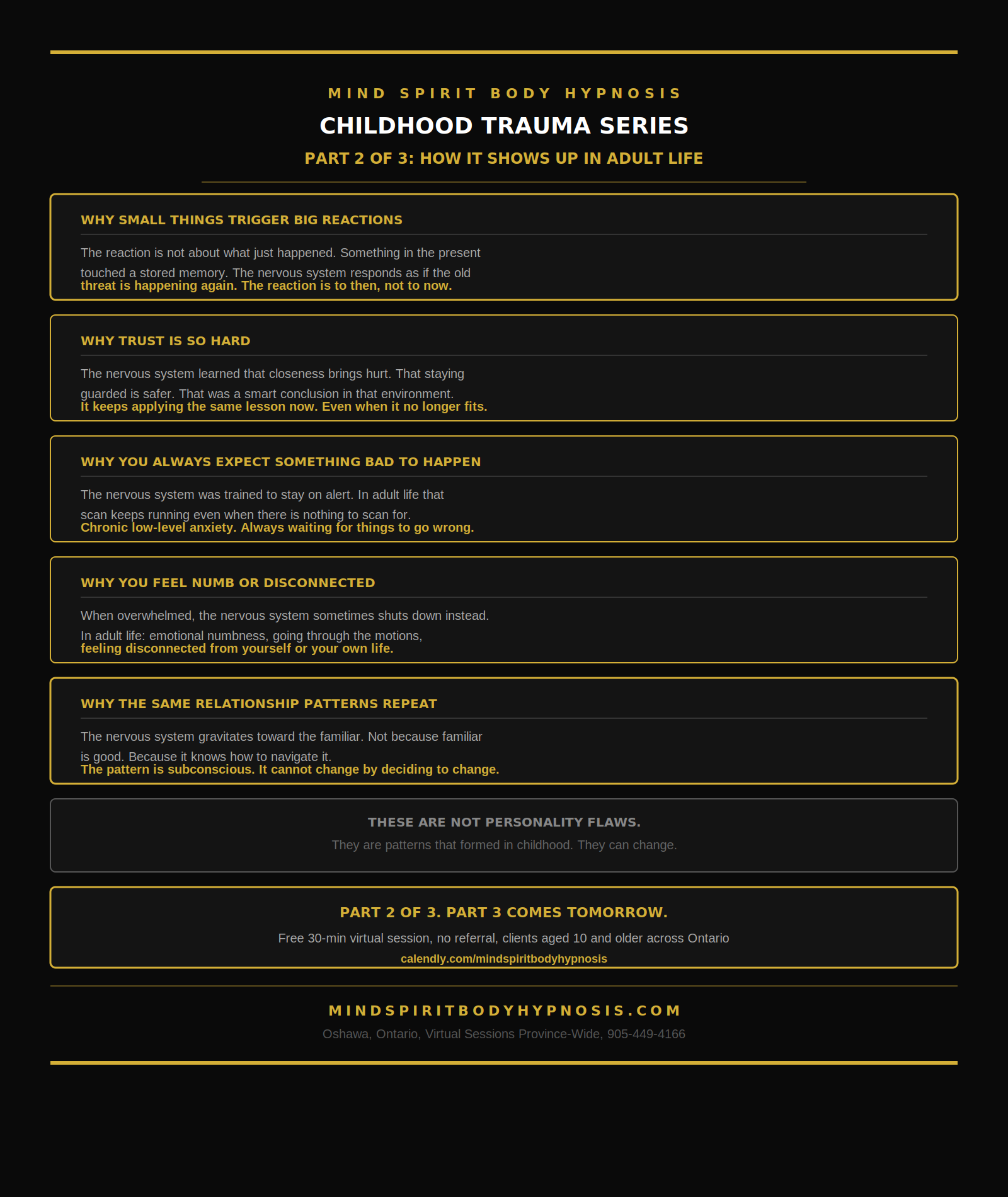
Why Small Things Trigger Big Reactions
In Part 1, we looked at how the brain stores traumatic memories differently. They do not get filed away as the past. They stay close to the surface, unresolved.
So when something in the present touches one of those stored memories a tone of voice, a look on someone's face, being ignored, conflict starting to build the brain responds as if the old threat is happening again.
The present moment is not the problem. The stored memory is the problem. But the stored memory fires automatically, before any conscious thought gets involved.
This is why the reaction feels out of proportion. It is not a reaction to what is happening now. It is a reaction to what happened then.
And it is not a choice. It is not weakness. It is the nervous system doing exactly what it was trained to do: protect you from something it still sees as dangerous.
⭐ Pro Tip: When a reaction feels bigger than the situation seems to call for, try asking: what does this remind me of? Not in an analytical way, just gently notice. Often there is an older version of the same feeling underneath. That older feeling is what needs the attention, not just the current situation.
Why Trust Is Hard
When a child grows up in an environment where the people around them were not safe, where a parent was unpredictable, where love was conditional, where promises were broken, the nervous system learns something important.
It learns that people are not reliable. That closeness brings hurt. That it is safer to stay a little distant, to not need too much, to not fully let people in.
That was a smart, protective conclusion to draw in that environment. In a household where the adults could not be counted on, staying guarded made sense.
But the nervous system keeps applying that conclusion in adult life. Even when the current people in your life are actually trustworthy, something holds back. Something monitors. Something waits for the moment things will go wrong.
This is not being difficult. It is an old protection strategy still running.
Why You Always Expect Something Bad to Happen
When a child grows up in an unsafe or unpredictable environment, the nervous system learns to stay on alert.
It scans for danger. It reads other people's moods carefully. It prepares for things to go wrong so the blow will not come as a complete surprise.
In adulthood, this shows up as chronic low-level anxiety. A sense of dread that does not have a clear source. Difficulty relaxing fully even when things are going well. Always waiting for the other shoe to drop.
The person may not even realize this is happening. It has been their normal for so long that they assume everyone feels this way.
They do not. The constant background anxiety is the nervous system still running the old scan even though the environment it was built for no longer exists.
Research on childhood trauma consistently shows that early adverse experiences are one of the strongest predictors of adult anxiety disorders, particularly generalized anxiety and hypervigilance, which involve exactly this pattern of chronic low-level threat monitoring (Heim & Nemeroff, 2001).
For more on how trauma-driven anxiety is addressed at Mind Spirit Body Hypnosis, the hypnotherapy for anxiety and stress pillar page covers the nervous system mechanisms.
Why You Feel Numb or Disconnected
Not all trauma responses look like anxiety. Some look like the opposite.
When the nervous system is overwhelmed and cannot fight or flee, it sometimes shuts down instead. This is the freeze response. It is the body's last line of protection.
In adult life, this shows up as emotional numbness. A sense of going through the motions. Feeling disconnected from yourself or from other people. Difficulty feeling joy, excitement, or emotion in situations where you feel you should.
Some people describe it as living behind glass; they can see life happening but cannot quite feel it.
This is not depression in the conventional sense, though it can look similar. It is the nervous system that learned to protect itself by switching off. The switch-off was useful once. In adult life, it creates a different kind of suffering: the suffering of not being fully present for your own life.
⭐ Pro Tip: Emotional numbness and disconnection are often the body's way of saying: there is something here that has not been felt yet. Rather than pushing for emotion, the most useful starting point is simply noticing -- what does my body feel right now? Just paying attention to physical sensation, without trying to force feeling, is often the gentlest entry point back to the self.
Why the Same Relationship Patterns Repeat
This is one of the most painful features of unhealed childhood trauma. People find themselves in the same kinds of relationships again and again, with the same dynamic, the same pain, the same ending, even when they can see the pattern clearly.
The reason is that the nervous system gravitates toward the familiar. Not because familiar is comfortable; it often is not. But because familiar is what it knows how to navigate.
A child who grew up with a critical parent learned to manage that kind of relationship. They know the terrain. In adulthood, something in them recognizes that terrain that critical energy, that dynamic of seeking approval, that particular kind of emotional withdrawal and moves toward it. Not consciously. Not because they want to be hurt. Because the nervous system is doing what it always does: finding what it knows.
This is also why changing the pattern is so hard from the outside. A person can know intellectually that they keep choosing unavailable partners, keep taking on too much responsibility, keep over-functioning in relationships and still find themselves doing it again because the pattern is subconscious. It is driven by the old nervous system programme, not by conscious choice.
For more on how the trauma roots of relationship patterns and self-sabotage are addressed through hypnotherapy, the EMDR and trauma therapy page covers the clinical approach.
Part 3 of this series covers how hypnotherapy actually helps heal all of this, and what sessions look like at Mind Spirit Body Hypnosis. More about the approach is available on the about page.
What My Clients Say
"Working with Fanis has changed my life. After years of therapy for anxiety and confidence issues, I wanted to try something different. This experience has transformed me from the inside out and continues to have an effect even after our sessions. I am now able to be myself, face my fears, surround myself with those who care about me and live a fulfilling and happy life. So grateful."
Kristen W. | Anxiety and Confidence | Five Stars
FAQ
Why do small things trigger big reactions in me? Because the reaction is not really about the small thing. Something in the present moment has touched a stored traumatic memory, and the nervous system responds as if the old situation is happening again. The reaction is to then, not to now.
Why is it hard for me to trust people? Because your nervous system learned in childhood that the people closest to you were not reliably safe. That was a smart conclusion in that environment. It keeps applying the same conclusion now, even when current people in your life are actually trustworthy.
Why do I always feel like something bad is about to happen? Because the nervous system learned to stay on alert. It was trained in an environment where danger was possible at any time. In adulthood, it keeps scanning even when there is nothing to scan for. This is not anxiety in your imagination. It is a trained nervous system response.
Why do I feel numb or disconnected? Because the nervous system learned to protect itself by switching off when things got too overwhelming. In adult life, that switch-off continues. It is not a personal failing. It is a protection strategy that has outlived the environment it was built for.
Why do I keep repeating the same relationship patterns? Because the nervous system gravitates toward the familiar. Not because familiar is good, but because it knows how to navigate it. The pattern is subconscious and cannot be changed simply by deciding to change it. It needs to be addressed at the level where it operates.
Can these patterns actually change? Yes. They are not permanent features of who you are. They are learned responses that developed in a specific context. They can be unlearned and replaced with more functional patterns through direct subconscious work.
How do I get started? Book a free 30-minute virtual strategy session at calendly.com/mindspiritbodyhypnosis. No referral needed.
Ready to Take the Next Step?
If any of these patterns feel familiar, that recognition matters. It is the beginning of understanding what has been driving things and what can actually change.
Book your free session: calendly.com/mindspiritbodyhypnosis
Call or text: 905-449-4166
Email: info@mindspiritbodyhypnosis.com
Visit: mindspiritbodyhypnosis.com
Serving clients virtually across Ontario, including Durham Region, Toronto, Ontario, and beyond.
Disclaimer: This article is for informational purposes only. It is not medical or psychological advice. If you are in crisis, please get in touch with the 988 Suicide Crisis Helpline or go to your nearest emergency room. Results vary by individual.
Written by Fanis Makrigiannis | Certified Hypnotherapist and NLP Master Practitioner | Mind Spirit Body Hypnosis.