Can hypnosis help with Perfectionism?
Hypnotherapy for Perfectionism in Ontario: Your Questions Answered
TL;DR: Perfectionism is not a character trait, not a work ethic, and not a strength that occasionally goes too far. It is a subconscious protection mechanism that developed in a specific context and has been running as a strategy ever since, a strategy that produces anxiety, burnout, procrastination, and the constant experience of never being quite enough, regardless of what is achieved. At Mind Spirit Body Hypnosis in Oshawa, Ontario, the five questions people ask most about perfectionism and hypnotherapy are answered here, directly and without the productivity-culture framing that makes perfectionism so difficult to question.
Quick Answer
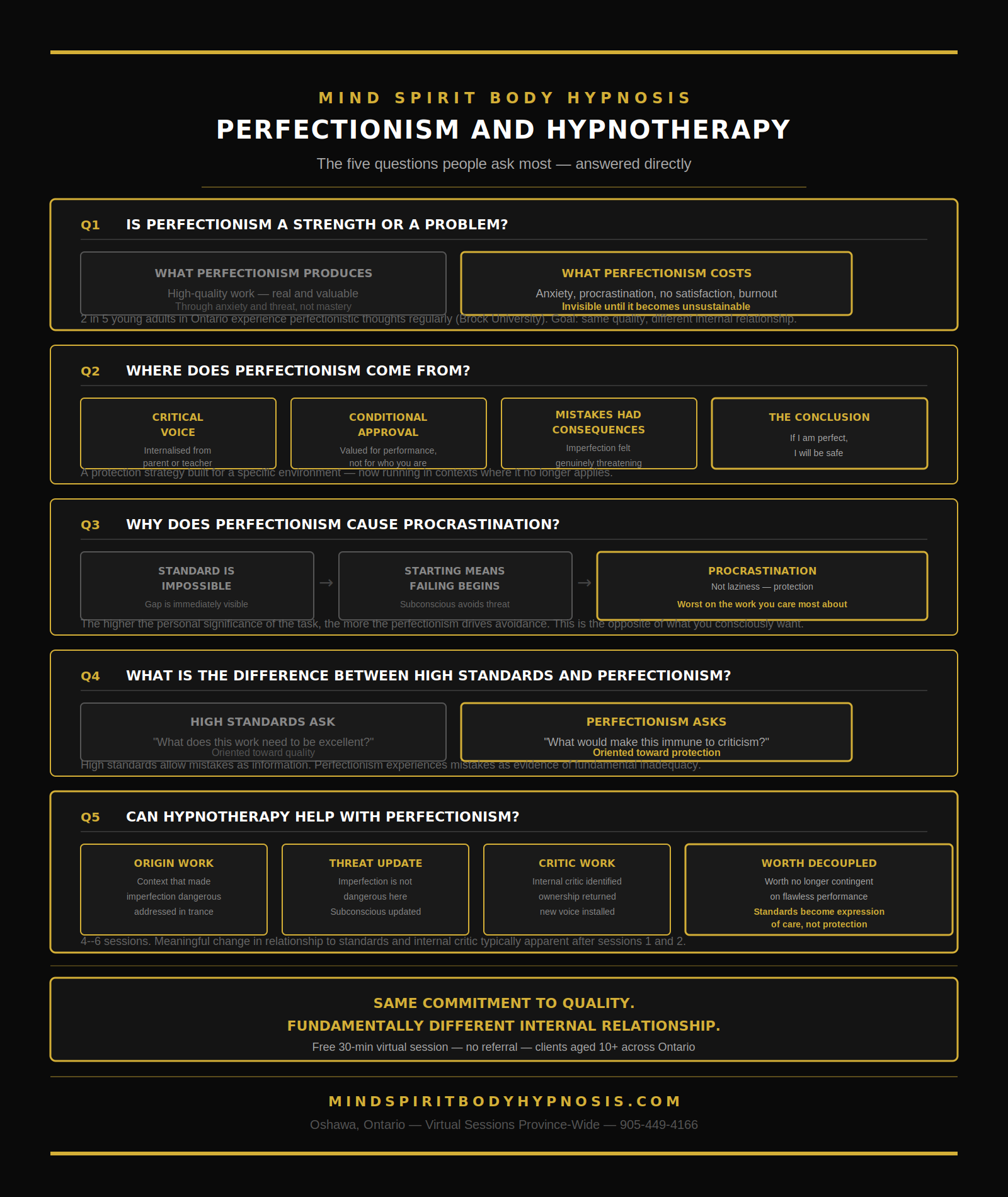
Perfectionism is a subconscious strategy for managing the threat of criticism, rejection, or failure, built from specific formative experiences and now operating automatically as a demand for impossibly high standards to feel safe. Research from Brock University found that two in five young adults in Ontario report experiencing perfectionistic thoughts regularly, making it one of the most common patterns presented in clinical practice in the province. Hypnotherapy addresses perfectionism at the subconscious level where the threat-protection mechanism operates, changing the relationship between the person's sense of safety and the impossibility of flawlessness. At Mind Spirit Body Hypnosis in Oshawa, Ontario, Fanis Makrigiannis, a Certified Hypnotherapist and NLP Master Practitioner, offers virtual sessions province-wide for clients of all ages ready to do excellent work without the cost of permanent internal pressure.
Questions This Article Answers
Is perfectionism a strength or a problem?
Where does perfectionism come from?
Why does perfectionism cause procrastination?
What is the difference between high standards and perfectionism?
Can hypnotherapy help with perfectionism?
In This Article:
Perfectionism has excellent public relations. In professional contexts, it is often presented as a strength, and people who are perfectionists have frequently been told, explicitly or by implication, that the standard they hold themselves to is admirable. The perfectionist learns to experience their perfectionism as synonymous with their competence, their professionalism, their work ethic. To question it feels like questioning whether they care enough.
This is part of what makes perfectionism so difficult to address. It does not present as a problem the way anxiety or depression does. It presents as a high standard, and high standards are supposed to be valuable. The cost of the high standard- the anxiety, the never-quite-enough feeling, the procrastination, the exhaustion, the inability to feel satisfied by anything produced these are experienced as personal failings rather than as consequences of the perfectionism itself.
In my practice, clients who arrive for perfectionism work often do so obliquely; they arrive for anxiety, or procrastination, or the inability to rest, or the sense that they are never quite good enough despite considerable objective evidence to the contrary. The perfectionism reveals itself in the course of the first session as the organizing principle underlying all of it.
Is Perfectionism a Strength or a Problem?
This is the question that perfectionists ask most defensively, and it deserves a genuinely honest answer rather than one that simply validates either position.
Perfectionism is not a strength. It is a protection strategy that produces results in specific contexts while extracting a high and often invisible cost in others.
The results perfectionism produces are real. High-quality work, meticulous attention to detail, and the consistent effort to improve and refine these are genuinely valuable. The perfectionist often does produce excellent work. This is why perfectionism is so difficult to relinquish: it appears to be working. The work is good. The standards are met. The criticism does not arrive.
What the perfectionist typically does not account for is the cost of maintaining the strategy. The chronic anxiety that accompanies the gap between the current output and the impossible standard. The inability to submit, finish, or release work because it is never quite ready. The absence of genuine satisfaction even when the work is objectively excellent, because the internal standard has already moved. The relational cost of perfectionism in others: the expectation of the same impossibility, the difficulty tolerating the reasonable imperfection of collaborators. The burnout that arrives when the effort required to maintain the standard finally exceeds the available resources.
Perfectionism produces good work through anxiety and threat rather than through genuine mastery and engagement. This distinction matters because the former has a ceiling: anxiety-driven performance eventually exhausts itself while the latter does not.
The goal of hypnotherapy for perfectionism is not to produce lower standards. It is to produce the same commitment to quality through a fundamentally different internal relationship, one driven by genuine care for the work rather than by the threat of what happens if the standard is not met.
⭐ Pro Tip: The clearest test of whether your high standards are perfectionism or genuine excellence orientation is what you feel in the moment of completing something to a high standard. Genuine high standards produce a quality of quiet satisfaction, even briefly, when the work is done well. Perfectionism produces a pivot to the next thing, an inability to register satisfaction because the standard has already moved or because the relief of finishing is immediately replaced by the anxiety of what comes next. If you cannot remember the last time you genuinely felt satisfied by your own work, that is perfectionism.
Where Does Perfectionism Come From?
Perfectionism is always a learned strategy, and it almost always develops in a context where the stakes of imperfection were genuinely high.
When children grow up with harsh criticism, high expectations, or emotional unpredictability, they may begin striving for perfection as a way to prevent negative reactions or gain approval. When a child's emotional needs are not consistently met, they may internalize the belief that acceptance depends on performance: if I do everything right, I will be accepted. If I do not make mistakes, I will not be rejected. If I am perfect, I will be safe.
In this context, perfectionism is not irrational. It is the most intelligent available response to a specific environment. The child who learns that imperfection produces criticism, withdrawal of love, or punishment develops perfectionism as a protective adaptation, a reliable strategy for managing an environment that responded badly to anything less than the required standard.
The specific origins of perfectionism in clinical practice take several common forms:
Highly critical significant others. A parent, teacher, or authority figure whose critical voice was more consistent and more emotionally charged than their affirming one. The child internalizes this voice, and it continues operating as the internal critic long after the source is no longer present. The internal critic is not the person's own voice. It is a borrowed one that has become so familiar it feels native.
Conditional approval tied to performance. Environments in which love, praise, or belonging were consistently contingent on achievement. The implicit message: you are valued for what you produce, not for who you are. The child concludes that the only route to acceptance is performance, and that performance must be perfect to be safe.
Environments where mistakes had significant consequences. Families in which emotional volatility, public shaming, or disproportionate reactions to error created a genuine threat around imperfection. The perfectionism that develops in this context is acutely threat-driven, not just a preference for quality but a genuine strategy for safety.
Social comparison and competitive environments. Contexts in which worth was explicitly measured by relative ranking among siblings, in academic or sporting competition, in environments where success was zero-sum. The perfectionism that develops here is comparative: not just about the standard itself but about always needing to be better than.
The high-achieving family system. Families where success was the primary currency of identity and belonging, where the implicit expectation of high performance was never explicitly stated but pervasively felt. The perfectionism here is often the most invisible, because it presents not as trauma but as aspiration, and the person has no clear formative moment to point to, only the diffuse sense that ordinary has never been enough.
For more on how formative experiences establish subconscious belief systems that drive perfectionism and self-sabotage, the hypnotherapy for self-sabotage pillar page covers the foundational mechanisms.
Why Does Perfectionism Cause Procrastination?
This is the question that surprises people most, because the relationship between perfectionism and procrastination appears contradictory. If the perfectionist cares so much about quality, why do they avoid starting or finishing?
The answer reveals one of the most important things about perfectionism: it is not primarily about quality. It is primarily about the avoidance of the experience of failure.
The procrastination that perfectionism produces is a form of protection. If the work is not started, it cannot fail. If the work is not finished, it cannot be evaluated and found wanting. The procrastination is not laziness or a lack of motivation; the perfectionist is typically intensely motivated and often feels acutely guilty about the procrastination, which produces additional anxiety, which makes starting even harder. The procrastination is the subconscious protection strategy doing what it was designed to do: keeping the person out of situations where failure, criticism, or inadequacy might occur.
This produces the characteristic perfectionism-procrastination cycle: the standard is impossibly high, starting requires being in a position where the gap between the standard and the current output is immediately visible, the discomfort of that gap triggers avoidance, the avoidance produces guilt and time pressure, the time pressure eventually forces a start, the work is completed under stress rather than with the quality the perfectionist wanted to produce, the output does not meet the impossibly high standard, and the conclusion drawn is not that the standard was unrealistic but that more effort and higher standards are required next time.
Research on perfectionism consistently identifies procrastination as one of its most reliable expressions, particularly in high-stakes situations where the stakes of imperfection are felt most acutely. The higher the personal significance of the task, the more the perfectionism drives avoidance, which is the opposite of what the person consciously wants and another indicator that the pattern is subconscious rather than deliberate (Flett & Hewitt, 2002, Perfectionism: Theory, Research and Practice).
⭐ Pro Tip: If you notice that procrastination is most severe on the projects you care most about the ones where the quality genuinely matters to you, where your reputation or identity is most invested that is perfectionism-driven procrastination rather than a general avoidance pattern. The high stakes increase the threat of imperfection, which increases the avoidance. The work you care most about is often the work you start latest and finish under the most stress. Identifying this pattern is the beginning of addressing it.
What Is the Difference Between High Standards and Perfectionism?
This distinction is the most practically important one for people beginning to question their relationship with their own standards, and it is one that genuine high achievers often resist because they have spent years conflating the two.
High standards are a commitment to quality that is proportionate, responsive to context, and compatible with completion and satisfaction. The person with high standards produces excellent work, can distinguish between what requires their highest effort and what requires good enough, can complete work and feel genuine satisfaction when it meets the standard, and can tolerate the natural imperfection of work in progress without being paralyzed by it.
Perfectionism is a rigid demand for an impossible standard across most or all contexts, driven not by genuine care for the work but by the anxiety of what happens if the standard is not met. It is incompatible with completion because no completed work ever fully meets the internal standard. It is incompatible with satisfaction because satisfaction requires the standard to feel met and the perfectionist's standard consistently moves. And it is incompatible with genuine risk-taking because perfectionism drives avoidance of any situation where failure is possible.
Here is the most practical distinction: high standards ask "what does this work need to be excellent?" Perfectionism asks "what would make this work immune to criticism?"
These are fundamentally different questions. The first is oriented toward quality. The second is oriented toward protection. High standards produce genuinely excellent work. Perfectionism produces work that is defended rather than offered and often work that is never released at all.
The relationship with mistakes is perhaps the clearest differentiator. High standards allow for mistakes as information -- as data about how to improve, opportunities to learn, normal features of a process of becoming more skilled. Perfectionism experiences mistakes as evidence of fundamental inadequacy, as confirmation of the not-enough belief that underlies the protection strategy.
Can Hypnotherapy Help With Perfectionism?
Yes, and specifically because hypnotherapy addresses the subconscious protection mechanism that drives perfectionism rather than the conscious standards that express it.
Perfectionism is maintained at the subconscious level by a threat assessment: imperfection is dangerous. The danger might be criticism, rejection, loss of belonging, or the catastrophic confirmation of the not-enough belief. Whatever the specific threat, the subconscious has learned to treat the possibility of imperfection as genuinely threatening and to respond with the full protection mechanism: anxiety, avoidance, the internal critic, the impossible standard that perfectionism represents.
Addressing perfectionism at the conscious level challenging the standards, developing more realistic expectations, practising self-compassion is valuable but operates above the level of the threat mechanism. The subconscious threat assessment remains unchanged. The person knows consciously that the standard is unrealistic. The anxiety fires anyway.
Hypnotherapy changes the threat assessment itself. In trance, the original context in which imperfection became genuinely threatening is identified and addressed. The subconscious is updated with the understanding that its current environment is not the same as the environment that produced the protection strategy; that imperfection in the current context does not carry the consequences it carried when the strategy was learned. And a new and more accurate operating assumption is installed: that genuine quality and genuine effort are sufficient, that the person's worth is not contingent on flawlessness, and that completion is more valuable than perfection.
NLP techniques provide additional tools for specific perfectionism presentations. The internal critic voice is identified, examined, and changed in its authority, location, and ownership. The procrastination pattern is interrupted and replaced with a more functional starting response. The impossible standard is made visible as a structure with specific submodality qualities, and those qualities are changed directly, making the standard more proportionate and more responsive to context.
For more on how anxiety as the driver of perfectionism is addressed alongside the perfectionism work, the hypnotherapy for anxiety and stress pillar page covers the nervous system mechanisms that perfectionism activates.

How the Work Is Done at Mind Spirit Body Hypnosis
The approach to perfectionism at Mind Spirit Body Hypnosis has four components:
Origin work. The specific context in which perfectionism developed as a protection strategy is identified and addressed in trance. The formative experience of what imperfection cost the criticism received, the approval withdrawn, the belonging threatened is revisited with adult resources. The subconscious is updated with the understanding that the strategy was intelligent in that context and that the current context is fundamentally different.
Threat assessment updating. The subconscious belief that imperfection is dangerous is directly addressed. Not by arguing that mistakes are fine this is what the perfectionist already consciously knows but by changing the subconscious experience of what imperfection means about the person and what consequences it actually carries. The threat assessment is updated to be proportionate to current reality.
Internal critic work. The perfectionist's internal critic the voice that is never satisfied, that points to every flaw, that preemptively delivers the harshest possible evaluation of every output is identified, examined, and changed. Its authority is addressed, its ownership is clarified as borrowed rather than inherent, and a more functional internal voice is installed to replace it.
Identity and worth decoupling. The most fundamental work: separating the person's sense of worth from the quality of their output. The subconscious belief that worth is contingent on performance that the person is only as valuable as their last achievement, only as safe as the absence of criticism is addressed directly and replaced with a more accurate and functional identity: one whose worth is unconditional and whose standards are an expression of genuine care rather than a management of existential threat.
Most perfectionism programmes at Mind Spirit Body Hypnosis run between four and six sessions, with meaningful change in the relationship to standards and the internal critic typically apparent after sessions one and two. All sessions are delivered virtually, available to clients aged 10 and older across Ontario. More about the approach is available on the about page.
What to Expect at Mind Spirit Body Hypnosis
The first session is a conversation. Where does the perfectionism show up most reliably? What does the internal critic say and when does it say it loudest? What is the specific experience of completing something and releasing it? What does procrastination look like and on which projects is it worst? And what would change in work, in relationships, in daily experience if the standard were proportionate and the work could be done without the chronic internal pressure?
This mapping is thorough because perfectionism expresses differently in different people. Some clients' perfectionism is primarily about work output. Others experience it most acutely in relationships, in how they present themselves socially, in their parenting, or in their body. The specific expression of the perfectionism determines the most effective programme.
What My Clients Say
"I cannot say enough about how amazing Fanis is! He has truly changed my life. I was always an anxious person and always overthinking everything. After seeing Fanis I feel like a completely different person. The anxiety is gone and my mind is actually quiet for the first time in my life. I am forever grateful."
Amanda B. | Anxiety and Overthinking | Five Stars
"Working with Fanis has changed my life. After years of therapy for anxiety and confidence issues, I wanted to try something different. This experience has transformed me from the inside out and continues to have an effect even after our sessions. I am now able to be myself, face my fears, surround myself with those who care about me and live a fulfilling and happy life. So grateful."
Kristen W. | Anxiety and Confidence | Five Stars
FAQ
Is perfectionism a strength? Perfectionism produces results through anxiety and threat rather than through genuine mastery and engagement. The quality is real. The cost chronic anxiety, procrastination, inability to feel satisfied, burnout is also real and often invisible until it becomes unsustainable. The goal of hypnotherapy is not lower standards but the same commitment to quality through a fundamentally different internal relationship.
Where does perfectionism come from? From specific formative environments in which imperfection carried genuine consequences: critical significant others, conditional approval, environments where mistakes were shamed or punished. Perfectionism is an intelligent protection strategy developed in a specific context. It is always learned, and because it was learned, it can be changed.
Why does perfectionism cause procrastination? Because if the work is not started, it cannot fail. Perfectionism-driven procrastination is protection from the experience of imperfection, not laziness. The higher the personal stakes of the project, the more the perfectionism drives avoidance. The procrastination is worst on the work that matters most.
What is the difference between high standards and perfectionism? High standards ask: what does this work need to be excellent? Perfectionism asks: what would make this work immune to criticism? High standards produce genuinely excellent work. Perfectionism produces work that is defended rather than offered, and often work that is never completed at all.
Can hypnotherapy help with perfectionism? Yes. Hypnotherapy changes the subconscious threat assessment that drives perfectionism the belief that imperfection is dangerous rather than the conscious standards that express it. The origin, the internal critic, the worth-performance link, and the impossible standard are all addressed directly at the subconscious level where they operate.
How many sessions will I need? Most perfectionism programmes at Mind Spirit Body Hypnosis run four to six sessions. Meaningful change in the relationship to standards and the internal critic is typically apparent after sessions one and two. Perfectionism with deep roots in significant early experience may require additional sessions.
Is perfectionism related to anxiety? Yes, very directly. Perfectionism is driven by the anxiety of what happens if the standard is not met, and it produces chronic anxiety as a consequence of the impossible gap between the current output and the required standard. Addressing perfectionism and anxiety together produces the most effective and lasting outcomes.
Can I do sessions virtually from anywhere in Ontario? Yes. All sessions are delivered virtually, province-wide, with no referral required.
How do I get started? Book a free 30-minute virtual strategy session at calendly.com/mindspiritbodyhypnosis. No referral needed
Ready to Take the Next Step?
If you have been achieving at a high level and still feel like nothing you do is quite enough, the problem is not your standards. It is the threat mechanism underneath them. That is what hypnotherapy changes.
I offer a free 30-minute virtual strategy session for new clients across Ontario. No pressure. Just an honest conversation about what perfectionism has been costing you and what a different relationship with your own standards might feel like.
Book your free session: calendly.com/mindspiritbodyhypnosis
Call or text: 905-449-4166
Email: info@mindspiritbodyhypnosis.com
Visit: mindspiritbodyhypnosis.com
Serving clients virtually across Ontario, including Durham Region, Toronto, Ontario, and beyond.
Disclaimer: This article is for informational purposes only and does not constitute medical or psychological advice. Hypnotherapy and NLP are complementary approaches and are not a substitute for diagnosis or treatment by a qualified healthcare provider. Results vary by individual.
Written by Fanis Makrigiannis | Certified Hypnotherapist & NLP Master Practitioner | Mind Spirit Body Hypnosis.