Can hypnotherapy help with ptsd?
Can Hypnotherapy Help With PTSD?
TL;DR: PTSD is not a memory problem. It is a nervous system problem in which the brain has filed a traumatic experience as ongoing present-tense danger rather than past-tense history, and it responds accordingly every time a trigger is encountered. At Mind Spirit Body Hypnosis in Oshawa, Ontario, Fanis Makrigiannis uses hypnotherapy and EMDR to help the nervous system complete what it could not complete at the time of the trauma, helping clients of all ages across the province move through the world without the past constantly breaking into the present.
Quick Answer
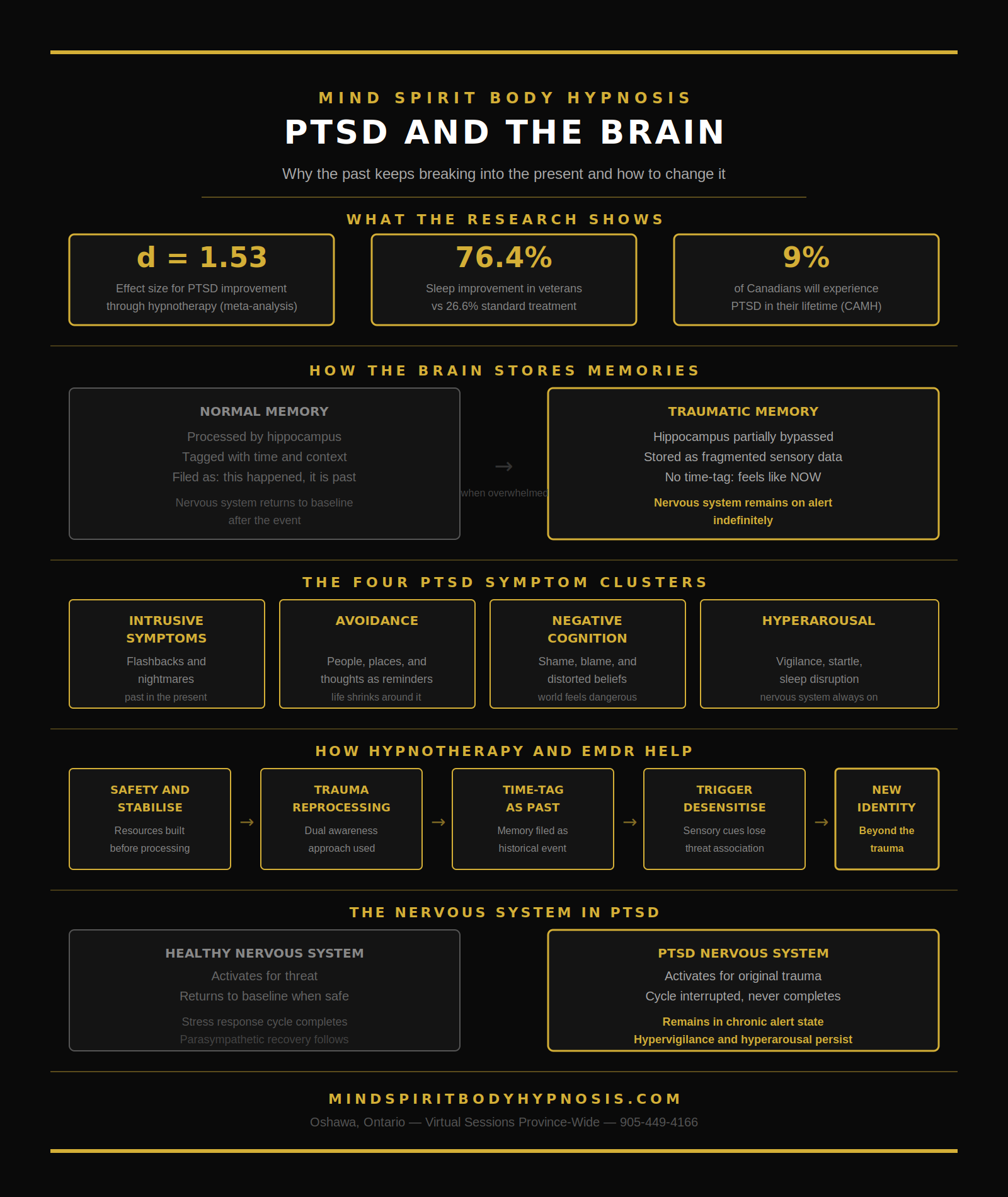
Hypnotherapy for PTSD is a subconscious-focused approach that addresses post-traumatic stress by helping the nervous system process and file traumatic memories as past events rather than ongoing threats, reducing the hyperarousal, intrusive symptoms, and avoidance behaviours that characterize the condition. A meta-analysis found a large effect size (d = 1.53) for PTSD symptom improvement through hypnotherapy. Fanis Makrigiannis, a Certified Hypnotherapist, NLP Master Practitioner, and EMDR Practitioner at Mind Spirit Body Hypnosis in Oshawa, Ontario, offers virtual sessions across the province for clients of all ages ready to reclaim their present from the past.
Questions This Article Answers
Can hypnotherapy help with PTSD symptoms?
How is PTSD different from normal stress responses?
Why do PTSD symptoms persist long after the trauma?
What is the role of the nervous system in PTSD?
What is the best complementary treatment for PTSD?
In This Article:
The sound of a car backfiring. The smell of a particular cologne. A television programme that cuts to a scene you were not expecting. Something that looks, sounds, or feels even vaguely similar to what happened. And suddenly, without warning and without any rational basis, you are back there.
Not remembering it. Not thinking about it. Back there. The body responds as if the threat is current and immediate. The heart rate climbs. The breathing shallows. The world narrows to the threat and the need to respond to it.
This is PTSD. And the reason it feels so impossible to reason with is that it is not being processed by the reasoning part of the brain. It is being processed by the survival part. And that part does not understand that it is over.
In my practice, clients who come for PTSD work often arrive carrying enormous amounts of shame alongside the symptoms. Shame about what happened to them, shame about their reactions, and shame that they are still struggling when, by any reasonable measure, they should be past it by now. The shame is part of the condition. And it is rarely warranted.
What Is PTSD and How Does It Differ From Normal Stress?
Post-traumatic stress disorder is a recognized mental health condition that develops in some people following exposure to a traumatic event or series of events. It is characterized by four main symptom clusters: intrusive symptoms such as flashbacks and nightmares, avoidance of reminders of the trauma, negative changes in thoughts and mood, and heightened arousal including hypervigilance, sleep disturbance, and exaggerated startle response.
According to the Centre for Addiction and Mental Health in Ontario, approximately 9 percent of Canadians will experience PTSD at some point in their lifetime. In Ontario, rates are higher in populations with elevated exposure to trauma, including first responders, healthcare workers, military veterans, survivors of abuse, and individuals who experienced significant adverse childhood events.
Normal stress responses are proportionate, time-limited, and resolve when the threat passes. PTSD is distinguished by its persistence, its disproportionate intensity relative to current circumstances, and most importantly, by the involuntary intrusion of the past into the present. The distinguishing feature is not the severity of the original trauma but the way the nervous system has processed and stored it.
Not everyone who experiences trauma develops PTSD. The key factor is whether the nervous system is able to complete its stress response cycle at the time of the trauma. When the cycle is interrupted, the traumatic experience is not filed as a past event but remains as active, unresolved threat material that the nervous system continues to respond to as if it is ongoing.
⭐ Pro Tip: PTSD does not only follow dramatic single-incident traumas. Complex PTSD, which develops from prolonged or repeated exposure to trauma, such as childhood abuse, domestic violence, or sustained workplace bullying, often presents without the clear flashback symptoms associated with single-incident PTSD. Clients with complex PTSD frequently arrive not recognizing their presentation as trauma-related at all, instead identifying chronic anxiety, emotional dysregulation, relationship difficulties, and persistent low self-worth as their primary concerns. If this resonates, a trauma-informed approach may be significantly more effective than managing the symptoms in isolation.
Why PTSD Symptoms Persist Long After the Trauma
Understanding why PTSD persists is essential to understanding why hypnotherapy works for it.
The human memory system does not store all memories in the same way. Ordinary experiences are processed by the hippocampus, tagged with a time and context, and filed as historical narrative: this happened, at this time, in this context, and it is now past.
Traumatic experiences that overwhelm the nervous system's capacity to process them are handled differently. The hippocampus, which requires a calm nervous system to function optimally, is partially bypassed. Instead, the experience is stored as a fragmented collection of sensory and emotional impressions, without the time-tagging and contextualization that would allow the brain to file it as historical. The result is a memory that feels like a present-tense experience rather than a past one, and a nervous system that remains prepared to respond to it as if it could happen again at any moment.
Triggers work by activating this fragment through sensory association. Any sensory input that resembles an element of the original trauma, a smell, a sound, a visual cue, or a body position, can activate the entire threat response even in the complete absence of actual danger. The person is not choosing to respond this way. The subconscious has a job, and the job is to keep them safe from what it still believes is an active threat.
Research published in the Journal of Traumatic Stress found that trauma-focused hypnotherapy was associated with significant reductions in PTSD symptom severity, including intrusive symptoms, avoidance, and hyperarousal, with the authors noting that hypnotherapy's direct access to the subconscious memory system made it particularly suited to addressing the fragmented storage pattern characteristic of traumatic memory (Lynn et al., 2012).
How Is the Nervous System Involved in PTSD?
PTSD is fundamentally a nervous system condition. Understanding this changes the entire approach to treatment.
The autonomic nervous system has two primary branches. The sympathetic branch activates for threat, mobilizing energy for fight or flight. The parasympathetic branch governs recovery and safety. In a healthy stress response, the sympathetic branch activates for the duration of the threat and then returns to baseline as the parasympathetic system takes over.
In PTSD, this return to baseline does not fully occur. The threat response was activated but never completed or resolved. The nervous system remains in a chronic state of partial sympathetic activation, scanning continuously for threat, prepared to respond at any moment. This produces the hypervigilance, sleep disruption, irritability, and exaggerated startle that characterize the arousal cluster of PTSD symptoms.
The hypnotic trance state produces a measurable and significant shift toward parasympathetic dominance. This is particularly relevant for PTSD because it creates the physiological safety conditions in which the nervous system can begin to complete what it could not complete at the time of the trauma. The trance state does not force processing. It provides the safety from which processing can occur naturally.
For more on how EMDR specifically addresses traumatic memory processing in the nervous system, the EMDR trauma therapy page at Mind Spirit Body Hypnosis covers the neurological mechanisms in detail.
How Hypnotherapy Addresses PTSD at the Subconscious Level
As a certified hypnotherapist and EMDR practitioner trained through the American Board of Hypnotherapy, I approach PTSD with the care, pacing, and clinical precision that trauma work requires. Sessions never push material to the surface before the client is ready, and the work is always led by what the nervous system can safely tolerate at each stage.
Safety and stabilization first. Before any direct trauma processing begins, early sessions focus on establishing the internal resources and nervous system stability the client will need for the deeper work. This includes installing a safe place imagery, anchoring a calm and grounded state, and ensuring the client has effective tools for managing distress between sessions. Many clients find this stage itself profoundly relieving.
Trauma memory reprocessing. Using guided imagery within the safety of trance, traumatic memories are approached in a carefully titrated way. Rather than reliving the experience at full emotional intensity, the client processes it from a position of dual awareness, connected to the present-moment safety of the trance state while accessing the traumatic material. This dual awareness is central to trauma processing in hypnotherapy and prevents the retraumatization risk associated with unguided exposure.
Time-tagging and narrative integration. A specific focus of the hypnotherapy work is helping the subconscious file the traumatic memory as a past event. Using direct suggestion and guided imagery, the experience is given a time context, placed in the past tense, and integrated into the person's broader life narrative as something that happened and is over, rather than something that is still happening.
Trigger desensitization. Once the core memory work is progressing, sessions address the specific sensory triggers that activate the trauma response in daily life. Each trigger is approached in trance, and its association with the original threat is systematically reduced. The sensory cue is allowed to become just a sound or just a smell, rather than a signal that the threat is present again.
Resilience and future identity installation. The final stages of trauma work address who the person is becoming on the other side of the PTSD. New identity statements are installed: not someone defined by what happened to them, but someone who has processed a difficult experience and emerged with greater self-knowledge, resilience, and capacity for presence.
A randomized controlled trial published in the International Journal of Clinical and Experimental Hypnosis found that hypnotherapy for PTSD in combat veterans produced a 76.4 percent improvement in sleep quality compared to 26.6 percent for standard treatment, alongside significant reductions in intrusive symptoms and avoidance (Abramowitz et al., 2008).
The Role of EMDR in PTSD Treatment
EMDR is recognized by the World Health Organization as a first-line treatment for PTSD. At Mind Spirit Body Hypnosis, EMDR and hypnotherapy are used in combination for PTSD presentations, with each addressing different but complementary aspects of the trauma response.
EMDR's bilateral stimulation, alternating eye movements, tapping, or auditory tones, activates the brain's natural memory processing mechanism in a way that allows traumatic memories to be reprocessed and filed appropriately. The bilateral stimulation appears to mimic the processing that occurs during REM sleep, allowing the brain to complete what it was unable to complete in the immediate aftermath of the trauma.
Hypnotherapy complements EMDR by providing the nervous system safety and parasympathetic activation from which EMDR processing can occur most effectively, by addressing the subconscious beliefs and identity patterns that EMDR's protocol does not directly target, and by installing the resilience resources and future identity that consolidate the gains made in EMDR.
For more on how EMDR is used at Mind Spirit Body Hypnosis and the full clinical approach to trauma treatment, the about page covers qualifications, training, and practice philosophy in detail.

What to Expect in a Session
The first session is a careful, unhurried conversation. What brings you now? What are the most disruptive symptoms? Do you have a sense of what the underlying trauma or traumas are, or is the connection to experience unclear? What do you most need from the work?
This conversation is itself part of the work. Many clients with PTSD have not had the experience of telling their story in an environment of genuine, non-reactive presence. The first session may feel more valuable than expected simply as a result of this.
From there, the work proceeds at a pace determined entirely by what the nervous system can safely tolerate. There is no rushing toward the traumatic material. The foundation is built first. The direct work follows when the foundation is solid.
Most PTSD programmes at Mind Spirit Body Hypnosis run between six and twelve sessions, reflecting the layered nature of the condition. Complex presentations with multiple trauma sources, adverse childhood experiences, or significant comorbid anxiety and depression may require a longer programme. All sessions are delivered virtually and are available to clients aged 10 and older across Ontario from the privacy of their own home.
What My Clients Say
"I began seeing Fanis after a long battle with trauma and grief. I suffered from severe anxiety, panic attacks, insomnia and self-harm. After 3 months of weekly hypnotherapy sessions done online, I no longer suffer from panic attacks, insomnia, or self harm and have learned how to better regulate my emotions and find peace. Fanis helped me process many childhood traumas and confront my overwhelming grief. I am eternally grateful to Fanis and his wonderful work."
Sara V. | Trauma and Grief | Five Stars
FAQ
Can hypnotherapy help with PTSD symptoms? Yes. A meta-analysis found a large effect size (d = 1.53) for PTSD symptom improvement through hypnotherapy. Hypnotherapy is particularly effective for PTSD because it directly accesses the subconscious memory system where traumatic experiences are stored, facilitating the processing and filing that the nervous system was unable to complete at the time of the trauma.
How is PTSD different from normal stress responses? Normal stress responses are proportionate, time-limited, and resolve when the threat passes. PTSD is characterized by its persistence, its involuntary intrusion into the present, and its disproportionate intensity relative to current circumstances. The distinguishing factor is whether the nervous system was able to complete its stress response cycle at the time of the trauma.
Why do PTSD symptoms persist long after the trauma? Traumatic experiences that overwhelm the nervous system's processing capacity are stored as fragmented sensory and emotional impressions rather than contextualized historical narrative. This means the brain cannot file them as past events. The nervous system continues responding to them as if they are present-tense threats, producing the ongoing symptoms of PTSD.
What is the role of the nervous system in PTSD? PTSD involves a nervous system that could not complete its stress response cycle at the time of the trauma. It remains in chronic partial sympathetic activation, scanning for threat and prepared to respond. Hypnotherapy produces the parasympathetic shift needed to create the safety conditions from which the nervous system can finally complete the process.
What is the best complementary treatment for PTSD? Both EMDR and hypnotherapy are supported by research as effective complementary approaches for PTSD. At Mind Spirit Body Hypnosis, the two are combined. EMDR addresses traumatic memory reprocessing through bilateral stimulation. Hypnotherapy addresses the subconscious beliefs, identity patterns, and nervous system regulation that support and consolidate the EMDR work.
How many sessions will I need? Most PTSD programmes at Mind Spirit Body Hypnosis run between six and twelve sessions. Complex presentations with multiple trauma sources or significant comorbidities may require a longer programme. The work proceeds at the pace the nervous system can safely tolerate.
Is this suitable for younger clients? Yes. Mind Spirit Body Hypnosis works with clients aged 10 and older. Trauma presentations in children and adolescents respond well to hypnotherapy and EMDR, which are gentle, non-invasive, and can be adapted to age-appropriate language and imagery.
Can I do sessions virtually from anywhere in Ontario? Yes. All sessions are delivered virtually, province-wide, with no referral required. The virtual format is particularly valuable for trauma clients as it allows them to engage from the safety of their own environment.
What if I have already tried therapy and still have symptoms? Many clients with PTSD have completed significant courses of talk therapy and found that residual symptoms remain. Hypnotherapy and EMDR address the subconscious and somatic dimensions of trauma that talk-based approaches often cannot fully reach. The combination frequently produces change where previous approaches reached a plateau.
How do I get started? Book a free 30-minute virtual strategy session at calendly.com/mindspiritbodyhypnosis. No referral needed.
Ready to Take the Next Step?
If the past keeps breaking into the present, no matter how much time has passed or how much work you have already done, the nervous system has not finished processing what happened. That is not a failure. It is something that can be addressed.
I offer a free 30-minute virtual strategy session for new clients across Ontario. There is no pressure, just a conversation about what you are carrying and how hypnotherapy or EMDR may help you find genuine peace from the past.
Book your free session: calendly.com/mindspiritbodyhypnosis
Call or text: 905-449-4166
Email: info@mindspiritbodyhypnosis.com
Visit: mindspiritbodyhypnosis.com
Serving clients virtually across Ontario, including Durham Region, Toronto, Ottawa, and beyond.
Disclaimer: This article is for informational purposes only and does not constitute medical or psychological advice. PTSD is a serious mental health condition that requires assessment and management by a qualified healthcare provider. Hypnotherapy and EMDR are complementary approaches and are not a substitute for clinical diagnosis or treatment. If you are experiencing a mental health crisis, please contact the 988 Suicide Crisis Helpline or go to your nearest emergency room. Results vary by individual.
Written by Fanis Makrigiannis | Certified Hypnotherapist & NLP Master Practitioner | Mind Spirit Body Hypnosis.