Can Hypnotherapy cure performance anxiety?
Can Hypnotherapy Cure Performance Anxiety?
TL;DR: Performance anxiety is not a lack of ability. It is a subconscious threat response that fires in high-stakes situations and hijacks exactly the cognitive and physical resources the performance requires. At Mind Spirit Body Hypnosis in Oshawa, Ontario, Fanis Makrigiannis uses hypnotherapy and NLP to rewire that threat response at the subconscious level, helping clients of all ages across the province perform at their actual capability rather than the diminished version anxiety produces.
Quick Answer
Hypnotherapy for performance anxiety is a subconscious-focused approach that addresses the conditioned threat response, limiting beliefs, and identity patterns that generate anxiety before and during high-stakes performance situations, by retraining the nervous system to associate performance contexts with focused energy rather than threat. Research published in the International Journal of Clinical and Experimental Hypnosis found hypnotherapy significantly reduced performance anxiety and improved objective performance outcomes in athletes and performers. Fanis Makrigiannis, a Certified Hypnotherapist and NLP Master Practitioner at Mind Spirit Body Hypnosis in Oshawa, Ontario, offers virtual sessions across the province for clients of all ages ready to stop leaving their best performance in the practice room.
Questions This Article Answers
Can hypnotherapy help with performance anxiety?
What causes performance anxiety?
Why does anxiety make performance worse?
How is performance anxiety different from stage fright?
What is the best treatment for performance anxiety?
In This Article:
You know the material. You have done the preparation. In practice, in rehearsal, in the quiet of your own space, it comes together exactly as it should. And then the moment arrives. The audience, the examiner, the starting gun, the stage, the camera. And something shifts.
The clear mind becomes cluttered. The body that was coordinated becomes stiff. The voice that was strong becomes unreliable. And you perform a version of yourself that is noticeably less than what you know you are capable of.
This is performance anxiety. And the frustrating thing about it is that it is not a skill problem. The ability is there. The preparation is there. What is not there, in the moment that matters most, is access to what you have already built.
In my practice, clients who come for performance anxiety work span an enormous range: competitive athletes before major events, musicians before auditions and concerts, students before examinations, professionals before presentations, actors before auditions, and public speakers before keynotes. What they share is not a lack of talent or preparation but a subconscious threat response that fires precisely when they can least afford it.
What Is Performance Anxiety and Who Does It Affect?
Performance anxiety is the experience of significant anxiety in response to being evaluated or observed while performing a task. It activates the threat response, producing physiological symptoms including elevated heart rate, muscle tension, shallow breathing, perspiration, and cognitive symptoms including intrusive thoughts, concentration difficulties, and catastrophic predictions.
It is extraordinarily common. Research suggests that between 25 and 40 percent of performing artists experience clinically significant performance anxiety, and rates in competitive athletes, students facing high-stakes examinations, and professionals required to present publicly are similarly elevated. In many of these populations, performance anxiety is the single most significant factor limiting the expression of genuine capability.
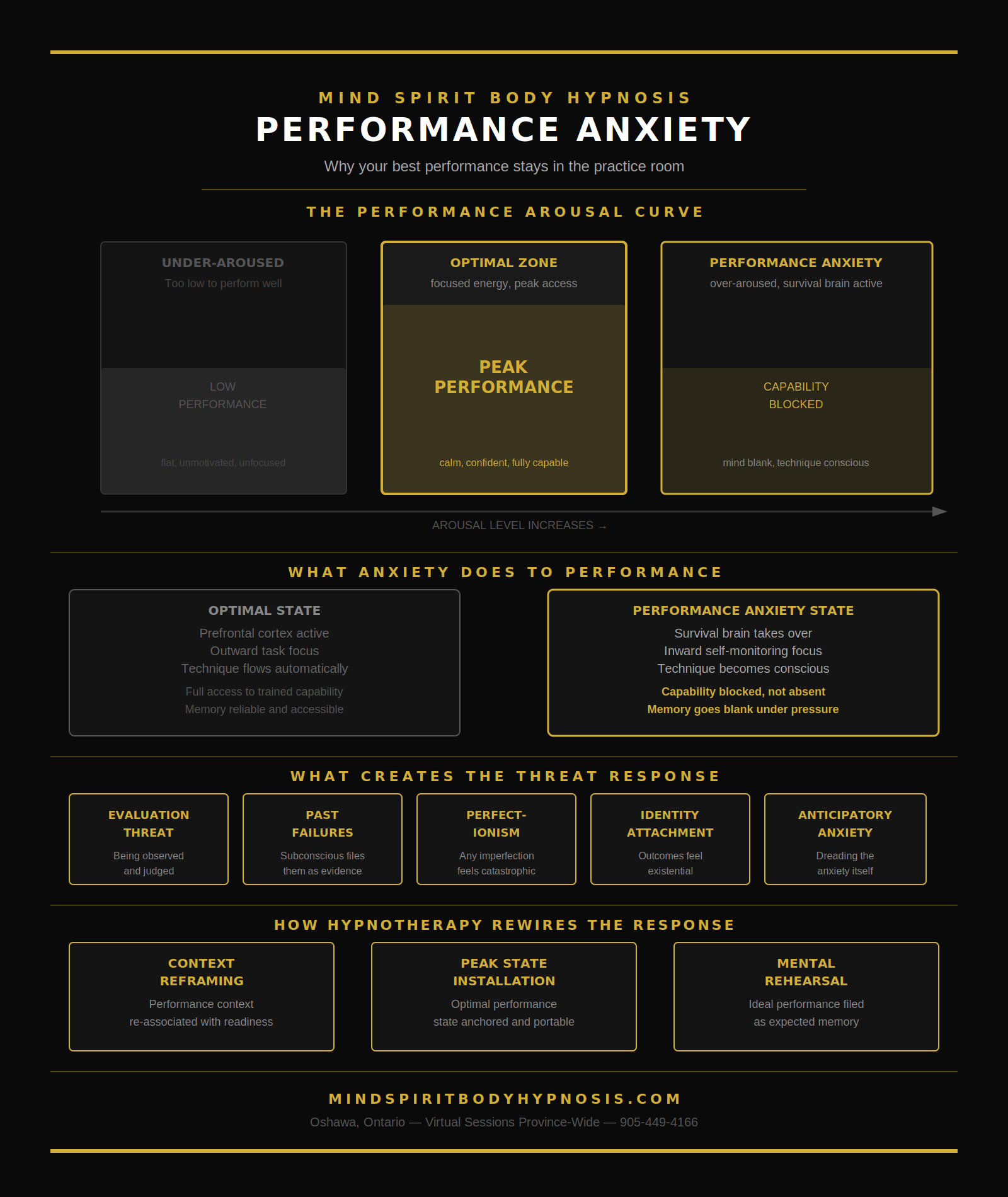
It is important to note that not all pre-performance arousal is harmful. A moderate level of activation before a performance, what sports psychologists refer to as the optimal arousal zone, actually enhances performance by sharpening focus and mobilizing energy. Performance anxiety becomes a problem when arousal exceeds this zone and shifts from energizing to disruptive. The goal of hypnotherapy is not to eliminate all pre-performance arousal but to ensure that the activation stays within the range that supports peak performance rather than undermining it.
⭐ Pro Tip: One of the most reliable ways to identify whether your pre-performance arousal is working for or against you is to notice where your attention goes. Optimal arousal produces outward-focused attention: you are thinking about the task, the music, the audience, the game. Performance anxiety produces inward-focused attention: you are thinking about how you are doing, how you look, what might go wrong. This shift from task focus to self-focus is the single most damaging cognitive effect of performance anxiety, and it is directly addressed in hypnotherapy.
What Causes Performance Anxiety?
Performance anxiety has both subconscious and neurological roots, and the specific combination varies from person to person.
Evaluation threat. The presence of an observer, examiner, or audience activates a social threat response in the brain. Humans are profoundly social animals, and the judgment of others activates the same neural alarm system as physical danger. For individuals with high evaluation sensitivity, this response exceeds the level that supports performance.
Past performance failures. A specific experience of performing badly, blanking under pressure, freezing at an audition, or being publicly criticized can create a powerful subconscious imprint. The brain files the performance context as the site of a previous failure and activates a protective threat response to prevent it from happening again.
Perfectionism and outcome focus. When the subconscious has concluded that only perfect performance is acceptable, any performance situation carries the weight of potential catastrophic failure. The anxiety is not about the performance itself but about the consequences of an imperfect one.
Identity attachment. When personal worth is deeply tied to performance outcomes, the performance stakes become existential rather than situational. A poor performance is not just a disappointment; it is evidence of fundamental inadequacy. This identity-level attachment dramatically amplifies the threat response.
Accumulated experience of anxiety itself. For many people, performance anxiety has its own history. Having experienced it repeatedly, the subconscious has learned to anticipate it. The dread of the anxiety becomes as disruptive as the anxiety itself, and the anticipatory response begins firing earlier, sometimes days before the event.
Research published in the Journal of Sport and Exercise Psychology found that performance anxiety operates through two primary mechanisms: worry, the cognitive component characterized by intrusive negative thoughts, and somatic anxiety, the physiological component characterized by bodily arousal, with the cognitive component having the larger negative impact on performance outcomes (Hardy et al., 1996).
For more on how anxiety and its subconscious drivers are addressed at Mind Spirit Body Hypnosis, the hypnotherapy for anxiety and stress pillar page covers the foundational nervous system mechanisms.
Why Anxiety Makes Performance Worse
Understanding the neuroscience of this makes it much clearer why hypnotherapy works and why many conventional approaches to managing performance anxiety do not.
When the threat response activates, it redirects cognitive resources from the prefrontal cortex, the brain region responsible for complex thought, fine motor control, creative access, and working memory, to the more primitive survival brain. This redirection is efficient for survival: you do not need creative thinking to escape a predator. But it is catastrophic for performance, which requires exactly the resources the threat response has just diverted.
The result is the characteristic performance anxiety experience: the mind goes blank, the automatic technique becomes conscious and effortful, the memory that was accessible disappears, the body that was fluid becomes rigid. This is not a skill failure. It is a neurological consequence of being in the wrong brain state for the task.
This also explains why simply trying to calm down rarely helps in the moment. The instruction to calm down comes from the prefrontal cortex. The threat response, generated by the amygdala, does not respond to instructions from higher-level processing when it has already been activated. The subconscious has already decided there is a threat, and reassurance from the conscious mind is not sufficient to update that decision in real time.
Hypnotherapy works by changing the decision at the source. Rather than managing the anxiety response after it activates, it changes how the subconscious evaluates the performance situation in the first place.
For more on how self-sabotage patterns and performance limitations interact at the subconscious level, the hypnotherapy for self-sabotage page covers the overlapping mechanisms.
How Hypnotherapy Rewires the Performance Threat Response
As a certified hypnotherapist trained through the American Board of Hypnotherapy, I approach performance anxiety as a conditioned subconscious threat response with an identifiable structure that can be changed. The work is precise and practical, and builds tools that the client can use independently in any performance context.
Performance context reframing. The specific contexts that trigger the anxiety response, the stage, the exam room, the starting line, the camera, the podium, are identified and, in trance, systematically re-associated with focused energy, readiness, and capability rather than threat. Many clients notice within the first week that entering the performance context feels meaningfully different: less charged, more familiar, more like where they belong.
Root cause work. When performance anxiety traces to a specific past failure experience or to deep identity-level beliefs about what performance outcomes mean, the trance state allows those origins to be accessed and updated. The memory of the past failure is reprocessed with adult resources and perspective. The identity attachment to performance outcomes is loosened at the subconscious level.
Pre-performance state installation. A specific peak performance state, characterized by outward focus, calm confidence, physical ease, and complete access to trained capability, is built in trance and anchored to a physical cue. Activating this anchor immediately before a performance produces a reliable shift into the optimal arousal zone rather than the anxiety-driven dysregulation that performance anxiety creates.
Mental rehearsal. Research in sport psychology and performance science consistently shows that vivid mental rehearsal activates the same neural pathways as physical practice. In trance, the client performs their upcoming performance event in complete sensory detail, doing so with the calm, focused, fully capable state the session has installed. This becomes a reference experience the nervous system draws on when the actual performance arrives.
A randomized controlled trial published in the International Journal of Clinical and Experimental Hypnosis found that hypnotherapy significantly reduced performance anxiety and improved objective performance scores in music students, with the hypnotherapy group showing significantly greater improvements in both self-reported anxiety and examiner-rated performance quality compared to a control group (Stanton, 1994).
NLP Techniques for Peak Performance States
NLP offers precise, portable tools for managing performance anxiety in real time. Clients I work with across Ontario find these particularly valuable because they can be used independently immediately before any performance.
The circle of excellence. A resource state of peak performance, characterized by the exact mental and physical qualities in which the person is at their best, is built in trance and anchored to stepping into an imagined circle on the floor. Before any performance, the client steps into the circle, activating the full resource state. Many high-performance athletes and performers use this technique as a consistent pre-performance ritual.
Submodality works on the performance image. The mental representation of the upcoming performance has specific qualities: a size, a distance, a colour, an emotional charge. For performance anxiety, these qualities tend to make the event feel enormous, imminent, and threatening. Changing those qualities directly reduces the anxiety response. When the upcoming performance is made smaller, brighter, and more manageable in the internal representation, the physiological anxiety it generates reduces proportionally.
Attention anchoring. A specific anchor that reliably shifts attention from inward self-monitoring to outward task focus is installed and practised. In the moment of performance, when self-focus threatens to derail the execution, the anchor provides an immediate pathway back to the task.
Future pacing is the ideal performance. The subconscious walks through the upcoming performance in complete sensory detail, experiencing it as going exactly as prepared, with full access to capability, with calm focus and physical ease, with the audience or examiner receiving exactly what was intended. This scene is filed as expected memory, making the ideal performance feel like the natural and expected outcome rather than a best-case hope.
More about how these techniques are applied in practice at Mind Spirit Body Hypnosis is available on the about page.

What to Expect in a Session
The first session is a conversation. What is the performance context? What happens specifically when the anxiety fires? Is there a particular moment in the performance where it tends to peak? Has there been a specific experience that started or significantly worsened it? What does your performance look and feel like when you are at your best, and what would it mean to access that state reliably?
This mapping shapes the subconscious work. The induction is gentle, and most clients reach a deeply relaxed trance state within minutes. The core work then targets the specific threat associations, limiting beliefs, and performance state architecture identified in the conversation.
Performance anxiety typically responds quickly to hypnotherapy. Many clients notice a meaningful shift after the first or second session: a reduction in anticipatory anxiety, a different quality to the pre-performance period, and a greater sense of access to their trained capability during the performance itself. Most programmes at Mind Spirit Body Hypnosis run between two and four sessions, with some complex presentations requiring additional work.
All sessions are delivered virtually and are available to clients aged 10 and older across Ontario from the comfort of their own homes.
What My Clients Say
"I came to Fanis with pretty severe anxiety surrounding a fear of heights and flying. I felt my anxiety was holding me back from fully living my life and experiencing the world. After 3 sessions with Fanis my anxiety is next to nothing and I have been able to experience things I never thought possible. I would highly recommend Fanis to anyone suffering from anxiety or phobias!"
Chris H. | Anxiety and Phobias | Five Stars
FAQ
Can hypnotherapy help with performance anxiety? Yes. Hypnotherapy directly addresses the subconscious threat response, limiting beliefs, and identity patterns that generate performance anxiety. Research confirms significant reductions in self-reported anxiety and improvements in objective performance quality through hypnotherapy, with effects superior to control conditions.
What causes performance anxiety? Performance anxiety is caused by a combination of evaluation threat activating social survival responses, past performance failures creating conditioned threat associations, perfectionism and outcome focus raising the perceived stakes, identity attachment to performance outcomes, and accumulated anticipatory anxiety from previous experiences of the response itself.
Why does anxiety make performance worse? The threat response redirects cognitive resources away from the prefrontal cortex, the brain region responsible for complex thought, fine motor control, creative access, and working memory, to the survival brain. This produces the characteristic performance anxiety effects: blank mind, rigid technique, inaccessible memory, and loss of the fluid automaticity that prepared performance requires.
How is performance anxiety different from stage fright? Stage fright is commonly used to describe performance anxiety, specifically in theatrical and public-facing contexts. Performance anxiety is the broader term covering the same response across all evaluative performance situations: sport, music, academic examinations, public speaking, and professional presentations. The subconscious mechanism is identical.
What is the best treatment for performance anxiety? Research supports both cognitive behavioural approaches and hypnotherapy as effective treatments for performance anxiety. Hypnotherapy is particularly effective because it changes the subconscious evaluation of the performance situation rather than managing the conscious experience of anxiety it produces, resulting in bigger and more durable change.
How many sessions will I need? Most clients at Mind Spirit Body Hypnosis working on performance anxiety complete two to four sessions. Many notice a meaningful shift after the first session. Complex presentations with deep identity attachment or significant past failure experiences may require additional work.
Is this suitable for younger clients? Yes. Mind Spirit Body Hypnosis works with clients aged 10 and older. Performance anxiety is particularly common in young athletes, student musicians, and students facing high-stakes examinations. Hypnotherapy and NLP are gentle, non-invasive, and can be adapted to age-appropriate language and imagery.
Can I do sessions virtually from anywhere in Ontario? Yes. All sessions are delivered virtually, province-wide, with no referral required.
What if I have had performance anxiety my whole career? Long-standing performance anxiety can absolutely shift. The subconscious threat response that maintains it was learned and can be unlearned. Many clients who have managed performance anxiety for their entire professional or athletic career find that addressing the subconscious root produces reliable access to their genuine capability for the first time.
How do I get started? Book a free 30-minute virtual strategy session at calendly.com/mindspiritbodyhypnosis. No referral needed.
Ready to Take the Next Step?
If your performance at the moment consistently falls short of what you are capable of in practice, that is not a talent problem. It is a subconscious threat response. And it can be changed.
I offer a free 30-minute virtual strategy session for new clients across Ontario. There is no pressure, just a conversation about what is happening and how hypnotherapy or NLP may help you perform at your actual level.
Book your free session: calendly.com/mindspiritbodyhypnosis
Call or text: 905-449-4166
Email: info@mindspiritbodyhypnosis.com
Visit: mindspiritbodyhypnosis.com
Serving clients virtually across Ontario, including Durham Region, Toronto, Ottawa, and beyond.
Disclaimer: This article is for informational purposes only and does not constitute medical or psychological advice. Hypnotherapy and NLP are complementary approaches and are not a substitute for diagnosis or treatment by a qualified healthcare provider. Results vary by individual.
Written by Fanis Makrigiannis | Certified Hypnotherapist & NLP Master Practitioner | Mind Spirit Body Hypnosis.