Can hypnotherapy break the sleep anxiety loop?
Can Hypnotherapy Break the Sleep Anxiety Loop?
TL;DR: Sleep anxiety is a self-reinforcing trap: the dread of not sleeping creates the very wakefulness it fears, and the more effort is applied to sleeping, the further sleep retreats. At Mind Spirit Body Hypnosis in Oshawa, Ontario, Fanis Makrigiannis uses hypnotherapy and NLP to interrupt this loop at the subconscious level, helping clients of all ages across the province stop trying to sleep and start sleeping again.
Quick Answer
Hypnotherapy for sleep anxiety is a subconscious-focused approach that addresses the conditioned bedtime threat response and catastrophic thought patterns that create and sustain the sleep anxiety loop by directly retraining the nervous system's association between the bedroom environment and threat. Research published in Complementary Therapies in Medicine found hypnotherapy significantly reduced sleep onset latency and improved sleep quality in people with insomnia. Fanis Makrigiannis, a Certified Hypnotherapist and NLP Master Practitioner at Mind Spirit Body Hypnosis in Oshawa, Ontario, offers virtual sessions across the province for clients of all ages caught in the exhausting cycle of dreading sleep.
Questions This Article Answers
What is sleep anxiety, and how does it cause insomnia?
Why does trying harder to sleep make it worse?
How is sleep anxiety different from general insomnia?
Can hypnotherapy break the sleep anxiety loop?
What is the best treatment for sleep anxiety?
In This Article:
It begins at about 9 pm. A quiet awareness that bedtime is approaching. A small tightening in the chest. By 10 pm, it has a familiar quality: the calculation of how many hours of sleep remain if you fall asleep right now, the anticipation of lying in the dark staring at the ceiling, the memory of last night and the night before.
By the time you actually get into bed, your nervous system is running a moderate threat response. And a nervous system running a threat response cannot sleep.
This is sleep anxiety, and it is one of the most self-defeating patterns the subconscious can produce: the fear of not sleeping is the thing that prevents sleeping.
In my practice, clients with sleep anxiety often arrive having already tried every sleep hygiene recommendation available. The consistent bedtime. The no-screens rule. The cool dark bedroom. The white noise. The magnesium. And all of it provides modest improvement at best, because none of it addresses the fundamental issue: the subconscious has learned that the bedroom is a place of threat and failure, and it is responding accordingly.
What Is Sleep Anxiety and How Does the Loop Form?
Sleep anxiety is the experience of significant anxiety specifically associated with the approach of sleep or the act of trying to sleep. It is distinct from general anxiety and from primary insomnia, though it frequently coexists with both.
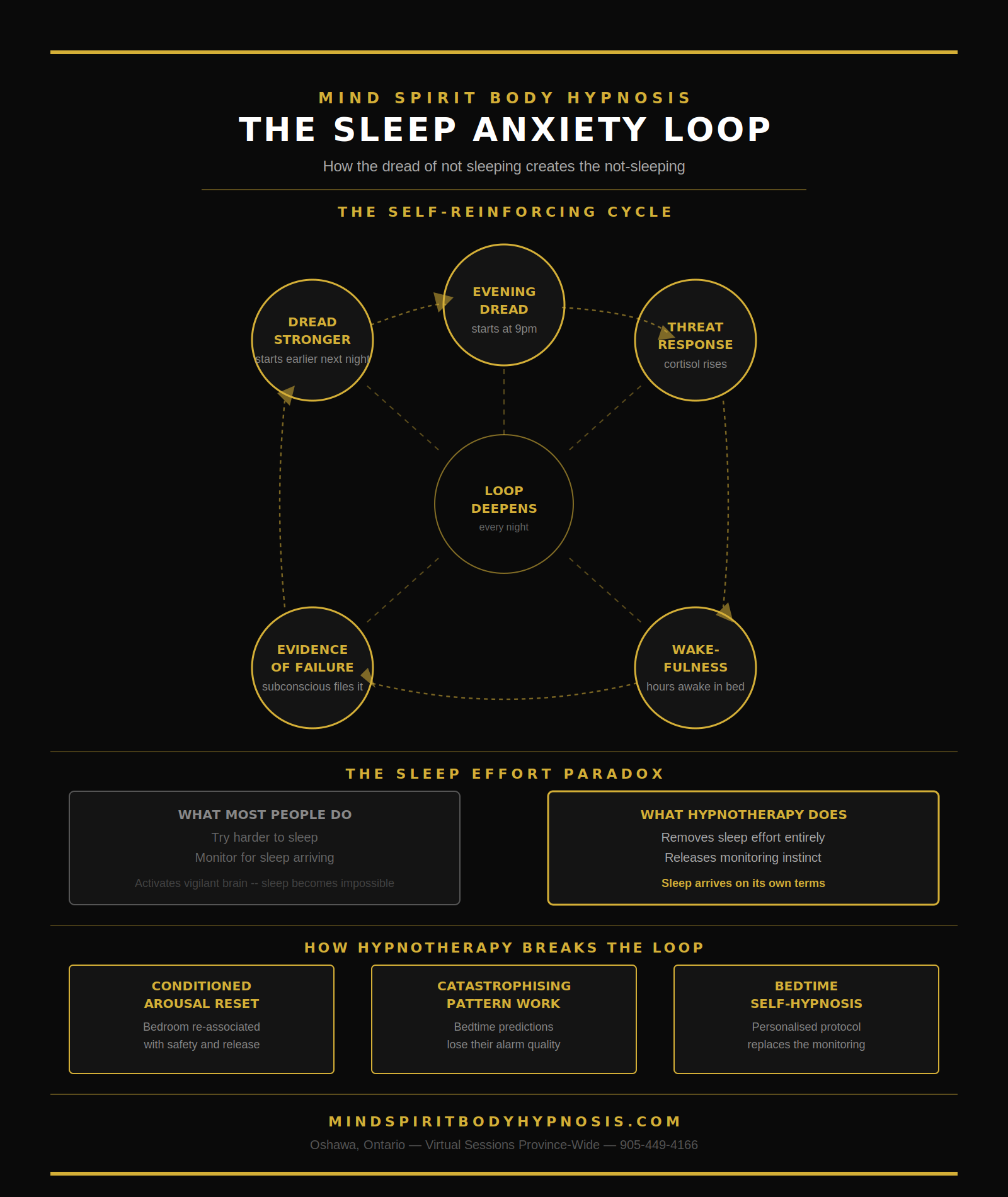
The loop forms through a process of conditioned learning. A period of poor sleep, often triggered by stress, illness, life disruption, or a single difficult night, leads to wakefulness that becomes associated with the bedroom environment and the act of trying to sleep. The subconscious, which learns from experience, begins to anticipate wakefulness each time the sleep situation arises. This anticipation activates the threat response, which produces the very physiological state, elevated cortisol, elevated heart rate, and heightened alertness, that makes sleeping impossible.
Each night of sleeplessness strengthens the association. Each morning of exhaustion adds evidence that the bedroom is a place where the person fails. And each evening, the dread begins earlier, the threat response activates more reliably, and the loop becomes more deeply conditioned.
According to the Public Health Agency of Canada, approximately 13 to 33 percent of Canadian adults experience significant sleep disruption, with anxiety identified as the most common psychological trigger. In Ontario, where chronic workplace stress and the demands of urban and suburban life are particularly pronounced, sleep anxiety is one of the most frequently cited concerns in the context of hypnotherapy enquiries.
⭐ Pro Tip: One of the most reliable signs that sleep anxiety rather than primary insomnia is the central issue is the difference between falling asleep on the sofa and falling asleep in bed. Most people with sleep anxiety drop off easily in front of the television or in other non-bedroom environments, then become wide awake the moment they move to bed. This is conditioned arousal: the bedroom itself has become a trigger for wakefulness. It is subconscious, not physiological, and it responds extremely well to hypnotherapy.
Why Trying Harder to Sleep Makes It Worse
This is the central paradox of sleep anxiety, and the reason that most conventional advice about improving sleep, while genuinely useful for people with primary insomnia, often makes sleep anxiety worse rather than better.
Sleep is an involuntary process. It cannot be made to happen through effort. In fact, effortful attention to sleep, monitoring whether it is arriving, calculating remaining hours, and trying to relax hard enough, produces the precise cognitive and physiological conditions that prevent it. The brain cannot simultaneously be in a state of vigilant effort and in the state of released awareness that sleep requires.
For someone with sleep anxiety, the bedroom has become associated with this vigilant effort. The instruction to lie down, be still, and sleep signals the subconscious to activate its problem-solving, monitoring mode. The harder the person tries, the more alert they become, and the more evidence accumulates that sleep is something they cannot do.
Research consistently confirms that sleep effort, measured as the degree to which a person actively tries to control their sleep, is one of the strongest predictors of insomnia severity, stronger than actual physiological arousal in many cases. People who sleep poorly but make little effort to control it have significantly better sleep outcomes than people who sleep poorly and try hard to fix it. The trying is part of the problem.
Hypnotherapy addresses this directly. The trance state itself is a demonstration that the nervous system can release vigilant control without effort, by creating the conditions in which release happens naturally. This becomes a reference point the subconscious can return to at bedtime.
For more on how the nervous system drives both anxiety and sleep disruption, and how hypnotherapy addresses both at once, the hypnotherapy for anxiety and stress pillar page covers the foundational mechanisms.
How Is Sleep Anxiety Different From General Insomnia?
These two presentations overlap significantly but are meaningfully distinct, and the difference matters for treatment.
Primary insomnia is difficulty sleeping that is not primarily driven by psychological arousal. It may have circadian, behavioural, or medical components. Sleep hygiene improvements, stimulus control therapy, and sleep restriction are all effective first-line approaches.
Sleep anxiety is a psychological pattern in which the prospect and act of sleeping become a conditioned threat trigger. Insomnia is a consequence of the anxiety, not the primary condition. Treating the sleep behaviour directly without addressing the anxiety maintains a ceiling on improvement.
Here is how the two experiences differ in practice:
Primary insomnia: The inability to sleep without significant preceding dread. Sleep may be difficult in multiple environments. No particular fear of the act of sleeping.
Sleep anxiety: The inability to sleep in the bedroom specifically, preceded by escalating anticipatory dread. Sleep may come easily in other contexts. The dread of sleep is often worse than the sleeplessness itself.
For more on how hypnotherapy approaches sleep and insomnia specifically, the hypnotherapy for sleep and insomnia page at Mind Spirit Body Hypnosis covers the foundational clinical approach.
How Hypnotherapy Breaks the Sleep Anxiety Loop
As a certified hypnotherapist trained through the American Board of Hypnotherapy, I approach sleep anxiety as a conditioned subconscious threat pattern with an identifiable learning history. The work targets the specific components of the loop that sustain it.
Conditioned arousal interruption. The subconscious association between the bedroom environment and threat is one of the most important targets in sleep anxiety work. In trance, the specific environmental cues that trigger the anxious response, the pillow, the darkness, lying down, the clock, are systematically re-associated with safety, permission to release, and the naturalness of sleep. Many clients notice within the first week that entering the bedroom feels different, less charged, less laden with the expectation of failure.
Catastrophizing thought pattern work. The catastrophic predictions that fire in the pre-sleep period, I will not sleep again, I will be unable to function tomorrow, this is destroying my health, are addressed directly in trance. The subconscious learns to receive these thoughts differently: as sensations that pass rather than as accurate forecasts that require urgent management.
Sleep effort reduction. A central aim of the hypnotherapy work is to reduce the effortful monitoring of sleep itself. Using guided suggestion, the subconscious is invited to release the problem-solving relationship with sleep and return to treating it as something that happens naturally rather than something that must be achieved.
Self-hypnosis bedtime protocol. A personalized self-hypnosis sequence is taught and anchored to the specific bedtime context. Rather than lying awake monitoring for sleep, the client has a practised internal process to enter. The process does not try to produce sleep. It produces a state of released, receptive calm from which sleep can arise on its own terms.
Research published in Complementary Therapies in Medicine found that hypnotherapy for insomnia produced significant reductions in sleep onset latency, improvements in sleep quality, and reductions in anxiety associated with sleep, with effects maintained at follow-up and enhanced over successive sessions (Lam et al., 2018).
NLP Techniques That Restore Natural Sleep
NLP offers precise, practical tools for dismantling the internal architecture of sleep anxiety. Clients I work with across Ontario find these particularly useful as independent tools to apply at bedtime.
The cognitive shuffle. A technique with growing research support in which the person generates a sequence of unrelated, vivid mental images at bedtime, mimicking the natural pre-sleep imagery pattern of healthy sleepers. This interrupts the analytical, self-monitoring thought stream that sustains sleep anxiety and shifts the mind toward the associative, drifting quality that precedes sleep. It can be learned in a single session and used independently every night.
Submodality works on the sleep dread. The anticipatory dread of another sleepless night has a specific internal structure: a location in the body, a quality, a sound, a colour. Changing those qualities directly reduces the intensity of the experience. When the dread is made smaller, more distant, and less vivid, the physiological activation it generates reduces proportionally.
Anchoring a sleep-permission state. A state of deep, released, comfortable drowsiness experienced during trance is anchored to a physical cue such as a specific breath or hand position. When this anchor is activated at bedtime, it provides a pathway back to the sleep-permission state rather than the monitoring state that sleep anxiety produces.
Future pacing restful nights. The subconscious is walked through vivid, sensory-rich scenes of the client entering the bedroom with ease, lying down without dread, releasing awareness naturally, and waking refreshed. These scenes are filed as expected memory, replacing the accumulated evidence of failure with a new set of expected experiences.
More about how these techniques are applied at Mind Spirit Body Hypnosis is available on the about page.

What to Expect in a Session
The first session is a conversation. When did the sleep anxiety begin? Is there a night or period that started it? What does the dread feel like, and when does it arrive in the evening? What is the experience once in bed? Has there been any period of sleeping well, and if so, what was different?
This mapping shapes the subconscious work. The induction is slow and careful, particularly in the first session, because clients with sleep anxiety sometimes have residual apprehension about lying still in a quiet, dark-ish environment. The initial trance experience itself is often the first time the client has been genuinely relaxed and still without either sleeping or fighting wakefulness, and this can be profoundly relieving.
Most sleep anxiety programmes at Mind Spirit Body Hypnosis run between three and five sessions. Many clients notice a meaningful change in their bedtime experience after the first or second session: a reduction in anticipatory dread, a different quality of lying in bed, a sense that sleep is something that can happen rather than something they are failing to achieve. All sessions are delivered virtually and are available to clients aged 10 and older across Ontario from the comfort of their own homes.
What My Clients Say
"I had been dealing with racing thoughts every single night for over two years. I would lie there for hours, going over everything in my head, and nothing helped. After three sessions with Fanis I was falling asleep within 20 minutes. It felt like someone had finally given my brain an off switch. I cannot recommend him enough."
Dan B. | Sleep and Anxiety | Five Stars
FAQ
Can hypnotherapy break the sleep anxiety loop? Yes. Hypnotherapy directly addresses the conditioned threat response that drives sleep anxiety, retraining the nervous system's association between the bedroom and danger and reducing the sleep effort that sustains the loop. Research supports significant improvements in sleep onset and quality through hypnotherapy for insomnia with an anxiety component.
What is sleep anxiety? Sleep anxiety is significant anxiety specifically associated with the approach or act of sleeping. It creates a self-reinforcing loop in which the dread of not sleeping produces the physiological arousal that prevents sleeping. Each night of wakefulness strengthens the conditioned association between the bedroom and failure.
Why does trying harder to sleep make it worse? Sleep is an involuntary process that cannot be produced through effort. Effortful attention to sleep activates the monitoring, problem-solving brain state that is physiologically incompatible with sleep. Research confirms that sleep effort is one of the strongest predictors of insomnia severity, often more so than physiological arousal itself.
How is sleep anxiety different from general insomnia? Sleep anxiety is a psychological pattern in which the prospect of sleeping becomes a conditioned threat trigger. Insomnia is a consequence of this anxiety. It typically involves anticipatory dread before bed, easy sleep in non-bedroom environments, and significant distress about the act of sleeping itself.
What is the best treatment for sleep anxiety? Approaches that address the conditioned threat response and reduce sleep effort at the subconscious level produce the most lasting results for sleep anxiety. Hypnotherapy is particularly well suited because it demonstrates that the nervous system can release vigilant control without effort, directly undermining the loop that maintains the anxiety.
How many sessions will I need? Most clients at Mind Spirit Body Hypnosis working on sleep anxiety complete three to five sessions. Many notice a meaningful change in their bedtime experience after the first or second session. The timeline depends on the duration of the pattern and whether there are compounding anxiety or trauma components.
Is this suitable for younger clients? Yes. Mind Spirit Body Hypnosis works with clients aged 10 and older. Sleep anxiety in children and adolescents responds well to hypnotherapy and NLP, which are gentle, non-invasive, and medication-free.
Can I do sessions virtually from anywhere in Ontario? Yes. All sessions are delivered virtually, province-wide, with no referral required. The virtual format is particularly well suited to sleep anxiety work because clients can move directly to their own bedroom after the session.
What if I have been told to try CBT-I? CBT-I is an evidence-based first-line treatment for insomnia and an excellent complement to hypnotherapy. Many clients at Mind Spirit Body Hypnosis have already completed a CBT-I programme and find that hypnotherapy addresses the residual conditioned arousal and anticipatory anxiety that CBT-I's behavioural components did not fully resolve.
How do I get started? Book a free 30-minute virtual strategy session at calendly.com/mindspiritbodyhypnosis. No referral needed.
Ready to Take the Next Step?
If bedtime has become the most stressful part of your day, and every evening begins with the quiet dread of another sleepless night, the loop can be broken. The subconscious learned it. The subconscious can unlearn it.
I offer a free 30-minute virtual strategy session for new clients across Ontario. There is no pressure, just a conversation about what has been happening at bedtime and how hypnotherapy or NLP may help you sleep again.
Book your free session: calendly.com/mindspiritbodyhypnosis
Call or text: 905-449-4166
Email: mindspiritbodyhypnosis@gmail.com
Visit: mindspiritbodyhypnosis.com
Serving clients virtually across Ontario, including Durham Region, Toronto, Ottawa, and beyond.
Disclaimer: This article is for informational purposes only and does not constitute medical or psychological advice. Some sleep disorders have physical causes that require medical assessment before pursuing psychological treatment. Hypnotherapy and NLP are complementary approaches and are not a substitute for medical care. Please consult your doctor if you have not yet had your sleep difficulties assessed. Results vary by individual.
Written by Fanis Makrigiannis | Certified Hypnotherapist & NLP Master Practitioner | Mind Spirit Body Hypnosis.