Can Hypnotherapy help with intrusive thoughts?
Can Hypnotherapy Help With Intrusive Thoughts?
TL;DR: Intrusive thoughts are not a sign of madness, danger, or hidden desire. They are involuntary mental events that the brain generates automatically, and the more distressing they feel, the more strongly they tend to signal the opposite of what they appear to say. At Mind Spirit Body Hypnosis in Oshawa, Ontario, Fanis Makrigiannis uses hypnotherapy and NLP to change the subconscious relationship between the mind and its most unwanted thoughts, helping clients of all ages across the province stop being controlled by thoughts they never chose and never wanted.
Quick Answer
Hypnotherapy for intrusive thoughts is a subconscious-focused approach that addresses the nervous system hyperactivation, thought-action fusion beliefs, and compulsive response patterns that give intrusive thoughts their power by modulating the brain networks responsible for self-referential processing and emotional threat detection. Research published in Behavioural Sciences in March 2026 found that hypnotic induction produces measurable reconfiguration of the default mode network, executive control network, and salience network, the precise neural systems involved in intrusive thought generation and the distress response they produce. Fanis Makrigiannis, a Certified Hypnotherapist and NLP Master Practitioner at Mind Spirit Body Hypnosis in Oshawa, Ontario, offers virtual sessions across the province for clients of all ages who are ready to stop fighting their own minds.
Questions This Article Answers
Do intrusive thoughts mean I want to act on them?
Why do I have intrusive thoughts?
How do I get rid of intrusive thoughts?
Are intrusive thoughts a sign of OCD?
Can hypnotherapy help with intrusive thoughts?
In This Article:
The thought arrives without warning. It is violent, sexual, sacrilegious, or simply deeply, inexplicably wrong. It is the opposite of what you believe, who you are, and what you would ever choose. It arrives in a moment of tenderness, during prayer, while holding someone you love.
And then comes the second wave: the horror at having had the thought at all. The desperate attempt to push it away. The monitoring of whether it is coming back. The checking, the reassurance-seeking, the quiet and corrosive shame.
This is the experience of intrusive thoughts. Not the mild wondering or fleeting dark humour that everyone occasionally experiences, but the persistent, viscerally distressing kind that arrives unbidden, feels fundamentally alien, and refuses to simply pass.
In my practice, clients with intrusive thoughts almost always arrive carrying enormous shame alongside the thoughts themselves. Many have never told anyone. Some have been managing the private experience of it for years, decades, or their entire remembered life. And almost universally, the first thing they need to hear, the thing that changes the quality of the conversation immediately, is the answer to the most searched question about intrusive thoughts anywhere on the internet.
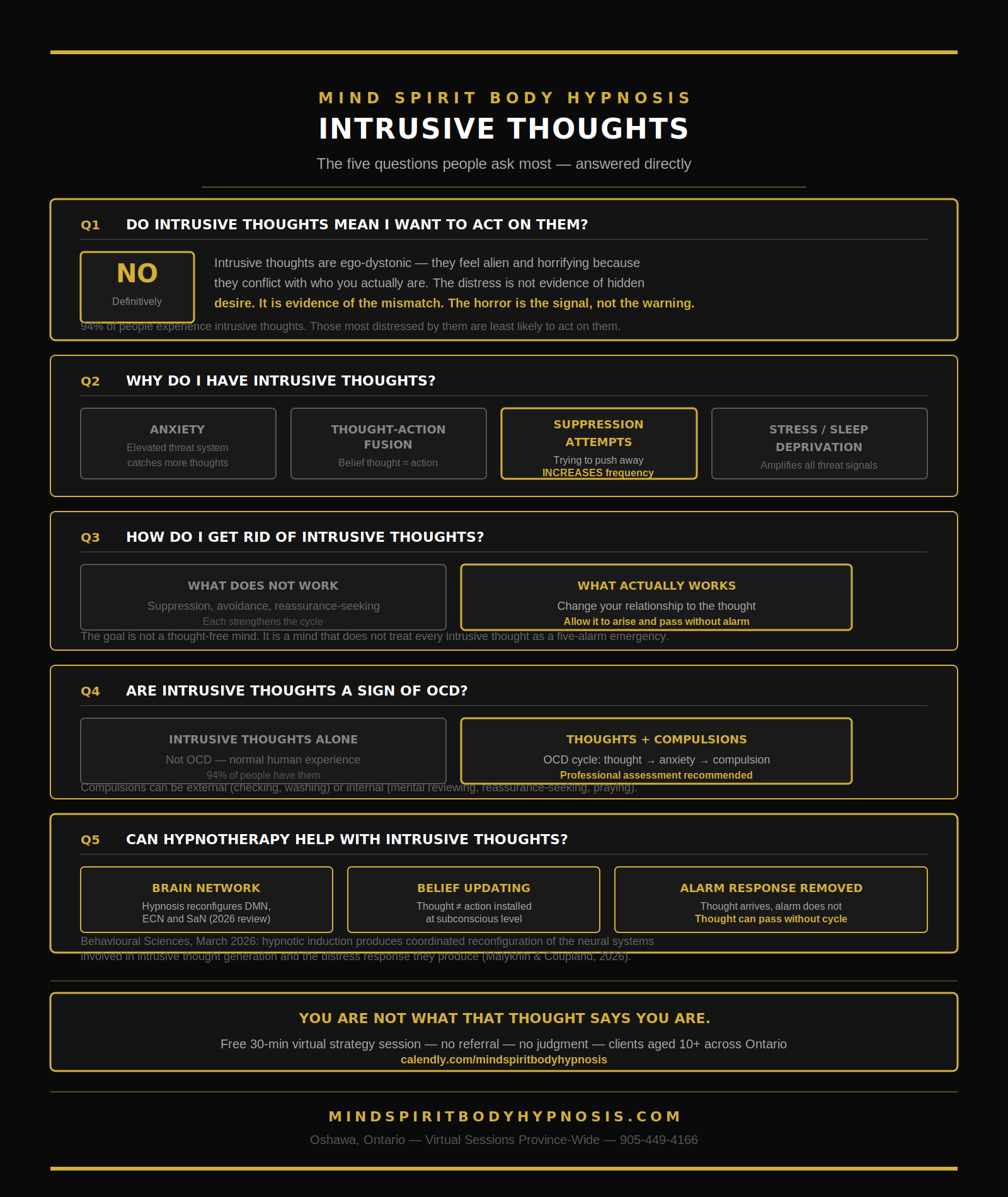
Do Intrusive Thoughts Mean I Want to Act on Them?
No. This is the single most important thing to understand about intrusive thoughts, and it is worth saying it with complete clarity before anything else.
Intrusive thoughts do not reflect your desires, your intentions, your character, or your values. In fact, they almost always reflect the opposite. The reason a violent thought in the presence of someone you love is so disturbing is precisely that you love them. The reason a sexually intrusive thought is so distressing is precisely that it violates your actual values. The reason a thought about harming yourself or others feels so horrifying is that harming yourself or others is the last thing you would choose.
The distress the thought produces is not evidence of hidden desire. It is evidence of the mismatch between the thought's content and who you actually are. People who genuinely want to do harmful things do not experience intrusive thoughts about doing them as distressing. They plan. The person who is horrified by the thought is, neurologically and psychologically, the last person who should be afraid of it.
Clinicians refer to this pattern as ego-dystonic experience: thoughts that are experienced as alien, unwanted, and fundamentally inconsistent with the person's sense of self. This is the defining characteristic of intrusive thoughts. If the thought is deeply upsetting and feels completely unlike you, that is not a warning. That is the mechanism of intrusive thoughts working exactly as the research describes.
⭐ Pro Tip: A reliable self-check: if you are asking whether your intrusive thought means you want to act on it, the answer is almost certainly no. People who have genuine intentions or desires do not typically experience those intentions as horrifying, alien, and unwanted. The horror itself is the evidence that the thought does not represent your actual self. This check does not replace professional support when thoughts are persistent or significantly distressing, but it is a reliable starting point for understanding what is happening.
Why Do I Have Intrusive Thoughts?
This is the second most commonly searched question about intrusive thoughts, and the answer is both reassuring and neurologically interesting.
Intrusive thoughts happen to everyone. Research consistently finds that approximately 94 percent of the general population experience unwanted, intrusive thoughts at some point, including thoughts about harming others, sexual content, blasphemy, and other distressing material. The thoughts themselves are not a sign of pathology. They are a feature of how the brain operates.
The brain is constantly scanning, predicting, imagining, and sorting possibilities. It not only produces calm, rational, welcome thoughts. It generates a continuous stream of mental content, including material that is odd, random, exaggerated, taboo, or frightening. For most people, these thoughts pass without significant attention or distress.
For some people, these thoughts catch. They hook into the attention system rather than passing through it, producing a cycle of distress, suppression attempts, and monitoring that paradoxically keeps the thought more present rather than less. The content of the thought is not the issue. The relationship to the thought is.
Several factors increase the likelihood of intrusive thoughts becoming stuck rather than passing:
Anxiety and nervous system hyperactivation. When the nervous system is already running an elevated threat response, the brain's salience detection system is more sensitive. It assigns greater significance to neutral or minor mental events, including uncomfortable thoughts, treating them as requiring urgent attention rather than allowing them to pass.
Thought-action fusion. A belief, often subconscious, that having a thought is morally equivalent to acting on it, or that thinking something makes it more likely to happen. This belief is extremely common in people with intrusive thoughts and OCD, and it has no basis in reality. Thoughts are mental events. They are not intentions, predictions, or reflections of character.
Suppression attempts. Research consistently confirms that trying to suppress unwanted thoughts increases their frequency and intensity. The classic example is the white bear experiment: participants told not to think about a white bear think about it significantly more than control groups. Every attempt to push the intrusive thought away signals to the brain that the thought is important enough to be suppressed, which increases its prominence.
Stress, sleep deprivation, and hormonal changes. Intrusive thoughts increase in frequency and intensity under any condition that activates the threat system: chronic stress, poor sleep, significant life transitions, pregnancy and postpartum periods, and grief are all associated with elevated intrusive thought frequency.
Research published in the Journal of Obsessive-Compulsive and Related Disorders found that intrusive thought frequency is significantly predicted by anxiety sensitivity and thought-action fusion beliefs, with suppression attempts producing measurable increases in thought intrusion rather than the reduction people expected (Najmi & Wegner, 2008).
For more on how anxiety drives the nervous system patterns that give intrusive thoughts their power, the hypnotherapy for anxiety and stress pillar page covers the foundational nervous system mechanisms.
How Do I Get Rid of Intrusive Thoughts?
This is the most practically searched question about intrusive thoughts. And the honest answer is counterintuitive, which is why so many people find conventional advice about intrusive thoughts frustrating and unhelpful.
You cannot get rid of intrusive thoughts by trying to get rid of them. Trying to eliminate intrusive thoughts strengthens them, because the attempt to suppress signals to the brain that the thought is a genuine threat requiring vigilance. Every suppression attempt is a confirmation to the subconscious that the thought matters.
The goal is not to eliminate the thoughts. It is to change your relationship to them. When intrusive thoughts no longer produce the alarm response, when they are allowed to arise and pass without triggering a cycle of distress, monitoring, and suppression, their frequency and intensity reduce naturally. Not because they have been controlled, but because they are no longer being fed.
This is the principle behind effective evidence-based approaches to intrusive thoughts, and it is where hypnotherapy makes its most significant contribution. Hypnotherapy does not teach the person to think differently about their intrusive thoughts. It changes, at the subconscious level, the automatic threat response that the intrusive thoughts trigger. The thought arrives. The alarm does not automatically follow. Without the alarm, the suppression attempt does not follow. Without the suppression attempt, the thought can pass.
⭐ Pro Tip: One of the most effective immediate tools for managing an intrusive thought in the moment is to label it rather than react to it. Instead of engaging with the content, the person simply notices: I am having an intrusive thought. This simple act of labelling creates a moment of distance between the observer and the thought, reducing the automatic alarm response. Over time, this distance widens. With hypnotherapy, the widening is installed directly at the subconscious level, so the person does not have to consciously create it each time.
Are Intrusive Thoughts a Sign of OCD?
Not necessarily. Intrusive thoughts occur across many different presentations and in people with no diagnosable condition at all. Understanding the distinction is important.
Intrusive thoughts are a normal feature of human mental life. The vast majority of people who experience occasional, passing intrusive thoughts do not have OCD or any other diagnosable condition. The thoughts are distressing but manageable; they do not significantly interfere with functioning, and they reduce on their own as stress reduces.
Intrusive thoughts become a clinical concern, and potentially part of an OCD presentation, when they are accompanied by compulsive responses. OCD is not defined by the presence of intrusive thoughts alone, but by the cycle of obsession and compulsion: the intrusive thought activates anxiety, and the person performs a mental or behavioural compulsion in an attempt to neutralize the anxiety or prevent a feared outcome. The temporary relief produced by the compulsion reinforces the cycle, making the next intrusive thought more distressing and the need for the compulsion more urgent.
Compulsions can be external, such as checking behaviours, reassurance-seeking, ordering, cleaning, or internal, mental reviewing, praying, counting, replaying events. Many people with OCD have primarily internal compulsions and have not identified their behaviour as compulsive at all.
If intrusive thoughts are accompanied by compulsive checking, reassurance-seeking, reviewing, avoidance, or significant interference with daily functioning, a formal assessment from a qualified professional is recommended. Hypnotherapy for intrusive thoughts with an OCD component is most effective when used as a complement to evidence-based OCD treatment rather than as a standalone approach.
How Hypnotherapy Addresses Intrusive Thoughts at the Root
As a certified hypnotherapist trained through the American Board of Hypnotherapy, I approach intrusive thoughts as a pattern involving nervous system dysregulation, thought-action fusion beliefs, and compulsive response habits -- all of which can be addressed at the subconscious level.
Default mode network recalibration. A landmark review published in Behavioural Sciences in March 2026 found that hypnotic induction produces coordinated reconfiguration of the default mode network, executive control network, and salience network, the precise brain systems involved in self-referential processing and the threat detection that drives intrusive thought distress (Malykhin & Coupland, 2026). In plain terms: hypnosis changes how the brain processes self-referential thought, directly reducing the alarm response that intrusive thoughts trigger.
Thought-action fusion belief updating. The subconscious belief that having a thought is morally equivalent to acting on it is identified and directly addressed in trance. Using guided suggestion and reframing, the subconscious is updated with a more accurate model: thoughts are mental events. They are not intentions. They are not predictions. They are not character assessments. As this belief updates at the subconscious level, the alarm response to intrusive thoughts reduces automatically.
Suppression of habit interruption. The automatic suppression response that follows an intrusive thought is addressed as a subconscious habit pattern. Rather than suppressing, the subconscious is trained to allow thoughts to arise and pass without escalation. This is installed in trance using guided imagery and direct suggestion, making the allowing response automatic rather than effortful.
Nervous system baseline regulation. Because intrusive thoughts are amplified by nervous system hyperactivation, reducing the general anxiety baseline reduces the frequency and intensity of the intrusive thought experience. Hypnotherapy produces measurable parasympathetic shifts that reduce this baseline, making the nervous system less reactive to the thought content even before the specific thought pattern work is done.
Shame and self-compassion work. For many clients, the shame accumulated around the intrusive thoughts is as distressing as the thoughts themselves. In trance, this shame is addressed directly, with specific work on the understanding that having intrusive thoughts is a common, documented, neurologically explained human experience that says nothing accurate about the person's character, intentions, or worth.
NLP Techniques That Change Your Relationship With Unwanted Thoughts
NLP offers precise, portable tools for changing the structural relationship between the person and their intrusive thoughts. Clients I work with across Ontario find these particularly useful as independent between-session tools.
The defusion technique. NLP and acceptance-based approaches share this tool: the person learns to observe the intrusive thought as a mental event rather than a fact or a signal. In trance, this is installed as a subconscious automatic response, so that when the thought arrives, the defusion happens before the alarm fires rather than after. The person notices the thought without being captured by it.
Submodality works on the intrusive thought. Every intrusive thought has a specific internal structure: a quality, a voice, a location, a visual character. These structural features determine how much power the thought has. Changing those features, making the thought quieter, smaller, more distant, and less vivid, reduces the alarm response proportionally. This can be done in under two minutes and provides immediate relief in moments of acute distress.
The observer position. Moving from the inside of the intrusive thought to an observing, witnessing perspective on it dramatically reduces the emotional intensity of the experience. In trance, this shift is practised repeatedly until it becomes the automatic response to the thought rather than the effortful alternative.
Future pacing a mind at peace with its own content. The client is walked through vivid scenes of the client in situations that previously triggered intrusive thoughts, experiencing them with the capacity to notice a thought, allow it to be there, and continue with what they were doing, without suppression, without alarm, without compulsive response. These scenes are filed as expected experiences.
More about how NLP and hypnotherapy are combined in practice at Mind Spirit Body Hypnosis is available on the about page.

What to Expect in a Session
The first session is a conversation, and for clients with intrusive thoughts, it is a conversation that many have never had with anyone before. What kind of thoughts? When did they start? What happens in the moments after they arrive? What do you do to manage them? Has anyone else ever known about this?
This conversation is held with complete clinical composure. Intrusive thoughts of any content, including violent, sexual, blasphemous, or self-harm-related material, are a documented and well-understood psychological phenomenon. Nothing you describe will be met with alarm or judgment.
The trance work begins with nervous system regulation and safety. It progresses through the thought-action fusion belief work and the suppression habit interruption. Later sessions address the shame material and install the future-paced relationship with mental content.
Most programmes for intrusive thoughts at Mind Spirit Body Hypnosis run between three and six sessions. Many clients notice a meaningful reduction in the alarm response to intrusive thoughts after the first two sessions. All sessions are delivered virtually and are available to clients aged 10 and older across Ontario from the privacy of their own home.
What My Clients Say
"I cannot say enough about how amazing Fanis is! He has truly changed my life. I was always an anxious person and always overthought everything. After seeing Fanis I feel like a completely different person. The anxiety is gone and my mind is actually quiet for the first time in my life. I am forever grateful."
Amanda B. | Anxiety and Overthinking | Five Stars
FAQ
Do intrusive thoughts mean I want to act on them? No. Intrusive thoughts are ego-dystonic: they feel alien, horrifying, and completely inconsistent with who you are, because they are. The distress they produce is evidence of the mismatch between the thought's content and your actual values. People who genuinely want to do harmful things do not experience intrusive thoughts about doing so as distressing.
Why do I have intrusive thoughts? Approximately 94 percent of people experience intrusive thoughts. The brain generates a continuous stream of mental content, including uncomfortable material. Intrusive thoughts become a problem not because of their content but when anxiety, thought-action fusion beliefs, and suppression attempts give them more power than they deserve.
How do I get rid of intrusive thoughts? You cannot get rid of intrusive thoughts by trying to get rid of them -- suppression attempts increase their frequency and intensity. The goal is to change your relationship to the thoughts rather than eliminate them. When the thoughts no longer trigger an alarm response, they arise and pass without sustaining the cycle of distress that makes them so consuming.
Are intrusive thoughts a sign of OCD? Not necessarily. Intrusive thoughts are a normal human experience and occur across many contexts. They become part of an OCD presentation when accompanied by compulsive responses, mental or behavioural, designed to neutralize the anxiety the thoughts produce. If thoughts are accompanied by compulsions and significantly interfere with daily life, a professional assessment is recommended.
Can hypnotherapy help with intrusive thoughts? Yes. A 2026 neuroscience review confirmed that hypnotic induction produces measurable reconfiguration of the default mode network, executive control network, and salience network -- the precise brain systems involved in intrusive thought generation and distress. Hypnotherapy addresses thought-action fusion beliefs, suppression habits, nervous system hyperactivation, and shame at the subconscious level.
How many sessions will I need? Most clients at Mind Spirit Body Hypnosis working on intrusive thoughts complete three to six sessions. Many notice a meaningful reduction in the alarm response after the first two sessions. Presentations with significant OCD components or trauma roots may require additional sessions.
Is hypnotherapy safe for intrusive thoughts? Yes. Hypnotherapy is a gentle, non-invasive approach. For clients with intrusive thoughts in the context of OCD, hypnotherapy is most effective as a complement to evidence-based OCD treatment rather than a standalone approach. Suitability is assessed openly in the free strategy session.
Should I be afraid of my intrusive thoughts? No. The thoughts themselves are not dangerous. They do not predict your behaviour, reflect your character, or signal hidden desires. They are mental events. The distress they produce is real, but it is caused by the alarm response to the thoughts, not by the thoughts themselves.
What if my intrusive thoughts feel very real and vivid? Vividness and intensity are features of how the brain processes threat, not indicators of the thought's significance or your likelihood of acting on it. The more distressing the intrusive thought, the more strongly it tends to signal ego-dystonic material that conflicts with your actual values.
How do I get started? Book a free 30-minute virtual strategy session at calendly.com/mindspiritbodyhypnosis. No referral needed. Nothing you describe will be met with judgment.
Ready to Take the Next Step?
If intrusive thoughts have been managing you rather than passing through you, that is not who you are. It is a pattern your nervous system has built around them. And it can change.
I offer a free 30-minute virtual strategy session for new clients across Ontario. There is no judgment, no alarm, and no pressure. Just a conversation about what has been happening and how hypnotherapy or NLP may help you build a genuinely different relationship with your own mind.
Book your free session: calendly.com/mindspiritbodyhypnosis
Call or text: 905-449-4166
Email: info@mindspiritbodyhypnosis.com
Visit: mindspiritbodyhypnosis.com
Serving clients virtually across Ontario, including Durham Region, Toronto, Ontario, and beyond.
Disclaimer: This article is for informational purposes only and does not constitute medical or psychological advice. Intrusive thoughts that are persistent, significantly distressing, or accompanied by compulsive behaviours warrant professional assessment. If you are experiencing thoughts of harming yourself or others that feel like genuine urges rather than unwanted intrusions, please contact the 988 Suicide Crisis Helpline or go to your nearest emergency room. Hypnotherapy and NLP are complementary approaches and are not a substitute for clinical diagnosis or treatment. Results vary by individual.
Written by Fanis Makrigiannis | Certified Hypnotherapist & NLP Master Practitioner | Mind Spirit Body Hypnosis.