Does Hypnotherapy work for Anxiety?
Does Hypnotherapy Work for Anxiety? Your Ontario Questions Answered
TL;DR: Yes, hypnotherapy works for anxiety, and it works specifically because it addresses the subconscious patterns that generate anxiety at a level that conscious coping strategies alone cannot reach. At Mind Spirit Body Hypnosis in Oshawa, Ontario, Fanis Makrigiannis has collected the most common questions Ontarians are asking before their first session, and this article answers every one of them directly and honestly.
Quick Answer
Hypnotherapy for anxiety is supported by a growing body of research. A meta-analysis published in the Journal of Consulting and Clinical Psychology found hypnotherapy significantly enhanced the effectiveness of cognitive behavioural therapy for anxiety, with the hypnotherapy group showing 70 percent more improvement than the non-hypnotherapy group. At Mind Spirit Body Hypnosis in Oshawa, Ontario, Fanis Makrigiannis, a Certified Hypnotherapist (ABH, NGH) and NLP Master Practitioner (ABNLP), offers virtual sessions province-wide for clients of all ages who want to understand what hypnotherapy actually is and whether it is right for them.
Questions This Article Answers
Does hypnotherapy actually work for anxiety?
How many hypnotherapy sessions will I need for anxiety?
Is hypnotherapy covered by OHIP in Ontario?
Will I lose control or be unconscious during hypnosis?
What is the difference between hypnosis and hypnotherapy?
In This Article:
One of the most common things I hear in the first five minutes of a free strategy session is some version of: I have been thinking about this for a long time, but I have a lot of questions. And then the questions come, and they are almost always the same questions, which tells me that the same barriers are keeping a large number of people from accessing something that could genuinely help them.
This article is my attempt to answer every one of those questions directly, honestly, and without the kind of promotional hedging that makes it hard to trust what you are reading. I want you to make an informed decision, not just a hopeful one.
Does Hypnotherapy Actually Work for Anxiety?
Yes. But it is worth being specific about what that means, because hypnotherapy works for anxiety differently from most other approaches, and understanding the mechanism helps explain both why it is effective and why the effects tend to be more durable than those produced by symptom management approaches alone.
Anxiety is not primarily a thinking problem. If it were, people with anxiety would be able to think their way out of it, but they cannot. Anxiety is a subconscious threat response: an automatic activation of the nervous system's alarm system in response to patterns, triggers, and associations that the subconscious has filed as dangerous. The subconscious makes this determination faster than the conscious mind can intervene, which is why the anxiety often feels as if it comes from nowhere and why rational reassurance so rarely switches it off.
Hypnotherapy works by accessing the subconscious directly, in a state of focused relaxation where the subconscious is more receptive to change. In this state, the patterns, beliefs, and associations driving the anxiety can be identified and updated. The trigger fires. The anxiety response does not automatically follow. Not because the person has learned to manage the anxiety better, but because the subconscious no longer evaluates the trigger as a threat in the same way.
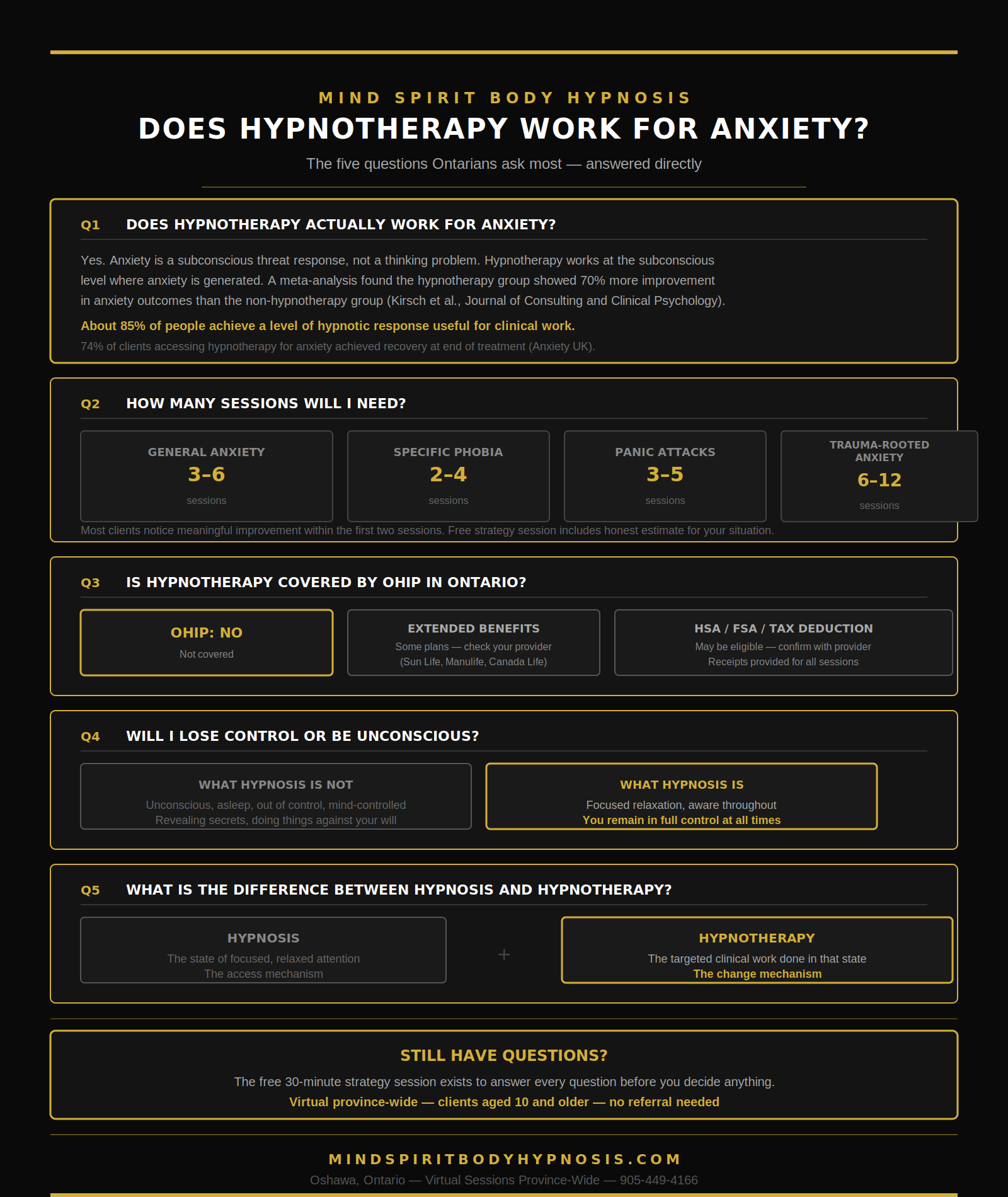
Research supports this mechanism. A meta-analysis published in the Journal of Consulting and Clinical Psychology found that adding hypnotherapy to cognitive behavioural therapy produced 70 percent more improvement in anxiety outcomes than CBT alone, with the hypnotherapy group maintaining gains at follow-up (Kirsch et al., 1995). A systematic review published in the International Journal of Clinical and Experimental Hypnosis found significant effect sizes for hypnotherapy across anxiety presentations, including generalized anxiety, specific phobias, and test anxiety (Alladin, 2014).
Does hypnotherapy work for everyone? No. About 15 percent of the population is highly hypnotically responsive, approximately 70 percent are moderately responsive, and approximately 5 percent show limited response. However, the capacity for hypnotic response is not the same as the benefit from hypnotherapy. Many clients who do not achieve deep trance states still experience significant and lasting improvement in anxiety through the NLP and subconscious work that accompanies the hypnotherapy process.
⭐ Pro Tip: A reliable informal test of hypnotic responsiveness is your absorption capacity: being fully immersed in a film, a book, a piece of music, or a daydream to the point where you lose track of time or your surroundings. People who experience this easily tend to be highly responsive to hypnotherapy. If this describes you, hypnotherapy is likely to be particularly effective for your anxiety.
How Many Sessions Will I Need?
This is the question I am asked most often, and I want to give you a genuinely useful answer rather than a vague one.
For most anxiety presentations, clients at Mind Spirit Body Hypnosis complete between three and six sessions, with meaningful improvement typically noticed after the first two. This is considerably faster than most talk therapy models, and the reason is the mechanism: hypnotherapy works at the subconscious level where the anxiety originates rather than at the conscious level where the person is already aware of the problem.
Here is a more specific breakdown by presentation:
General anxiety and worry: Three to five sessions for most clients. The nervous system regulation and core belief work that drives generalized anxiety responds well to hypnotherapy, with the reduction in background anxiety often noticeable after sessions one and two.
Specific phobias: Two to four sessions in most cases. Specific phobias are among the most responsive presentations for hypnotherapy because they have a clear trigger structure that can be systematically addressed.
Panic attacks: Three to five sessions. The anticipatory anxiety about the panic attack is often as debilitating as the panic attack itself, and both are addressed in the work.
Performance anxiety: Two to four sessions for most clients.
Anxiety with significant trauma roots: Six to twelve sessions, reflecting the layered nature of the underlying material.
These are realistic averages. Some clients achieve their goals faster. Others require additional sessions, particularly where there is significant history or where the anxiety presentation is complex. In the free strategy session, I will always give you an honest assessment of what is realistic for your specific situation.
⭐ Pro Tip: The number of sessions you need is not a measure of the severity of your problem or of your progress. It reflects the complexity of the subconscious pattern and how many layers it has. Someone with a simple specific phobia and someone with decades of generalized anxiety with trauma roots need different amounts of work, and both are completely normal. What matters is that each session produces a genuine shift, which you will be able to feel.
Is Hypnotherapy Covered by OHIP in Ontario?
This is one of the most searched questions about hypnotherapy in Ontario, and the answer requires a bit of nuance.
OHIP does not cover stand-alone hypnotherapy services. Hypnotherapy delivered by a certified hypnotherapist, even a highly credentialed one, is not an OHIP-covered service in Ontario.
However, there are several other avenues worth checking:
Extended health benefits. Some employer-provided extended health benefit plans include coverage for hypnotherapy, particularly when it is delivered alongside or as part of a broader therapeutic programme. Plans from providers, including Sun Life, Manulife, and Canada Life, sometimes include hypnotherapy coverage. Check your benefits booklet or call your provider directly. You will often need to ask specifically whether hypnotherapy by a certified hypnotherapist is covered, as the answer varies significantly by plan.
Health Spending Accounts (HSA) and Flexible Spending Accounts (FSA). If you have an HSA or FSA through your employer, hypnotherapy costs may be eligible for reimbursement, particularly when the treatment is for a medical or psychological condition. This is worth confirming with your plan administrator.
Tax deductibility. Hypnotherapy may be eligible as a medical expense for tax purposes in Canada when prescribed by a medical doctor or as part of treatment for a recognized medical condition. Consult with a tax professional for your specific situation.
At Mind Spirit Body Hypnosis, receipts are available for all sessions for insurance or tax submission purposes. The best place to start is checking your specific plan, as coverage varies significantly.
For more information on what hypnotherapy for anxiety involves and how it is delivered at Mind Spirit Body Hypnosis, the hypnotherapy for anxiety and stress pillar page covers the clinical approach in detail.
Will I Lose Control or Be Unconscious?
No. And this is probably the most important myth to address, because it is the one that prevents the most people from trying something that could help them significantly.
Here is what hypnosis actually is: a state of focused attention and heightened internal awareness in which the critical, analytical part of the mind relaxes its usual gatekeeping function and the subconscious becomes more receptive to suggestion and change. It is not unconsciousness. It is not sleep. You are aware throughout. You can hear everything that is being said. You can open your eyes and leave the room at any moment you choose.
Here is what hypnosis is not: being put under, losing awareness, having your mind controlled, doing things you would not normally do, or revealing information you would not otherwise share. The theatrical hypnosis of stage shows, in which performers appear to control unwilling participants, is a different phenomenon entirely, relying on social compliance and self-selection of highly responsive volunteers. It has nothing to do with clinical hypnotherapy.
In a clinical hypnotherapy session, you remain in control throughout. Your values, preferences, and boundaries are not suspended. You cannot be made to say or do anything that conflicts with your genuine will. If a suggestion does not sit right with you, you will simply not respond to it. This is not a limitation of the process. It is a feature of how hypnosis actually works.
Most clients describe the experience as feeling deeply relaxed and pleasantly absorbed, similar to the feeling of being almost asleep but still aware of the world around them, or the absorbed state of being deeply engaged in a film or a piece of music. Some clients experience more vivid imagery. Others experience a quality of calm and heaviness. Both are normal.
What Is the Difference Between Hypnosis and Hypnotherapy?
Hypnosis is the state: the condition of focused attention, relaxed critical awareness, and heightened subconscious receptivity that the induction process produces.
Hypnotherapy is the therapeutic work done within or alongside that state: the identification and updating of subconscious patterns, beliefs, and associations that are driving the presenting concern. Hypnosis is the access mechanism. Hypnotherapy is what is done with that access.
This is an important distinction because hypnosis on its own, without skilled therapeutic direction, is not consistently effective for complex presentations. The quality of the hypnotherapy depends primarily on the quality of the therapeutic work done in the hypnotic state, which depends on the training, experience, and clinical judgement of the practitioner.
At Mind Spirit Body Hypnosis, the hypnotic state is used as a platform for specific, targeted therapeutic work. The precise nature of that work is determined by the presenting concern, the individual client's history, and the mapping done in the first session. Generic relaxation in trance is a very different experience from clinical hypnotherapy, and it is clinical hypnotherapy that produces the lasting outcomes the research supports.
Can Anyone Be Hypnotised?
Approximately 95 percent of the population can achieve a degree of hypnotic response useful for clinical work. The remaining 5 percent either require specialized techniques or find that the direct hypnotic approach is not their most effective pathway, in which case the NLP work that accompanies the hypnotherapy often produces an equivalent outcome.
Contrary to what many people believe, intelligence and strong will do not reduce hypnotic responsiveness. In fact, research consistently finds that imaginative capacity and the ability to become absorbed in internal experience, qualities often associated with intelligence and creativity, are positively correlated with hypnotic responsiveness.
Anxiety itself does not prevent hypnosis. Many clients assume that because they are anxious, they will not be able to relax enough to enter trance. In practice, the opposite is often true: people with high anxiety frequently enter trance quite readily, because the same quality of absorbed, automatic attention that drives their anxiety is the quality that makes hypnotic induction effective.

What Does Hypnotherapy Feel Like?
Most clients describe the experience as the deepest relaxation they have felt in years. The body becomes heavy and comfortable. The awareness of the room recedes slightly without disappearing. Thoughts slow. The critical monitoring quality of ordinary wakefulness softens.
Within this state, the therapeutic work varies in quality depending on the presentation. Some clients experience clear internal imagery. Others experience a felt sense of release, safety, or shift. Some clients notice very little during the session itself but feel a tangible difference in their anxiety pattern in the days that follow. All of these are normal responses.
The post-session experience is often described as similar to waking from a genuinely deep sleep: clear-headed, calm, and grounded in a way that ordinary rest does not always produce. Some clients notice a reduction in their anxiety within hours of the first session. Others notice the shift gradually over several days.
For more on what to expect from the full programme at Mind Spirit Body Hypnosis, the about page covers the approach, the sessions, and what clients can expect in detail.
Is Hypnotherapy Safe?
Yes, when delivered by a qualified and trained practitioner. Hypnotherapy has an excellent safety record when used appropriately for the conditions it is suited to.
There are some contraindications and areas of caution worth being aware of. Hypnotherapy is not recommended as a first-line approach for people currently experiencing active psychosis, severe dissociation, or certain other complex psychiatric presentations, and a qualified hypnotherapist will assess your suitability in the initial conversation. If you have a history of psychosis or significant dissociation, please disclose this in the free strategy session so the approach can be appropriately tailored or an alternative pathway recommended.
For the vast majority of clients with anxiety, specific phobias, stress, sleep difficulties, habit change, and confidence concerns, hypnotherapy is straightforward, safe, and non-invasive. There are no pharmaceutical side effects. Sessions are conducted in a supportive, collaborative environment in which your comfort and safety are the primary concerns throughout.
What My Clients Say
"Working with Fanis has changed my life. After years of therapy for anxiety and confidence issues, I wanted to try something different. This experience has transformed me from the inside out and continues to have an effect even after our sessions. I am now able to be myself, face my fears, surround myself with those who care about me and live a fulfilling and happy life. So grateful."
Kristen W. | Anxiety and Confidence | Five Stars
"I cannot say enough about how amazing Fanis is! He has truly changed my life. I was always an anxious person and always overthinking everything. After seeing Fanis I feel like a completely different person. The anxiety is gone and my mind is actually quiet for the first time in my life. I am forever grateful."
Amanda B. | Anxiety and Overthinking | Five Stars
FAQ
Does hypnotherapy work for anxiety? Yes. A meta-analysis found that adding hypnotherapy to CBT produced 70 percent more improvement in anxiety outcomes than CBT alone. Hypnotherapy is effective because it addresses the subconscious patterns generating anxiety rather than managing the conscious experience of it.
How many sessions will I need for anxiety in Ontario? Most clients at Mind Spirit Body Hypnosis complete three to six sessions for general anxiety, with meaningful improvement noticed after the first two. Specific phobias typically require two to four sessions. Complex presentations with significant trauma roots may require six to twelve sessions. An honest session estimate is always given in the free strategy session.
Is hypnotherapy covered by OHIP in Ontario? No. OHIP does not cover stand-alone hypnotherapy. However, some extended health benefit plans (Sun Life, Manulife, Canada Life) include hypnotherapy coverage, and HSA or FSA reimbursement may be available. Receipts are provided for all sessions at Mind Spirit Body Hypnosis.
Will I lose control during hypnosis? No. You remain aware and in control throughout. You cannot be made to say or do anything against your will. The hypnotic state is one of focused relaxation and heightened internal awareness, not unconsciousness or loss of agency.
What is the difference between hypnosis and hypnotherapy? Hypnosis is the state of focused attention and relaxed critical awareness. Hypnotherapy is the therapeutic work done within that state: identifying and updating the subconscious patterns driving the presenting concern. Hypnosis is the access mechanism; hypnotherapy is the clinical work.
Can anyone be hypnotized? Approximately 95 percent of people can achieve a useful level of hypnotic response. Anxiety, strong will, and high intelligence do not reduce responsiveness. For the 5 percent with limited hypnotic response, NLP techniques used alongside the hypnotherapy typically produce comparable outcomes.
What does hypnotherapy feel like? Most clients describe it as the deepest relaxation they have experienced in years, with a quality of absorbed calm similar to being nearly asleep but still aware. Imagery, felt sense of release, and post-session calm are all commonly reported. The experience varies by individual and session.
Is hypnotherapy safe? Yes, when delivered by a qualified practitioner. Hypnotherapy has an excellent safety record for anxiety, phobias, sleep difficulties, habits, and confidence concerns. Suitability is assessed in the initial free strategy session, and contraindications are discussed openly.
How is hypnotherapy different from meditation? Meditation is a self-directed practice of attention regulation, typically without a specific therapeutic target or practitioner-guided change process. Hypnotherapy is a clinically directed process in which the hypnotic state is used as a platform for targeted subconscious therapeutic work. Both promote relaxation; only hypnotherapy directly targets the specific subconscious patterns driving the presenting concern.
How do I get started? Book a free 30-minute virtual strategy session at calendly.com/mindspiritbodyhypnosis. No referral needed, no pressure, and your questions are always welcome.
Ready to Take the Next Step?
If you have been sitting with these questions for a while, that is normal. The best thing you can do now is have the conversation. The free strategy session is exactly that -- a conversation, not a commitment. You can ask every question on this list and whatever else is on your mind.
Book your free session: calendly.com/mindspiritbodyhypnosis
Call or text: 905-449-4166
Email: info@mindspiritbodyhypnosis.com
Visit:mindspiritbodyhypnosis.com
Serving clients virtually across Ontario, including Durham Region, Toronto, Ontario, and beyond.
Disclaimer: This article is for informational purposes only and does not constitute medical or psychological advice. Hypnotherapy and NLP are complementary approaches and are not a substitute for diagnosis or treatment by a qualified healthcare provider. Information about OHIP coverage and insurance is general guidance only; please confirm with your specific provider. Results vary by individual.
Written by Fanis Makrigiannis | Certified Hypnotherapist (ABH, NGH) & NLP Master Practitioner (ABNLP) | Mind Spirit Body Hypnosis.