Hypnotherapy for weight loss in Ontario
Hypnotherapy for Weight Loss in Ontario: Your Questions Answered
TL;DR: The questions people ask before their first weight loss hypnotherapy session are almost always the same. Does it work? How does it compare to Ozempic? Why have diets kept failing? How many sessions? What is the virtual gastric band? This article answers all five directly, honestly, and without the hype that makes it hard to trust what you are reading online.
Quick Answer
Hypnotherapy for weight loss works not by suppressing appetite chemically but by addressing the subconscious behavioural and emotional patterns that drive overeating in the first place. Research consistently confirms that adding hypnotherapy to a weight loss programme nearly doubles results compared to the programme alone. At Mind Spirit Body Hypnosis in Oshawa, Ontario, Fanis Makrigiannis, a Certified Hypnotherapist and NLP Master Practitioner, offers virtual sessions province-wide for clients of all ages who are ready to address not just what they eat, but why.
Questions This Article Answers
Does hypnotherapy actually work for weight loss?
How does hypnotherapy compare to Ozempic and GLP-1 medications?
Why do diets keep failing even when I follow them perfectly?
How many sessions will I need for weight loss hypnotherapy?
What is the virtual gastric band and does it work?
In This Article:
You have tried the diets. You have lost the weight, more than once, and watched it return. You have tracked calories, reduced portions, eliminated entire food groups. And for a while it works, and then something shifts, and the old patterns reassert themselves with a completeness that makes the effort feel like it never happened.
This is not a willpower problem. It is not a knowledge problem. You know what to eat. You know that the late-night eating, the stress-driven reaching for food, the emotional eating that arrives with certain feelings and refuses to stop until something else does none of it is helping. And knowing has not been enough.
The reason is that the patterns driving the overeating are not located where the diets are addressed. They are located in the subconscious. And the subconscious responds to different tools.
In my practice, the clients who arrive for weight loss hypnotherapy are often the most motivated, most informed, and most experienced dieters in the room. They have done everything that is supposed to work. And they are here because they are finally addressing the layer of the problem that none of it reached.
Does Hypnotherapy Actually Work for Weight Loss?
Yes, and specifically because it works at a different layer from every other weight loss approach.
Every effective weight loss approach addresses the what: what to eat, what not to eat, what macronutrient ratio, what caloric deficit. Hypnotherapy addresses the why: why you reach for food when you are not hungry, why the diet that works for six weeks stops working when stress arrives, why certain emotional states produce specific food cravings that override every conscious intention.
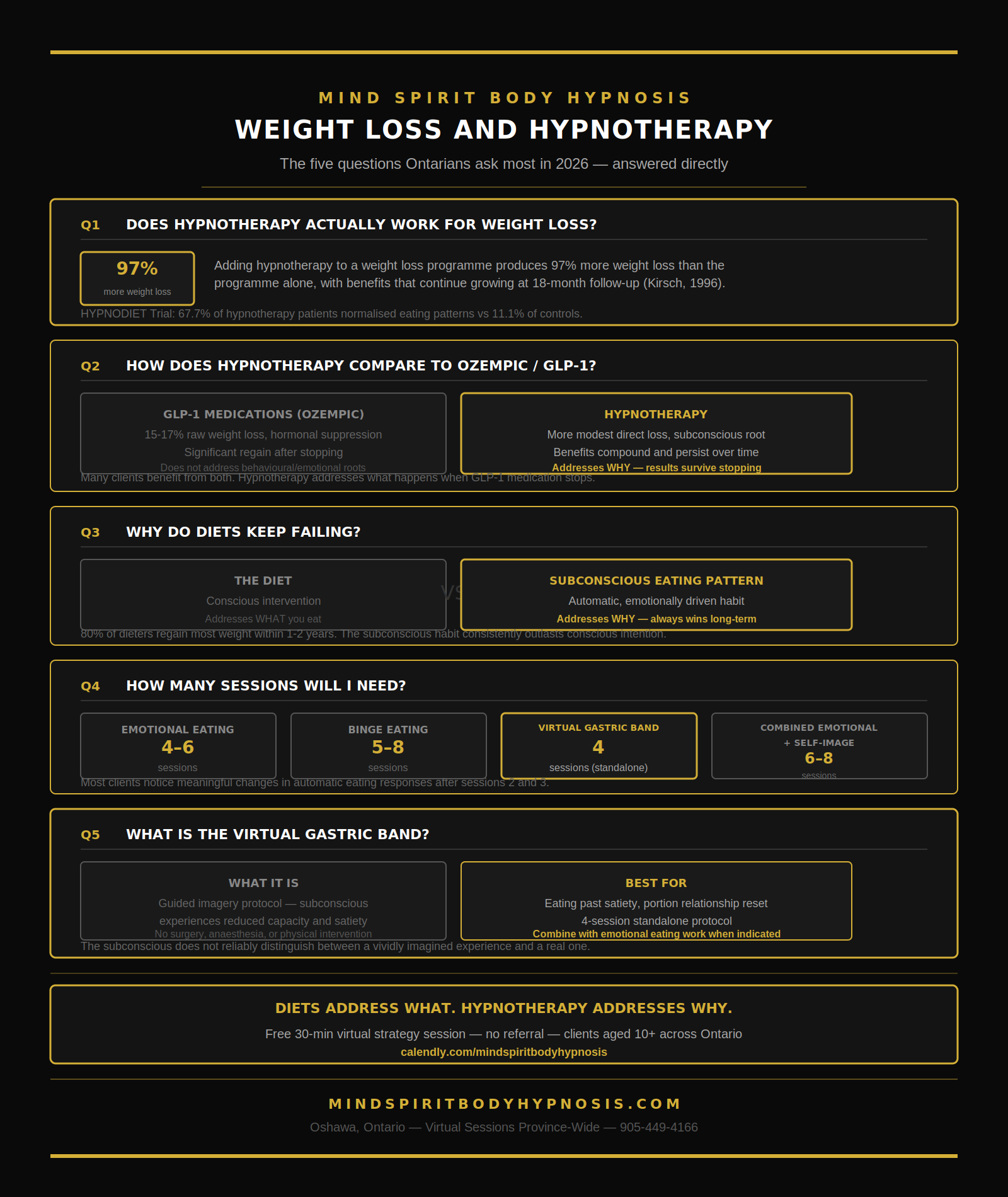
The research is detailed. A meta-analysis published in the Journal of Consulting and Clinical Psychology found that adding hypnotherapy to a cognitive behavioural weight loss programme produced 97 percent more weight loss than the behavioural programme alone, and that the hypnotherapy group's results continued improving at eighteen-month follow-up while the control group's had plateaued (Kirsch, 1996). Participants who practised self-hypnosis between sessions lost significantly more weight, an average of 9.6 kg, and consumed significantly fewer calories per day compared to those who did not.
The HYPNODIET clinical trial found that 67.7 percent of hypnotherapy patients normalized their eating patterns compared to just 11.1 percent of controls, a striking difference that reflects hypnotherapy's specific effectiveness at the behavioural and emotional layer of weight management.
What hypnotherapy does not do is produce rapid dramatic weight loss on its own. It is not a replacement for a sound nutritional approach. It is an amplifier of that approach, addressing the subconscious layer that determines whether the nutritional changes stick. The clients who do best in the programme are those who pair the hypnotherapy work with a sensible eating approach rather than treating the hypnotherapy as a substitute for it.
⭐ Pro Tip: The clearest indicator that hypnotherapy is the right next step in your weight loss journey is not your current weight or what diets you have tried. It is whether you notice a consistent gap between what you intend to eat and what you actually eat in moments of stress, boredom, loneliness, or emotional activation. If the gap is consistent and the same triggers keep producing the same eating responses despite your conscious intentions, the pattern is subconscious. That is exactly where hypnotherapy works.
How Does Hypnotherapy Compare to Ozempic?
This is the question that 2026 has added to every weight loss conversation in Ontario, and it deserves a genuinely honest answer rather than a promotional one.
GLP-1 medications, including Ozempic (semaglutide) and Wegovy, produce larger raw weight loss than hypnotherapy alone. Research confirms GLP-1 medications produce weight loss of 15 to 17 percent of body weight by suppressing appetite hormonally, which is more than hypnotherapy produces as a standalone intervention. This is not something to hide or minimize. These medications work, for the right candidates, under the right medical supervision.
The honest comparison looks like this:
GLP-1 medications: Suppress appetite hormonally, producing significant caloric reduction without addressing the behavioural and emotional drivers of overeating. They work while being taken. Significant weight regain typically occurs after stopping because the underlying patterns have not changed. They are prescription-only, require ongoing medical supervision, cost significantly more per month, and carry side effects including nausea, gastrointestinal disruption, and in some cases more serious concerns.
Hypnotherapy: Addresses the behavioural and emotional roots of overeating that GLP-1 medications do not target. Produces more modest direct weight loss but targets why the eating patterns exist. The results compound over time rather than reversing when the treatment stops, because the subconscious patterns that drove the overeating have been changed rather than chemically suppressed. No pharmaceutical side effects. No ongoing cost after the programme.
The most effective approach for many people: Both. Some clients currently taking GLP-1 medications find hypnotherapy a valuable complement, using the medication's appetite suppression to reduce the immediate pressure of overeating while using hypnotherapy to address the emotional and behavioural patterns that will determine what happens when or if they stop the medication.
At Mind Spirit Body Hypnosis, the conversation about your specific situation is always honest about what hypnotherapy can and cannot do, and when referral to a medical practitioner for additional support is appropriate.
⭐ Pro Tip: If you are considering GLP-1 medications and wondering whether hypnotherapy is worth adding, the most useful question to ask is: what will I do when I stop taking the medication? If the answer is uncertain, addressing the subconscious behavioural and emotional patterns now, while the medication is reducing the immediate pressure, may produce significantly better long-term outcomes than either approach alone.
Why Do Diets Keep Failing?
This is the most emotionally important question in weight loss, because the repeated failure of diets that are correctly followed is one of the most demoralizing experiences in the weight loss journey. And the answer, when it is finally understood, changes everything about how the problem is approached.
Diets fail not because of the diet and not because of the person following it. They fail because they address the conscious layer of a problem that is primarily operating at the subconscious layer.
Here is how it works. The subconscious has established a set of associations, habits, and coping patterns around food. Certain emotional states trigger certain eating behaviours automatically, before any conscious decision is involved. Stress produces a reach for specific foods. Loneliness produces a reach for specific foods. The end of a difficult day produces a reach for specific foods. The subconscious is not consulting the diet plan. It is executing a programme that has been reinforced thousands of times over many years, and that provides immediate, reliable emotional relief.
The diet is a conscious intervention. The eating pattern is a subconscious habit. Conscious intention consistently loses to subconscious habit over time, which is why the most common pattern is: diet starts, results appear, life becomes difficult, subconscious habit reasserts, diet ends, weight returns.
Research published in the American Journal of Clinical Nutrition found that approximately 80 percent of people who achieve significant weight loss through diet and exercise alone have regained most or all of it within one to two years, with the regain rate increasing with each subsequent diet attempt. The subconscious interpretation of each failed diet strengthens the belief that change is not sustainable, making subsequent attempts harder rather than easier.
Hypnotherapy changes the subconscious programme rather than competing with it. When the subconscious no longer uses food to regulate emotional states, the diet does not need to fight against a competing programme. The nutritional approach and the subconscious are working in the same direction.
For more on the emotional eating patterns that underlie diet failure and how hypnotherapy addresses them specifically, the hypnotherapy for weight loss pillar page covers the full clinical approach.
How Many Sessions Will I Need?
Here is an honest, specific answer rather than a vague one.
Most weight loss hypnotherapy programmes at Mind Spirit Body Hypnosis run between four and eight sessions, depending on the specific presentation. Here is a more precise breakdown:
Emotional eating as the primary driver: Four to six sessions. The emotional triggers, unmet needs, and food-emotion associations that drive emotional eating respond well to hypnotherapy, with meaningful shifts in the automatic eating response typically apparent after sessions two and three.
Binge eating patterns: Five to eight sessions, reflecting the layered nature of the pattern and the shame and restriction cycle that typically accompanies it.
Weight loss with significant trauma or anxiety roots: Six to ten sessions. When the eating pattern is deeply connected to emotional regulation and has significant historical roots, additional sessions address the underlying emotional material.
Virtual gastric band programme: Four sessions, as a standalone protocol. Can be extended if additional emotional eating work is indicated.
Combined emotional eating and self-image work: Six to eight sessions, addressing both the eating behaviour and the body image and identity patterns that interact with it.
In the free strategy session, you will always receive an honest estimate for your specific situation based on a genuine conversation about what is happening and what has already been tried.
⭐ Pro Tip: The most consistent predictor of good outcomes in weight loss hypnotherapy is not the number of sessions but the quality of engagement between sessions. Clients who listen to the session recording between appointments, notice and record their eating triggers in the days following each session, and bring that material to the next session consistently see faster and more durable results than clients who attend sessions without this between-session engagement. The hypnotherapy changes the subconscious programme. The between-session engagement consolidates and deepens those changes.
What Is the Virtual Gastric Band?
The virtual gastric band is one of the most searched weight loss hypnotherapy topics in Ontario, and it is also one of the most misunderstood. Here is what it actually is and what it is not.
The virtual gastric band is a hypnotherapy protocol in which the subconscious is guided to experience the physiological effects of a gastric band procedure: a sense of reduced stomach capacity, earlier satiety signals, and a changed relationship with food quantity, without any surgery, anesthesia, or physical intervention whatsoever.
It works on the principle that the subconscious does not reliably distinguish between a vividly imagined experience and a real one. Using structured guided imagery and direct suggestion over four sessions, the subconscious is guided through the experience of having the procedure and then through the recovery and adjustment period. Clients frequently report experiencing genuine changes in how much food they need to feel satisfied, and in the physical experience of fullness, following the protocol.
What the virtual gastric band is particularly effective for: clients who tend to eat past the point of fullness, who have genuine difficulty recognizing satiety signals, and who would benefit from a reset of their portion relationship rather than or in addition to emotional eating work.
What the virtual gastric band is not: a replacement for emotional eating work when emotional triggers are the primary driver of overeating. If the eating is driven primarily by emotional state rather than by genuine hunger that continues past natural satiety, the virtual gastric band alone will not address the emotional driver. In those cases, it is most effective when combined with the emotional eating work.
At Mind Spirit Body Hypnosis, the virtual gastric band protocol is available as a standalone four-session programme or as part of a more comprehensive weight loss programme that includes the emotional eating and subconscious belief work.
More about how the full weight loss programme is structured at Mind Spirit Body Hypnosis is available on the about page.

What to Expect at Mind Spirit Body Hypnosis
The first session is a conversation. What has been tried before and what happened? What are the specific eating patterns that are most difficult to change? Is the eating driven primarily by emotional state, by physical patterns like night eating, by specific cravings, or by a combination? What has worked temporarily and what ended it?
This conversation shapes everything. Some clients are best served by the virtual gastric band protocol. Others need primarily emotional eating work. Many need a combination. The honest assessment of what will serve you best always comes first.
Sessions are conducted virtually, available to clients aged 10 and older across Ontario from the comfort of their own home. For more on how anxiety and stress, which are among the most common drivers of emotional eating, are addressed alongside the weight loss work, the hypnotherapy for anxiety and stress pillar page covers the related mechanisms.
What My Clients Say
"Fanis has literally changed my life! I came in for weight loss and stress eating and have lost 20 pounds in 3 months. I no longer reach for food when I am stressed and I finally feel in control around food for the first time in years. I cannot recommend him enough!"
Sandra M. | Weight Loss and Emotional Eating | Five Stars
"Fanis has done so much for me in such a short period of time -- helped me quit smoking, and also helped me to believe and love myself. So professional and patient like no one I have ever met. He has given me hope and strength I have been needing for a long time. I could never thank him enough. Today I believe in myself!"
Natasha C. | Quit Smoking | Five Stars
FAQ
Does hypnotherapy work for weight loss? Yes. Adding hypnotherapy to a weight loss programme produces 97 percent more weight loss than the programme alone, with results that continue improving at eighteen-month follow-up. Hypnotherapy works by addressing the subconscious behavioural and emotional patterns that drive overeating, which dietary approaches alone do not reach.
How does hypnotherapy compare to Ozempic for weight loss? GLP-1 medications produce larger raw weight loss by suppressing appetite hormonally but require ongoing use and carry significant weight regain risk after stopping. Hypnotherapy produces more modest direct weight loss but targets the behavioural and emotional roots of overeating, with benefits that compound over time. Many people benefit from both approaches together.
Why do diets fail even when I follow them? Diets are a conscious intervention competing against a subconscious habit. Emotional eating patterns, stress-driven cravings, and food-emotion associations operate below conscious awareness and consistently override dietary intention over time. Hypnotherapy changes the subconscious programme rather than competing with it, which is why the nutritional approach works better alongside hypnotherapy.
How many sessions will I need for weight loss? Most programmes at Mind Spirit Body Hypnosis run between four and eight sessions. Emotional eating presentations typically need four to six. Binge eating patterns need five to eight. The virtual gastric band is a four-session protocol. An honest session estimate is always given in the free strategy session.
What is the virtual gastric band? A hypnotherapy protocol in which the subconscious is guided to experience the physiological effects of a gastric band procedure, including reduced stomach capacity and earlier satiety signals, without surgery or physical intervention. It is most effective for clients who eat past natural satiety and less effective as a standalone when emotional eating is the primary driver.
Can hypnotherapy help with specific food cravings? Yes. Cravings are subconscious conditioned responses that respond very well to direct hypnotherapy intervention. The specific emotional associations and neural reward patterns associated with particular foods can be identified and updated in trance.
Is hypnotherapy safe for weight loss? Yes. Hypnotherapy for weight loss is gentle, non-invasive, and has no pharmaceutical side effects. For clients with a history of eating disorders, suitability is assessed openly in the initial session, and the approach is adapted, or complementary professional referral is recommended as appropriate.
Can I do sessions virtually from anywhere in Ontario? Yes. All sessions are delivered virtually, province-wide, with no referral required.
What if I am also taking Ozempic or another GLP-1 medication? Hypnotherapy complements GLP-1 medications well. While the medication reduces immediate appetite pressure, the hypnotherapy addresses the behavioural and emotional patterns that will determine outcomes when the medication is eventually stopped. Many clients on GLP-1 medications find the combination produces significantly better results than either approach alone.
How do I get started? Book a free 30-minute virtual strategy session at calendly.com/mindspiritbodyhypnosis. No referral needed.
Ready to Take the Next Step?
If you have been addressing what you eat for years and the same patterns keep returning, it is time to address why. The subconscious layer is where the pattern lives. And it is where hypnotherapy works.
I offer a free 30-minute virtual strategy session for new clients across Ontario. No pressure, no judgment. Just an honest conversation about what has been happening and what approach is most likely to produce lasting change.
Book your free session: calendly.com/mindspiritbodyhypnosis
Call or text: 905-449-4166
Email: info@mindspiritbodyhypnosis.com
Visit: mindspiritbodyhypnosis.com
Serving clients virtually across Ontario, including Durham Region, Toronto, Ontario, and beyond.
Disclaimer: This article is for informational purposes only and does not constitute medical or nutritional advice. Information about GLP-1 medications, including Ozempic, is general in nature and is not a substitute for advice from your prescribing physician. Hypnotherapy and NLP are complementary approaches and are not a substitute for medical treatment of obesity-related conditions. Please consult a qualified healthcare provider for advice specific to your health situation. Results vary by individual.
Written by Fanis Makrigiannis | Certified Hypnotherapist & NLP Master Practitioner | Mind Spirit Body Hypnosis.