How do I overcome my fear of failure?
Hypnotherapy for Fear of Failure in Ontario: Your Questions Answered
TL;DR: Fear of failure is not a weakness, and it is not a personality flaw. It is a subconscious protection mechanism that developed from specific experiences of failure being made to feel catastrophic, and it produces avoidance of exactly the things that matter most. At Mind Spirit Body Hypnosis in Oshawa, Ontario, the five questions people ask most about fear of failure and hypnotherapy are answered here, directly.
Quick Answer
Fear of failure is a subconscious threat response to the perceived consequences of not succeeding consequences that were learned in specific experiences to feel dangerous to belonging, worth, or safety. It is one of the most common and most costly patterns in clinical practice because it produces avoidance of risk, opportunity, and growth in precisely the areas that matter most to the person. Hypnotherapy addresses fear of failure at the subconscious level where the threat learning is stored, changing what failure means to the nervous system rather than managing the fear from the outside. At Mind Spirit Body Hypnosis in Oshawa, Ontario, Fanis Makrigiannis, a Certified Hypnotherapist and NLP Master Practitioner, offers virtual sessions province-wide for clients of all ages.
Questions This Article Answers
Is fear of failure normal?
Where does fear of failure come from?
Why does fear of failure make me avoid things I actually want?
What is the difference between fear of failure and perfectionism?
Can hypnotherapy help with fear of failure?
In This Article:
There is a particular frustration that comes with fear of failure. It is not the fear of things that do not matter. It is the fear of exactly the things that matter most.
The project that would be meaningful. The relationship that would be worth having. The career move that would finally align with what the person actually wants. The creative work that feels like it comes from somewhere real.
These are the things that stay unstarted, unfinished, or so heavily defended that they lose the quality that made them worthwhile in the first place.
And the frustration is compounded by self-awareness. The person with fear of failure usually knows what they are doing. They can see the avoidance clearly. They understand, intellectually, that not trying guarantees the outcome they are afraid of. And the knowing makes no difference because the fear is not operating at the level of knowing.
Is Fear of Failure Normal?
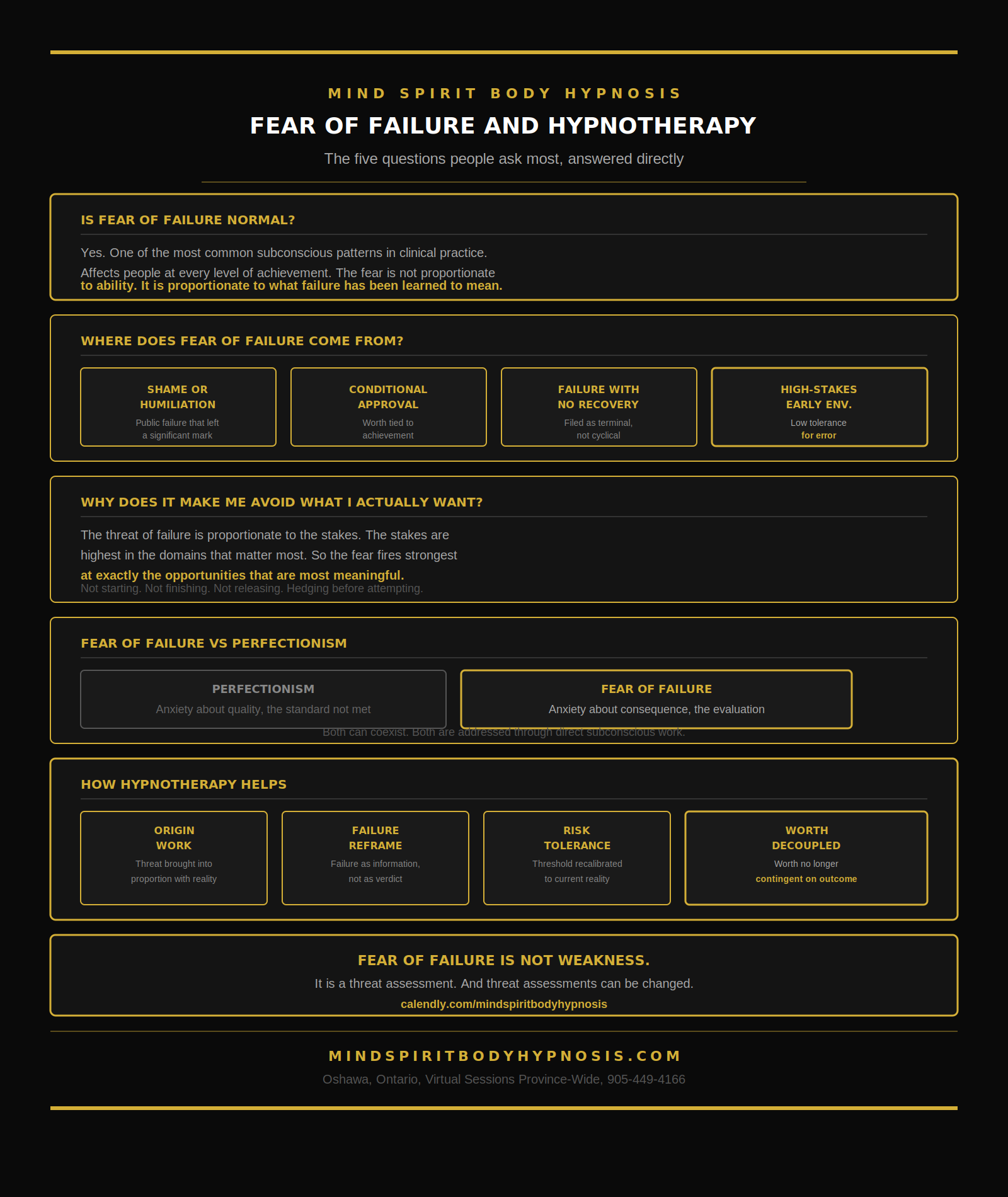
Yes, it is one of the most common subconscious patterns in clinical practice, and it affects people across every profession, age, and level of objective achievement.
Fear of failure does not discriminate by competence. Some of the people most affected by it are objectively the most capable people with significant demonstrated ability who consistently hold back from the next risk, the next venture, the next exposure of something that genuinely matters to them. The fear is not proportionate to actual capability. It is proportionate to the subconscious threat assessment around what failure would mean.
Research from the Global Entrepreneurship Monitor consistently identifies fear of failure as one of the primary reasons people do not pursue opportunities they actively want, with rates particularly elevated in high-income, high-competition environments where the social consequences of visible failure are perceived as significant. In Ontario's professional context, where career identity is often tightly held, and public failure carries real social cost, fear of failure is among the most prevalent presentations in confidence and self-sabotage work.
Experiencing fear of failure is not the same as having poor confidence across the board. Many people with significant fear of failure function at a high level in established domains where the risk parameters are known and managed. The fear is most acute at the edges of new territory, visible risk, and anything where the outcome is genuinely uncertain, and the stakes feel personal.
⭐ Pro Tip: One of the clearest indicators of fear of failure rather than ordinary caution is where the avoidance is most intense. Ordinary caution is proportionate to actual risk. Fear of failure is most intense at precisely the opportunities that matter most the ones where the outcome would be most meaningful and the exposure most personal. If you notice that the projects you care most about are the ones you start last and finish with the most internal resistance, that is fear of failure, not a lack of interest or ability.
Where Does Fear of Failure Come From?
Fear of failure is always learned. No one arrives with it. It develops from specific experiences in which failure was made to feel dangerous, not merely disappointing, but genuinely threatening to safety, belonging, worth, or love.
The most common origins in clinical practice:
Failure that produced shame or humiliation. Public failure in childhood or adolescence, academic, social, or performative, that was met with ridicule, criticism, or a quality of exposure that left a significant emotional mark. The subconscious filed this not as "that went badly" but as "failure reveals something fundamentally wrong with me." The threat assessment that forms is: failure is not just disappointing; it is dangerous to identity.
Conditional love or approval tied to achievement. Environments in which love, approval, or belonging were explicitly or implicitly contingent on success. The message: you are valued when you succeed and at risk when you do not. In this context, failure is not a neutral outcome to be learned from; it is a threat to the most fundamental human needs. The subconscious protection response is not to avoid failure for its own sake but to avoid the withdrawal of love or belonging that failure produced.
A significant formative failure with no recovery narrative. A specific experience of trying, failing, and being left with only the failure, with no adult support, no reframe, no experience of recovery and trying again. The subconscious learns that failure is a terminal state rather than a stage in a cycle. Taking a risk means potentially arriving at that terminal state again.
High-stakes environments with low tolerance for error. Academic, athletic, or professional environments in early life where the cost of failure was genuinely high and where there was little room for the natural learning curve that comes from making mistakes. The nervous system learned to treat error as catastrophic, and carries that learning into adult contexts where the actual stakes are different.
Vicarious learning from a significant other's experience of failure. Watching a parent or close figure experience a failure that was devastating financially, relationally, or socially and absorbing the lesson that failure produces those consequences. The subconscious generalizes: that could happen to me, and I should not risk the situations that could lead there.
For more on how subconscious belief systems formed in early experience operate as self-sabotage patterns in adult life, the hypnotherapy for self-sabotage pillar page covers the foundational mechanisms.
Why Does Fear of Failure Make Me Avoid Things I Actually Want?
This is the most confusing and most painful feature of fear of failure: it produces avoidance of exactly the things the person cares most about.
The mechanism is straightforward once the subconscious logic is clear. The threat of failure is proportionate to the stakes. The stakes are highest in the domains that matter most. Therefore, the fear is most intense around the opportunities that carry the most meaning.
This produces the avoidance paradox. The person with fear of failure does not avoid random things; they avoid the specific category of risk that involves genuine personal exposure and meaningful outcome. The business venture. The creative project. The relationship that would actually require vulnerability. The application for the thing they actually want. These are precisely the things that the subconscious is most motivated to protect against, because these are the things where failure would feel most significant.
The avoidance takes different forms in different people:
Not starting. The project that has been planned, outlined, and considered for months or years but remains unbegun. The starting would make the risk real. As long as it is planned but not started, failure remains hypothetical.
Not finishing. Starting is possible, but the closer the work gets to completion to the moment of release, submission, or exposure the more the resistance intensifies. Many people with fear of failure have a long history of projects that reached 80 percent and stopped there.
Finishing but not releasing. Completing the work but not sharing it, submitting it, or making it available for evaluation. The work exists, but the feedback, which represents the possibility of the feared judgement, is indefinitely deferred.
Heavily hedging before attempting. Pre-emptively lowering expectations, framing the attempt as casual or uncommitted, making it known that the person does not really care about the outcome. This is subconscious protection: if failure arrives, the person can say they were not really trying. The emotional exposure is managed by denying the genuine investment.
All of these patterns share the same subconscious logic: do not allow the thing that matters to be evaluated, because evaluation creates the possibility of the feared verdict.
⭐ Pro Tip: The hedging pattern framing genuine attempts as casual, downplaying investment before an outcome is known, is one of the most reliable identifiers of fear of failure in high-functioning people. When someone has a significant, genuine investment in an outcome but presents it as if they barely care, the presentation is protection. The subconscious is managing the exposure by keeping the stakes officially low, even when they are privately very high. Noticing this in yourself, the gap between what you privately care about and what you allow yourself to publicly invest in is one of the most honest starting points for this work.
What Is the Difference Between Fear of Failure and Perfectionism?
These two patterns are closely related and frequently co-occur, but they are distinct in their primary mechanism and their expression.
Perfectionism (covered in detail in hypnotherapy for perfectionism) is driven primarily by the fear of the standard not being met or of producing work that falls short of an impossibly high internal benchmark. The perfectionist engages with the task but cannot complete or release it because it is never quite right. The anxiety is about quality.
Fear of failure is driven primarily by the fear of the outcome of being evaluated and found wanting, of the consequences of not succeeding. The person with fear of failure may not be particularly concerned with the internal standard of the work. They are concerned with what happens if it does not succeed. The anxiety is about consequence.
In practice, the two overlap significantly. A person can have both holding an impossibly high standard (perfectionism) as a protection against the possibility of failure (fear of failure), using quality as a reason to delay the moment of risk. But the primary driver is different, and the work addresses them at different points.
The clearest way to distinguish them in clinical practice is to ask: if you knew the outcome would be successful, would you be able to do the work? The perfectionist often still struggles because the standard itself is the problem, regardless of outcome. The person with primary fear of failure typically finds the work much more accessible when the threat of evaluation is removed.

Can Hypnotherapy Help With Fear of Failure?
Yes, and for the same reason hypnotherapy works well with all threat-based subconscious patterns: it operates directly at the level where the threat assessment is made and maintained.
Fear of failure is not a conscious choice to avoid risk. It is a subconscious threat response that fires faster than conscious deliberation, and that is not meaningfully changed by conscious reasoning. The person who knows they are avoiding something important, understands why, and still cannot close the gap between intention and action is experiencing the subconscious operating independently of conscious instruction, which is exactly the gap that hypnotherapy is designed to bridge.
The approach at Mind Spirit Body Hypnosis addresses fear of failure across four specific dimensions:
Origin work. The specific experiences that established failure as threatening the shame, the conditional love, the significant formative failure, the high-stakes environment are accessed in trance and addressed directly. The subconscious is updated with the understanding that the current environment is not the same as the environment where failure was genuinely dangerous. The threat assessment is brought into proportion with current reality.
Failure reframe. The subconscious meaning of failure what it reveals, what it produces, what it threatens is directly addressed in trance. A new and more functional relationship with failure is installed: failure as information, as a stage in a learning cycle, as evidence of having tried rather than evidence of fundamental inadequacy. This is not a conscious reframe that the subconscious evaluates and rejects; it is a direct subconscious experience in the receptive trance state.
Risk tolerance update. The threshold at which risk registers as genuinely threatening is recalibrated. The nervous system learns the difference between catastrophic risk and the manageable uncertainty of meaningful attempt. The automatic threat response reduces in intensity. Calculated risk begins to feel possible rather than dangerous.
Identity and worth decoupling. The subconscious link between outcome and worth the belief that failure reveals something fundamentally inadequate about the person is addressed and dissolved. A more accurate identity is installed: one whose worth is not contingent on outcome, and whose relationship with risk is therefore genuinely free rather than permanently defended.
In my practice, fear of failure work typically takes between three and five sessions, depending on the depth of the original experience and the range of contexts in which the avoidance is active. All sessions are delivered virtually, available to clients aged 10 and older across Ontario. More about the approach is available on the about page.
What My Clients Say
"Working with Fanis has changed my life. After years of therapy for anxiety and confidence issues, I wanted to try something different. This experience has transformed me from the inside out and continues to have an effect even after our sessions. I am now able to be myself, face my fears, surround myself with those who care about me and live a fulfilling and happy life. So grateful."
Kristen W. | Anxiety and Confidence | Five Stars
"I cannot say enough about how amazing Fanis is! He has truly changed my life. I was always an anxious person and always overthinking everything. After seeing Fanis I feel like a completely different person. The anxiety is gone and my mind is actually quiet for the first time in my life. I am forever grateful."
Amanda B. | Anxiety and Overthinking | Five Stars
FAQ
Is fear of failure normal? Yes. It is one of the most common subconscious patterns in clinical practice, affecting people across every profession and level of achievement. Research consistently identifies it as a primary reason people do not pursue opportunities they actively want. It is not a sign of low competence; many of the people most affected by it are objectively highly capable.
Where does fear of failure come from? From specific experiences in which failure was made to feel genuinely dangerous -- to belonging, worth, love, or safety. The most common origins are failure that produced shame or humiliation, conditional love tied to achievement, a significant formative failure with no recovery, and high-stakes early environments with low tolerance for error.
Why does fear of failure make me avoid what I actually want? Because the threat of failure is proportionate to the stakes. The higher the stakes, the more intense the avoidance. The things that matter most carry the highest stakes and therefore trigger the strongest protection response. This produces avoidance of exactly the opportunities that are most meaningful.
What is the difference between fear of failure and perfectionism? Perfectionism is primarily driven by the fear of the standard not being met and anxiety about quality. Fear of failure is driven by the fear of the outcome, anxiety about consequence and evaluation. Both can coexist. The clearest test: if the outcome were guaranteed to be successful, would the work still feel impossible? Perfectionists often still struggle. Those with primary fear of failure typically find it much more accessible.
Can hypnotherapy help with fear of failure? Yes. Hypnotherapy addresses the subconscious threat assessment that drives avoidance: what failure means, what it threatens, what it reveals directly at the level where it operates. The origin, the failure reframe, the risk tolerance, and the worth-outcome link are all addressed through direct subconscious work.
How many sessions will I need? In my practice, fear of failure work typically takes three to five sessions, depending on the depth of the original experience and the range of contexts in which avoidance is active. An honest estimate is always given in the free strategy session.
Does this work even if I do not have a clear memory of where the fear came from? Yes. The subconscious holds the relevant material even when clear conscious memories are absent. The trance work accesses and updates the stored pattern directly, without requiring a detailed narrative of origin.
Can I do sessions virtually from anywhere in Ontario? Yes. All sessions are delivered virtually, province-wide, with no referral required.
How do I get started? Book a free 30-minute virtual strategy session at calendly.com/mindspiritbodyhypnosis. No referral needed.
Ready to Take the Next Step?
The things you have been not starting, not finishing, or not releasing this is not a talent problem. It is a threat assessment problem. And threat assessments can be changed.
I offer a free 30-minute virtual strategy session for new clients across Ontario. No pressure. Just an honest conversation about what has been staying out of reach and what a different relationship with risk might feel like.
Book your free session: calendly.com/mindspiritbodyhypnosis
Call or text: 905-449-4166
Email: info@mindspiritbodyhypnosis.com
Visit: mindspiritbodyhypnosis.com
Serving clients virtually across Ontario, including Durham Region, Toronto, Ontario, and beyond.
Disclaimer: This article is for informational purposes only and does not constitute medical or psychological advice. Hypnotherapy and NLP are complementary approaches and are not a substitute for diagnosis or treatment by a qualified healthcare provider. Results vary by individual.
Written by Fanis Makrigiannis | Certified Hypnotherapist and NLP Master Practitioner | Mind Spirit Body Hypnosis.