What’s the fastest way to break a phone addiction?
Hypnotherapy for Phone Addiction in Ontario: Your Questions Answered
TL;DR: Phone addiction is a real behavioural pattern driven by the same dopamine-based reward system that underlies other compulsive habits, and it is not a willpower problem. In 2026, 67 percent of social media users report scrolling past the point they intended to stop, and 58 percent check their phone within five minutes of waking up. Hypnotherapy addresses the subconscious habit loop and the unmet need driving compulsive phone use at the level where they operate. At Mind Spirit Body Hypnosis in Oshawa, Ontario, the five questions people ask most about phone addiction and hypnotherapy are answered here, directly.
Quick Answer
Phone addiction is a compulsive pattern of phone use that continues despite the person wanting to stop, driven by a dopamine-based variable reward system deliberately engineered into social media platforms, and reinforced by subconscious patterns of anxiety relief, boredom avoidance, and emotional regulation. It is not a character flaw, a lack of self-discipline, or something that willpower alone can reliably change. Hypnotherapy addresses the subconscious habit loop directly: the automatic reach, the anxiety that the phone is managing, and the need that compulsive scrolling has been recruited to meet. At Mind Spirit Body Hypnosis in Oshawa, Ontario, Fanis Makrigiannis, a Certified Hypnotherapist and NLP Master Practitioner, offers virtual sessions province-wide for clients of all ages.
Questions This Article Answers
Is phone addiction a real thing?
Why can I not stop scrolling even when I want to?
What is doomscrolling doing to my brain?
Why do I reach for my phone without thinking?
Can hypnotherapy help with phone addiction?
In This Article:
The pattern is remarkably consistent across clients. It starts before they are fully awake. The phone is in their hand before they have decided to reach for it. It continues through the day: the quick check that takes twenty minutes, the scroll that started as two minutes of downtime and became an hour. It ends late at night, eyes dry, neck sore, the content long since stopped being interesting, and still scrolling.
And the part that is most distressing is not the time lost. It is the feeling of not being in control of something that seems like it should be simple to stop.
It is not simple. And it is not simple for structural reasons that have nothing to do with willpower or self-discipline.
Is Phone Addiction a Real Thing?
Yes, and the evidence for this has become considerably stronger in 2026 as the research catches up with what most people are already experiencing.
Phone addiction, more precisely described as problematic smartphone use or compulsive social media use, shares the key features of other behavioural addictions: compulsive use despite wanting to stop, increasing amounts of time needed to produce the same effect, the use of the behaviour to regulate emotional states, disruption of sleep, relationships, work, and daily functioning, and a characteristic feeling of agitation or anxiety when the phone is unavailable.
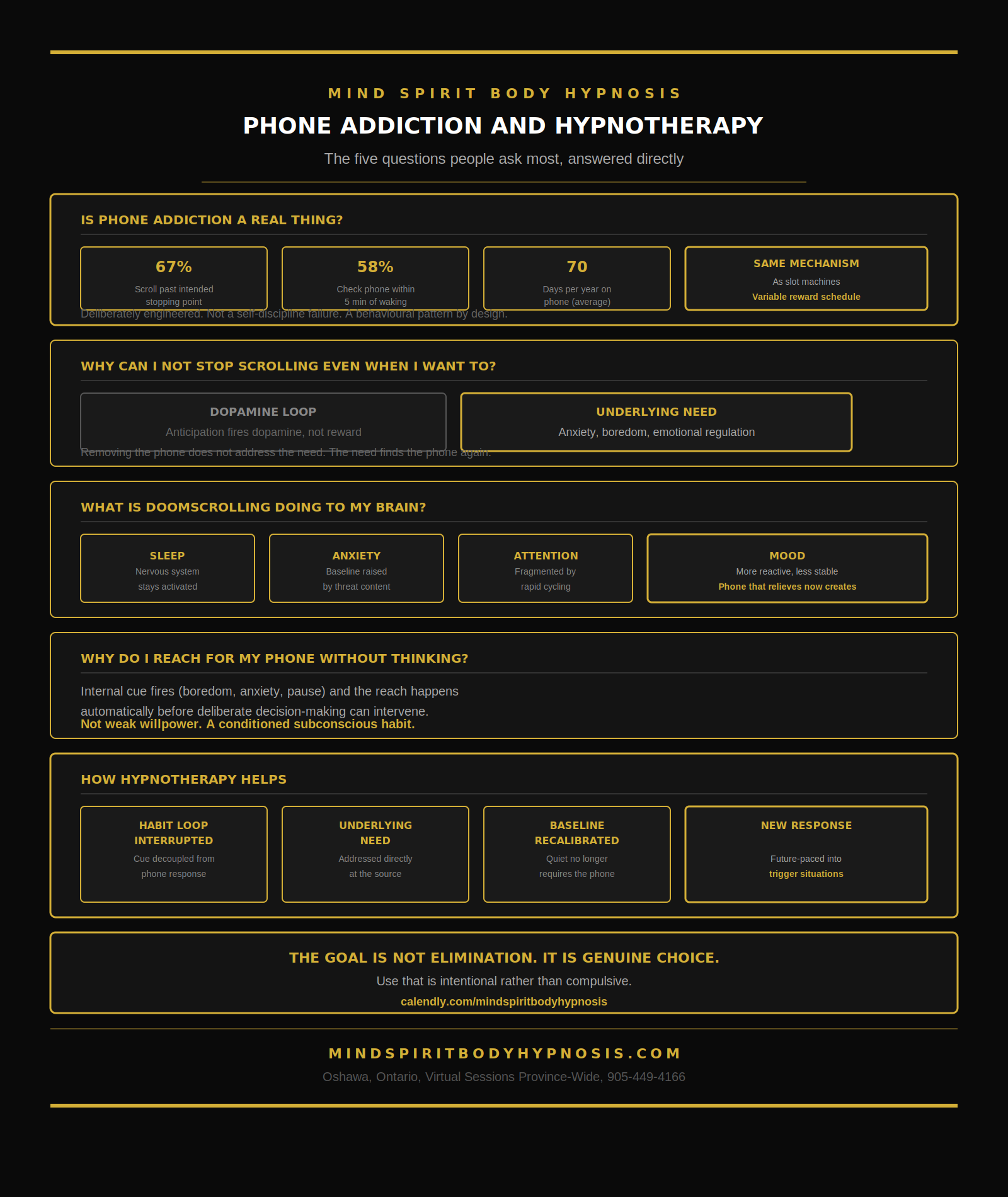
In 2026, 67 percent of social media users report scrolling past the point they intended to stop. The average TikTok session is 32 minutes, up from 26 minutes in 2024. Fifty-eight percent of people check their phone within five minutes of waking up. The average person spends the equivalent of 70 days per year on their phone.
These are not the numbers of people choosing to spend their time this way. They are the numbers of a population in a compulsive relationship with a technology that has been deliberately engineered to be addictive.
This is the critical context that changes the conversation about phone addiction. The platforms are not neutral tools. They are designed around variable reward schedules, the same mechanism that makes slot machines compelling. The unpredictability of what the next scroll will bring the viral post, the relevant update, the piece of news that finally explains what is happening triggers dopamine release in anticipation rather than in response to reward. The infinite scroll removes natural stopping points. The algorithm learns precisely what keeps each individual engaged. This is not accidental design. It is the intended outcome of billions of dollars of engineering and psychological research aimed at maximizing time on the platform.
Understanding this is not an excuse for the behaviour. It is the context that explains why willpower alone is rarely sufficient to change it and why addressing the habit requires something that operates at the same subconscious level as the addiction itself.
⭐ Pro Tip: The clearest indicator of problematic phone use versus ordinary heavy use is the relationship between intention and behaviour. Heavy use is chosen. Problematic use continues past the point of intention, past the moment of deciding to stop, past the point where the content is interesting, past the point where the person knows they should be sleeping or working or present with the people around them. If you regularly find yourself doing the thing you decided not to do, that is the gap between conscious intention and subconscious habit that hypnotherapy is designed to address.
Why Can I Not Stop Scrolling Even When I Want To?
Because the decision to stop is being made at the conscious level, while the behaviour is being driven at the subconscious level, and the subconscious is faster, more powerful, and not responsive to conscious instruction.
The mechanism is a dopamine-based variable reward loop that operates below conscious awareness. When you open the feed, your brain is not looking for information. It is anticipating a reward: the interesting post, the relevant update, the emotional stimulus of any kind. The anticipation itself releases dopamine. The next scroll might bring the reward. And the next. The unpredictability of the reward schedule is what makes it so difficult to stop; certainty would reduce the dopamine response, but uncertainty amplifies it.
This is the same neurochemical mechanism that underlies gambling, and it is deliberately replicated in platform design. The pull-to-refresh gesture mimics the lever of a slot machine. The notification badge creates anticipatory dopamine. The infinite scroll removes the natural endpoint that would signal completion and allow disengagement.
But the dopamine loop is only part of the story. In clinical practice, compulsive phone use almost always has a second layer: the subconscious function the phone is serving. The phone is being used to manage anxiety. To avoid boredom, which the nervous system has learned to experience as threatening. To escape from a task or situation that produces discomfort. To feel connected when loneliness is present. To provide stimulation that the rest of life is not currently providing.
The phone is not the problem. The phone is the solution the subconscious has found for a different problem. And that is why removing access to the phone, deleting apps, using screen time limits, and putting the phone in another room produces such limited and short-lived results. The underlying need remains. It finds the phone. Or it finds something else.
Changing the habit sustainably requires addressing both the conditioned dopamine loop and the underlying need that compulsive phone use has been recruited to meet.
For more on how anxiety as a driver of compulsive habits is addressed at Mind Spirit Body Hypnosis, the hypnotherapy for anxiety and stress pillar page covers the nervous system foundations.
What Is Doomscrolling Doing to My Brain?
Doomscrolling, the specific pattern of compulsive consumption of distressing news, conflict, and negative content, has a distinct set of consequences beyond general phone overuse.
The nervous system does not distinguish between reading about a disaster and experiencing one directly. When threatening content is consumed repeatedly, the stress response fires repeatedly. Cortisol and adrenaline are released. The threat-detection system becomes more sensitized. The nervous system that is regularly fed a stream of alarming content learns to stay in a state of heightened alertness not because there is immediate danger, but because the pattern of input is training it to remain vigilant.
The consequences are measurable and well-documented:
Sleep disruption. Doomscrolling before bed keeps the nervous system in an activated state incompatible with the physiological conditions needed for sleep onset. The blue light suppresses melatonin. The emotional content conflict, threat, and distress maintain cortisol elevation. Sleep that follows is less restorative. The tiredness the next day increases reliance on the phone for stimulation, which increases evening scrolling, which worsens sleep. The cycle is self-reinforcing.
Anxiety amplification. Chronic low-level stress from repeated threat exposure raises the baseline anxiety level. The world feels more dangerous, more unpredictable, and more out of control, partly because the algorithmic feed is specifically selecting for content that produces that feeling, because engagement is highest when emotional arousal is highest.
Attention fragmentation. The rapid cycling between brief content items conditions the brain's attention system toward short attention spans. Sustained focus on a single task becomes harder. The restlessness that arrives when the phone is not available is partly the nervous system recalibrating to a level of stimulation it has learned to expect.
Emotional dysregulation. The constant low-level emotional stimulation of the feed outrage, anxiety, entertainment, comparison reduces the nervous system's capacity to regulate emotion effectively. Mood becomes more reactive and less stable. The phone that was supposed to provide relief from negative emotion increasingly produces it.
⭐ Pro Tip: The clearest way to understand what doomscrolling is doing to your nervous system is to check in with how you feel immediately after putting the phone down, not during the scrolling, but after. Most people with a doomscrolling pattern notice that they feel worse after the session than before it began. More anxious. More restless. More vaguely unsettled. That is the nervous system reporting the actual cost of the input it just received. The brief dopamine anticipation during the scroll has resolved; what remains is the cortisol load from the content.
Why Do I Reach for My Phone Without Thinking?
Because the reach has become a subconscious habit, an automatic behavioural response to a specific internal cue that has been conditioned through thousands of repetitions.
Habits form through a simple three-part loop: a cue triggers a routine which produces a reward. In the case of phone use, the cue is usually an internal state: a moment of boredom, a brief pause in activity, a feeling of anxiety or discomfort, a transition between tasks. The routine is the reach for the phone. The reward is the relief of the discomfort, the stimulation of the dopamine system, or both.
After this loop has been repeated enough times, the routine becomes automatic. The cue fires and the reach happens before conscious deliberation is possible. The phone is in the hand before the decision has been made to pick it up. This is not a lack of discipline. This is how habits work: the basal ganglia, which manages habitual behaviour, operates independently of the prefrontal cortex, which handles deliberate decision-making. Once a habit is sufficiently established, it bypasses the deliberate system entirely.
This is why awareness and intention produce such limited change with established phone habits. The person can know they are doing it. They can decide to stop. And the next time the cue fires, the reach happens before the decision can intervene.
What changes the automatic reach is working at the level of the cue and the routine, changing what the nervous system reaches for when the internal trigger fires, and addressing the underlying state (the boredom, the anxiety, the discomfort) that has been managing itself through the phone.

Can Hypnotherapy Help With Phone Addiction?
Yes, and it addresses the dimensions of phone addiction that conscious effort alone cannot reliably change.
The approach at Mind Spirit Body Hypnosis works at the subconscious level where both the habit loop and the underlying need are operating:
Habit loop interruption. The automatic cue-routine connection is identified and directly changed in trance. The internal cue that currently triggers the reach the boredom, the anxiety pause, the transition discomfort is decoupled from the phone response. A new and more functional automatic response is installed: a breath, a grounding, a genuine pause something the subconscious can reach for that meets the actual need rather than the habitual escape route.
Underlying need identification and addressing. What has the phone been recruited to do? In trance, the specific emotional function the compulsive phone use is serving anxiety relief, boredom avoidance, loneliness management, stimulation provision is identified and addressed directly. When the underlying need is met more effectively at the subconscious level, the compulsive reach loses its urgency.
Dopamine system recalibration. The nervous system has been conditioned to require a certain level of stimulation. In trance, a genuine state of calm satisfaction the felt experience of being present, grounded, and sufficient without external stimulation is installed and anchored. This does not eliminate the desire for engagement. It changes the quality of the signal, so that a moment of quiet is no longer experienced as a problem requiring the phone as a solution.
Future pacing. The person is walked through the specific situations in which the compulsive reach most reliably fires, lying in bed, the transition moments, and the brief pause and experiences responding differently in each. These future scenes are filed as expected experience, so that when they occur, the new response is what is available.
In my practice, phone addiction work typically takes between two and four sessions, depending on the depth of the underlying anxiety pattern and the range of triggering situations. All sessions are delivered virtually, available to clients aged 10 and older across Ontario. More about the approach is available on the about page.
For more on how the habit patterns underlying compulsive phone use are addressed alongside smoking cessation and other habit change work, the hypnotherapy for habits pillar page covers the habit change mechanisms in detail.
What My Clients Say
"Fanis has done so much for me in such a short period of time -- helped me quit smoking, and also helped me to believe and love myself. So professional and patient like no one I have ever met. He has given me hope and strength I have been needing for a long time. I could never thank him enough. Today I believe in myself!"
Natasha C. | Quit Smoking and Confidence | Five Stars
"I cannot say enough about how amazing Fanis is! He has truly changed my life. I was always an anxious person and always overthinking everything. After seeing Fanis I feel like a completely different person. The anxiety is gone and my mind is actually quiet for the first time in my life. I am forever grateful."
Amanda B. | Anxiety and Overthinking | Five Stars
FAQ
Is phone addiction a real thing? Yes. Problematic smartphone use shares the key features of behavioural addiction: compulsive use despite wanting to stop, increasing use over time, use to regulate emotional states, and disruption of sleep, relationships, and daily function. In 2026, 67 percent of social media users report scrolling past the point they intended to stop. The platforms are deliberately engineered using the same variable reward mechanisms as gambling.
Why can I not stop scrolling even when I want to? Because the behaviour is driven at the subconscious level by a dopamine-based reward loop, while the decision to stop is being made at the conscious level. The subconscious is faster and more powerful than conscious intention. The phone is also usually serving a subconscious function: anxiety relief, boredom avoidance, and emotional regulation that the conscious decision to stop does not address.
What is doomscrolling doing to my brain? It is maintaining chronic low-level stress activation through repeated threat content, disrupting sleep, amplifying anxiety, fragmenting attention, and reducing emotional regulation capacity. The nervous system does not distinguish between reading about a disaster and experiencing one. Repeated threat input trains the system to stay on alert.
Why do I reach for my phone without thinking? Because the reach has become an automatic subconscious habit the behavioural response to an internal cue (boredom, anxiety, a pause) that has been reinforced through thousands of repetitions until it bypasses deliberate decision-making entirely.
Can hypnotherapy help with phone addiction? Yes. Hypnotherapy works at the subconscious level where the habit loop, the underlying need, and the dopamine conditioning all operate. The automatic reach is interrupted, the underlying need is addressed directly, a calmer baseline is installed, and new automatic responses are future-paced.
Will this mean I can never use my phone? No. The goal is not elimination but restoration of genuine choice and use that is intentional rather than compulsive. Most clients find that their actual desired use of the phone (communication, information, connection) becomes more satisfying when the compulsive background noise of the habit is removed.
How many sessions will I need? In my practice, phone addiction work typically takes two to four sessions, depending on the depth of the underlying anxiety pattern and the range of trigger situations. An honest estimate is given in the free strategy session.
Can I do sessions virtually from anywhere in Ontario? Yes. All sessions are delivered virtually, province-wide, with no referral required.
How do I get started? Book a free 30-minute virtual strategy session at calendly.com/mindspiritbodyhypnosis. No referral needed.
Ready to Take the Next Step?
If you are regularly doing something you have already decided to stop, that is a subconscious habit operating below conscious instruction. It can be changed not through more willpower, but through working at the level where the habit actually lives.
I offer a free 30-minute virtual strategy session for new clients across Ontario. No pressure. Just an honest conversation about what the pattern is costing you and what genuine choice might look like.
Book your free session: calendly.com/mindspiritbodyhypnosis
Call or text: 905-449-4166
Email: info@mindspiritbodyhypnosis.com
Visit: mindspiritbodyhypnosis.com
Serving clients virtually across Ontario, including Durham Region, Toronto, Ontario, and beyond.
Disclaimer: This article is for informational purposes only and does not constitute medical or psychological advice. Hypnotherapy and NLP are complementary approaches and are not a substitute for diagnosis or treatment by a qualified healthcare provider. Results vary by individual.
Written by Fanis Makrigiannis | Certified Hypnotherapist and NLP Master Practitioner | Mind Spirit Body Hypnosis.