Can Hypnotherapy help with childhood trauma?
Can Hypnotherapy Help With Childhood Trauma?
TL;DR: Childhood trauma does not stay in childhood. It travels forward in time, shaping the adult nervous system, the adult relationship patterns, the adult sense of self, and the adult emotional responses in ways that often feel inexplicable to the person experiencing them. At Mind Spirit Body Hypnosis in Oshawa, Ontario, Fanis Makrigiannis uses hypnotherapy and EMDR to help adult survivors of childhood trauma address the roots of what is still running in the present, helping clients of all ages across the province live from who they actually are rather than who they learned they had to be.
Quick Answer
Hypnotherapy for childhood trauma is a subconscious-focused approach that addresses the unprocessed emotional material, limiting beliefs, and nervous system patterns established by adverse childhood experiences, by accessing the subconscious memories and beliefs where that material is stored and updating them with an adult perspective, resources, and compassion. Research from the landmark ACE Study found that childhood adversity is one of the strongest predictors of adult physical and mental health outcomes, with cumulative exposure producing significantly elevated risk across a range of conditions. Fanis Makrigiannis, a Certified Hypnotherapist, NLP Master Practitioner, and EMDR Practitioner at Mind Spirit Body Hypnosis in Oshawa, Ontario, offers virtual sessions across the province for adult survivors ready to stop being run by a past that has already happened.
Questions This Article Answers
Can hypnotherapy help with childhood trauma in adults?
How does childhood trauma affect adult life?
What are adverse childhood experiences (ACEs)?
Why does childhood trauma persist into adulthood?
What is the best treatment for childhood trauma in Ontario?
In This Article:
You cannot always point to it clearly. There was no single catastrophic event. But there was an environment. An unpredictable parent. A home where emotional safety was conditional. A childhood where you learned, very early, that something about you was not quite right, not quite lovable, not quite safe. Or perhaps there were events, things that happened that were not spoken of, that were minimized, that you were asked to move past before you had been given the tools or the years to do so.
Now, decades later, you notice the patterns. The way certain situations produce a response that feels too large for what is actually happening. The way relationships follow a familiar shape, no matter how determined you are to make them different. The way the inner critic speaks with such authority. The way calm has always felt temporary and provisional, like something that could be taken away.
This is childhood trauma living in adult life. Not as memory necessarily, but as a pattern. As a body. As the subconscious operating system that was written in the earliest years and has been running ever since.
In my practice, clients who come for childhood trauma work often arrive not having identified it as trauma at all. They come for anxiety, or relationship difficulties, or chronic low self-worth, or an inexplicable sense of emptiness. The childhood origins become visible in the work.
What Is Childhood Trauma and What Are ACEs?
Childhood trauma encompasses a wide range of adverse experiences that occur during the developmental years and exceed the child's capacity to process and integrate them with the resources available at the time. It is not limited to dramatic or obviously abusive events, though it includes those.
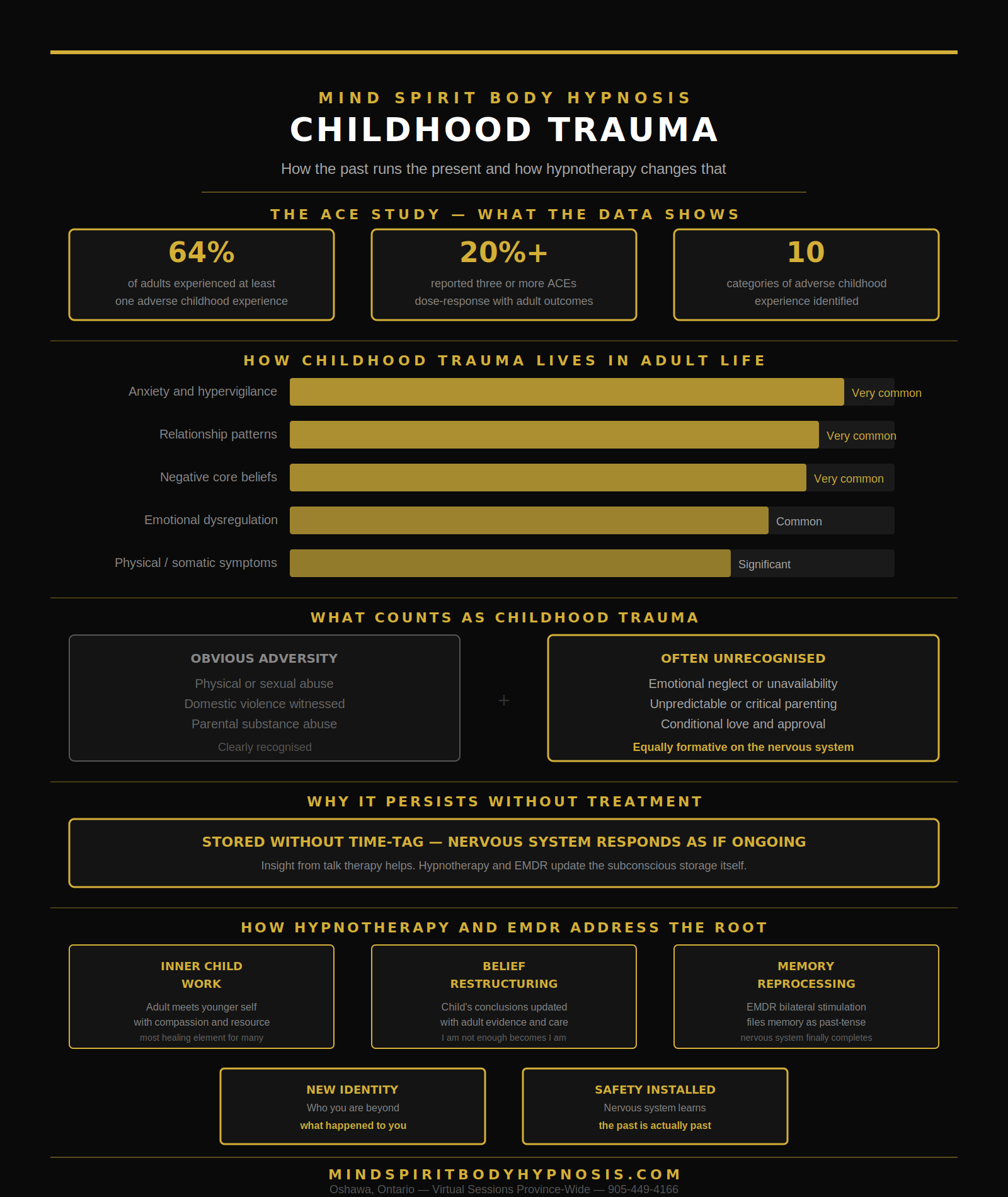
The ACE Study, the landmark research conducted by the Centers for Disease Control and Kaiser Permanente, identified ten categories of adverse childhood experiences that are strongly associated with adult health and well-being outcomes. These include physical, emotional, and sexual abuse; physical and emotional neglect; and five categories of household dysfunction, including parental separation, domestic violence, household substance abuse, household mental illness, and incarceration of a household member.
The study found that ACEs are far more common than most people realize. Approximately 64 percent of adults in the study reported at least one ACE, and more than 20 percent reported three or more. Critically, the relationship between ACE score and adult outcomes was dose-dependent: the higher the ACE score, the higher the risk of a wide range of adult health, mental health, and social difficulties.
In Ontario, where population surveys find comparable or higher rates of adverse childhood experiences, childhood trauma is one of the most prevalent and most under-addressed contributors to adult mental health presentations. Many adults carrying significant childhood trauma have never had it named or addressed directly, having learned in childhood that their experiences were not significant enough to warrant attention.
⭐ Pro Tip: Childhood trauma does not require a dramatic single event to produce lasting effects. Chronic emotional neglect, growing up in a home where emotional expression was shamed or ignored, living with a parent whose mood was unpredictable, and experiencing consistent criticism or conditional love are all forms of developmental trauma that shape the nervous system just as profoundly as more obviously adverse events. If you find yourself wondering whether your childhood was difficult enough to warrant attention, the answer is probably yes. The question is not whether it meets a threshold but whether it is still affecting how you live now.
How Childhood Trauma Affects Adult Life
The effects of childhood trauma on adult functioning are pervasive, often invisible to the person experiencing them, and frequently misattributed to personality, character, or inexplicable bad luck rather than to their actual source.
Anxiety and hypervigilance. The nervous system of a child who grew up in an unpredictable or unsafe environment learns to scan continuously for threat. In adulthood, this produces chronic anxiety, an exaggerated startle response, difficulty relaxing fully, and a persistent sense that something is about to go wrong. The hypervigilance that protected the child has become the default operating mode of the adult, regardless of whether the current environment is actually threatening.
Relationship patterns. Attachment patterns established in the earliest relationships become templates for subsequent relationships throughout life. Adults who experienced inconsistent, unavailable, or frightening caregiving in childhood frequently find themselves repeating relationship patterns, anxious attachment, avoidant attachment, difficulty trusting, fear of abandonment, and difficulty with intimacy that trace directly to those early templates.
Self-worth and identity. The beliefs a child forms about themselves in the context of their earliest relationships become the core of the adult self-concept. If the message received in childhood was that you are too much, not enough, burdensome, unlovable, or fundamentally flawed, those beliefs do not evaporate with age. They operate as subconscious filters through which all adult experience is processed.
Emotional dysregulation. Children who did not have their emotional experiences validated, named, and helped to regulate in the context of a calm, responsive caregiver develop nervous systems that struggle with emotional regulation in adulthood. Emotions arrive too intensely, persist too long, or are suppressed entirely. The window of tolerance for emotional experience is narrowed, and ordinary life events can produce responses that seem disproportionate to outside observers.
Somatic symptoms. Research consistently confirms that childhood trauma is stored not only in memory and belief but in the body itself. Chronic pain, gastrointestinal difficulties, fatigue, immune dysregulation, and a wide range of physical symptoms have all been associated with elevated ACE scores, reflecting the body's continued carrying of what the mind has not been able to process.
Research published in the American Journal of Preventive Medicine found that childhood adversity was associated with significantly increased risk of depression, anxiety, substance use, and relationship dysfunction in adulthood, with cumulative ACE scores producing a graded dose-response relationship with each outcome (Felitti et al., 1998).
For more on how trauma affects the nervous system and how EMDR and hypnotherapy work together to address it, the EMDR trauma therapy page covers the neurological foundations in detail.
Why Childhood Trauma Persists Without Treatment
This is one of the most important things to understand about childhood trauma, and the reason that time alone, insight alone, and even significant personal growth often fail to resolve the patterns it produces.
Childhood trauma is stored differently from ordinary memory. Experiences that occur in childhood, particularly in the earliest years before the narrative memory system is fully developed, and experiences that overwhelm the child's capacity to process them, are stored as fragmented sensory, emotional, and somatic impressions rather than as coherent narrative memories. They do not have a clear timestamp or context. They feel, to the nervous system, like present-tense experience rather than past-tense history.
This is why childhood trauma continues to produce present-day responses decades after the events themselves. The nervous system is not responding to a memory. It is responding to what it still registers as an ongoing, unresolved situation.
Additionally, the beliefs formed in childhood about the self, about relationships, and about safety carry the authority that they were given by the child's most significant relationships and the earliest formative experiences. These are not beliefs the adult chose or would endorse on reflection. They are beliefs the child formed under duress, with limited cognitive resources, in a context of emotional dependency. They have been operating subconsciously ever since.
Talk therapy can provide insight into these patterns. Insight is valuable. But insight does not change the subconscious belief. It does not update the nervous system's threat assessment. It does not refile the fragmented childhood memory as past-tense history. For those changes, work at the subconscious level is required.
⭐ Pro Tip: A particularly reliable sign that the current difficulty traces to childhood rather than to present circumstances is when the emotional intensity of a reaction is clearly greater than the present situation warrants. When a partner's criticism produces shame that feels total and devastating, or when being left alone briefly produces abandonment terror, or when making an error produces self-attack that feels life-threatening, the current situation has activated something much older. The present event is the trigger. The wound is in the past. And that is where the most effective work happens.
How Hypnotherapy Addresses Childhood Trauma at the Root
As a certified hypnotherapist and EMDR practitioner trained through the American Board of Hypnotherapy, I approach childhood trauma with the careful pacing, safety-first orientation, and clinical precision that developmental trauma work requires. No session pushes material to the surface before the client is ready, and the work is always led by what the nervous system can safely hold at each stage.
Safety and resource installation. Every programme of childhood trauma work begins here. Before any direct contact with traumatic material, early sessions establish the internal safety and regulatory capacity the work will require. A safe internal place is built and anchored. A self-compassion and self-resource state is installed. The client develops reliable access to a regulated internal state before the deeper material is approached.
Age regression and inner child work. Using guided imagery in trance, the adult client connects with the younger self who had the experiences that are still affecting the present. This is not a return to the original distress, but a compassionate meeting with that younger self from the perspective of the adult, with adult resources, adult perspective, and adult capacity for care that was not available at the time. Many clients describe this as the most healing element of the entire programme.
Belief identification and restructuring. The core subconscious beliefs established in childhood, about the self, about others, about safety and belonging, are identified and directly updated in trance. The belief that I am not enough is examined against the evidence of the adult's actual life. The belief that I am unsafe is examined against the current reality. More accurate, functional, and compassionate beliefs are installed at the subconscious level where the originals have been operating.
Trauma memory reprocessing. Using the combined framework of hypnotherapy and EMDR, specific traumatic memories are approached in a carefully titrated dual-awareness state. Rather than reliving the experience at full emotional intensity, the memory is processed from a position of adult safety and resource. The emotional charge is reduced. The memory receives the time-tagging and contextualization it was unable to receive at the time of the original experience.
Identity and future self installation. The final stage of childhood trauma work addresses who the person is becoming now that the past is no longer running the present. A new identity, grounded in an accurate self-assessment rather than the child's conclusions under duress, is installed and anchored. The client experiences, in trance, what it feels like to move through the world as this person: grounded, self-trusting, relational, present.
Research published in the European Journal of Psychotraumatology found that trauma-focused hypnotherapy produced significant reductions in trauma symptom severity in adults with childhood trauma histories, with improvements in self-reported safety, self-worth, and relational functioning maintained at six-month follow-up (Lesmana et al., 2009).

The Role of EMDR in Childhood Trauma Treatment
EMDR is recognized by the World Health Organization as a first-line treatment for PTSD and is particularly well-suited to childhood trauma because of its capacity to process traumatic memories that exist below the level of verbal narrative.
For childhood trauma that occurred before the development of full narrative memory, or that was too overwhelming to be encoded coherently, bilateral stimulation provides a pathway to processing that does not require the client to articulate what happened in words. The bilateral stimulation, alternating eye movements, tapping, or auditory tones, activates the brain's natural information processing system, allowing fragmented childhood material to be processed and integrated.
At Mind Spirit Body Hypnosis, EMDR and hypnotherapy are used in combination for childhood trauma presentations. Hypnotherapy provides the safety, resourcing, and subconscious belief work that EMDR's protocol does not directly target. EMDR provides the specific memory reprocessing mechanism that childhood trauma material often requires. Together, they address the full scope of what childhood adversity has left in its wake.
More about how EMDR and hypnotherapy are combined at Mind Spirit Body Hypnosis is available on the about page.
What to Expect in a Session
The first session is a gentle conversation. What brings you now? Is there a specific pattern, relationship dynamic, or emotional experience that you have traced to your early years? Do you have a sense of what the childhood experiences were, or is the connection between past and present something you are still piecing together? What do you most need to feel safe at work?
This conversation shapes everything that follows. Some clients arrive with clear and specific childhood material they are ready to address. Others arrive knowing only that something in the present keeps connecting to something in the past, without knowing what. Both are valid starting points.
The early sessions focus on safety and resourcing. The direct memory and belief work follows when the foundation is solid. Most childhood trauma programmes at Mind Spirit Body Hypnosis run between six and twelve sessions, reflecting the layered nature of developmental trauma. All sessions are delivered virtually and are available to clients aged 10 and older across Ontario from the privacy and safety of their own homes.
For more on how anxiety as an adult presentation of childhood trauma is addressed at Mind Spirit Body Hypnosis, the hypnotherapy for anxiety and stress pillar page covers the nervous system foundations.
What My Clients Say
"I began seeing Fanis after a long battle with trauma and grief. I suffered from severe anxiety, panic attacks, insomnia and self harm. After 3 months of weekly hypnotherapy sessions done online, I no longer suffer from panic attacks, insomnia, or self harm and have learned how to better regulate my emotions and find peace. Fanis helped me process many childhood traumas and confront my overwhelming grief. I am eternally grateful to Fanis and his wonderful work."
Sara V. | Trauma and Grief | Five Stars
FAQ
Can hypnotherapy help with childhood trauma in adults? Yes. Hypnotherapy directly accesses the subconscious memories, limiting beliefs, and nervous system patterns established by childhood adversity. Research confirms significant reductions in trauma symptom severity and improvements in self-worth and relational functioning through trauma-focused hypnotherapy, with effects maintained at follow-up.
How does childhood trauma affect adult life? Childhood trauma affects adult life through chronic anxiety and hypervigilance, repetitive relationship patterns rooted in early attachment, negative core beliefs about the self, emotional dysregulation, and somatic symptoms. These effects are not personality traits but patterns established when the child's nervous system responded to circumstances that exceeded its available resources.
What are adverse childhood experiences (ACEs)? ACEs are ten categories of adversity identified by the landmark ACE Study, including physical, emotional, and sexual abuse; physical and emotional neglect; and household dysfunction, including parental separation, domestic violence, substance abuse, mental illness, and incarceration. The study found approximately 64 percent of adults had experienced at least one ACE.
Why does childhood trauma persist into adulthood? Childhood trauma is stored as fragmented sensory and emotional impressions without time-tagging or narrative context, meaning the nervous system continues responding to it as present-tense experience. The beliefs formed in childhood under duress operate as subconscious filters through adult life. Talk therapy can provide insight; hypnotherapy and EMDR address the subconscious storage itself.
What is the best treatment for childhood trauma in Ontario? Approaches that work at the subconscious level where childhood trauma is stored, including trauma-focused hypnotherapy and EMDR, produce the most lasting results. At Mind Spirit Body Hypnosis, both are combined: EMDR for memory reprocessing and hypnotherapy for belief restructuring, identity work, and nervous system regulation.
How many sessions will I need? Most childhood trauma programmes at Mind Spirit Body Hypnosis run between six and twelve sessions, reflecting the layered nature of developmental trauma. The timeline depends on the extent of the childhood material, the number of adverse experiences, and whether there are compounding adult trauma presentations.
Is this suitable for younger clients? Yes. Mind Spirit Body Hypnosis works with clients aged 10 and older. For younger clients, the approach is adapted to age-appropriate language and imagery while maintaining the same clinical framework.
Can I do sessions virtually from anywhere in Ontario? Yes. All sessions are delivered virtually, province-wide, with no referral required. The virtual format is particularly valuable for childhood trauma clients who may find in-person settings activating.
What if I am not sure whether what I experienced counts as trauma? If it is still affecting how you live, it counts. The question for treatment is not whether the experience meets an external threshold but whether its effects are present in your adult life. Developmental trauma does not require dramatic events. Chronic emotional neglect and conditional love produce the same nervous system patterns as more obviously adverse experiences.
How do I get started? Book a free 30-minute virtual strategy session at calendly.com/mindspiritbodyhypnosis. No referral needed.
Ready to Take the Next Step?
If the past is still running more of your present than you would choose, it does not have to. The experiences happened. They cannot be changed. But the way they live in your nervous system, your beliefs, and your patterns can be.
I offer a free 30-minute virtual strategy session for new clients across Ontario. There is no pressure, just a conversation about what has been carried and how hypnotherapy or EMDR may help you put it in its proper place: the past.
Book your free session: calendly.com/mindspiritbodyhypnosis
Call or text: 905-449-4166
Email: info@mindspiritbodyhypnosis.com
Visit: mindspiritbodyhypnosis.com
Serving clients virtually across Ontario, including Durham Region, Toronto, Ontario and beyond.
Disclaimer: This article is for informational purposes only and does not constitute medical or psychological advice. Childhood trauma can have serious and complex effects on mental and physical health. Hypnotherapy and EMDR are complementary approaches and are not a substitute for diagnosis or treatment by a qualified healthcare provider. If you are experiencing a mental health crisis, please contact the 988 Suicide Crisis Helpline or go to your nearest emergency room. Results vary by individual.
Written by Fanis Makrigiannis | Certified Hypnotherapist & NLP Master Practitioner | Mind Spirit Body Hypnosis.