Can Hypnotherapy overcome dental anxiety?
Can Hypnotherapy Overcome Dental Anxiety?
TL;DR: Dental anxiety is not irrational sensitivity, and it is not weakness. It is a conditioned subconscious threat response that fires in the dental context, often originating in a specific experience or a learned pattern from childhood, and it is one of the most treatable phobia presentations in hypnotherapy practice. At Mind Spirit Body Hypnosis in Oshawa, Ontario, Fanis Makrigiannis uses hypnotherapy and NLP to neutralize the subconscious dental threat response, helping clients of all ages across the province access the dental care they need without fear ruining the experience.
Quick Answer
Hypnotherapy for dental anxiety is a subconscious-focused approach that addresses the conditioned fear response, loss-of-control associations, and negative sensory memories that make dental settings intensely threatening, by retraining the subconscious to associate the dental environment with calm, safety, and a manageable experience rather than threat. Research published in the British Dental Journal found hypnotherapy effective in managing dental phobia with a measurable impact on both psychological and physical domains, enabling patients to tolerate procedures they had previously been unable to undergo. Fanis Makrigiannis, a Certified Hypnotherapist and NLP Master Practitioner at Mind Spirit Body Hypnosis in Oshawa, Ontario, offers virtual sessions across the province for clients of all ages ready to stop letting dental fear damage their health.
Questions This Article Answers
Can hypnotherapy help with dental anxiety?
What causes dental anxiety and dental phobia?
How is dental phobia different from ordinary dental nervousness?
Why does dental anxiety get worse if untreated?
What is the best treatment for dental anxiety in Ontario?
In This Article:
You have not been to the dentist in years. You know you should go. You have told yourself you will book the appointment. And every time the moment comes, something stops you. The thought of the chair. The smell of the waiting room. The sound of the drill. The particular vulnerability of lying back with someone working inside your mouth, unable to speak, unable to leave easily, unable to control what happens next.
This is dental anxiety. And it is significantly more common than most people realize, partly because the shame about having it prevents people from talking about it, and partly because the avoidance it produces means many sufferers have simply built their lives around never having to face it.
In my practice, clients with dental anxiety often arrive not having had a professional dental examination in five, ten, or fifteen years. They have managed intermittent tooth pain with over-the-counter remedies. They have watched dental problems compound and worsen because the fear of the dental environment is, to their nervous system, more threatening than the dental problem itself. And they arrive carrying significant shame about this alongside the fear.
The shame is not warranted. The fear is a conditioned subconscious response, not a character weakness. And it can be changed.
What Is Dental Anxiety and How Common Is It?
Dental anxiety is a significant and often debilitating fear response specifically associated with dental settings, procedures, or the anticipation of dental treatment. It ranges in severity from manageable nervousness that nonetheless produces avoidance, through significant anxiety that makes dental visits highly distressing, to dental phobia: an intense, persistent fear that makes dental attendance functionally impossible.
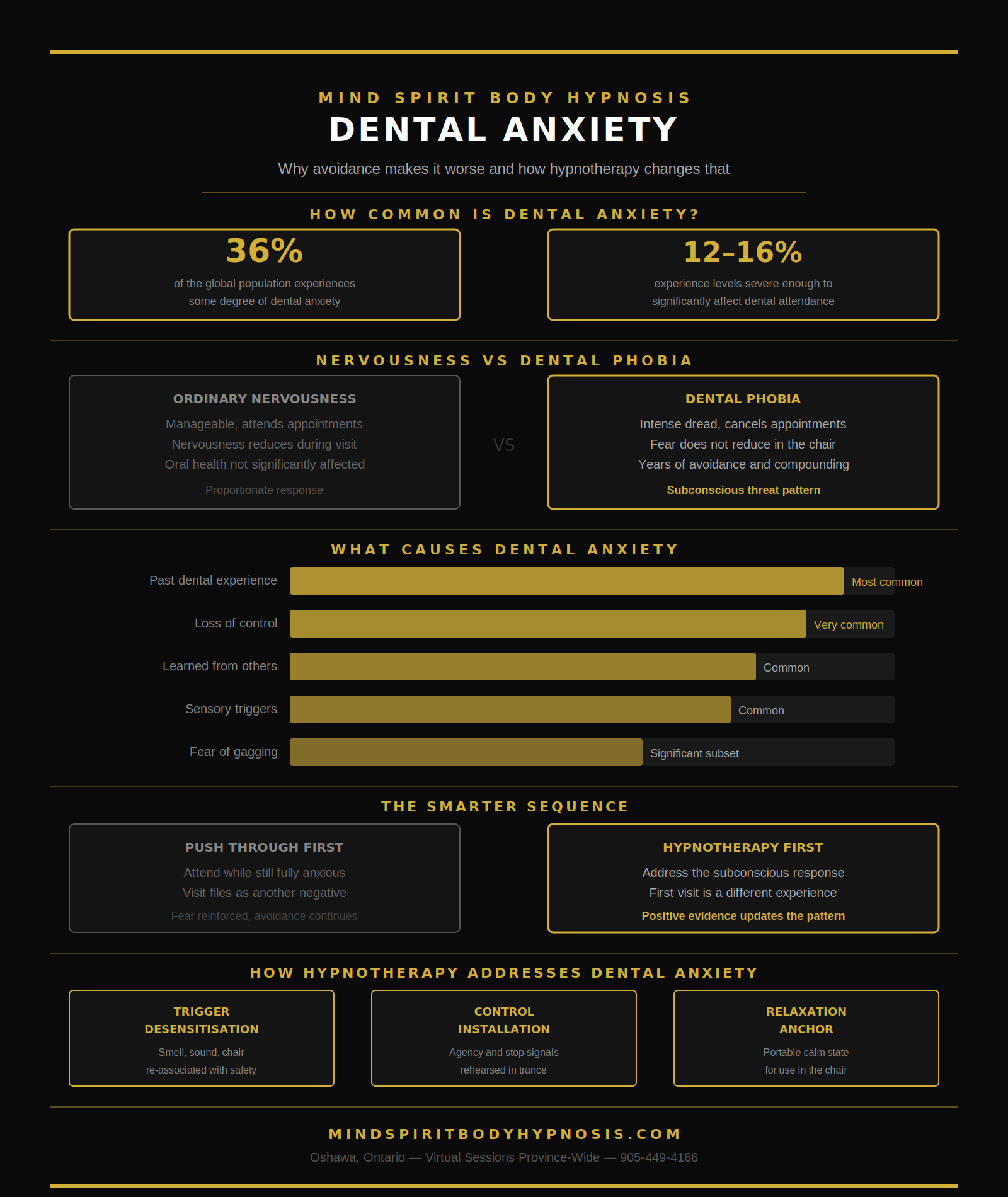
Research consistently finds dental anxiety to be among the most prevalent specific fears in the adult population. A systematic review published in the International Dental Journal found that approximately 36 percent of the global population experiences some degree of dental anxiety, with between 12 and 16 percent experiencing levels severe enough to significantly affect dental attendance and oral health outcomes. In Canada, surveys find comparable rates, with dental anxiety identified as the primary reason for delayed or avoided dental care in a substantial proportion of the adult population.
The consequences of untreated dental anxiety are significant. Research published in the British Dental Journal in 2025 found that dental anxiety and phobia consistently produce poor oral health outcomes through avoidance, with patients reporting years of avoided care, escalating dental problems, and significant shame and social impact from the oral health consequences of not attending (Seligman et al., 2025).
⭐ Pro Tip: The intensity of dental anxiety has no reliable relationship to the actual pain or discomfort of modern dental procedures. Many people with severe dental phobia have, on the occasions they have attended, experienced very little physical pain. The fear is not primarily about pain. It is about loss of control, vulnerability, the specific sensory environment of the dental setting, and in many cases, the subconscious filing of past experiences as evidence that the dental environment is a place of genuine threat. This distinction matters because it means the fear can be addressed directly, without waiting for dental procedures to become less uncomfortable.
What Causes Dental Anxiety?
Dental anxiety almost always has identifiable origins, even when those origins are not immediately obvious to the person experiencing the fear.
Negative past dental experiences. A specific experience of significant pain, an unexpected or poorly managed procedure, or a dentist whose manner communicated criticism or impatience can create a powerful subconscious threat imprint. The brain files the dental environment as a site of historical danger and activates a protective threat response whenever the environmental cues appear again. The procedure may have been decades ago. The subconscious response fires as if it just happened.
Loss of control and vulnerability. The dental chair produces a specific combination of circumstances that is particularly activating for anxiety-prone nervous systems: lying prone, unable to speak freely, with another person working inside the body at close range, and with limited ability to exit quickly. For people with underlying anxiety or trauma, this specific configuration of powerlessness and vulnerability can trigger a strong threat response independent of any associated pain.
Learned fear from significant others. Children are extraordinarily sensitive to the emotional states of their caregivers. A parent who expresses significant anxiety about dental visits, or who communicates that dentists were frightening or painful, can establish a dental fear in a child who has never had a negative dental experience of their own. The fear is learned before it is experienced.
The smell, sound, and sensory environment. For people with established dental anxiety, the specific sensory cues of the dental environment, the smell of the antiseptic, the sound of the drill, the texture of the instruments, become conditioned triggers that activate the full threat response independently of any actual procedure. The waiting room is enough. The car park is sometimes enough.
Fear of gagging or loss of bodily control. A specific subset of dental anxiety is centred not on pain but on the fear of gagging, vomiting, or losing control of the body during a procedure. This fear is often accompanied by significant shame and can be as debilitating as pain-focused dental fear.
Research published in the Journal of Dental Research found that dental anxiety is significantly predicted by general anxiety sensitivity, negative past dental experiences, and trait anxiety, with all three operating primarily below the level of conscious rational thought and showing limited response to reassurance or information alone (Hmud & Walsh, 2009).
For more on how specific fears and phobias are addressed at Mind Spirit Body Hypnosis, the hypnotherapy for fears and phobias pillar page covers the subconscious mechanics of conditioned fear in detail.
How Is Dental Phobia Different From Ordinary Nervousness?
This distinction is important because it determines both the nature of the treatment and the degree of urgency.
Ordinary dental nervousness is the mild discomfort and apprehension that most people experience before dental appointments, particularly before unfamiliar or complex procedures. It is proportionate, manageable, and does not significantly interfere with dental attendance. People with ordinary dental nervousness attend appointments despite feeling nervous, and the nervousness reduces over the course of the visit.
Dental phobia is qualitatively different. It produces a full or near-full fear response that is disproportionate to the actual threat, does not diminish significantly once the visit is underway, and leads to significant avoidance of dental care over extended periods. The anticipatory anxiety may begin days before a scheduled appointment. People with dental phobia often cancel appointments at the last moment and avoid rescheduling, sometimes for years.
Here is how the two presentations differ in practice:
Ordinary nervousness: Manageable anxiety, attends appointments, nervousness reduces during the visit, oral health not significantly compromised by avoidance.
Dental phobia: Intense anticipatory dread, avoids or cancels appointments, cannot sustain the visit once begun, oral health significantly compromised by extended avoidance, significant shame about the situation.
Why Dental Anxiety Gets Worse Without Treatment
This is one of the most important things to understand about dental anxiety, and the reason that simply hoping to manage it eventually, or waiting until a dental emergency forces attendance, rarely produces durable improvement.
Dental anxiety maintains and intensifies itself through the same avoidance cycle that sustains all specific phobias. Each avoided appointment confirms the subconscious threat assessment: the dental environment was sufficiently threatening to avoid, meaning the fear was justified. The threat belief is reinforced rather than resolved. The next prospect of dental attendance triggers an even stronger response.
Added to this is the escalating consequence loop. The longer dental attendance is avoided, the more likely it is that dental problems will have compounded and that any eventual necessary dental treatment will be more complex and longer in duration. The person who finally attends after five years of avoidance is facing a more involved treatment than they would have faced with regular attendance, which confirms and amplifies the fear for subsequent occasions.
The shame that accumulates alongside the avoidance creates a further barrier. Many people with dental phobia feel too embarrassed to disclose the extent of their avoidance to a dentist, preventing them from accessing the reassurance and accommodations that might make attendance possible.
⭐ Pro Tip: If dental anxiety has led to avoidance for more than two years, the most effective sequence is to address the anxiety with hypnotherapy before booking any dental appointment. Attempting to push through the fear to attend first, and then address the anxiety, almost always reinforces the fear because the appointment, attended in a full anxiety state, registers as another negative experience. Addressing the subconscious response first means that the first post-treatment dental attendance is a genuinely different experience, which provides the positive experiential evidence the subconscious needs to update its threat assessment.
How Hypnotherapy Addresses Dental Anxiety at the Root
As a certified hypnotherapist trained through the American Board of Hypnotherapy, I approach dental anxiety as a conditioned subconscious threat pattern with identifiable origins and a specific sensory trigger structure. The work is precise, targeted, and builds tools that the client can use independently in the dental setting.
Trigger desensitization. The specific sensory cues that most reliably activate the dental anxiety response, the smell, the sound, the chair, the instruments, and the proximity of the dentist, are identified and, in trance, systematically re-associated with safety and calm rather than threat. Each trigger is approached in guided imagery, encountered without the anxiety response following, and the subconscious association is updated. By the time the client attends a dental appointment, the environmental cues feel familiar and manageable rather than activating.
Root cause work. The original experience or learning that established the dental threat association is identified and addressed in trance. Where the fear traces to a specific past dental experience, that experience is revisited with adult resources and perspective: the pain and fear that occurred are acknowledged, and the subconscious is updated with the understanding that modern dental care and that historical experience are not the same thing. Where the fear was learned from a significant other, the learning is examined and updated at the subconscious level.
Control and safety installation. The specific fear of loss of control in the dental chair is addressed directly. In trance, the client rehearses being in the dental setting with a genuine sense of agency: knowing that they can signal the dentist to stop, that the procedure will not continue without their consent, that they are a participant rather than a passive recipient. This experience of retained control, rehearsed repeatedly in guided imagery, changes the subconscious assessment of the dental situation from one of helplessness to one of manageable collaboration.
Relaxation state anchoring. A deep physiological relaxation state, produced and experienced in trance, is anchored to a physical cue such as a specific breath or pressure on the arm. When this anchor is activated in the dental chair, it provides immediate access to the parasympathetic state that is physiologically incompatible with the anxiety response. Many clients use this anchor throughout dental procedures as an independent self-regulation tool.
Mental rehearsal of a calm dental visit. The subconscious walks through the upcoming dental appointment in complete sensory detail, from the moment of walking into the waiting room through to leaving the surgery, experiencing the entire sequence with calm, groundedness, and the sense of having managed something that previously felt impossible. This scene is filed as an expected experience, making the actual appointment feel familiar rather than threatening.
Research published in the British Dental Journal confirmed that hypnotherapy produced measurable impacts on both the psychological experience of dental anxiety and the physical responses associated with it, enabling patients to tolerate procedures that had previously been inaccessible and producing lasting changes in dental attendance behaviour (Seligman et al., 2025).

NLP Techniques That Calm the Dental Threat Response
NLP offers precise, portable tools for managing dental anxiety in real time. Clients I work with across Ontario find these particularly useful as tools to use independently in the dental setting.
Submodality works on dental fear. The internal representation of a dental appointment has specific qualities: its size in the internal visual field, its emotional charge, and its proximity. Changing those qualities directly reduces the anxiety response. When the dental appointment is made smaller, more distant, and less vivid in the internal representation, the physiological anxiety it generates reduces proportionally. This can be done in under two minutes and is an effective pre-appointment tool.
The relaxation anchor. A state of deep physiological calm anchored in trance is reactivated at any point during the dental visit by applying the anchoring cue. The anchor provides an immediate alternative to the escalating anxiety state without requiring concentration, effort, or anything that the dental team would notice.
Attention redirection. A specific NLP technique for shifting attention away from the dental environment and toward an absorbing internal experience: a preferred location, a favourite activity, a piece of music. With practice, this attention shift can be maintained through short procedures, providing a genuine experiential alternative to the focused attention on the dental threat that anxiety produces.
Future pacing successful dental attendance. The subconscious walks through the client's first post-treatment dental appointment as a successful experience: arriving, managing the waiting room, being in the chair, completing the procedure, and leaving with the genuine satisfaction of having accessed care that was previously unavailable. This scene is installed as expected memory rather than hoped-for possibility.
More about how NLP and hypnotherapy are applied at Mind Spirit Body Hypnosis is available on the about page.
What to Expect in a Session
The first session is a conversation. How long has the avoidance been going on? Is there a specific experience that appears to have started or significantly worsened the fear? What are the specific aspects of the dental environment that are most activating? Has there been any attempt to attend in recent years, and what happened? And what would it mean for your health and your daily life to be able to access dental care without the fear of running out of experience?
The mapping shapes the trance work. The induction is gentle, and most clients reach a deeply relaxed state quickly. The work begins with the relaxation state anchoring, which provides an immediate practical tool, and progresses through the trigger desensitization and root cause work over subsequent sessions.
Dental anxiety typically responds well to hypnotherapy. Most clients require between two and four sessions. Many notice a meaningful reduction in anticipatory anxiety after the first session. All sessions are delivered virtually, available to clients aged 10 and older across Ontario from the comfort of their own home, which means the work happens in a completely different environment from the dental setting and without any additional activation.
What My Clients Say
"I came to Fanis with pretty severe anxiety surrounding a fear of heights and flying. I felt my anxiety was holding me back from fully living my life and experiencing the world. After 3 sessions with Fanis my anxiety is next to nothing and I have been able to experience things I never thought possible. I would highly recommend Fanis to anyone suffering from anxiety or phobias!"
Chris H. | Anxiety and Phobias | Five Stars
FAQ
Can hypnotherapy help with dental anxiety? Yes. Hypnotherapy directly addresses the conditioned threat response, loss-of-control associations, and sensory trigger patterns that drive dental anxiety and phobia. Research published in the British Dental Journal confirms measurable hypnotherapy effectiveness in managing dental phobia, enabling patients to access care they had previously been unable to tolerate.
What causes dental anxiety? Dental anxiety is most commonly caused by negative past dental experiences that created a subconscious threat imprint, the specific loss-of-control and vulnerability configuration of the dental chair, learned fear from anxious significant others during childhood, conditioned sensory triggers such as the smell and sound of the dental environment, and in some cases, fear of gagging or bodily loss of control. It is a subconscious conditioned response, not a personality weakness.
How is dental phobia different from ordinary nervousness? Ordinary dental nervousness is manageable, does not prevent attendance, and decreases during the visit. Dental phobia is a full fear response that is disproportionate to the actual threat, produces significant avoidance over extended periods, and compounds oral health outcomes significantly. The anticipatory dread may begin days before an appointment and lead to last-minute cancellation.
Why does dental anxiety get worse without treatment? Dental anxiety self-reinforces through avoidance. Each avoided appointment confirms the subconscious threat assessment. As avoidance continues, dental problems compound, making any eventual necessary treatment more complex, which amplifies the fear further. Direct subconscious treatment before attempting to attend is significantly more effective than pushing through the fear.
What is the best treatment for dental anxiety in Ontario? Approaches that address the conditioned subconscious threat response and desensitize the specific dental triggers produce the most lasting results. Hypnotherapy is particularly effective because it changes the subconscious association between the dental environment and threat, and provides portable self-regulation tools that the client can use independently in the dental setting.
How many sessions will I need? Most clients at Mind Spirit Body Hypnosis working on dental anxiety require between two and four sessions. Many notice a meaningful reduction in anticipatory anxiety after the first session. The timeline depends on the severity and duration of the fear and whether there are compounding trauma or anxiety factors.
Is this suitable for younger clients? Yes. Mind Spirit Body Hypnosis works with clients aged 10 and older. Dental anxiety in children and adolescents responds particularly well to hypnotherapy and NLP, which are gentle, non-invasive, and medication-free.
Can I do sessions virtually from anywhere in Ontario? Yes. All sessions are delivered virtually, province-wide, with no referral required. The virtual format is particularly valuable for dental anxiety because the work happens in a completely different, non-activating environment.
Should I tell my dentist I am working with a hypnotherapist? It is worth letting your dentist know, as many are receptive and can make accommodations, including agreed stop signals, adjusted positioning, and a slower pace, that complement the hypnotherapy work. You do not need to, but collaboration, where possible, enhances the outcome.
How do I get started? Book a free 30-minute virtual strategy session at calendly.com/mindspiritbodyhypnosis. No referral needed.
Ready to Take the Next Step?
If dental anxiety has been controlling your dental health for years, that is not who you are. It is a subconscious pattern. And it can change before you need to sit in the chair.
I offer a free 30-minute virtual strategy session for new clients across Ontario. There is no pressure, just a conversation about what has been getting in the way and how hypnotherapy or NLP may help you access the care your health needs without the fear of the experience.
Book your free session: calendly.com/mindspiritbodyhypnosis
Call or text: 905-449-4166
Email: info@mindspiritbodyhypnosis.com
Visit: mindspiritbodyhypnosis.com
Serving clients virtually across Ontario, including Durham Region, Toronto, Ontario, and beyond.
Disclaimer: This article is for informational purposes only and does not constitute medical or psychological advice. Hypnotherapy and NLP are complementary approaches and are not a substitute for dental assessment or treatment. This article does not encourage avoidance of necessary dental care. Please consult your dentist and a qualified healthcare provider for advice on your dental health. Results vary by individual.
Written by Fanis Makrigiannis | Certified Hypnotherapist & NLP Master Practitioner | Mind Spirit Body Hypnosis.