Can Hypnotherapy help with Caregiver Burnout?
Can Hypnotherapy Help With Caregiver Burnout?
TL;DR: Caregiver burnout is not a sign that you do not love enough or give enough. It is what happens when the nervous system has been running a sustained stress response without adequate recovery for so long that it stops being able to generate the energy needed to continue. At Mind Spirit Body Hypnosis in Oshawa, Ontario, Fanis Makrigiannis uses hypnotherapy and NLP to help caregivers of all kinds across the province regulate the nervous system, release the accumulated emotional weight of caregiving, and rebuild genuine capacity rather than simply pushing through.
Quick Answer
Hypnotherapy for caregiver burnout is a subconscious-focused approach that addresses the nervous system dysregulation, emotional suppression, identity erosion, and guilt patterns that sustain caregiver burnout, by creating the physiological safety conditions in which genuine recovery becomes possible and rebuilding the internal resources that sustained caregiving has depleted. Research published in Complementary Therapies in Clinical Practice found hypnotherapy significantly reduced caregiver stress and improved emotional regulation and sleep quality in caregivers of people with chronic illness. Fanis Makrigiannis, a Certified Hypnotherapist and NLP Master Practitioner at Mind Spirit Body Hypnosis in Oshawa, Ontario, offers virtual sessions across the province for caregivers of all ages ready to stop running on empty.
Questions This Article Answers
Can hypnotherapy help with caregiver burnout?
What causes caregiver burnout?
How is caregiver burnout different from general exhaustion?
Why does caregiver guilt make burnout worse?
What is the best treatment for caregiver burnout in Ontario?
In This Article:
You cannot remember the last time you woke up feeling rested. The emotional reserves that used to be there when you needed them are gone. You are performing the care, doing what needs to be done, but the capacity that made it feel meaningful has been replaced by a numbness you are afraid to look at too closely. Because if you stop and feel it, you are not sure you will be able to start again.
This is caregiver burnout. And it does not mean you have failed the person or people depending on you. It means your nervous system has been operating in a sustained state of threat and demand, without adequate recovery, for longer than it can sustain.
Caregivers come in many forms. Parents of children with significant medical, developmental, or mental health needs. Adult children caring for aging parents with dementia or chronic illness. Nurses, teachers, social workers, and first responders whose professional role is the sustained care of others. Partners of people living with addiction, chronic pain, or significant mental health conditions. Informal caregivers who have built their entire daily life around another person's needs without any formal recognition or support.
What they share is not a role but a pattern: giving beyond the available resource, suppressing their own needs in service of someone else's, and feeling that stopping or asking for help is a form of abandonment.
What Is Caregiver Burnout and Who Does It Affect?
Caregiver burnout is a state of physical, emotional, and mental exhaustion that develops when the demands of caring for another person consistently exceed the caregiver's available resources and recovery time. It is characterized by emotional exhaustion, depersonalization or a sense of emotional disconnection from the care role, reduced sense of personal efficacy or meaning in the caregiving, and often significant physical health deterioration.
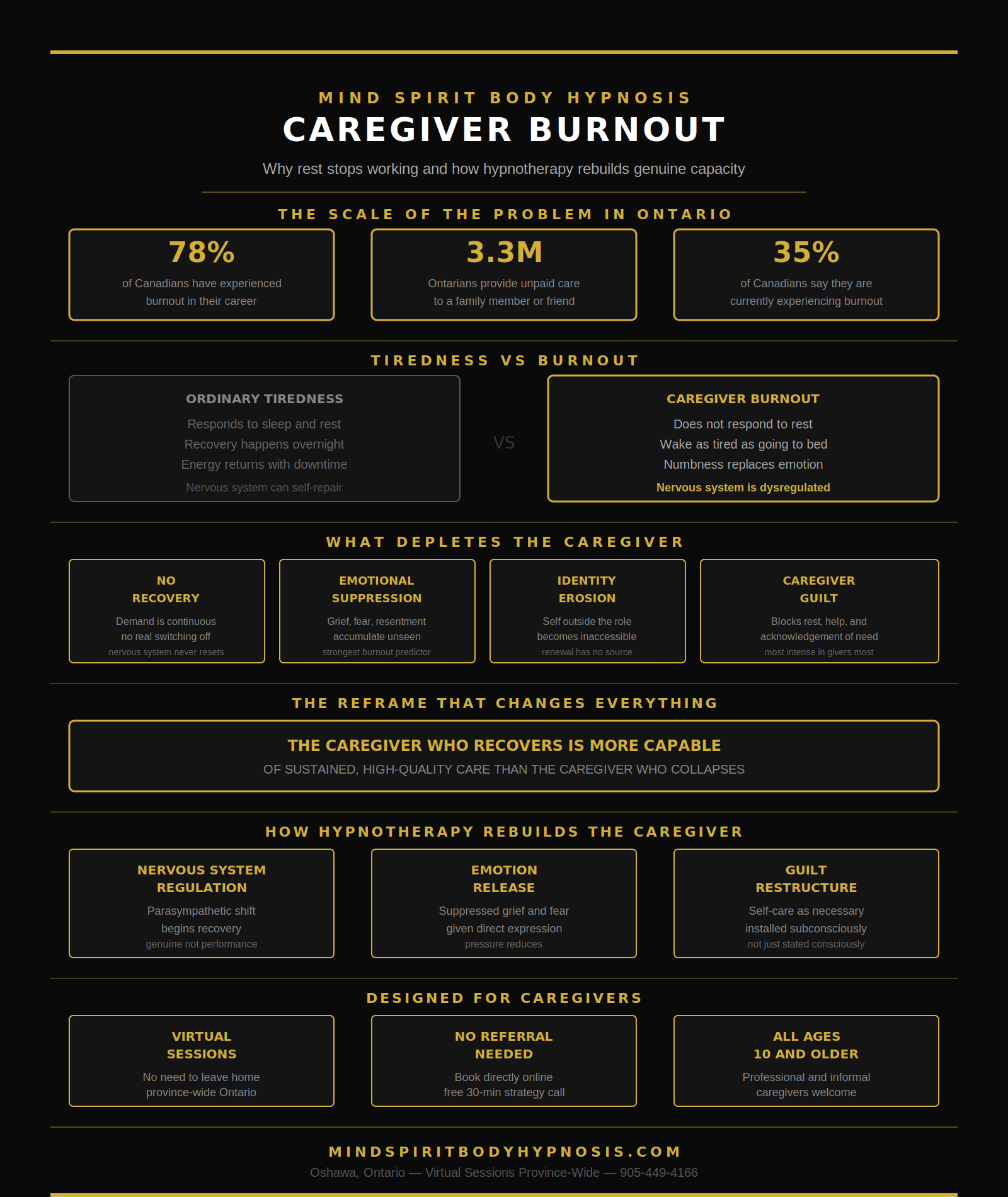
According to the Canadian Centre for Occupational Health and Safety, burnout is recognized as a significant occupational health concern, with caregiving professions among the highest-risk groups. Surveys consistently find that approximately 78 percent of Canadians report having experienced burnout at some point, with caregivers, both professional and informal, reporting rates significantly above the general population average.
In Ontario, the burden of informal caregiving has grown substantially in recent years. The Ontario Caregiver Organization estimates that approximately 3.3 million Ontarians provide unpaid care to a family member or friend, with the majority reporting a significant impact on their own health, sleep, and emotional well-being as a result.
The experience of caregiver burnout is distinct from general tiredness or even general occupational stress. It is characterized by a specific combination of depletion, disconnection, and guilt that makes it particularly resistant to conventional recovery strategies, rest, holidays, and reduced workload, which help with ordinary exhaustion.
⭐ Pro Tip: One of the clearest signs that exhaustion has become burnout rather than simple tiredness is the loss of the ability to recover overnight. Ordinary tiredness responds to sleep. Burnout does not. If you are waking up in the morning as tired as when you went to bed, if rest no longer produces restoration, the nervous system has moved beyond simple fatigue into the dysregulated state that burnout produces. This is the point at which rest alone is insufficient and direct nervous system work becomes necessary.
What Causes Caregiver Burnout?
Caregiver burnout is rarely caused by a single factor. It almost always develops through a combination of the following:
Chronic sustained demand without recovery. The caregiving role, particularly informal caregiving, is often continuous in a way that few other roles are. There is no clocking out, no weekend, no holiday from the emotional and physical demands of the role. The nervous system requires genuine downtime, not just absence of activity but the physiological shift into parasympathetic recovery, to repair the wear of sustained demand. Without it, the system progressively depletes.
Emotional suppression. Caregivers frequently suppress their own emotional responses in the service of the person they are caring for. The grief of watching someone decline. The fear of what comes next. The resentment that is too shameful to acknowledge. The loneliness of a role that is profoundly isolating. These emotions do not disappear when suppressed. They accumulate in the nervous system, generating a chronic background activation that compounds the direct stress of caregiving.
Loss of identity and self. Sustained caregiving often involves a progressive erosion of the caregiver's own identity, interests, relationships, and sense of self independent of the caregiving role. When the question of who you are outside the role becomes unanswerable, the person has lost not just energy but the internal resources from which renewal could come.
Secondary traumatization. Caregivers who witness suffering, medical crises, or significant deterioration in the person they care for are at risk of vicarious trauma: a form of indirect traumatization in which exposure to another person's distress produces trauma-like symptoms in the caregiver. Hypervigilance, intrusive thoughts, emotional numbing, and sleep disruption are all common in caregivers with secondary traumatization and are rarely recognized as trauma responses.
Research published in the Journal of Occupational Health Psychology found that emotional suppression was the single strongest predictor of burnout severity in caregiving populations, more predictive than workload alone, with caregivers who suppressed rather than processed their emotional responses to caregiving showing significantly higher burnout scores at follow-up (Hülsheger et al., 2013).
For more on how anxiety, nervous system dysregulation, and emotional suppression interact and how hypnotherapy addresses all three, the hypnotherapy for anxiety and stress pillar page covers the foundational nervous system mechanisms.
Why Caregiver Guilt Makes Burnout Worse
Caregiver guilt is one of the most damaging and least acknowledged features of caregiver burnout, and it operates as a maintenance mechanism that prevents the recovery it appears to be motivating.
Caregiver guilt is the persistent sense that whatever you are giving is not enough, that your own needs are a luxury you cannot afford, that asking for help or taking time for yourself is a betrayal of the person who depends on you. It is extraordinarily common, deeply painful, and rarely based on an accurate assessment of what is actually being given.
Guilt does several things that make burnout worse rather than better. It prevents the caregiver from accessing rest because rest feels unearned. It blocks the acknowledgement of difficult emotions like resentment or grief, because feeling those things seems to confirm inadequacy. It makes it impossible to ask for or accept help because needing help feels like failure. And the energy consumed by the guilt itself is energy the nervous system desperately needs for recovery.
The cruel irony of caregiver guilt is that it is most intense in the caregivers who are giving the most. The people who feel they are not doing enough are almost universally the people who are doing more than is sustainable. Guilt is not a reliable indicator of inadequacy. It is a reliable indicator of a care system that has no room for the caregiver.
⭐ Pro Tip: Caregiver guilt tends to intensify at exactly the moment rest or recovery is most needed, which is the body's way of resisting what the subconscious has coded as abandonment. A useful reframe, and one that is installed directly in hypnotherapy work, is that the caregiver who recovers is more capable of sustained, high-quality care than the caregiver who collapses. Taking care of yourself is not a withdrawal from care. It is how sustainable care is possible. This reframe, while rationally obvious, needs to be installed at the subconscious level to actually change the guilt response.
How Hypnotherapy Addresses Caregiver Burnout at the Root
As a certified hypnotherapist trained through the American Board of Hypnotherapy, I approach caregiver burnout as a multi-layered pattern involving nervous system dysregulation, accumulated emotional material, identity erosion, and guilt. The work is gentle, carefully paced, and specifically calibrated to the reality that caregivers often have very limited time and energy available for their own recovery.
Nervous system regulation. The trance state itself produces a measurable and significant shift toward parasympathetic nervous system dominance. For many caregivers, the hypnotherapy session is the first genuinely downregulated nervous system state they have experienced in months or years. This is not merely relaxation. It is a physiological recalibration that begins the actual recovery process rather than simply masking the exhaustion temporarily.
Accumulated emotion release. The suppressed emotional material of caregiving, the grief, the fear, the resentment, the loneliness, the helplessness, is approached in trance with safety and compassion. Each emotional layer is given direct expression and allowed to move through rather than being managed or suppressed further. As the accumulated emotional weight reduces, the nervous system's baseline activation level drops, and genuine energy begins to return.
Identity and self-reconnection. In trance, the caregiver is guided back to the parts of themselves that exist independently of the caregiving role: the interests, values, relationships, and sources of meaning that sustained them before the role consumed them. These parts are reactivated and reconnected, providing an internal resource base from which recovery and sustained care both become possible.
Guilt restructuring. The subconscious belief that self-care is abandonment is identified and directly addressed in trance. The more accurate and functional belief that sustainable care requires a cared-for caregiver is installed at the subconscious level rather than simply stated consciously. Many clients report that this single shift produces more immediate practical change than any other element of the work.
Sleep restoration. Caregiver burnout almost universally disrupts sleep, both through physiological hyperarousal and through anticipatory anxiety about the caregiving demands of the next day. Hypnotherapy addresses both dimensions, recalibrating the nervous system's nocturnal baseline and addressing the anticipatory thought patterns that prevent restorative sleep.
For more on how sleep disruption in the context of chronic stress is addressed at Mind Spirit Body Hypnosis, the hypnotherapy for sleep and insomnia page covers the specific mechanisms in detail.
NLP Techniques That Rebuild Caregiver Resilience
NLP offers precise, practical tools for rebuilding the internal resource base that caregiver burnout depletes. Clients I work with across Ontario find these particularly valuable because they can be used independently in the limited time available between caregiving demands.
The resource state anchor. A state of genuine, embodied restoration, experienced in trance and qualitatively different from the partial recovery of ordinary rest, is anchored to a physical cue. Activating this anchor provides immediate access to a recovered physiological state that does not require hours of rest to achieve. Many caregivers use this anchor as a two-minute recovery tool between caregiving demands.
Boundary installation. The internal permission to have needs, to take time, to say no, to ask for help, is installed as a subconscious operating assumption rather than a conscious intention that the guilt response immediately overrides. This is one of the most transformative elements of the NLP work for caregivers.
Future pacing sustainable care. The subconscious is walked through a vivid scene of the caregiver in six months, caring for the person who depends on them with genuine presence, warmth, and capacity, because they have been regularly attending to their own recovery. This scene is filed as the expected future, making the self-care that produces it feel necessary rather than indulgent.
Parts integration for caregiver identity. The part of the caregiver that gives and the part that needs are brought into dialogue and integrated, ending the internal war between care and self-care that caregiver guilt maintains. With integration, both can operate without the other being cancelled.
More about how NLP and hypnotherapy are applied in practice at Mind Spirit Body Hypnosis is available on the about page.

What to Expect in a Session
The first session is a conversation with no demands on performance or productivity. How long have you been in this role? What does the depletion feel like in the body? What emotions are you managing or suppressing most frequently? What does rest look like in your life at the moment, and is it working? And what would you need to feel like yourself again?
The trance work begins gently. Many caregivers report that the first session is the first time they have allowed themselves to simply be still and receive something for themselves, rather than giving or managing, for as long as they can remember. The relief of that alone is often significant.
Most caregiver burnout programmes at Mind Spirit Body Hypnosis run between four and six sessions, though meaningful improvement in nervous system regulation and sleep quality often begins after the first or second session. All sessions are delivered virtually and are available to clients aged 10 and older across Ontario from the comfort of their own home, which is particularly important for caregivers with limited ability to leave the caregiving environment.
What My Clients Say
"I began seeing Fanis after a long battle with trauma and grief. I suffered from severe anxiety, panic attacks, insomnia and self harm. After 3 months of weekly hypnotherapy sessions done online, I no longer suffer from panic attacks, insomnia, or self harm and have learned how to better regulate my emotions and find peace. Fanis helped me process many childhood traumas and confront my overwhelming grief. I am eternally grateful to Fanis and his wonderful work."
Sara V. | Trauma and Grief | Five Stars
FAq
Can hypnotherapy help with caregiver burnout? Yes. Hypnotherapy directly addresses the nervous system dysregulation, emotional suppression, identity erosion, guilt patterns, and sleep disruption that characterize caregiver burnout. Research supports significant reductions in caregiver stress and improvements in emotional regulation and sleep quality through hypnotherapy.
What causes caregiver burnout? Caregiver burnout is caused by chronic sustained demand without adequate recovery, emotional suppression of the caregiver's own feelings, progressive loss of identity and self outside the caregiving role, and in many cases, secondary traumatization from witnessing suffering or decline. It is rarely caused by insufficient love or effort; it is almost always caused by insufficient resources and recovery.
How is caregiver burnout different from general exhaustion? The key distinction is the loss of the ability to recover through rest. Ordinary exhaustion responds to sleep and downtime. Caregiver burnout does not improve because the nervous system has moved into a dysregulated state that rest alone cannot correct. Waking as tired as when you went to sleep is a reliable indicator that rest is no longer sufficient and direct nervous system work is needed.
Why does caregiver guilt make burnout worse? Caregiver guilt prevents rest, blocks the acknowledgement of difficult emotions, and makes it impossible to ask for or accept help. It consumes energy the nervous system needs for recovery and intensifies at precisely the moment rest is most needed. It is most intense in caregivers who are giving the most, making it an unreliable indicator of inadequacy and a significant barrier to recovery.
What is the best treatment for caregiver burnout in Ontario? Approaches that address the nervous system regulation, emotional processing, and identity restoration components of caregiver burnout produce the most lasting results. Hypnotherapy is particularly well-suited because it directly accesses the subconscious patterns maintaining the burnout, including guilt and emotional suppression, while simultaneously providing the physiological recovery conditions the nervous system needs.
How many sessions will I need? Most clients at Mind Spirit Body Hypnosis working on caregiver burnout complete four to six sessions. Many notice a meaningful improvement in sleep quality and nervous system baseline after the first one or two sessions. The timeline depends on the duration and severity of the burnout and whether secondary trauma is present.
Is this suitable for professional caregivers? Yes. Hypnotherapy and NLP are equally effective for professional caregivers, including nurses, teachers, social workers, and first responders, and for informal caregivers such as parents and adult children. The patterns addressed, nervous system dysregulation, emotional suppression, guilt, and identity erosion, are common across all caregiving contexts.
Can I do sessions virtually from anywhere in Ontario? Yes. All sessions are delivered virtually, province-wide, with no referral required. The virtual format is particularly valuable for caregivers who cannot easily leave the home environment.
What if I feel guilty about spending time on my own recovery? That guilt is itself a symptom of caregiver burnout, and it is directly addressed in the hypnotherapy work. The caregiver who recovers is better able to provide sustained, high-quality care than the caregiver who collapses. Attending to your own wellbeing is not a withdrawal from care. It is how sustainable care remains possible.
How do I get started? Book a free 30-minute virtual strategy session at calendly.com/mindspiritbodyhypnosis. No referral needed.
Ready to Take the Next Step?
If you have been giving everything to someone else's well-being and have nothing left for your own, that is not who you are. It is a state your nervous system has reached. And it can change.
I offer a free 30-minute virtual strategy session for new clients across Ontario. There is no pressure, just a conversation about what you are carrying and how hypnotherapy or NLP may help you recover the capacity to care for others sustainably by caring for yourself first.
Book your free session: calendly.com/mindspiritbodyhypnosis
Call or text: 905-449-4166
Email: info@mindspiritbodyhypnosis.com
Visit: mindspiritbodyhypnosis.com
Serving clients virtually across Ontario, including Durham Region, Toronto, Ottawa, and beyond.
Disclaimer: This article is for informational purposes only and does not constitute medical or psychological advice. Hypnotherapy and NLP are complementary approaches and are not a substitute for medical or clinical care. Caregiver burnout can have serious physical and mental health consequences; please consult a healthcare provider if you have concerns. Results vary by individual.
Written by Fanis Makrigiannis | Certified Hypnotherapist & NLP Master Practitioner | Mind Spirit Body Hypnosis.