How Hypnotherapy Helps Heal Childhood Trauma (Part 3 of 3)
TL;DR: This is the final part of a three-part series on childhood trauma. Part 1 covered what trauma is. Part 2 covered how it shows up in adult life. This part covers how hypnotherapy actually helps, what happens in sessions, what changes, and what to expect at Mind Spirit Body Hypnosis in Oshawa, Ontario.
Quick Answer
Hypnotherapy helps heal childhood trauma by going directly to the subconscious where the stored memories, beliefs, and nervous system patterns live. Talk therapy helps you understand what happened. Hypnotherapy helps change how the mind and body are still responding to it. The two are not the same thing, and for many people with childhood trauma, hypnotherapy reaches a layer that understanding alone never could. At Mind Spirit Body Hypnosis in Oshawa, Ontario, Fanis Makrigiannis offers virtual sessions province-wide for clients of all ages who are ready to stop being run by what happened before.
Questions This Article Answers
How is hypnotherapy different from talk therapy for trauma?
Do I have to relive what happened?
What actually happens in a hypnotherapy session for trauma?
How many sessions will I need?
What does healing actually feel like?
In This Article:
A lot of people come for trauma work after years of talk therapy. They understand what happened. They understand why they respond the way they do. And the reactions have not changed.
That is not because the therapy failed. Talk therapy is genuinely helpful. It builds understanding, language, and insight. These things matter.
But understanding operates at the conscious level. The trauma is stored at the subconscious level. The reactions, the patterns, the nervous system responses they are happening below where conscious understanding lives.
This is the gap that hypnotherapy is designed to cross.
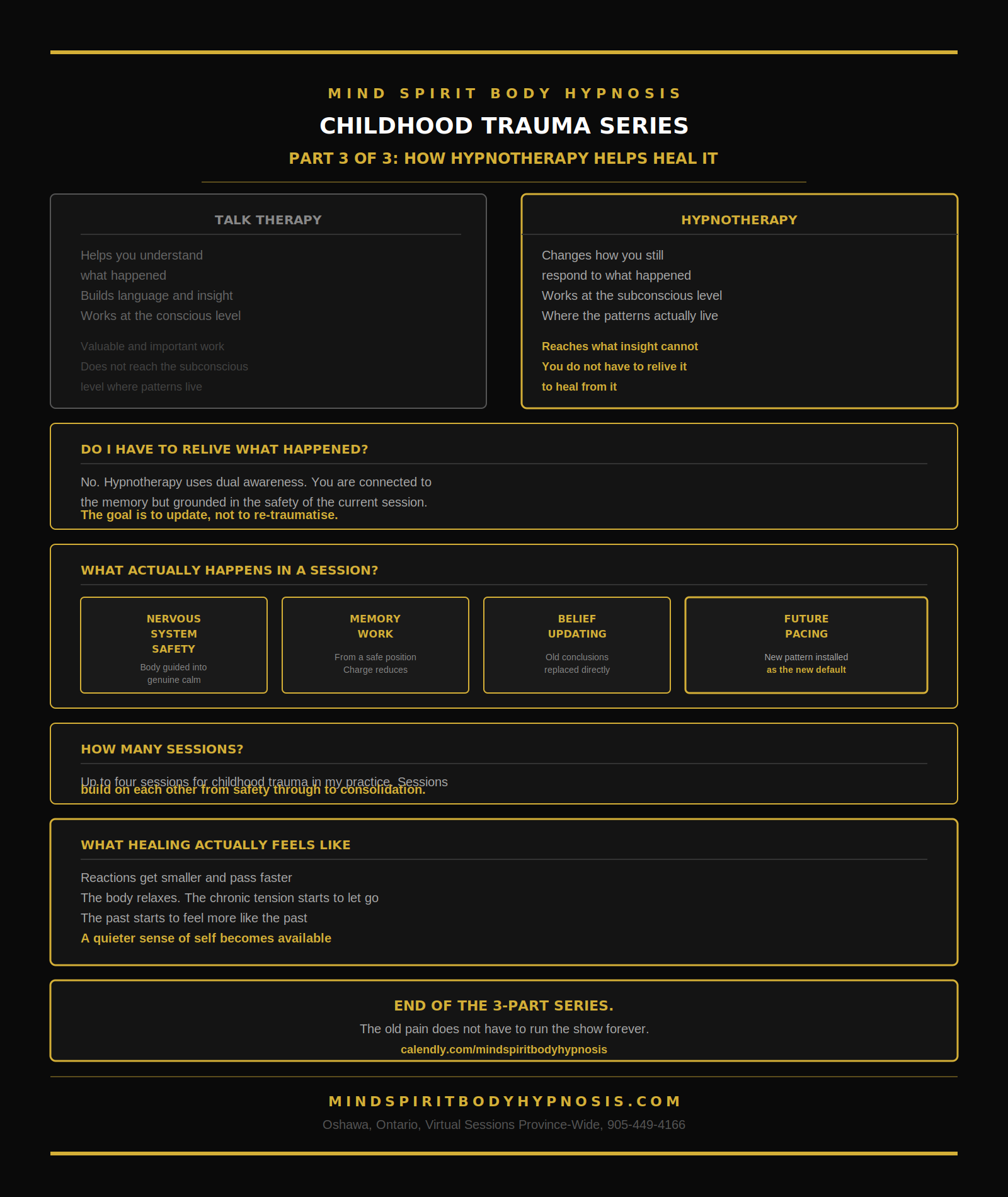
How Is Hypnotherapy Different From Talk Therapy?
Talk therapy helps you make sense of what happened. You explore the past, name what you felt, understand the impact, and build a different relationship with the story of your life. This is real and important work.
Hypnotherapy works differently. It does not primarily focus on making sense of the story. It focuses on changing how the mind and body are still responding to it.
In a relaxed, focused trance state, the subconscious becomes more open to change. The stored memories, the beliefs that formed in childhood, and the nervous system patterns that developed around them can all be accessed and updated directly.
This is important because the subconscious is not persuaded by understanding. You cannot tell the subconscious "I know this is safe" and have it update. It learns through direct experience, and the trance state allows that direct experience to happen in a safe, controlled way.
For many people with childhood trauma, hypnotherapy reaches a layer that years of insight-based work never reached, not because the previous work was wrong, but because it was working at a different level.
⭐ Pro Tip: Hypnotherapy and talk therapy are not in competition. Many clients at Mind Spirit Body Hypnosis use both. Talk therapy builds the map. Hypnotherapy changes the terrain. If you are already in therapy, hypnotherapy can work alongside it very well.
Do I Have to Relive What Happened?
No.
This is one of the biggest fears people have about trauma therapy: that they will have to go back into the worst moments of their life and feel it all again.
Hypnotherapy does not work by flooding you with the full intensity of the original experience. It works by accessing the memory from a position of safety.
This is called dual awareness. You are connected to the memory; it is there, present, but you are also fully grounded in the safety of the current session. You are not inside the past event. You are observing it, working with it, from a safe distance.
The goal is not to re-traumatize. The goal is to update. The memory stays, but its charge reduces. The nervous system learns that it is over, that the old threat is in the past, and that the current moment is safe.
This is also why hypnotherapy can work even for people who do not have clear memories of what happened. The stored emotional and physical responses can be worked with directly without a clear narrative, without detailed verbal description, without having to go through everything that happened.
What Actually Happens in a Session?
Every session begins with a conversation.
What brought you here? What has been most difficult? What patterns have you noticed? What would you like to be different? This conversation is not an interrogation. It is mapping and understanding the specific shape of your experience so the work can be targeted to what you actually need.
The trance state comes next. This is gentler than most people expect. There is no dramatic moment of going under. The body becomes heavy and comfortable. The mind becomes quieter. You are aware throughout; you can hear what is being said, you are not asleep, and you can open your eyes and end the session at any moment you choose.
Within the trance state, different things can happen depending on what is being addressed:
Nervous system regulation. The body is guided into a state of genuine safety and calm. For many trauma survivors, this is a profound and unfamiliar experience of being in the body without vigilance. This alone begins to update the nervous system's operating state.
Memory work. Stored traumatic memories are approached gently, from a position of safety. The memory is not relived at full intensity; it is revisited with the adult's resources, perspective, and the ability to do something differently than the child could. The emotional charge of the memory reduces. It begins to feel more like something that happened, rather than something still happening.
Belief updating. The beliefs that formed around the traumatic experience I am not safe, I am not enough, people cannot be trusted are identified and changed at the subconscious level. New and more accurate beliefs are installed. Not as conscious affirmations that the subconscious evaluates and rejects, but as direct subconscious experience.
Future pacing. The person is walked through future situations that previously triggered the trauma response and experiences those situations from a different, more resourced place. This installs the new pattern as the expected default.
After the session, most people describe feeling calm and clear. Some feel a little tired, like something has shifted. In the days that follow, the changes often continue; situations that previously produced a strong reaction may feel different. The charge has started to reduce.
How Many Sessions Will I Need?
In my practice, childhood trauma typically takes up to four sessions.
This is honest and realistic. Childhood trauma often involves multiple layers, multiple memories, multiple belief patterns, multiple nervous system adaptations. This is not a quick fix. It is careful, thorough work.
Some clients notice significant change after one or two sessions. Others need the full programme to see the shifts consolidate. An honest estimate for your specific situation is always given in the free strategy session.
The sessions build on each other. The first session establishes safety and begins the nervous system regulation work. Later sessions go deeper into the specific memories and beliefs. The final sessions consolidate and future-pace, making the new patterns the default.
What Does Healing Actually Feel Like?
People describe it in different ways. But some things come up again and again.
The reactions get smaller. The things that used to trigger a big response still happen, but the wave is smaller. It passes faster. There is more space between what happens and how you respond.
The body relaxes. The chronic tension, the low-level vigilance, the holding it starts to let go. People describe feeling lighter. Less braced.
The past feels more like the past. The memories are still there, but they stop feeling present-tense. They feel more like things that happened, not things that are still happening.
Trust becomes more possible. The automatic assumption that people will hurt you or let you down softens. There is more room to let people in, in smaller ways at first, and then more.
You start to feel more like yourself. Or maybe like the self you would have been, if things had gone differently. There is something quieter. Something that does not need to manage everything. Something that can be still.
This is not the end of difficulty. Healing from childhood trauma does not mean a life without pain. It means that the old pain no longer runs the show.
For more on the approach to trauma work at Mind Spirit Body Hypnosis, the EMDR and trauma therapy page and the about page cover the full clinical framework.

What to Expect at Mind Spirit Body Hypnosis
The first session is a conversation. No pressure to share more than you are ready to share. No expectation that you will have everything figured out.
The work is paced carefully. Nothing happens before you are resourced enough for it. The goal is always safety first, and every step of the work is built on that foundation.
All sessions are delivered virtually, available to clients aged 10 and older across Ontario (and beyond) from the privacy of their own home.
What My Clients Say
"I began seeing Fanis after a long battle with trauma and grief. I suffered from severe anxiety, panic attacks, insomnia and self harm. After 3 months of weekly hypnotherapy sessions done online, I no longer suffer from panic attacks, insomnia, or self harm and have learned how to better regulate my emotions and find peace. Fanis helped me process many childhood traumas and confront my overwhelming grief. I am eternally grateful to Fanis and his wonderful work."
Sara V. | Trauma and Grief | Five Stars
"Working with Fanis has changed my life. After years of therapy for anxiety and confidence issues, I wanted to try something different. This experience has transformed me from the inside out and continues to have an effect even after our sessions. I am now able to be myself, face my fears, surround myself with those who care about me and live a fulfilling and happy life. So grateful."
Kristen W. | Anxiety and Confidence | Five Stars
FAQ
How is hypnotherapy different from talk therapy for trauma? Talk therapy builds understanding and insight. Hypnotherapy changes how the mind and body are still responding to the trauma at the subconscious level where the stored memories, beliefs, and nervous system patterns live. Both are valuable. They work at different levels.
Do I have to relive what happened? No. Hypnotherapy uses dual awareness: you are connected to the memory but grounded in the safety of the current moment. The goal is not to re-experience the trauma at full intensity. It is to update the stored response from a position of safety.
What happens in a trauma session? A conversation to map the experience, then a gentle trance state where nervous system regulation, memory work, belief updating, and future pacing all happen. It is gentler than most people expect. You are aware throughout.
How many sessions will I need? Up to four sessions for childhood trauma in my practice. The sessions build on each other, moving from nervous system safety through to memory work, belief updating, and consolidation.
What does healing actually feel like? Reactions become smaller and pass faster. The body relaxes. The past starts to feel more like the past. Trust becomes more possible. A quieter sense of self becomes available.
Can hypnotherapy help if I do not have clear memories? Yes. Hypnotherapy can work with the stored emotional and physical responses directly without needing a clear narrative or detailed memory of what happened.
Is it too late to heal from childhood trauma as an adult? No. The brain is capable of change at any age. The patterns formed in childhood can be updated through direct subconscious work regardless of how long they have been in place.
Can I do sessions virtually? Yes. All sessions are delivered virtually, province-wide, with no referral required.
How do I get started? Book a free 30-minute virtual strategy session at calendly.com/mindspiritbodyhypnosis. No referral needed.
Ready to Take the Next Step?
You have read all three parts of this series. You know what childhood trauma is, how it shows up, and how hypnotherapy helps heal it.
The next step is a conversation.
I offer a free 30-minute virtual strategy session for new clients across Ontario. No pressure. No expectations. Just a chance to talk about what has been difficult and whether this approach is right for you.
Book your free session: calendly.com/mindspiritbodyhypnosis
Call or text: 905-449-4166
Email: info@mindspiritbodyhypnosis.com
Visit: mindspiritbodyhypnosis.com
Serving clients virtually across Ontario, including Durham Region, Toronto, Ontario, and beyond.
Disclaimer: This article is for informational purposes only. It is not medical or psychological advice. If you are in crisis, please contact the 988 Suicide Crisis Helpline or go to your nearest emergency room. Results vary by individual.
Written by Fanis Makrigiannis | Certified Hypnotherapist and NLP Master Practitioner | Mind Spirit Body Hypnosis.