Why do I eat when I’m not hungry?
Hypnotherapy for Emotional Eating in Ontario: Your Questions Answered
TL;DR: Emotional eating is not a lack of discipline. It is the nervous system reaching for the most reliable available tool to manage an emotional state that has become too uncomfortable to sit with. The food is not the problem. The food is the solution the subconscious has found for a different problem. At Mind Spirit Body Hypnosis in Oshawa, Ontario, the five questions people ask most about emotional eating and hypnotherapy are answered here, directly.
Quick Answer
Emotional eating is the pattern of using food to manage emotional states rather than to satisfy physical hunger, driven by a subconscious habit loop in which specific emotions or internal states reliably trigger a reach for food, which provides brief genuine relief, which reinforces the habit. It is not a character flaw, a lack of willpower, or something that nutritional information alone will change. It is a subconscious emotional regulation strategy that developed because it worked, at least temporarily, and has become automatic. Hypnotherapy addresses emotional eating at the subconscious level where the habit loop, the emotional triggers, and the underlying need the food is meeting all operate. I offer virtual sessions province-wide for clients of all ages at Mind Spirit Body Hypnosis in Oshawa, Ontario.
Questions This Article Answers
Why do I eat when I am not hungry?
Why is it so hard to stop emotional eating even when I know I am doing it?
Why does emotional eating feel comforting in the moment but worse afterwards?
What emotions most commonly trigger emotional eating?
Can hypnotherapy help with emotional eating?
In This Article:
There is a particular clarity that arrives after an episode of emotional eating. You can see exactly what happened. Something difficult occurred: a stressful day, a hard conversation, a feeling you did not want to sit with, and the kitchen became the destination. And now you are on the other side of it, and the original difficult feeling is still there, joined by guilt and the mild self-reproach of having done it again.
People who struggle with emotional eating are almost always intelligent about it. They understand what is happening. They can describe the pattern in detail. The understanding is not the problem. The pattern is subconscious, and subconscious patterns do not respond to understanding the way we hope they will.
Why Do I Eat When I Am Not Hungry?
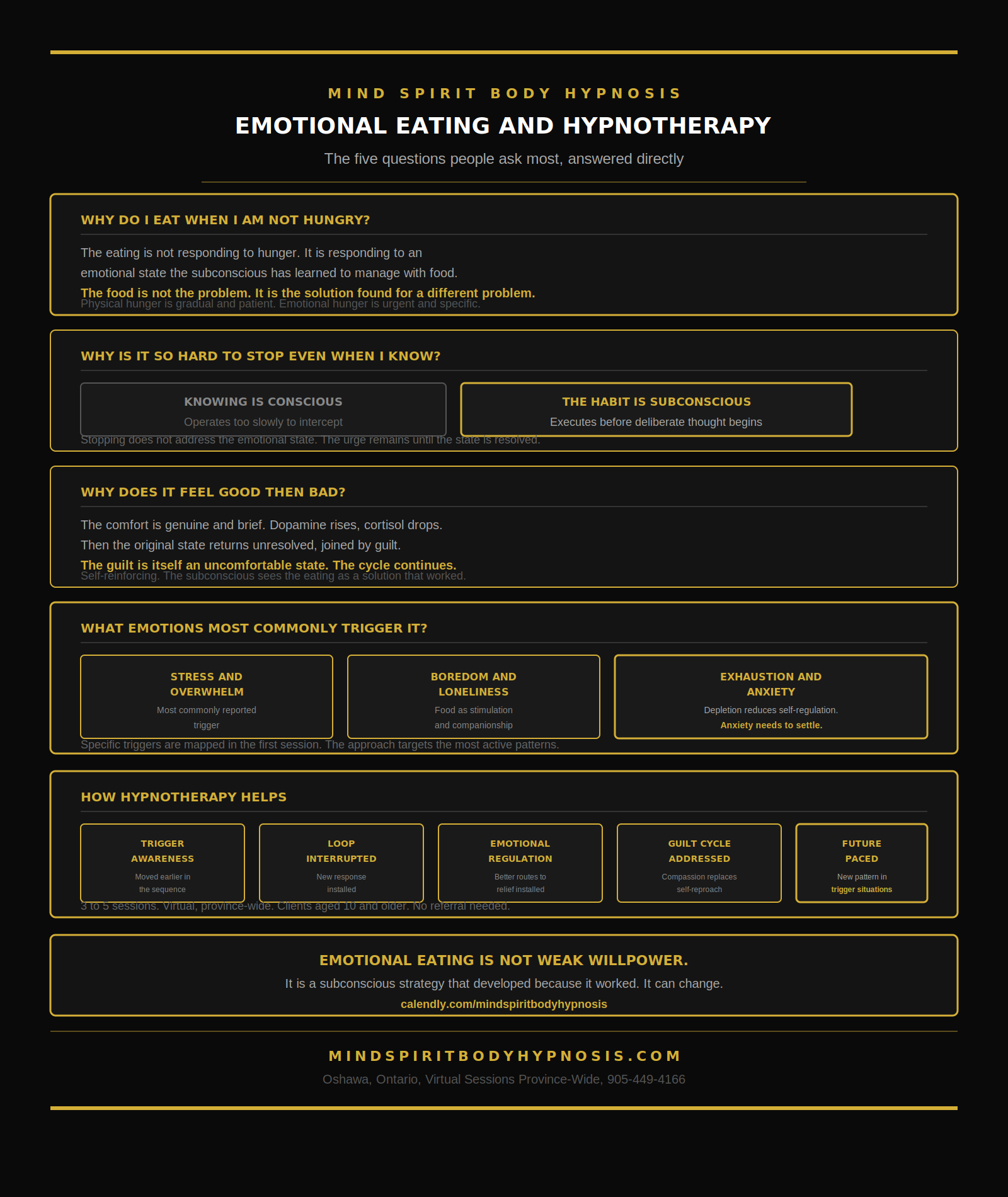
Because the eating is not responding to hunger. It is responding to an internal emotional state that the subconscious has learned to manage with food.
The distinction between physical hunger and emotional hunger is one of the most practically important and most frequently overlooked aspects of emotional eating work. Physical hunger builds gradually. It is located in the stomach. It is satisfied by any food. It does not feel urgent in the way emotional hunger does, and it does not carry the quality of craving the specific pull toward particular foods, particularly those that are sweet, salty, or high in fat.
Emotional hunger arrives differently. It comes on quickly, sometimes suddenly. It is often for specific foods: comfort foods, familiar foods, foods associated with relief or reward. It feels urgent in a way that physical hunger rarely does. And it originates not in the stomach but in the emotional state that is present: the stress, the frustration, the loneliness, the boredom, the feeling that cannot be comfortably held.
The subconscious reaches for food in response to this emotional state because food has been established, through repeated experience, as a reliable way to change that state. The first experiences of this association are often formed early: food as comfort when distress occurred, food as reward when something difficult was completed, food as companionship when loneliness was present. Over time and through repetition, the association strengthens until it becomes automatic: this emotional state produces a reach for food.
Understanding the distinction between physical and emotional hunger is the beginning of creating a genuine choice in the moment. Most people who struggle with emotional eating can, when they slow down sufficiently, identify which kind of hunger they are responding to. The challenge is that the emotional urge does not naturally invite this kind of slow, reflective inquiry. It arrives with urgency and produces the reach before reflection can intervene.
For more on how the anxiety dimension that often underlies emotional eating is addressed at Mind Spirit Body Hypnosis, the hypnotherapy for anxiety and stress pillar page covers the nervous system mechanisms.
⭐ Pro Tip: The most useful question to ask when a food urge arrives is not Am I hungry? Which is often too easy to answer incorrectly in the direction of yes. A more revealing question is: What am I feeling right now? Not what do I want to eat, but what is happening in my body and emotional state in this exact moment. Stress hunger has a quality of urgency and narrowing; attention contracts, the pull toward food feels almost physical, and it is hard to think about anything else. Genuine physical hunger feels different: broader, more patient, less charged with emotional content. Learning to distinguish the felt quality of the two is one of the most practical pieces of self-awareness that comes from this work.
Why Is It So Hard to Stop Even When I Know I Am Doing It?
For the same reason any established subconscious habit is resistant to conscious intervention: the habit executes faster than deliberate decision-making, and stopping it does not address the underlying emotional state it was recruited to manage.
Emotional eating operates as a conditioned automatic response. The emotional trigger fires the stressful feeling, the difficult conversation ending, the moment of sitting down after a demanding day, and the movement toward food begins automatically, before deliberate thought has engaged. By the time the conscious mind notices what is happening, the reach is already well underway.
Even when the person does catch themselves and notice the pattern starting, stopping produces a specific difficulty. The uncomfortable emotional state that triggered the reach is still present. The food was the solution the subconscious had prepared. Without the food, the uncomfortable state remains unaddressed, and the urge to resolve it continues. The stopping feels like tolerating an uncomfortable state with no relief in sight, which is genuinely difficult and genuinely different from ordinary self-control.
This is why nutritional information and conscious intention produce such limited and unreliable results with emotional eating. Knowing that you should not eat this does not change the fact that the emotional state that produced the urge is still present, still uncomfortable, and still without a means of resolution. The subconscious keeps reaching for the established solution.
Research confirms that hypnotherapy is effective in strengthening self-regulation and managing emotional impulses, specifically because it works at the subconscious level where the impulse originates, not at the conscious level where the person is already trying and already finding that trying is insufficient.
For more on how the self-sabotage patterns that accompany emotional eating are addressed at Mind Spirit Body Hypnosis, the hypnotherapy for self-sabotage pillar page covers the subconscious mechanisms in detail.
⭐ Pro Tip: The moment between the emotional trigger and the food is very small in an established emotional eating pattern, often seconds. One of the most effective early-stage practices is simply extending that moment by a deliberate few seconds before acting on the urge. Not to make a different decision necessarily, but to pause and notice. What is the feeling? Where in the body is it? What specifically does the urge feel like? This noticing does not instantly change the habit, but it begins to insert a moment of awareness into a sequence that previously had none. That awareness is the foundation on which a different response can eventually be built.
Why Does Emotional Eating Feel Comforting in the Moment But Worse Afterwards?
Because the comfort is genuine and brief, and what follows it is the original emotional state returning alongside guilt, and the guilt does nothing to address the original state, but adds a second uncomfortable layer to it.
The comfort is not imagined. Food, particularly the high-sugar, high-fat comfort foods that emotional eating characteristically reaches for, genuinely shifts neurochemistry in the short term. Dopamine is released. Cortisol drops briefly. The body activates its own opioid system in response to certain foods. There is a real, measurable physiological shift that produces genuine, if temporary comfort.
This is precisely what makes the habit so persistent. It works. Not sustainably, not in a way that addresses the actual problem, but in the moment it produces genuine relief. The subconscious is rational in its own terms: this is a reliable way to change this feeling. It will keep reaching for it.
The problem arrives in two phases. The first is the return of the original emotional state, which has not been resolved by the food. The stress is still there. The difficult conversation still happens. The loneliness or boredom or frustration is still present, because none of those things are amenable to being eaten away.
The second is the guilt, the self-reproach about having done it, the negative self-evaluation, the sense of having failed at something that should be simple. This guilt adds an uncomfortable emotional state to the original one. And uncomfortable emotional states, in a system that has learned to manage emotional states with food, produce a further urge to eat.
The cycle is self-reinforcing. The emotional eating that was supposed to provide relief produces guilt that requires its own management, which produces further eating. This is one of the most exhausting features of the pattern and one of the clearest indicators that the issue needs to be addressed at a deeper level than willpower or nutritional management can reach.
What Emotions Most Commonly Trigger Emotional Eating?
While the specific triggers vary significantly by person, several emotional states appear consistently across clinical practice:
Stress and overwhelm. The most commonly reported trigger. When the demands of the day, the week, or a specific situation have exceeded comfortable capacity, food becomes the available means of decompression. The eating is not primarily about the food; it is about the need for a contained, reliable experience of pleasure and relief in a context where almost everything else feels out of control.
Boredom and low stimulation. The nervous system that has been trained to expect a certain level of stimulation reaches for food when the stimulation drops. Boredom and emotional eating often happen in the evening, when the structure of the day has ended, and the quiet feels uncomfortable rather than restful.
Loneliness. Food as companionship, as comfort, as a reliable and uncomplicated source of pleasure when human connection is absent or insufficient. This is particularly common in the evenings and on weekends.
Exhaustion. When physical or emotional depletion has reduced the capacity for self-regulation, the subconscious reaches for the fastest available means of restoration. Depleted self-control is one of the most consistent predictors of emotional eating episodes.
Anxiety and anticipatory dread. Eating as a way of managing the uncomfortable physiological state of anxiety, reducing the arousal, providing a brief shift in focus, creating a moment of sensory engagement that interrupts the anxious thought spiral.
Frustration and anger. Food as an outlet for feelings that cannot be expressed or resolved in the actual situation. The eating provides a physical action, a sensory engagement, a way of doing something with an energy that has nowhere else to go.
The specific emotional triggers for each person are mapped carefully in the first session, because the most effective intervention targets the specific trigger-response patterns that are most active rather than applying a generic approach.

Can Hypnotherapy Help With Emotional Eating?
Yes, and it is one of the presentations where hypnotherapy produces some of the most immediate and practically significant change in my practice.
The reason is the mechanism. Emotional eating is a subconscious emotional regulation strategy, and hypnotherapy works directly at the subconscious level where both the habit and the emotional regulation need to operate.
Here is how I work with emotional eating at Mind Spirit Body Hypnosis:
Trigger mapping and awareness installation. In the intake conversation, I build a precise map of the specific emotional triggers for this person's eating pattern. The specific emotions, the specific contexts, the specific times of day. This map shapes everything that follows. In trance, the moment of trigger-awareness, which currently arrives too late to influence the automatic reach, is moved earlier in the sequence, giving genuine choice where previously there was only reflex.
Habit loop interruption. The automatic emotional trigger-to-food sequence is identified and directly changed. The emotional cue that currently leads to the reach for food is decoupled from that response. A new and more functional automatic response is installed something that meets the actual underlying emotional need without food.
Emotional regulation skills. The emotional states that have been managed with food the stress, the loneliness, the exhaustion, the boredom are addressed directly. In trance, the nervous system is given more effective routes to the regulation it has been seeking through food. A genuine experience of the emotional state settling without food is installed and anchored.
The guilt cycle. The secondary layer the guilt and self-reproach that follows emotional eating and produces further episodes is directly addressed. In trance, a more compassionate and functional relationship with the pattern is installed. Not permissiveness, but the understanding that the pattern was a solution rather than a failure, and that the work is finding a better solution rather than punishing the person for having needed one.
Future pacing. The specific situations in which emotional eating most reliably occurs the end of a stressful day, the quiet of the evening, the particular emotional state that has been the most consistent trigger are visited in trance with the new pattern already operating. The experience of feeling the trigger and responding differently is filed as an expected experience.
In my practice, emotional eating work typically runs between three and five sessions, depending on the range of emotional triggers and the depth of the original habit formation. All sessions are delivered virtually, available to clients aged 10 and older across Ontario. More about my approach is available on the about page.
What My Clients Say
"Working with Fanis has changed my life. After years of therapy for anxiety and confidence issues, I wanted to try something different. This experience has transformed me from the inside out and continues to have an effect even after our sessions. I am now able to be myself, face my fears, surround myself with those who care about me and live a fulfilling and happy life. So grateful."
Kristen W. | Anxiety and Confidence | Five Stars
"I cannot say enough about how amazing Fanis is! He has truly changed my life. I was always an anxious person and always overthinking everything. After seeing Fanis I feel like a completely different person. The anxiety is gone and my mind is actually quiet for the first time in my life. I am forever grateful."
Amanda B. | Anxiety and Overthinking | Five Stars
FAQ
Why do I eat when I am not hungry? Because the eating is responding to an emotional state rather than physical hunger. The subconscious has learned, through repeated experience, that food reliably changes specific uncomfortable emotional states. The reach for food is automatic, a conditioned response to the emotional trigger rather than a decision based on physical need.
Why is emotional hunger different from physical hunger? Physical hunger builds gradually, is located in the stomach, and is satisfied by any food. Emotional hunger arrives quickly, often for specific comfort foods, feels urgent rather than patient, and originates in an emotional state rather than physical need.
Why is it so hard to stop even when I know I am doing it? Because the habit executes at the subconscious level, faster than deliberate decision-making. Stopping does not address the underlying emotional state that triggered the reach. The state remains, the urge remains, and conscious intention is fighting against a subconscious system that has a well-established and reliable solution.
Why does emotional eating make me feel worse afterwards? Because the original emotional state returns unresolved, joined by guilt about the eating. The guilt is itself an uncomfortable emotional state which, in a system that manages emotional states with food, can produce further episodes. The cycle is self-reinforcing.
What emotions most commonly trigger emotional eating? Stress and overwhelm, boredom and low stimulation, loneliness, exhaustion, anxiety, and frustration. The specific triggers vary significantly by person and are mapped carefully in the first session.
Can hypnotherapy help with emotional eating? Yes. I work at the subconscious level where the habit loop, the emotional triggers, and the underlying regulation all need to operate to decouple the trigger from the food response, installing more functional emotional regulation routes, addressing the guilt cycle, and future-pace the new pattern into specific triggering situations.
How many sessions will I need? In my practice, emotional eating work typically runs three to five sessions, depending on the range of emotional triggers and the depth of the habit formation. We always provide an honest estimate in the free strategy session.
Can I do sessions virtually from anywhere in Ontario? Yes. All sessions are delivered virtually, province-wide, with no referral required.
How do I get started? Book a free 30-minute virtual strategy session at calendly.com/mindspiritbodyhypnosis. No referral needed.
Ready to Take the Next Step?
If you understand the pattern clearly and find that understanding has not been enough to change it, this is a subconscious habit. And subconscious habits respond to a different kind of intervention.
I offer a free 30-minute virtual strategy session for new clients across Ontario. No pressure. Just an honest conversation about what emotional eating has been like and what a different relationship with food might feel like.
Book your free session: calendly.com/mindspiritbodyhypnosis
Call or text: 905-449-4166
Email: info@mindspiritbodyhypnosis.com
Visit: mindspiritbodyhypnosis.com
Serving clients virtually across Ontario, including Durham Region, Toronto, Canada, and beyond.
Disclaimer: This article is for informational purposes only and does not constitute medical or psychological advice. Hypnotherapy and NLP are complementary approaches for self-improvement and habit change and are not a substitute for medical assessment, nutritional advice, or treatment. Results vary by individual.
Written by Fanis Makrigiannis | Certified Hypnotherapist and NLP Master Practitioner | Mind Spirit Body Hypnosis.