Can hypnotherapy help with burnout and identity loss?
Hypnotherapy for Burnout and Identity Loss in Ontario: Your Questions Answered
TL;DR: For high performers, burnout is not simply exhaustion. It is the collapse of an identity that was built on achievement, and rest alone does not fix it because the problem is not the schedule. It is the subconscious belief that your worth, belonging, and safety are contingent on performing. At Mind Spirit Body Hypnosis in Oshawa, Ontario, the five questions people ask most about burnout, identity loss, and hypnotherapy are answered here, directly.
Quick Answer
Burnout in high performers is the depletion that follows years of running a nervous system whose sense of safety is contingent on performance. Most people who reach this point have not simply been working too hard. They have been performing their sense of worth, often subconsciously, executing the belief that their value to others and their right to rest depend on what they produce. When producing becomes unsustainable and performing begins to crack, the exhaustion that follows is not only physical. It is existential. The question it forces is one many high achievers have never genuinely asked: who am I if I am not achieving? Hypnotherapy works at the subconscious level where the achievement-worth link was formed, not to remove ambition, but to make it genuinely chosen rather than compelled. I offer virtual sessions province-wide for clients of all ages at Mind Spirit Body Hypnosis in Oshawa, Ontario.
Questions This Article Answers
Why do I feel empty even though I am achieving everything I set out to do?
Why does rest feel impossible or wrong when I am burned out?
Who am I if I stop performing at this level?
Why does burnout make me question everything I have built?
Can hypnotherapy help with burnout and identity loss?
In This Article:
Burnout in a high performer has a specific quality that is different from ordinary tiredness. It is not that the person cannot think. Many people in burnout are still functioning, still delivering, still producing results that look fine from the outside. What has changed is the interior: the flatness, the disconnection, the sense of going through motions that used to feel meaningful. Achieving things that were supposed to feel like success and feeling, underneath them, remarkably little.
This flatness is one of burnout's most disorienting features because it does not fit the expected template. The person has done everything right. The career is where it was meant to be. The milestones are being met. And the sense of meaning and satisfaction that was supposed to accompany all of this has not arrived, or has arrived briefly and then evaporated, leaving something that feels like a quiet, private, slightly shameful emptiness.
The emptiness is information. It is not ingratitude or failure. It is the nervous system reporting on a cost that has not yet been accounted for.
Why Do I Feel Empty Even Though I Am Achieving Everything I Set Out to Do?
Because achievement, when it is driven by the subconscious belief that your worth depends on it, does not produce the sense of safety, belonging, or value it promises. It postpones the question.
Most high performers did not consciously choose to build their identity around achievement. The pattern developed early, from specific experiences that taught the subconscious a particular lesson: competence creates safety. Performing well earns approval. Being useful produces belonging. Being productive reduces criticism. These were real lessons from real environments, and the subconscious, which learns from experience, integrated them as operating principles.
The child who learned that their value was most reliably expressed through achievement grows into the adult who pursues achievement not only because they enjoy it, but because the subconscious has filed it as the route to safety. The ambition is genuine. The capability is genuine. But underneath them runs a subconscious driver that makes the achieving feel necessary rather than chosen, and that makes stopping feel genuinely threatening rather than simply uncomfortable.
Achievement driven by this subconscious pattern does not produce lasting satisfaction because it is not addressing the actual need. The need is for a settled sense of worth that is not contingent on the next result. Achievement can temporarily satisfy the anxiety that the subconscious generates: the sense that worth is still provisional, still contingent, still subject to review, but the satisfaction is brief because the underlying belief has not changed. The next achievement must be achieved. The worth must be re-earned.
This is why the milestones that were supposed to feel significant do not feel significant in the way that was expected. They provided relief, a momentary reduction of the subconscious anxiety, but not the resolution. The emptiness is the gap between what achievement can provide and what the person has been subconsciously expecting it to provide.
Research on this pattern is consistent: one of the most painful aspects of burnout in high achievers is that it forces people to confront a question they have not asked in years: who am I if I am no longer constantly producing or performing?
⭐ Pro Tip: A useful question for beginning to map the relationship between achievement and worth is this: how do you feel about yourself in the first 24 hours after completing something significant? Many people with subconscious achievement-worth linkage notice that the satisfaction of completion is briefer than expected, followed quickly by the orientation toward the next thing, or by a flatness that does not fit the occasion. That rapid reset the inability to rest in the completion is one of the clearest indicators that the achieving is serving a subconscious need rather than a conscious choice.
Why Does Rest Feel Impossible or Wrong When I Am Burned Out?
Because the subconscious has filed rest as genuinely threatening.
For the person whose sense of worth is tied to productivity, stopping produces the same anxiety that any other threat to worth produces. The nervous system that has learned that performing is the route to safety experiences the cessation of performing as an exposure, as the removal of the one thing that was guaranteeing the person's value to others and to themselves.
This is why burned-out high performers often describe feeling guilty when they rest, anxious when they are not productive, and unable to switch off even when the body is clearly signalling the need to do so. The rest that the body requires is experienced by the subconscious as threatening rather than restorative, and the subconscious is faster than the body's signals.
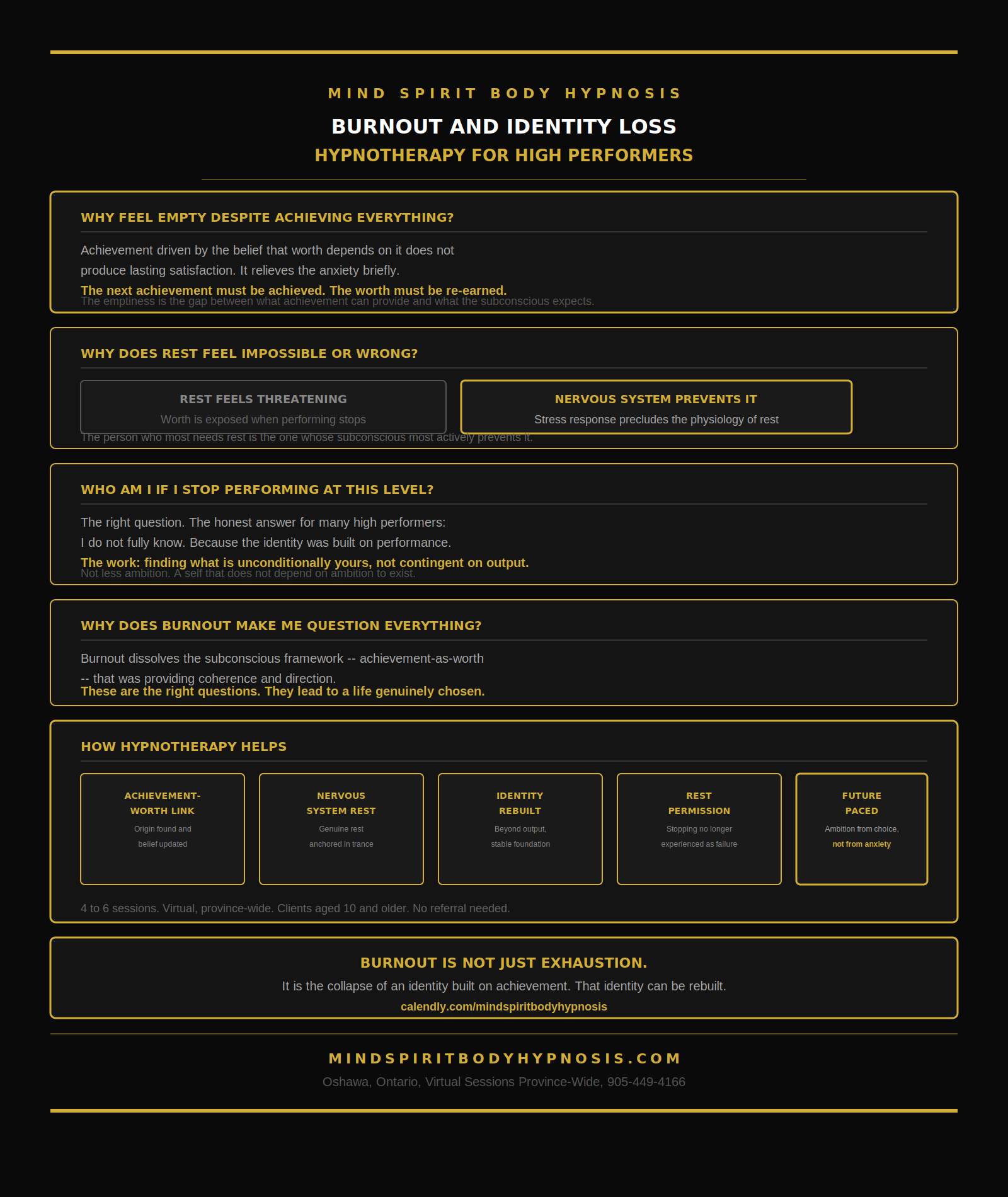
The irony is acute. The person who most needs to rest is the person whose subconscious is most actively generating the anxiety that prevents it. The nervous system is depleted. The system that would normally enable recovery is running a threat response that precludes the physiological conditions rest requires. The person lies down, and the mind activates. The body is still and the subconscious scans for the things that are not being done, the ways the pause might be observed or judged, the value that is not being produced while the rest is happening.
This is also why the standard advice for burnout take a holiday, reduce the workload, practise self-care produces limited and short-lived results for many high performers. The reduced workload is experienced as reduced worth. The holiday produces anticipatory anxiety about re-entry. The self-care is immediately evaluated for its productivity value. The nervous system does not rest in these conditions because the subconscious threat that prevents rest has not been addressed.
As research from Tiny Therapy Collective in Ontario confirms, many high performers describe feeling like they are functioning on autopilot or numb despite outward success, and when self-worth is tied to productivity, any perceived shortcoming can feel deeply personal.
For more on how the anxiety system that drives the inability to rest is addressed through hypnotherapy, the hypnotherapy for anxiety and stress pillar page covers the nervous system mechanisms.
⭐ Pro Tip: One of the most useful reframes for the guilt of resting is this: rest is not the absence of productivity. For someone running a depleted nervous system, genuine rest is the highest-leverage action available. It is the thing that makes everything else possible. The subconscious that has been trained to equate doing with worth cannot immediately accept this framing, but introducing it as a deliberate conscious thought in the moments when the guilt arises begins the process of updating the operating assumption. Not as an affirmation to be repeated, but as a genuine conceptual challenge to the belief that stopping is a failure.
Who Am I If I Stop Performing at This Level?
This is the question that burnout forces, and it is the most significant question the work addresses.
Most high performers have not genuinely asked this question because the performing has not stopped. The identity has been continuously maintained through the continuous output. There has been no gap in which the question could surface. And then burnout arrives, or the prospect of stepping back arrives, or a significant transition arrives, and the question is there, asking itself in the quiet that the high performer has not been in for years.
The honest answer, for most people at this point, is: I do not fully know.
This is not a failure. It is information about the degree to which the identity has been built around performance rather than personhood. The person who knows who they are independently of their performance has access to that knowledge in the absence of achieving. The person whose identity has been almost entirely built on achievement has, in the same absence, something that feels like a void.
What fills the void, in the early stages of genuine inquiry, is often uncomfortable. The feelings that performing was keeping at bay the quieter griefs, the older wounds, the needs that were subsumed into the drive begin to surface. This is not a regression. It is the beginning of an honest accounting. The things that performing was managing, the person now has to meet directly. And that is both more difficult and more meaningful than another achievement.
The work of rebuilding identity beyond performance is not the work of becoming less ambitious or less capable. It is the work of finding what is genuinely and unconditionally the person's own: the values, the ways of being, the sources of meaning that are not contingent on output. This is the work that hypnotherapy can do directly, because it operates at the subconscious level where the identity is structured and maintained.
Why Does Burnout Make Me Question Everything I Have Built?
Because burnout dissolves the subconscious framework that was making everything make sense.
When the framework of achievement-as-worth is intact and functioning, life has a particular coherence. The goals are clear. The direction is known. The benchmarks of success are established and being met. The person knows where they are going and why. This framework provides not just direction but meaning: the sense that what is being done matters and that the person doing it matters because of what they are doing.
When the framework begins to crack when the achieving produces flatness rather than satisfaction, when the performing becomes mechanical rather than engaged, when the body begins to refuse what the mind is still demanding the coherence starts to dissolve. The goals that seemed important begin to seem arbitrary. The path that seemed clear begins to seem like a path that someone else chose. The success that was supposed to feel like arrival begins to feel like it was the wrong destination.
This is not nihilism, and it is not ingratitude. It is the nervous system performing an honest reassessment at a point where the previous framework can no longer be sustained. The questions that arrive what is this for, is this actually what I want, who decided that this was success are the right questions. They are the questions that lead to a life that is genuinely chosen rather than compulsively driven.
The difficulty is that the reassessment is happening in a depleted state, without the resources that would normally make reflection productive. The person is questioning everything at the exact point when they have the least capacity for the inquiry. This is one of the most important reasons that support during burnout is not a luxury; it is the provision of a containing structure within which the genuine inquiry can happen without the depletion making every question feel catastrophic.
For more on how the self-sabotage patterns that accompany high-performance burnout are addressed at Mind Spirit Body Hypnosis, the hypnotherapy for self-sabotage pillar page covers the subconscious belief architecture in detail.
Can Hypnotherapy Help With Burnout and Identity Loss?
Yes, and specifically because burnout at this level is a subconscious belief problem as much as a schedule or workload problem. The schedule can be changed without the belief changing, and the burnout returns.
Here is how I work with burnout and identity loss at Mind Spirit Body Hypnosis:
The achievement-worth link. The subconscious belief that worth, belonging, and safety are contingent on performance is the root of performance-driven burnout. In trance, this belief is identified, examined at its origin, the specific early experiences that formed it and updated. A more accurate and more functional operating assumption is installed: that worth is not contingent on output, that belonging is not earned through performance, and that safety does not require the continuous proving that exhaustion has been the cost.
Nervous system regulation. The depleted nervous system of the burned-out high performer is addressed directly. In trance, genuine physiological rest not the absence of activity, but an active parasympathetic restoration is accessed and anchored. The experience of genuine rest without guilt, the felt sense of being at ease rather than monitoring, is installed as a reference state the nervous system can return to. For many clients, this experience in trance is the first genuine rest they have had in months or years.
Identity reconstruction. The question of who I am beyond what I achieve is addressed directly. In trance, the genuine unconditional aspects of identity the values, the ways of being, the things that matter independently of output are identified and installed as a stable foundation. Not an alternative to ambition, but a self that is not dependent on ambition to exist.
Rest permission. The guilt and anxiety that attend rest are addressed. The subconscious is updated with the understanding that rest is not a failure of productivity; it is a necessary condition for anything that follows it to be sustainable. The permission to stop, to be still, to exist without producing is installed as a subconscious default rather than as a conscious struggle.
Future pacing. The person is walked through their future: the work, the ambition, the contribution from the updated baseline. They experience what it feels like to be genuinely motivated rather than compelled, to achieve from choice rather than anxiety, to rest without guilt and return to work without the nervous system already running on depletion.
In my practice, burnout and identity work typically runs between four and six sessions, depending on the depth of the original belief formation and the extent of the identity reconstruction needed. All sessions are delivered virtually and are available to clients aged 10 and older across Ontario. More about my approach is available on the about page.

What My Clients Say
"Working with Fanis has changed my life. After years of therapy for anxiety and confidence issues, I wanted to try something different. This experience has transformed me from the inside out and continues to have an effect even after our sessions. I am now able to be myself, face my fears, surround myself with those who care about me and live a fulfilling and happy life. So grateful."
Kristen W. | Anxiety and Confidence | Five Stars
"I cannot say enough about how amazing Fanis is! He has truly changed my life. I was always an anxious person and always overthinking everything. After seeing Fanis I feel like a completely different person. The anxiety is gone and my mind is actually quiet for the first time in my life. I am forever grateful."
Amanda B. | Anxiety and Overthinking | Five Stars
FAQ
Why do I feel empty despite achieving everything I set out to do? Because achievement driven by the subconscious belief that worth depends on it does not produce lasting satisfaction. It temporarily relieves the anxiety the belief generates, but does not address the belief itself. The next achievement must be achieved. The emptiness is the gap between what achievement can provide and what the subconscious has been expecting it to provide.
Why does rest feel impossible or wrong? Because the subconscious has filed rest as threatening. For the person whose worth is tied to productivity, stopping exposes the worth to the same anxiety that any other threat to worth produces. The nervous system experiences the cessation of performing as a genuine threat, which activates the stress response that physiologically prevents the rest the body requires.
Who am I if I stop performing at this level? This is the right question. The honest answer for many high performers at this point is: I do not fully know because the identity has been almost entirely built on performance rather than personhood. The work is finding what is genuinely and unconditionally the person's own: the values, the ways of being, the sources of meaning that are not contingent on output.
Why does burnout make me question everything I have built? Because burnout dissolves the subconscious framework of achievement-as-worth that was providing coherence and direction. When that framework cracks, everything it was supporting becomes uncertain. The questions that arrive are the right questions. They lead to a life that is genuinely chosen rather than compulsively driven.
Can hypnotherapy help with burnout and identity loss? Yes. I work directly with the subconscious achievement-worth link, the nervous system's inability to rest, the identity reconstruction beyond performance, and the permission to exist without producing at the level where these patterns actually operate.
How is this different from general burnout recovery? Standard burnout advice addresses the schedule and the workload. This addresses the subconscious belief that made the schedule and workload compulsory in the first place. Without addressing the belief, changing the schedule produces temporary relief and the pattern returns.
How many sessions will I need? In my practice, burnout and identity work typically runs four to six sessions. An honest estimate for your specific situation is always given in the free strategy session.
Can I do sessions virtually from anywhere in Ontario? Yes. All sessions are delivered virtually, province-wide, with no referral required.
How do I get started? Book a free 30-minute virtual strategy session at calendly.com/mindspiritbodyhypnosis. No referral needed.
Ready to Take the Next Step?
If you have been achieving and feeling, underneath it, remarkably little, this is not ingratitude. It is a signal that the way you have been running is not sustainable, and that something more honest is available.
I offer a free 30-minute virtual strategy session for new clients across Ontario. No pressure. Just an honest conversation about what burnout has been like and what a life that is genuinely chosen might feel like.
Book your free session: calendly.com/mindspiritbodyhypnosis
Call or text: 905-449-4166
Email: info@mindspiritbodyhypnosis.com
Visit: mindspiritbodyhypnosis.com
Serving clients virtually across Ontario, including Durham Region, Toronto, Canada, and beyond.
Disclaimer: This article is for informational purposes only and does not constitute medical or psychological advice. Hypnotherapy and NLP are complementary approaches for self-improvement and are not a substitute for medical assessment or treatment. If you are experiencing a mental health crisis, please contact the 988 Suicide Crisis Helpline or go to your nearest emergency room. Results vary by individual.
Written by Fanis Makrigiannis | Certified Hypnotherapist and NLP Master Practitioner | Mind Spirit Body Hypnosis.