Can Hypnotherapy help with social anxiety?
Hypnotherapy for Social Anxiety in Ontario: Your Questions Answered
TL;DR: Social anxiety is not shyness, and it is not a personality flaw. It is the threat-detection system treating social situations as being observed, evaluated, or judged as genuinely dangerous. The fear is not about what other people are actually thinking. It is about what the subconscious has learned to expect. At Mind Spirit Body Hypnosis in Oshawa, Ontario, the five questions people ask most about social anxiety and hypnotherapy are answered here, directly.
Quick Answer
Social anxiety is persistent anxiety in social situations driven by the fear of being negatively evaluated, judged, or embarrassed a fear that activates the full physiological stress response in situations where no physical threat is present. It produces avoidance of social situations, intense self-monitoring during them, and prolonged rumination afterwards. It is not shyness, not introversion, and not a character flaw. It is a learned subconscious threat response that treats social evaluation as genuinely dangerous, and it responds directly to hypnotherapy because that is exactly the level at which the threat response operates. I offer virtual sessions province-wide for clients of all ages at Mind Spirit Body Hypnosis in Oshawa, Ontario.
Questions This Article Answers
Why do I feel anxious in social situations even when nothing bad is happening?
Why do I replay conversations and cringe for days afterwards?
Why does anxiety make me say the wrong thing or go blank?
Is social anxiety about being shy, or is it something different?
Can hypnotherapy help with social anxiety?
In This Article:
From the outside, social anxiety can look like many different things. Quietness at a gathering. Declining invitations. A stiff or awkward quality in conversation. Flushing or going blank at an inconvenient moment.
From the inside, it has a very specific quality. It is not that social situations are unpleasant. It is the particular vigilance they produce: the constant monitoring, the awareness of being observed, the anticipatory calculation of how things might go wrong and what it would mean if they did.
People with significant social anxiety are often perceptive, thoughtful, and deeply aware of others. The problem is not a deficit of social intelligence. It is that the threat system has recruited that social intelligence into the service of protection: scanning for evaluation, monitoring for signs of judgement, preparing for the possibility of exposure or embarrassment.
Why Do I Feel Anxious in Social Situations Even When Nothing Bad Is Happening?
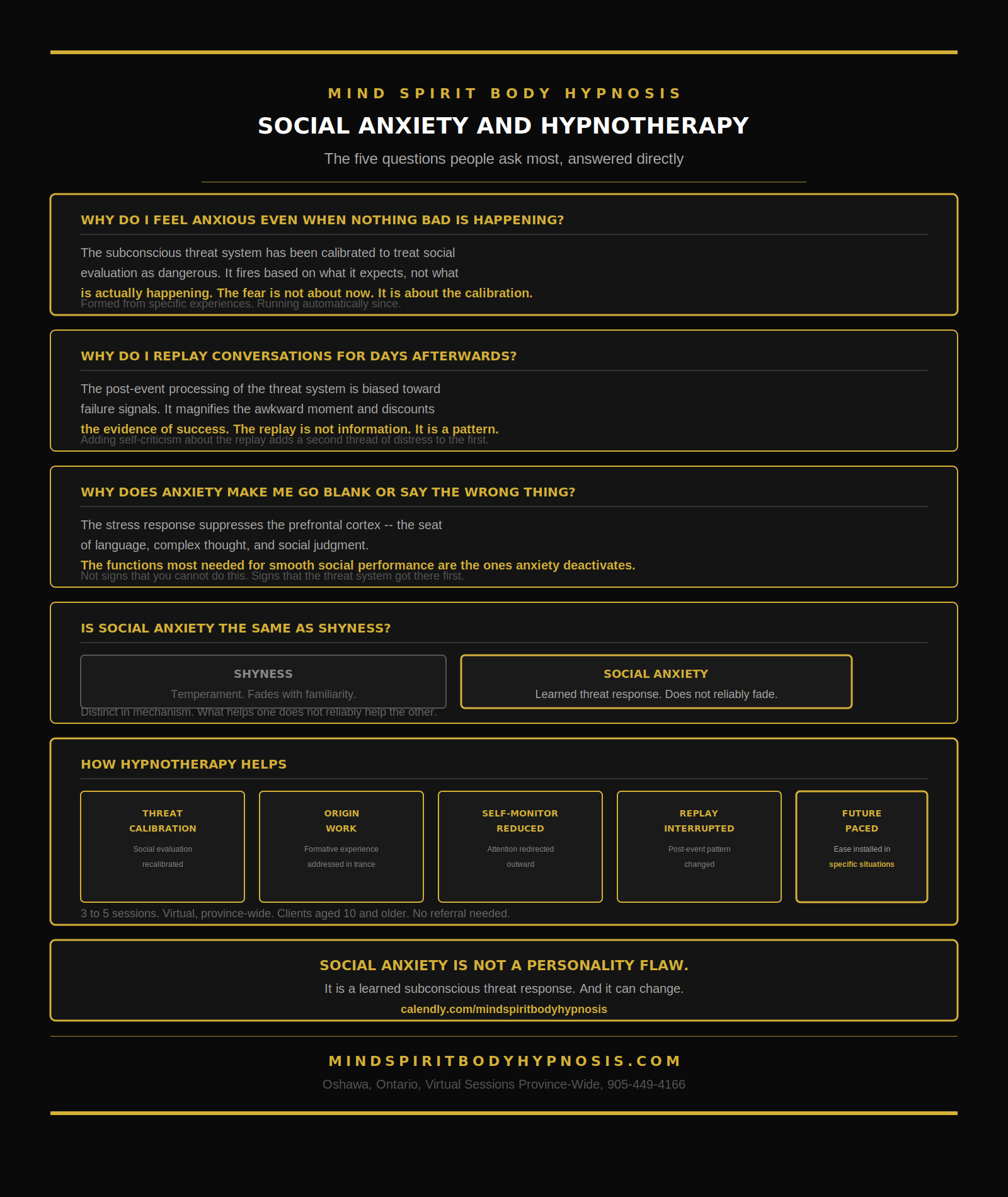
Because the subconscious has learned to treat social evaluation as a genuine threat, and the threat response fires based on what it expects, not based on what is actually happening.
The human brain has a deeply ingrained social threat system. In evolutionary terms, being excluded from the group was genuinely dangerous. Social rejection, humiliation, or loss of status carried real consequences for survival. The neural circuitry that monitors for social threat is therefore ancient, fast, and powerful, designed to fire early and err on the side of caution.
For most people, this system runs in the background without dominating experience. For people with significant social anxiety, the system has been calibrated to treat ordinary social situations being observed, meeting new people, speaking in a group as high-threat environments. The calibration happened through specific formative experiences: perhaps being embarrassed or humiliated publicly, perhaps growing up in an environment where social judgement was consistently experienced as harsh, perhaps early experiences of being visibly different, evaluated, or found wanting in a way that left a mark.
Once the calibration is established, it runs automatically. The social situation arises, and the threat response fires before conscious evaluation can assess whether the current situation actually warrants it. The heart rate increases. Self-consciousness intensifies. The monitoring system goes to full alert. All of this happens regardless of whether the people in the room are actually thinking anything negative.
Research consistently shows that people with significant social anxiety overestimate the probability that others are evaluating them negatively and overestimate the consequences of that evaluation. The experience is real. The threat assessment that generates it is inaccurate, but it is subconscious, and subconscious threat assessments are not changed by telling oneself that the fear is irrational.
For more on how the anxiety system and nervous system regulation that underlie this pattern are addressed, the hypnotherapy for anxiety and stress pillar page covers the foundational mechanisms.
⭐ Pro Tip: One of the most reliably revealing questions to ask when social anxiety is active is: what specifically am I afraid they will think? Most people, when they slow down to examine the fear, find a very specific imagined judgement underneath not a vague sense that something might go wrong, but a precise feared verdict. That specific imagined verdict is almost always connected to something much older than the current situation. It is the child's fear of a particular kind of evaluation, still being applied to adult social situations. Identifying the specific verdict is the beginning of the thread back to where the calibration happened.
Why Do I Replay Conversations and Cringe for Days Afterwards?
Because the social threat system does not switch off when the social situation ends. It enters a post-event processing mode, reviewing the interaction for evidence of the threatened outcome, for the missed signal, for the thing that was said or not said that might have confirmed the feared judgement.
This post-event rumination is sometimes called the post-mortem, and it is one of the most distressing features of social anxiety because it extends the suffering of a difficult social experience far beyond the event itself. A conversation that lasted ten minutes can be reviewed for days. A moment of awkwardness or perceived mistake can produce days of recurrent cringing and self-reproach.
The post-mortem has a specific and systematic bias. It selectively attends to the evidence of failure: the hesitation, the thing that came out wrong, the moment when the other person looked away, while systematically discounting the evidence of success: the moments of connection, the positive response, the normal flow of conversation. This selective attention is not random. It is the threat system doing what it always does: prioritizing threat signals over safety signals. The system that is designed to protect from social harm cannot afford to overlook a potential threat signal, so it magnifies threats and minimizes safety.
The result is a biased retrospective experience that consistently confirms the feared judgment, regardless of what actually happened. The person reviews the conversation and concludes that it went worse than it did. This conclusion is then filed as evidence that social situations are as dangerous as expected, which increases the threat calibration for the next one.
⭐ Pro Tip: The replay-and-cringe cycle is significantly intensified by the second layer of self-criticism: not just the cringe itself, but the frustration and shame about the cringe. The internal monologue that says I cannot believe I am still thinking about this; what is wrong with me adds a second thread of distress to the first. A more useful response to the replay when it arrives is simply to notice it without adding to it: the replay is here. This is what social anxiety does. I do not need to analyze it again or criticize myself for it. The replay is not information. It is a pattern. Noticing it as a pattern rather than engaging with its content reduces its intensity and duration.
Why Does Anxiety Make Me Say the Wrong Thing or Go Blank?
Because the physiological state of anxiety directly impairs the cognitive functions needed for smooth social performance -- and this impairment is the mechanism that produces the very outcome the anxiety is trying to prevent.
When the threat system activates, resources are redirected from the prefrontal cortex, the seat of language, complex thought, social judgment, and the ability to find the right word at the right time, toward the parts of the brain managing the survival response. Heart rate increases. Attention narrows. The body prepares for fight or flight.
In a physical threat situation, this redistribution is adaptive. You do not need eloquence to escape a predator. But in a social situation, the cognitive resources that have been suppressed are exactly what is needed. The ability to track the conversation, find the right word, maintain natural eye contact, and monitor tone and pacing all of these require the prefrontal cortex that the anxiety has just partially deactivated.
The result is the phenomenon so many people with social anxiety describe: going blank at precisely the moment that matters most. The mind empties. The right word is unavailable. The comment that would have been natural in a calmer state simply does not come. Or the reverse: the anxiety produces a kind of cognitive flood too many thoughts, too much self-monitoring, too much awareness of being observed and something comes out that was not what was intended.
The person then experiences the outcome the awkward moment, the thing that came out wrong as confirmation that social situations are as threatening as feared. The anxiety was right. This confirmation deepens the calibration for the next social situation, and the cycle continues.
Is Social Anxiety the Same as Shyness?
No, and the distinction is practically important for understanding the experience and for knowing what kind of intervention might help.
Shyness is a temperament dimension, a naturally occurring variation in how readily a person engages with novel social situations. Shy people may take longer to warm up, may prefer smaller groups, may find extended social engagement tiring. But shyness does not typically involve a full physiological threat response, does not produce significant avoidance of situations that are genuinely wanted, and does not generate the level of anticipatory anxiety and post-event rumination that characterizes social anxiety.
Social anxiety is a learned threat response, not a temperament. A shy person might feel some initial hesitation in a new social situation and then relax as familiarity increases. A person with significant social anxiety continues to experience the threat response even in familiar situations, even when nothing threatening is happening, and the response does not reliably reduce with exposure unless the underlying threat calibration changes.
There is also an important distinction in the relationship to social situations. Shy people may prefer less social engagement but can access social connection when they want it without the anxiety dominating the experience. People with significant social anxiety often genuinely want social connection and are prevented from accessing it fully by the threat system that activates in the situations they most want to be present for.
Both shyness and social anxiety can coexist in the same person, but they are distinct in their mechanism and in the approach that helps most. Shyness responds to gradual exposure and comfort-building. Social anxiety requires direct work at the subconscious level where the threat calibration is maintained.
For more on how the fear and phobia dimension of intense social fear is addressed at Mind Spirit Body Hypnosis, the hypnotherapy for fears and phobias pillar page covers the approach in detail.
Can Hypnotherapy Help With Social Anxiety?
Yes, and specifically because social anxiety is a subconscious threat response, and hypnotherapy operates directly at the subconscious level where that response is calibrated and maintained.
Here is how I work with social anxiety at Mind Spirit Body Hypnosis:
Threat calibration updating. The subconscious assessment of social situations as threatening is directly addressed. In trance, the specific social threat, the feared judgement, and the anticipated exposure are examined, and the calibration is updated. The nervous system is helped to distinguish between situations that genuinely warrant vigilance and the ordinary social contact that does not require the full threat response.
Origin work. The specific experiences that calibrated the social threat system the humiliation, the harsh environment, the early experience of being evaluated and found wanting are identified and addressed in trance with adult resources. The updated understanding is installed: that the current environment is not the same as the environment that produced the calibration.
Self-monitoring reduction. The intense internal self-monitoring that characterizes social anxiety the constant observation of oneself from the imagined perspective of others is directly addressed. In trance, attention is redirected outward toward genuine engagement with the situation rather than inward toward self-evaluation. This is installed as an automatic response that becomes available in social situations.
Post-event rumination interruption. The post-mortem pattern the replay, the cringe, the selective attention to evidence of failure is identified and interrupted. A different automatic response to the end of social situations is installed: a simple acknowledgment that the situation is over, not a review that extends and amplifies it.
Social confidence future pacing. Specific social situations that currently produce the strongest threat response the work presentation, the new social gathering, the conversation with someone senior are visited in trance with the updated calibration already operating. The experience of being present, engaged, and genuinely at ease in these situations is filed as an expected experience, making it more available when the actual situations occur.
In my practice, social anxiety work typically runs between three and five sessions, depending on the depth of the original calibration and the range of social situations that are currently most affected. All sessions are delivered virtually, available to clients aged 10 and older across Ontario. More about my approach is available on the about page.

What My Clients Say
"I cannot say enough about how amazing Fanis is! He has truly changed my life. I was always an anxious person and always overthinking everything. After seeing Fanis I feel like a completely different person. The anxiety is gone and my mind is actually quiet for the first time in my life. I am forever grateful."
Amanda B. | Anxiety and Overthinking | Five Stars
"Working with Fanis has changed my life. After years of therapy for anxiety and confidence issues, I wanted to try something different. This experience has transformed me from the inside out and continues to have an effect even after our sessions. I am now able to be myself, face my fears, surround myself with those who care about me and live a fulfilling and happy life. So grateful."
Kristen W. | Anxiety and Confidence | Five Stars
FAQ
Why do I feel anxious in social situations even when nothing bad is happening? Because the subconscious threat system has been calibrated to treat social evaluation as genuinely dangerous, and it fires based on what it expects rather than what is actually happening. The physiological anxiety response activates before conscious assessment can evaluate whether the current situation actually warrants it.
Why do I replay conversations and cringe for days afterwards? Because the post-event processing of the social threat system is biased toward threat signals. It selectively attends to the evidence of failure while discounting evidence of success, producing a biased retrospective that consistently confirms the feared judgement regardless of what actually happened.
Why does anxiety make me go blank or say the wrong thing? Because the stress response suppresses the prefrontal cortex, the seat of language, complex thought, and social judgment, redirecting resources toward survival functions. The cognitive functions most needed for smooth social performance are exactly the ones the anxiety partially deactivates.
Is social anxiety the same as shyness? No. Shyness is a temperament dimension, a natural variation in readiness to engage with novel social situations. Social anxiety is a learned subconscious threat response that activates the full physiological stress response in social situations. Both can coexist, but they are distinct in mechanism and in what helps most.
Can hypnotherapy help with social anxiety? Yes. I work directly with the subconscious threat calibration, the formative experiences that established it, the self-monitoring pattern, the post-event rumination, and the specific social situations that are most affected at the level where the pattern actually operates.
How many sessions will I need? In my practice, social anxiety work typically runs three to five sessions, depending on the depth of the original calibration and the range of social situations most affected. An honest estimate is always given in the free strategy session.
Can I do sessions virtually from anywhere in Ontario? Yes. All sessions are delivered virtually, province-wide, with no referral required.
How do I get started? Book a free 30-minute virtual strategy session at calendly.com/mindspiritbodyhypnosis. No referral needed.
Ready to Take the Next Step?
If social situations have been taking up more space than they should in the anticipation before, the self-monitoring during, and the replay afterwards, this is a nervous system pattern. And nervous system patterns can change.
I offer a free 30-minute virtual strategy session for new clients across Ontario. No pressure. Just an honest conversation about what social anxiety has been like and what genuinely relaxed social engagement might feel like.
Book your free session: calendly.com/mindspiritbodyhypnosis
Call or text: 905-449-4166
Email: info@mindspiritbodyhypnosis.com
Visit: mindspiritbodyhypnosis.com
Serving clients virtually across Ontario, including Durham Region, Toronto, Canada, and beyond.
Disclaimer: This article is for informational purposes only and does not constitute medical or psychological advice. Hypnotherapy and NLP are complementary approaches for self-improvement and stress management and are not a substitute for medical assessment or treatment. Results vary by individual.
Written by Fanis Makrigiannis | Certified Hypnotherapist and NLP Master Practitioner | Mind Spirit Body Hypnosis.