what is NLP and how does it work?
What Is NLP and How Does It Work? Your Ontario Questions Answered
TL;DR: NLP, Neuro-Linguistic Programming, is one of the most effective and least understood tools in the Mind Spirit Body Hypnosis practice. People ask about it constantly before their first session, and the questions reveal why it is so often undersold: the name sounds technical, the explanations online are either too vague or too jargon-heavy, and almost nobody explains how it actually works alongside hypnotherapy in a real clinical session. This article answers the five questions people ask most, directly and in plain language.
Quick Answer
NLP is a structured set of techniques for changing the way the brain processes experience, language, and meaning, particularly in the context of automatic emotional and behavioural responses that are not responding to conscious effort alone. It is not positive thinking, it is not affirmations, and it is not a self-help framework. Used alongside hypnotherapy by a trained practitioner, NLP provides precise, targeted tools for dismantling specific anxiety patterns, confidence limitations, and self-defeating behaviours at the subconscious level. At Mind Spirit Body Hypnosis in Oshawa, Ontario, Fanis Makrigiannis, a Certified NLP Master Practitioner (ABNLP) and Certified Hypnotherapist, offers virtual sessions province-wide for clients of all ages ready to work at the level where these patterns actually live.
Questions This Article Answers
What is NLP and how is it different from hypnotherapy?
Can NLP build real confidence or is it just positive thinking?
How quickly does NLP work?
What does an NLP session actually involve?
Can NLP help with anxiety and confidence at the same time?
In This Article:
The question arrives in almost every free strategy session, often slightly apologetically: I am not entirely sure what NLP is. I have heard the term, but I am not clear on what it actually does or why it is different from hypnotherapy. Can you explain it?
It is a fair question. NLP is a genuinely useful set of tools that has suffered from two things: a technical-sounding name that puts people off, and a decade of association with self-help culture that makes it sound like motivational speaking rather than clinical practice.
What NLP actually is, in a clinical context, is something quite different from both impressions. And understanding it changes how people think about what is possible for anxiety, confidence, and the subconscious patterns that have not shifted despite years of conscious effort.
What Is NLP and How Is It Different From Hypnotherapy?
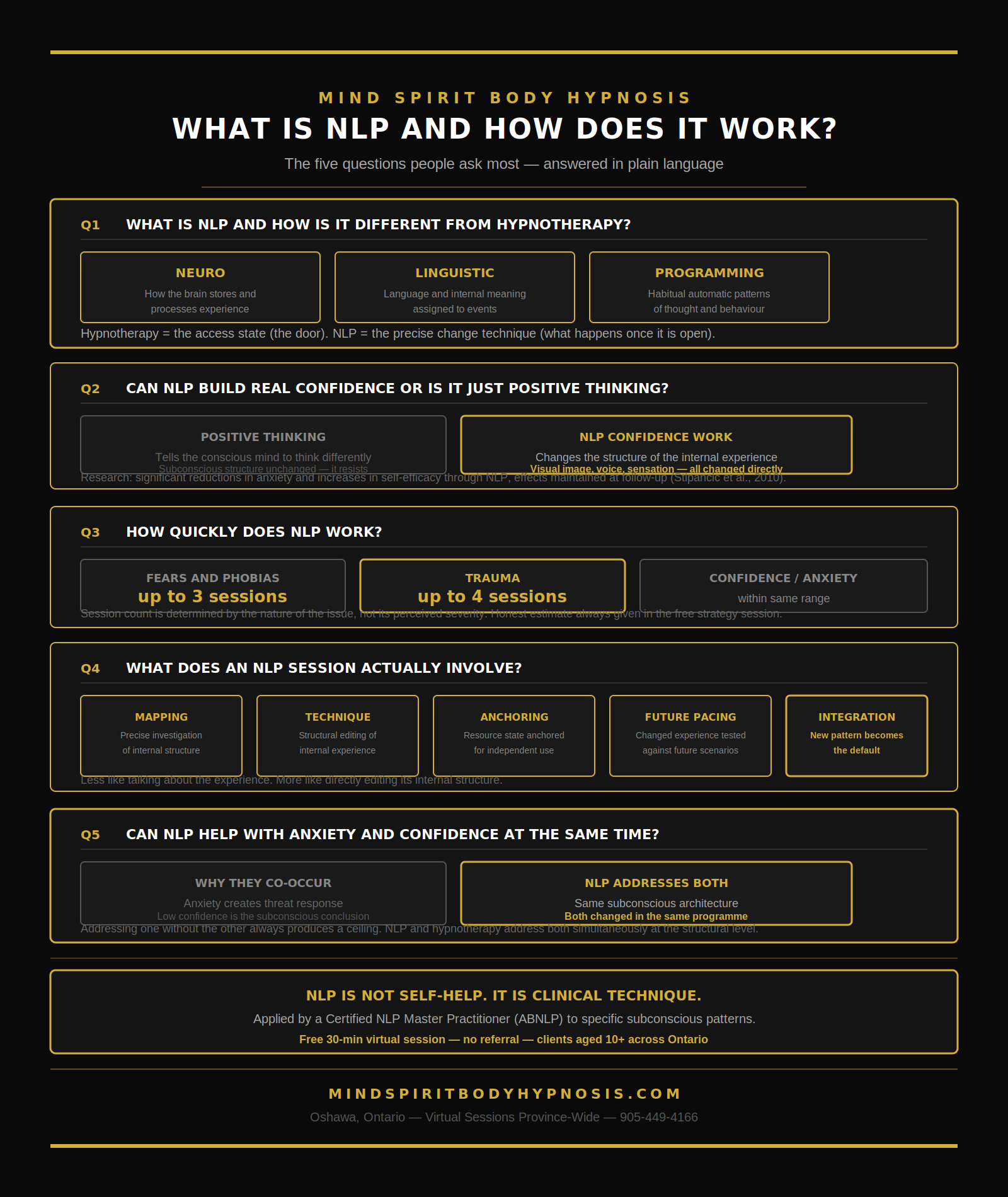
NLP stands for Neuro-Linguistic Programming. The name was coined in the 1970s by Richard Bandler and John Grinder, who modelled the techniques of several exceptionally effective therapists, including the hypnotherapist Milton Erickson, to identify what specifically produced change. The result was a set of structured techniques for working with the way the brain processes internal experience.
Breaking down the name helps clarify what it actually means in practice:
Neuro refers to the neurological processes through which the brain receives, stores, and recalls experience. Every emotion, every memory, every automatic response has a specific neurological structure -- a way it is represented internally in terms of visual images, sounds, physical sensations, and the qualities of those representations.
Linguistic refers to language, both the external language used to describe experience and the internal language of self-talk, belief statements, and the way meaning is assigned to events.
Programming refers to the patterns and habitual sequences of thought, feeling, and behaviour that operate automatically in specific contexts.
NLP works by identifying the specific internal structure of a problematic pattern and changing that structure directly. Rather than talking about the pattern or trying to override it with conscious effort, NLP changes the internal representation that is generating it.
How is this different from hypnotherapy?
Hypnotherapy uses the trance state, the focused relaxation in which the subconscious becomes more receptive to change, as the primary mechanism for accessing and updating patterns. The trance state is the door.
NLP provides a specific set of tools for what is done once that door is open. The two approaches are complementary and are most effective when used together: hypnotherapy provides the access state, NLP provides the precise change techniques.
In practice at Mind Spirit Body Hypnosis, NLP and hypnotherapy are not separate offerings. They are used in combination in every session, with the specific techniques selected based on what will most efficiently address the particular pattern the client is working on.
For more on the hypnotherapy component of the combined approach, the hypnotherapy for anxiety and stress pillar page covers the mechanisms in detail.
⭐ Pro Tip: The easiest way to understand the difference between NLP and hypnotherapy is to think of it this way: hypnotherapy is the state, NLP is the technique. Hypnotherapy creates the conditions for change. NLP specifies exactly what is changed and how. Used together by a trained practitioner, they address both the depth of access and the precision of the change, which is why the combination consistently produces better outcomes than either approach alone.
Can NLP Build Real Confidence or Is It Just Positive Thinking?
This is the most skeptical question about NLP, and it deserves a genuinely substantive answer.
NLP-based confidence work is not positive thinking. Positive thinking asks the conscious mind to think differently about a situation whose subconscious representation has not changed. As explored in the self-sabotage article, positive thinking runs directly into the existing subconscious belief and usually loses.
NLP confidence work operates at a completely different level. It identifies the specific internal structure of the low confidence experience: the visual representation of the feared situation, the internal voice that delivers the critical commentary, the physical sensation that arises when confidence is needed and does not arrive and changes those structural elements directly.
Here is a specific example. A client with low confidence in professional contexts typically has a characteristic internal representation of their feared scenario: they see themselves from above or outside, they hear a critical voice delivering a running commentary of inadequacy, and they feel a specific physical contraction in the chest or stomach. These are not vague feelings. They are specific internal structures that can be identified, examined, and changed.
NLP techniques like submodality work change the qualities of that internal representation directly. The visual image is moved, resized, and recoloured. The critical voice is changed in tone, location, and volume. The physical sensation is transformed in its qualities. The result is that the internal experience of the feared situation changes, and the behaviour that follows from it changes with it.
This is not positive thinking. It is structural change at the level of internal representation. The evidence base for NLP confidence techniques, while methodologically mixed in the academic literature, is substantial in clinical practice. Research published in the Journal of Psychotherapy Integration found that NLP techniques produced significant reductions in anxiety and significant increases in self-efficacy in controlled conditions, with effects maintained at follow-up (Stipancic et al., 2010).
The practical evidence from the Mind Spirit Body Hypnosis practice is consistent with this: clients who have tried affirmations, journalling, and CBT-based reframing without producing lasting confidence change frequently report that the structural NLP work produces a shift in their internal experience of confidence within the first one to two sessions that feels qualitatively different from anything they have previously achieved.
How Quickly Does NLP Work?
The honest answer is: faster than most people expect and slower than some NLP marketing claims.
In my practice, the session count is determined by the nature of the presenting issue rather than its perceived severity. Fears and phobias, including social anxiety, dental anxiety, fear of flying, and other specific fear presentations, typically resolve in up to three sessions. Trauma presentations, including childhood trauma, grief, PTSD, and performance trauma, typically require up to four sessions.
Confidence, self-sabotage, and generalized anxiety presentations sit within the same range depending on how many specific patterns need to be addressed and how many distinct life areas they affect. The NLP techniques themselves can produce measurable change within a single session. The programme builds across multiple sessions to ensure that change is consolidated, generalized across contexts, and held independently.
The factors that influence the number of sessions include the specificity of the pattern, the presence of multiple overlapping triggers, and the client's level of engagement between sessions. In the free strategy session, you will always receive an honest and specific estimate for your situation before committing to anything.
What can be said with confidence is that most clients at Mind Spirit Body Hypnosis notice a meaningful internal shift -- a different quality to the experience they came to address within the first two sessions. The full programme consolidates, deepens, and generalizes that shift.
⭐ Pro Tip: The speed of NLP change is most reliably maximized by the quality of the mapping done before the techniques are applied. The more precisely the specific internal structure of the pattern is identified -- including the exact qualities of the internal representation, the specific triggers, and the sequence of the pattern -- the more targeted and efficient the subsequent NLP work is. This is why the first session at Mind Spirit Body Hypnosis is always a thorough mapping conversation before any technique is applied.
What Does an NLP Session Actually Involve?
This is the transparency question, and it is one of the most useful things to answer clearly because the reality of NLP work is often quite different from what people imagine.
An NLP session at Mind Spirit Body Hypnosis is a combination of structured conversation, guided internal experience, and technique application. Here is what the different components actually look like in practice.
Mapping. The session typically begins with a precise exploration of the pattern being addressed. Not a general discussion of the problem but a specific investigation of its internal structure: what happens first, what the person sees and hears internally, where in the body the experience lands, what the sequence of the automatic response is. This mapping is both diagnostic and therapeutic; the act of observing the pattern from a position of curiosity rather than distress already begins to change the person's relationship to it.
Technique application. Once the structure is clear, the appropriate NLP technique is applied. This might involve guided internal work being asked to notice and then change specific qualities of an internal image or sound. It might involve a physical process like the Swish Pattern, in which the brain is trained to automatically replace one internal image with another. It might involve a structured dialogue between different parts of the internal experience. Most clients find this process genuinely surprising; it is less like talking therapy and more like directly editing the software of an experience.
Anchoring. A resource state calm confidence, groundedness, focused energy is built and anchored to a physical cue such as a specific touch or breath. This anchor can be activated independently in daily life whenever the problematic pattern would previously have fired. The anchor provides an alternative automatic response rather than requiring conscious effort to override the original one.
Future pacing. The changed internal experience is tested against anticipated future situations. The client walks through the scenario that previously triggered the problematic pattern and notices what is different. This both verifies the change and installs it as the expected future experience.
Integration. The session closes with a brief integration, consolidating the change and identifying what the client will notice in the coming days as the new pattern becomes their default.
More about how the combined NLP and hypnotherapy approach is structured at Mind Spirit Body Hypnosis is available on the about page.
Can NLP Help With Anxiety and Confidence at the Same Time?
Yes, and this is one of the most important practical advantages of the combined NLP and hypnotherapy approach.
Anxiety and low confidence are almost always co-occurring patterns, and they are not separate issues that happen to coexist. They are typically two expressions of the same underlying subconscious architecture. The anxiety produces the threat response that makes new situations feel dangerous. The low confidence is the subconscious conclusion about the self that the anxiety maintains. They feed each other.
Addressing one without the other almost always produces a ceiling on improvement. A person whose anxiety reduces but whose subconscious confidence beliefs remain unchanged will find that the low confidence triggers new anxiety. A person whose conscious confidence improves through effort but whose underlying anxiety patterns remain will find that performance situations re-activate the anxiety and collapse the confidence.
NLP addresses both simultaneously because it works at the structural level of internal representation, where both patterns are generated. The anxiety pattern has a specific internal structure. The confidence limitation has a specific internal structure. Both can be identified and changed within the same programme of work, often within the same session.
The specific NLP and hypnotherapy techniques used at Mind Spirit Body Hypnosis for this combined presentation include: the anxiety trigger desensitization work, submodality restructuring of the self-image, Circle of Excellence confidence anchoring, belief updating for the core confidence-limiting conclusions, and future pacing of the calm, confident, and fully resourced self in the specific contexts where the anxiety and confidence limitation have been most active.
For more on how self-sabotage, which frequently underlies both anxiety and confidence limitations, is addressed alongside this work, the hypnotherapy for self-sabotage pillar page covers the interconnected pattern architecture.

How NLP and Hypnotherapy Work Together
At Mind Spirit Body Hypnosis, NLP and hypnotherapy are not offered separately. They are integrated into every session because their combination is significantly more effective than either approach alone.
The integration works as follows. The hypnotic trance state is induced first, creating the physiological and psychological conditions in which the subconscious is most receptive to change. The NLP techniques are then applied within or alongside the trance state, where they produce change at a depth and speed that is not achievable in ordinary waking consciousness. The suggestions of hypnotherapy reinforce and consolidate the structural changes produced by the NLP techniques. The NLP techniques provide the precision and targeting that generic hypnotic suggestion lacks.
The result is an approach that is both deep and precise, accessing the subconscious through the trance state and then changing specific identified structures within it through NLP.
What to Expect at Mind Spirit Body Hypnosis
The first session is always a conversation before it is anything else. What brings you now? What specifically is not working in terms of the concrete life situations that are most affected, not just the general feeling. What has already been tried? What would change, practically and specifically, if the pattern shifted?
This conversation is the mapping. The techniques come after the map is clear. All sessions are delivered virtually, available to clients aged 10 and older across Ontario.
What My Clients Say
"Working with Fanis has changed my life. After years of therapy for anxiety and confidence issues, I wanted to try something different. This experience has transformed me from the inside out and continues to have an effect even after our sessions. I am now able to be myself, face my fears, surround myself with those who care about me and live a fulfilling and happy life. So grateful."
Kristen W. | Anxiety and Confidence | Five Stars
"I came to Fanis with pretty severe anxiety surrounding a fear of heights and flying. I felt my anxiety was holding me back from fully living my life and experiencing the world. After 3 sessions with Fanis my anxiety is next to nothing and I have been able to experience things I never thought possible. I would highly recommend Fanis to anyone suffering from anxiety or phobias!"
Chris H. | Anxiety and Phobias | Five Stars
FAQ
What is NLP? NLP, Neuro-Linguistic Programming, is a structured set of techniques for changing the way the brain processes internal experience, particularly the specific representations, sequences, and qualities that generate automatic emotional and behavioural responses. It was developed by modelling the most effective therapists across multiple disciplines, including hypnotherapy.
How is NLP different from hypnotherapy? Hypnotherapy uses the trance state as the mechanism for accessing the subconscious. NLP provides the specific techniques applied within or alongside that state to produce targeted structural change. Hypnotherapy is the access. NLP is the precision. Used together, they produce better outcomes than either alone.
Can NLP build real confidence? Yes. NLP confidence work changes the specific internal structure of low confidence experiences the visual representations, internal voices, and physical sensations that generate the experience rather than trying to override them with conscious positive thinking. The change is structural, not aspirational.
How quickly does NLP work? In my practice, fears and phobias resolve in up to three sessions. Trauma presentations typically require up to four sessions. Confidence, self-sabotage, and generalized anxiety sit within a similar range depending on the number of patterns involved. Most clients notice a meaningful internal shift after the first two sessions.
What does an NLP session involve? Structured mapping of the specific internal pattern, technique application to change its structure, anchoring of a resource state, future pacing of the changed experience, and integration. The process is more like directly editing an internal experience than talking about it.
Can NLP help with both anxiety and confidence? Yes. Anxiety and low confidence share the same underlying subconscious architecture and are most effectively addressed together. NLP provides the structural tools to address both within the same programme of work, often within the same session.
Is NLP evidence-based? The evidence base for NLP is methodologically mixed in terms of randomized controlled trial quality, but significant in clinical outcome studies. Research confirms significant reductions in anxiety and improvements in self-efficacy through NLP techniques. The clinical experience at Mind Spirit Body Hypnosis is consistent with these findings.
Do I need to know anything about NLP before my first session? No. The session is designed to be accessible regardless of prior knowledge. The mapping conversation will make clear which techniques are most appropriate for your specific pattern, and the techniques will be explained before they are applied.
Can I do sessions virtually from anywhere in Ontario? Yes. All sessions are delivered virtually, province-wide, with no referral required.
How do I get started? Book a free 30-minute virtual strategy session at calendly.com/mindspiritbodyhypnosis. No referral needed.
Ready to Take the Next Step?
If you have been working on anxiety or confidence with approaches that address the conscious layer, and the underlying pattern has not shifted, NLP and hypnotherapy work at the layer beneath it.
I offer a free 30-minute virtual strategy session for new clients across Ontario. No pressure, no jargon. Just an honest conversation about what has not been working and how the combined NLP and hypnotherapy approach may produce the change that has not yet arrived.
Book your free session: calendly.com/mindspiritbodyhypnosis
Call or text: 905-449-4166
Email: info@mindspiritbodyhypnosis.com
Visit: mindspiritbodyhypnosis.com
Serving clients virtually across Ontario, including Durham Region, Toronto, Ontario, and beyond.
Disclaimer: This article is for informational purposes only and does not constitute medical or psychological advice. NLP and hypnotherapy are complementary approaches and are not a substitute for diagnosis or treatment by a qualified healthcare provider. Results vary by individual.
Written by Fanis Makrigiannis | Certified Hypnotherapist & NLP Master Practitioner (ABNLP) | Mind Spirit Body Hypnosis.