Hypnotherapy for Habits and Addictions
Hypnotherapy for Habits and Addiction in Ontario: Your Questions Answered
TL;DR: The questions people ask before their first session for habit change and addiction are almost always the same. Can it actually help me quit smoking for good? What is the difference between a habit and an addiction? Why do I relapse even when I genuinely want to stop? Can it help me drink less without quitting entirely? How many sessions will I need? This article answers all five directly and honestly, without the promotional framing that makes it hard to trust what you are reading.
Quick Answer
Hypnotherapy for habits and addiction addresses the subconscious trigger patterns, emotional associations, and identity beliefs that keep people locked into behaviours they consciously want to stop, by retraining the automatic responses that willpower alone consistently fails to override. In clinical practice, hypnotherapy significantly increases long-term cessation outcomes compared to willpower-based approaches, nicotine replacement therapy, and cold turkey, because it addresses the subconscious root rather than competing with it from the outside. At Mind Spirit Body Hypnosis in Oshawa, Ontario, Fanis Makrigiannis, a Certified Hypnotherapist and NLP Master Practitioner, offers virtual sessions province-wide for clients of all ages who are ready to address the subconscious root of the habit rather than fighting it from the outside.
Questions This Article Answers
Can hypnotherapy help me quit smoking for good?
What is the difference between a habit and an addiction?
Why do I relapse even when I really want to stop?
Can hypnotherapy help me drink less without stopping completely?
How many sessions will I need to break a habit?
In This Article:
Every person who arrives for habit change work has already tried to stop. Most have tried more than once. Many have tried everything that conventional advice recommends: willpower, patches, apps, cold turkey, cutting down gradually, accountability partners, reward systems. And the habit came back.
This is not a character failing. It is the predictable result of addressing a subconscious pattern with conscious tools. The habit, whether it is smoking, drinking, vaping, overuse of substances, or any other compulsive behaviour, is not stored where willpower operates. It is stored in the subconscious, where automatic responses, emotional associations, and identity beliefs run below the level of conscious intention.
Hypnotherapy works at that level. And the outcomes for habit change are among the most consistent in the practice.
Can Hypnotherapy Help Me Quit Smoking for Good?
Yes, and the results in my practice speak more clearly than most people expect.
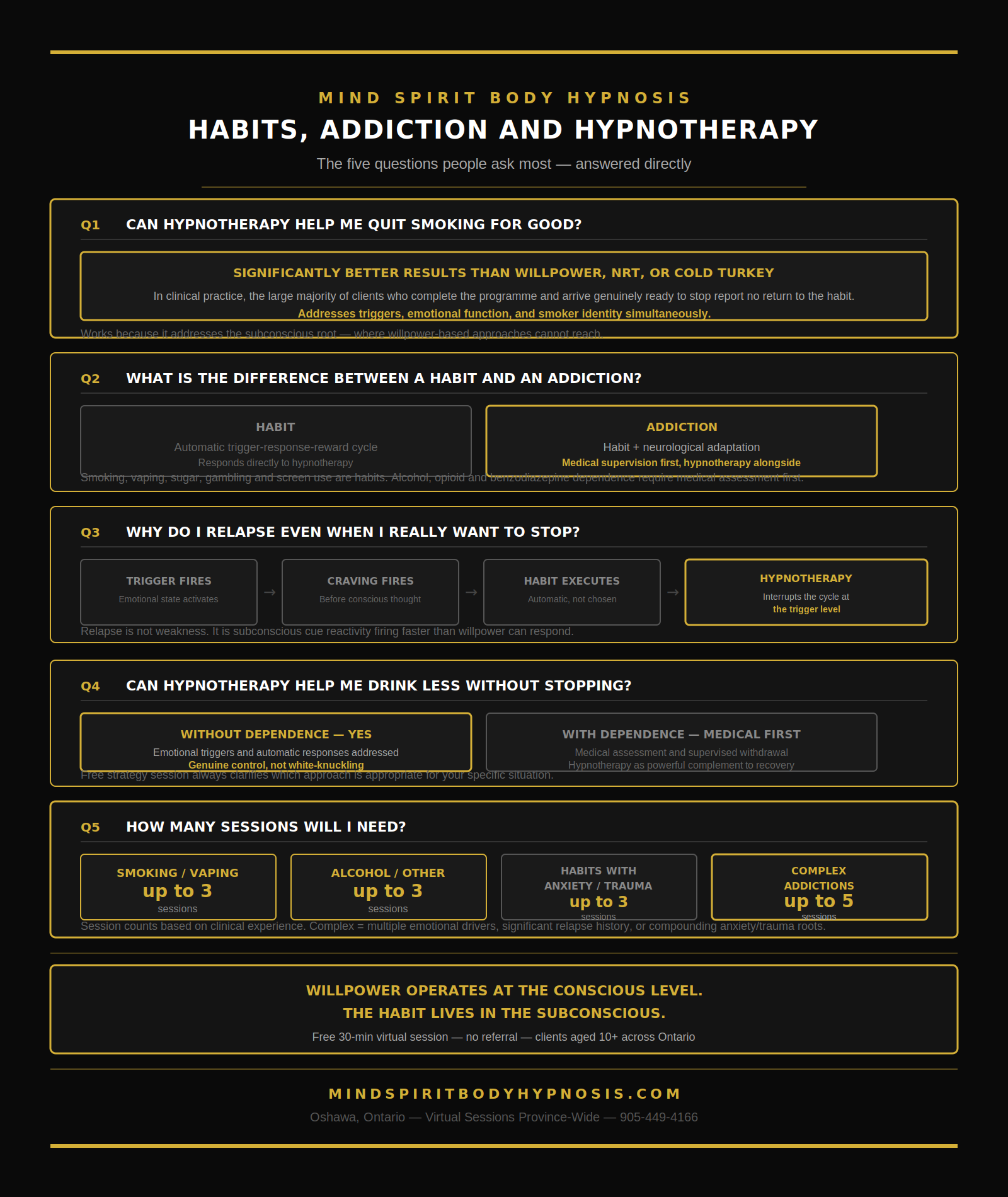
In my clinical experience at Mind Spirit Body Hypnosis, the large majority of clients who complete the full programme and come in genuinely ready to stop report no return to the habit. Research consistently confirms that hypnotherapy significantly increases the likelihood of long-term cessation compared to willpower-based approaches, NRT, and cold turkey, addressing what none of those approaches reach.
The reason hypnotherapy works for smoking cessation is not that it makes cigarettes taste unpleasant or triggers an aversion response, though those techniques exist. It is that it addresses the three actual drivers of smoking at the subconscious level: the trigger-response association, the emotional function the habit is serving, and the smoker identity.
The trigger-response association. Smoking is most powerfully maintained by conditioned triggers: the automatic response to morning coffee, finishing a meal, a stressful phone call, a specific social situation. These triggers fire faster than conscious intention can intervene. In trance, each trigger is identified, and the automatic response is systematically re-associated. The trigger fires. The response is no longer a reach for a cigarette.
The emotional function. For most smokers, cigarettes are serving a genuine emotional function: stress relief, punctuation of the day, a moment of alone time, a social connector, a way of managing anxiety. Hypnotherapy identifies what function the smoking is actually serving and installs alternative subconscious resources to meet that need. When the emotional function is met another way, the pull of the cigarette reduces dramatically.
The smoker identity. Many long-term smokers have incorporated smoking into their sense of who they are. Quitting requires not just a behavioural change but an identity shift from someone who smokes to someone who does not. In trance, the non-smoker identity is installed directly at the subconscious level, so the person begins to experience themselves as a non-smoker rather than as someone who is trying not to smoke. This distinction is the difference between white-knuckling and genuine change.
⭐ Pro Tip: The single most reliable predictor of successful smoking cessation through hypnotherapy is genuine readiness to stop. Hypnotherapy is not a technique that works on people who are ambivalent about quitting. If a part of you still wants to smoke, the work addresses that ambivalence first. But if you are genuinely ready to stop and the only thing that has prevented success is the automaticity of the habit and the absence of tools that work at the subconscious level, hypnotherapy is likely to be the most effective approach you have tried.
What Is the Difference Between a Habit and an Addiction?
This is one of the most practically useful questions to answer clearly, because the distinction affects both the approach to change and the realistic expectations for the process.
A habit is a behaviour that has become automatic through repetition. It operates below conscious awareness in familiar contexts and requires minimal cognitive effort to execute. Habits are maintained primarily by the trigger-response-reward cycle: a cue triggers the behaviour, the behaviour produces a familiar outcome, and the cycle reinforces itself. Habits can be changed by systematically interrupting the cycle and installing a different response to the trigger.
An addiction involves all of the above and adds a significant layer: neurological adaptation. With repeated use of certain substances, the brain's reward system recalibrates its baseline around the substance. The substance is no longer providing pleasure; it is preventing the discomfort of its absence. The person is no longer using to feel good but to feel normal. Physical withdrawal symptoms, when they occur, are the nervous system's response to the removal of something it has physiologically incorporated.
In practical terms for hypnotherapy:
Habits without significant neurological adaptation smoking, vaping, sugar, caffeine, screen use, gambling, many compulsive behaviours respond directly to hypnotherapy because the primary driver is the subconscious trigger-response pattern and the emotional function the behaviour is serving. Addressing these at the subconscious level is the most efficient path to lasting change.
Substances with significant neurological adaptation, such as alcohol dependence, opioid dependence, and benzodiazepine dependence, require medical supervision for withdrawal before or alongside any psychological intervention. Hypnotherapy is highly effective as a complement to medically supervised withdrawal and as a tool for addressing the emotional and identity dimensions of recovery, but it does not replace medical care for physiological dependence. At Mind Spirit Body Hypnosis, this distinction is always clarified in the initial session, and appropriate referral is made where it is indicated.
Most clients presenting for habit change at Mind Spirit Body Hypnosis are working on habits with strong subconscious roots rather than physiological dependence requiring medical management. The free strategy session always establishes which category applies and what the appropriate programme looks like.
Why Do I Relapse Even When I Really Want to Stop?
This is the most emotionally urgent question in habit change work, and it is the one that carries the most shame. Because if you really wanted to stop, you would stop. Right?
Wrong. And understanding why reveals exactly what willpower-based approaches are missing.
Relapse happens because the subconscious is more powerful than conscious intention and because relapse, when it occurs, typically happens in a specific emotional state that the subconscious has learned to associate with the habit. The relapse is not a decision. It is an automatic subconscious response to a trigger that fired faster than the conscious mind could intervene.
Here is the sequence. A specific emotional state arrives: stress, loneliness, boredom, anxiety, the particular quality of a social situation. The subconscious recognizes this state as one in which the habit has previously produced relief. Before any conscious deliberation occurs, the craving fires. The conscious mind, already under stress, has depleted willpower resources. The habit executes. And afterwards, the conscious mind interprets this as evidence of weakness, which increases shame and stress, which activates the very emotional state that triggered the relapse in the first place.
This cycle is not a character problem. It is a subconscious architecture problem. And it has a specific solution.
Research published in the Journal of Substance Abuse Treatment found that relapse is significantly predicted by cue reactivity, the automatic physiological and psychological response to habit-associated triggers, and that interventions targeting cue reactivity at the subconscious level produced significantly better long-term abstinence outcomes than willpower and motivation-based interventions alone (Marissen et al., 2006).
Hypnotherapy addresses the relapse cycle at its root: the subconscious cue reactivity that fires before conscious intention can engage. When the emotional triggers no longer automatically produce the craving, the relapse cycle loses its primary mechanism.
For more on how trigger patterns and emotional associations are addressed at Mind Spirit Body Hypnosis, the hypnotherapy for smoking cessation pillar page covers the clinical approach for the most common habit change presentation in the practice.
⭐ Pro Tip: The most reliable way to reduce relapse risk is to map your specific trigger sequence before attempting to change the behaviour. When does the craving fire most strongly? What emotional state immediately precedes it? What time of day, what context, what people or environments are most reliably associated with the urge? This mapping is the first work of every habit change session at Mind Spirit Body Hypnosis. The more precisely the trigger sequence is understood, the more targeted the subconscious work can be -- and the lower the relapse risk.
Can Hypnotherapy Help Me Drink Less Without Stopping Completely?
Yes, and this question reflects a genuinely important shift in how many people in Ontario are thinking about alcohol in 2026.
The abstinence-only model is not the right fit for everyone. For people who are not physiologically dependent on alcohol, who are not experiencing significant harm from their drinking, but who are drinking more than they want to, more often than they intend to, or in contexts they later regret, the goal is harm reduction and conscious control, not necessarily complete cessation.
Hypnotherapy is well-suited to this goal because it addresses the subconscious drivers of drinking directly. The specific emotional triggers that produce the reach for a drink the end-of-day wind-down, the social anxiety that makes a drink feel necessary, the stress response that seeks alcohol as its first resort can all be identified and addressed at the subconscious level. The automatic quality of the drinking response changes. The person finds themselves genuinely able to have one drink rather than three, to decline in situations where they would previously have drunk automatically, and to choose differently in the emotional states that previously produced the compulsive drinking response.
This harm reduction approach is appropriate for problem drinking that has not progressed to physiological dependence. For clients whose drinking involves significant physiological dependence, daily drinking to avoid withdrawal symptoms, inability to stop without physical symptoms, medical history of withdrawal complications, the appropriate first step is always medical assessment and supervised withdrawal before any psychological intervention is added. At Mind Spirit Body Hypnosis, this distinction is always clarified openly and honestly.
For clients who are not physiologically dependent but who are drinking more than they want to, the subconscious work around alcohol is among the most frequently requested and most successfully resolved presentations in the practice. The free strategy session is always the honest first step to determine what the appropriate approach is for your specific situation.
For more on how anxiety as a driver of drinking is addressed alongside the habit work, the hypnotherapy for anxiety and stress pillar page covers the nervous system mechanisms that underlie stress-driven drinking.

How Many Sessions Will I Need?
In my practice, the session count for habits and addictions depends on the complexity of the presentation.
Smoking cessation: Up to three sessions. The first session addresses the primary trigger-response associations and installs the non-smoker identity. Subsequent sessions consolidate the work, address any remaining triggers or emotional drivers, and build the long-term resilience that prevents relapse.
Vaping cessation: Up to three sessions, following the same structure as smoking cessation.
Alcohol harm reduction (not physiological dependence): Up to three sessions, addressing the emotional triggers and the automatic drinking response.
Other habits (sugar, screen use, gambling, compulsive behaviours without physiological dependence): Up to three sessions for the habit pattern itself. Where significant underlying anxiety or trauma roots are driving the behaviour, additional sessions may address that material.
Complex addictions (deeply rooted patterns with multiple emotional drivers, significant relapse history, or compounding anxiety and trauma roots): Up to five sessions. The additional sessions allow the work to address the layered subconscious architecture driving the pattern rather than only the surface behaviour.
All session estimates are confirmed honestly in the free strategy session based on a genuine conversation about your specific situation, history, and goals.
More about how the full programme is structured at Mind Spirit Body Hypnosis is available on the about page.
What to Expect at Mind Spirit Body Hypnosis
The first session is a conversation. How long has the habit been present? What have you already tried? What are the specific triggers that most reliably produce the urge: the times of day, the emotional states, the social contexts? What function is the habit serving? What would you lose if it disappeared tomorrow? And what would your life look like if the habit were no longer running it?
This mapping shapes the trance work precisely. The induction is gentle. The work is targeted. Most clients find the first session a genuinely different experience from every willpower-based attempt they have made before, not because of effort but because the change is happening at the level where the habit lives.
All sessions are delivered virtually, available to clients aged 10 and older across Ontario from the privacy of their own home. No referral required.
What My Clients Say
"Fanis has done so much for me in such a short period of time helped me quit smoking and also helped me to believe and love myself. So professional and patient like no one I have ever met. He has given me hope and strength I have been needing for a long time. I could never thank him enough. Today I believe in myself!"
Natasha C. | Quit Smoking | Five Stars
"I came to Fanis with pretty severe anxiety surrounding a fear of heights and flying. I felt my anxiety was holding me back from fully living my life and experiencing the world. After 3 sessions with Fanis my anxiety is next to nothing and I have been able to experience things I never thought possible. I would highly recommend Fanis to anyone suffering from anxiety or phobias!"
Chris H. | Anxiety and Phobias | Five Stars
FAQ
Can hypnotherapy help me quit smoking for good? Yes. In my clinical experience, the large majority of clients who complete the full programme and arrive genuinely ready to stop report no return to the habit. Hypnotherapy significantly increases long-term cessation outcomes compared to willpower, NRT, and cold turkey, because it addresses the trigger-response association, the emotional function of smoking, and the smoker identity the three actual drivers that those approaches do not reach.
What is the difference between a habit and an addiction? A habit is an automatic behaviour maintained by the trigger-response-reward cycle. An addiction adds significant neurological adaptation, where the brain has recalibrated around the substance and withdrawal produces physical symptoms. Habits without neurological adaptation respond directly to hypnotherapy. Substances with significant physiological dependence require medical supervision for withdrawal, with hypnotherapy as a powerful complement.
Why do I relapse even when I genuinely want to stop? Because relapse is a subconscious automatic response to a trigger, not a conscious decision. The emotional state fires, the craving follows before conscious intention can engage, and the habit executes. Hypnotherapy addresses the subconscious cue reactivity that produces the relapse cycle; the trigger no longer automatically produces the craving.
Can hypnotherapy help me drink less without stopping completely? Yes, for people who are not physiologically dependent on alcohol. The emotional triggers and automatic drinking responses are addressed at the subconscious level, producing genuine conscious control over drinking rather than white-knuckling. For physiological dependence, medical assessment and supervised withdrawal come first.
How many sessions will I need? In my practice, smoking and vaping cessation take up to three sessions. Alcohol harm reduction takes up to three sessions. Other habits without significant physiological dependence also typically resolve within three sessions. Complex addictions with multiple emotional drivers, significant relapse history, or compounding anxiety and trauma roots may take up to five sessions.
What if I have tried hypnotherapy before and it did not work? The quality and approach of hypnotherapy varies significantly between practitioners. The most common reason a previous hypnotherapy attempt did not produce lasting change is that the emotional function of the habit and the identity dimension were not addressed; only the surface behaviour was targeted. The free strategy session is the place to discuss what was and was not done before and what a more targeted approach would look like.
Is hypnotherapy safe for habit change? Yes. Hypnotherapy is gentle, non-invasive, and medication-free. For habits with significant physiological dependence, medical supervision is recommended alongside the hypnotherapy. Suitability is always assessed openly in the free strategy session.
Can I do sessions virtually from anywhere in Ontario? Yes. All sessions are delivered virtually, province-wide, with no referral required.
What if I am not sure whether I have a habit or a physiological dependence? The free strategy session will clarify this. Where physiological dependence is possible, appropriate medical referral is recommended before or alongside the hypnotherapy programme.
How do I get started? Book a free 30-minute virtual strategy session at calendly.com/mindspiritbodyhypnosis. No referral needed.
Ready to Take the Next Step?
If you have tried to stop before and the habit came back, that is not a character flaw. It is a subconscious pattern that has not yet been addressed at the level where it lives. That is what hypnotherapy changes.
I offer a free 30-minute virtual strategy session for new clients across Ontario. No judgment, no pressure. Just an honest conversation about what has been getting in the way and what a targeted subconscious approach could do differently.
Book your free session: calendly.com/mindspiritbodyhypnosis
Call or text: 905-449-4166
Email: info@mindspiritbodyhypnosis.com
Visit: mindspiritbodyhypnosis.com
Serving clients virtually across Ontario, including Durham Region, Toronto, Ottawa, and beyond.
Disclaimer: This article is for informational purposes only and does not constitute medical advice. Physiological dependence on alcohol, opioids, benzodiazepines, or other substances requires medical assessment and supervised withdrawal. Hypnotherapy and NLP are complementary approaches and are not a substitute for medical care. Please consult your doctor if you are unsure whether your substance use involves physiological dependence. Results vary by individual.
Written by Fanis Makrigiannis | Certified Hypnotherapist & NLP Master Practitioner | Mind Spirit Body Hypnosis.