Can hypnotherapy help with self-sabotage?
Hypnotherapy for Self-Sabotage in Ontario: Your Questions Answered
TL;DR: Self-sabotage is not a character flaw, and it is not a mystery. It is the predictable result of a subconscious belief system that was built from early experience and has been quietly running your decisions ever since. At Mind Spirit Body Hypnosis in Oshawa, Ontario, the five questions people ask most before addressing self-sabotage through hypnotherapy are answered here, directly and without the motivational framing that obscures how the pattern actually works.
Quick Answer
Self-sabotage is a subconscious protection mechanism, not a failure of will or character. The subconscious has concluded, based on experience, that success, visibility, connection, or change carries more danger than staying small, staying safe, or staying familiar, and it acts accordingly, regardless of what the conscious mind wants. Research confirms that subconscious belief updating through hypnotherapy produces measurable improvements in self-efficacy, goal achievement, and the reduction of self-defeating behaviour. At Mind Spirit Body Hypnosis in Oshawa, Ontario, Fanis Makrigiannis, a Certified Hypnotherapist and NLP Master Practitioner, offers virtual sessions province-wide for clients of all ages who are ready to stop getting in their own way.
Questions This Article Answers
Why do I keep getting in my own way?
What are limiting beliefs and where do they come from?
Why doesn't positive thinking work for me?
How can hypnotherapy change beliefs I did not even know I had?
How many sessions will I need to overcome self-sabotage?
In This Article:
You get close to something good. A promotion, a relationship, a business, a goal you have worked toward. And then something happens. You procrastinate until the opportunity passes. You pick a fight at exactly the wrong moment. You make a decision that you knew was wrong as you were making it. You find a way to ensure that the thing you most wanted does not quite arrive.
And you do it again. The pattern repeats with a consistency that is both frustrating and bewildering because it clearly is not what you want. And yet something in you keeps producing it.
This is self-sabotage. And the reason it is so difficult to address with willpower or insight alone is that it is not happening at the level of conscious decision. The subconscious has a different agenda from the conscious mind. And the subconscious always wins.
In my practice, clients who come for self-sabotage work are almost universally among the most self-aware, intelligent, and motivated people in the room. They understand the pattern in intricate detail. They have read the books. They have done the journalling. And they are here because understanding it has not been enough to stop it.
Why Do I Keep Getting in My Own Way?
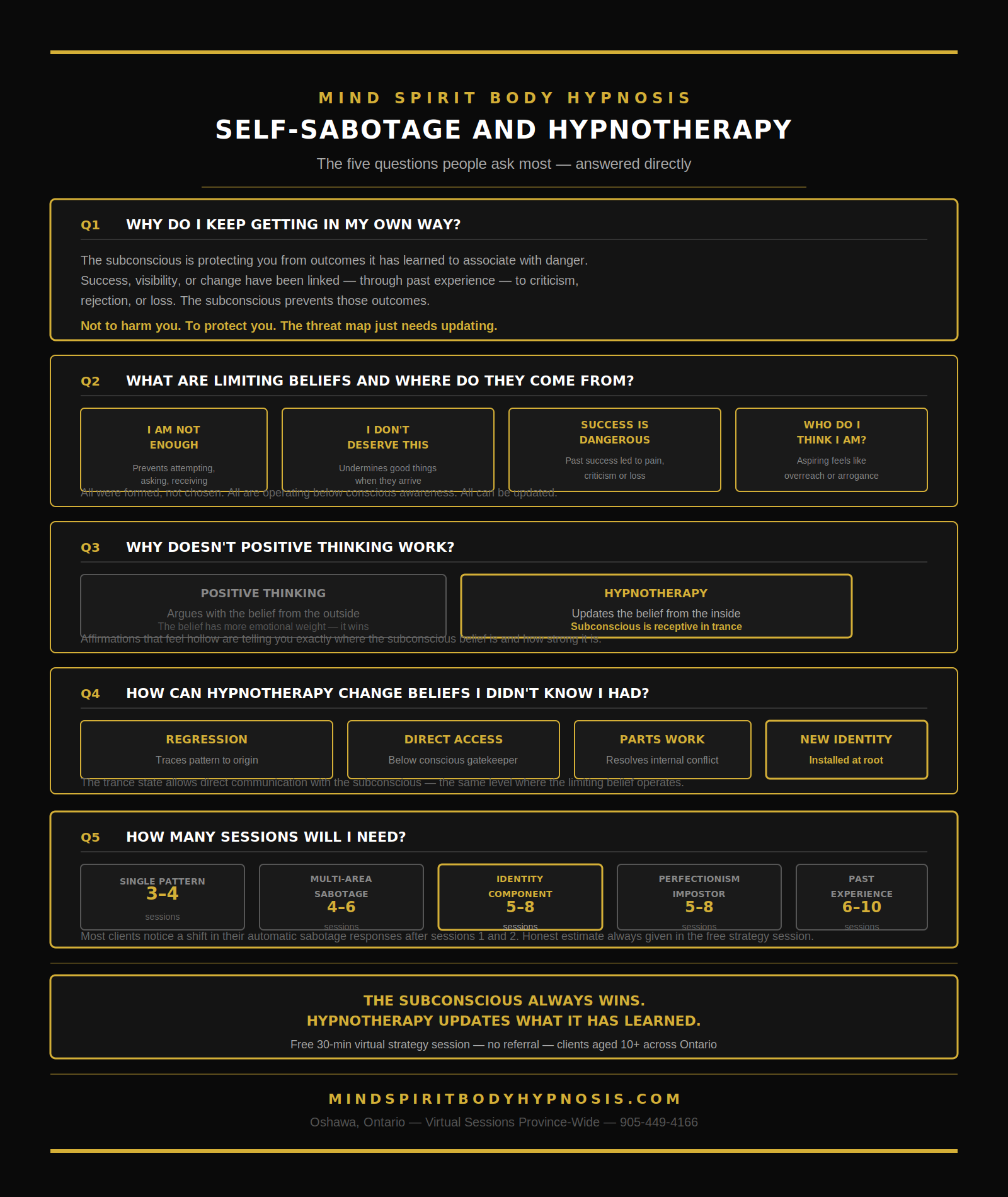
The answer to this question is one of the most liberating things many clients hear in the first session, because it reframes self-sabotage from a character flaw into a logical subconscious response to a learned threat assessment.
Self-sabotage is not irrational. At the subconscious level, it makes complete sense. The subconscious's primary function is to keep the person safe. Safety, to the subconscious, is not defined by what makes the conscious mind happy. It is defined by what is familiar, by what has been survived before, and by the avoidance of outcomes that have previously been associated with pain, rejection, humiliation, or loss.
When the subconscious has learned, through experience, that success brings criticism, that visibility brings attack, that intimacy brings betrayal, that trying hard and failing brings catastrophic shame, it does the only logical thing available to it. It prevents those outcomes from occurring. Not because it wants to harm the person but because it is trying to protect them from what it believes, based on available evidence, will hurt them.
Self-sabotage is the subconscious doing its job. The problem is that it is doing it with a threat map that was drawn from early experiences and has not been updated to account for who the person has become, what their current environment is actually like, or what they are genuinely capable of now.
Research published in the Journal of Personality and Social Psychology found that self-defeating behaviour is significantly predicted by subconscious self-concept discrepancies, where the gap between the conscious desired self and the subconscious expected self produces automatic behavioural compensation to reduce that gap, even when the compensation is obviously counterproductive to conscious goals (Baumeister & Scher, 1988).
⭐ Pro Tip: A reliable way to identify the specific subconscious belief driving your self-sabotage is to notice what happens just before the pattern activates. What does success, visibility, or the achievement of your goal seem to threaten? If you observe the moment of self-sabotage, you will often find a fleeting sense of danger, wrongness, or not-rightness that precedes the self-defeating action. That feeling is the subconscious threat response. It is the belief made felt. And that is exactly where the hypnotherapy work begins.
What Are Limiting Beliefs and Where Do They Come From?
Limiting beliefs are subconscious conclusions about the self, about others, and about the world that were formed in specific contexts, usually early, usually under conditions of emotional significance and that have been operating as facts ever since, long after the context that produced them no longer applies.
They are not opinions the person holds consciously. They are more fundamental than that. They are operating assumptions that filter every incoming experience, shape every decision, and produce the characteristic self-sabotage patterns with a consistency that makes them feel like personality rather than programming.
The most common limiting beliefs that drive self-sabotage include:
I am not enough. The belief that what the person currently is, knows, has, or can do is fundamentally insufficient. This belief prevents people from attempting things at which they might fail, from asking for what they want, and from allowing good things to stay when they arrive.
I do not deserve this. The belief that positive outcomes, success, love, or recognition are for other people but not for this person. Often drives the specific pattern of getting close to something good and then undermining it.
If I succeed, something bad will happen. A more complex limiting belief, often rooted in specific past experiences where success was followed by punishment, criticism, loss, or the withdrawal of approval. The subconscious has linked success to danger and acts to prevent it.
Who do I think I am? The belief that aspiring to something better, bigger, or different represents arrogance, overreach, or an invitation for humiliation. Often culturally reinforced and frequently modelled by significant others.
Where do these beliefs come from? They come from specific experiences that carried enough emotional weight to produce a subconscious conclusion. A critical parent. A humiliating failure witnessed by others. A relationship in which love was conditional on performance. A family system in which ambition was shamed, or success was punished. The belief is the subconscious's attempt to make sense of and protect against that experience. It generalizes from the specific situation to a universal rule. And it applies that rule indefinitely until it is directly updated.
For more on how limiting beliefs, self-sabotage, and subconscious identity patterns interact and how hypnotherapy addresses all three, the hypnotherapy for self-sabotage pillar page covers the clinical approach in detail.
Why Doesn't Positive Thinking Work?
This is the most frustrating question that arrives in the first session, usually from people who have spent months or years attempting to override their limiting beliefs through affirmations, visualization, gratitude practices, and conscious reframing.
The short answer is that positive thinking addresses the conscious layer of a problem that lives in the subconscious layer. It asks the conscious mind to say different things about a situation whose subconscious interpretation has not changed.
Here is the mechanism. The subconscious holds a belief: I am not enough. The conscious mind is instructed to repeat: I am more than enough. The subconscious, encountering this statement, does not update its belief. It registers a discrepancy. The discrepancy produces what psychologists call cognitive dissonance: the uncomfortable tension of holding two conflicting beliefs simultaneously. And to resolve that dissonance, the brain typically strengthens whichever belief has more emotional evidence behind it. Which is the original limiting belief, not the affirmation.
This is why affirmations frequently feel hollow, forced, or even counterproductive. They do not feel true because, to the subconscious, they are not true. And the subconscious treats them not as evidence of a new belief but as an argument against the existing one, an argument the existing belief, with all its historical emotional weight, easily wins.
Hypnotherapy bypasses this problem by working directly at the level where the limiting belief is stored. In trance, the critical, gatekeeping function of the conscious mind softens, and the subconscious becomes genuinely receptive to updated information. The belief is not argued against from the outside. It is updated from the inside. This produces a different quality of change: not the effortful maintenance of a conscious position but a genuine shift in what the subconscious evaluates as true.
Research published in Contemporary Hypnosis found that hypnotherapy produced significantly greater improvements in self-efficacy and self-concept than positive thinking interventions alone, with the hypnotherapy group showing continued improvement at six-month follow-up while the positive thinking group's gains had largely reversed (Heap, 2012).
⭐ Pro Tip: The clearest sign that positive thinking is not addressing the root of a limiting belief is when the affirmation feels unconvincing even to you as you say it. The feeling of hollowness is the subconscious registering the discrepancy between what is being stated and what it actually believes. This is useful information, not a sign of failure. It tells you exactly where the subconscious belief is and how strong it is -- which is precisely the information needed to target it effectively in hypnotherapy.
How Can Hypnotherapy Change Beliefs I Did Not Even Know I Had?
This is the mechanism question, and it is one of the most interesting aspects of hypnotherapy for self-sabotage work.
Most limiting beliefs are not consciously held. The person does not think: I believe I am not enough. They experience the downstream effects of that belief the procrastination, the avoidance, the inexplicable self-defeating decision, without recognizing the belief that is producing them. This is what makes self-sabotage so frustrating: the cause is below the level of awareness.
Hypnotherapy accesses the subconscious not by dragging the belief into conscious awareness first, but by working at the level where the belief operates. This happens in several ways.
Regression to origin. In trance, the subconscious is invited to trace the self-sabotage pattern back to its earliest recognizable form. What is the earliest time this feeling was present? What was happening? This process reliably surfaces the formative experiences that established the belief, often experiences the person had not previously connected to the current pattern, allowing those experiences to be revisited with adult resources and reinterpreted with a more accurate and functional frame.
Direct subconscious communication. The trance state allows the therapist to communicate directly with the subconscious operating system rather than the conscious editorial layer. Suggestions offered in trance are received not as arguments to evaluate but as information to integrate, in the same way that the original formative experiences were integrated below the level of critical analysis.
Parts work. Many self-sabotage patterns involve an internal conflict between a part that wants to succeed and a part that is afraid of what success will bring. NLP parts integration work, conducted in the hypnotic state, brings these parts into dialogue and resolution. Once the protective part understands that its safety function can be fulfilled without sabotage, the sabotage loses its subconscious mandate.
New identity installation. Beyond the belief work, hypnotherapy addresses the identity level: who the person fundamentally understands themselves to be. In trance, a new and more accurate identity one that includes deserving, capability, and safety with success is installed not as a conscious aspiration but as a subconscious operating assumption. The person begins to act from a different sense of self rather than from a different set of instructions to their existing self.
More about how identity-level work is conducted at Mind Spirit Body Hypnosis is available on the about page.
How Many Sessions Will I Need?
Here is a specific and honest breakdown based on common presentations in the practice.
Single specific self-sabotage pattern with identifiable trigger: Three to four sessions. When the pattern is clear procrastination specifically around one type of goal, or a relationship pattern that follows a single predictable shape, the targeted subconscious work can be efficient, and the results are often noticeable quickly.
Generalized self-sabotage across multiple life areas: Four to six sessions. When the self-sabotage shows up in career, relationships, health, and finances simultaneously, the underlying limiting belief is typically more deeply rooted and more broadly applied, requiring more sessions to address adequately across all its expressions.
Self-sabotage with significant identity component: Five to eight sessions. When the self-sabotage is closely tied to core identity beliefs not simply what the person does but who they fundamentally believe themselves to be the identity-level work takes additional sessions and produces bigger and more durable change.
Self-sabotage alongside perfectionism, impostor syndrome, or significant anxiety: Five to eight sessions, addressing the interconnected pattern architecture.
Self-sabotage with clear roots in specific past experiences or trauma: Six to ten sessions, incorporating the necessary root cause and origin work alongside the belief and identity updating.
For more on how anxiety and self-sabotage overlap and how hypnotherapy addresses both simultaneously, the hypnotherapy for anxiety and stress pillar page covers the foundational mechanisms.

What to Expect at Mind Spirit Body Hypnosis
The first session is a conversation. Where does the self-sabotage show up most reliably? Is there a pattern to when it activates? What does success, visibility, or achievement seem to threaten at the gut level? What has already been tried? And what would change, concretely and specifically, if the pattern stopped?
The mapping in the first session is thorough because the specificity of the subsequent trance work depends entirely on understanding the specific architecture of the particular self-sabotage pattern. Generic anti-sabotage suggestions are not what produces lasting change. Targeted work on the specific belief, origin, and identity pattern is.
All sessions are delivered virtually, available to clients aged 10 and older across Ontario from the comfort of their own home. Many clients begin to notice a shift in their automatic responses to their typical sabotage triggers after the first two sessions: a moment of awareness where the pattern was about to activate and did not, or activated with less force and was more easily redirected.
What My Clients Say
"Working with Fanis has changed my life. After years of therapy for anxiety and confidence issues, I wanted to try something different. This experience has transformed me from the inside out and continues to have an effect even after our sessions. I am now able to be myself, face my fears, surround myself with those who care about me and live a fulfilling and happy life. So grateful."
Kristen W. | Anxiety and Confidence | Five Stars
"I cannot say enough about how amazing Fanis is! He has truly changed my life. I was always an anxious person and always overthinking everything. After seeing Fanis I feel like a completely different person. The anxiety is gone and my mind is actually quiet for the first time in my life. I am forever grateful."
Amanda B. | Anxiety and Overthinking | Five Stars
FAQ
Why do I keep getting in my own way? Self-sabotage is the subconscious protecting you from outcomes it has learned to associate with danger: failure, criticism, rejection, loss. It is not irrational. It is the logical result of a threat map that was drawn from experience and has not been updated. The subconscious is doing its job. Hypnotherapy updates the threat map.
What are limiting beliefs? Limiting beliefs are subconscious conclusions about the self, others, and the world formed from specific formative experiences. They operate below conscious awareness as filtering assumptions that shape every decision and produce self-defeating behaviour patterns with a consistency that feels like personality but is actually learned programming.
Why doesn't positive thinking work for self-sabotage? Positive thinking addresses the conscious layer of a subconscious problem. The limiting belief encounters the affirmation as an argument, not as evidence, and strengthens against it because the original belief has far more emotional weight behind it. Hypnotherapy works at the subconscious level where the belief is stored, producing genuine updating rather than effortful conscious overriding.
How can hypnotherapy change beliefs I did not know I had? Through regression to origin, direct subconscious communication in trance, NLP parts integration, and identity-level installation. The trance state allows access to the subconscious operating system directly, bypassing the conscious editorial layer that evaluates and argues rather than integrating.
How many sessions will I need? Single specific pattern: three to four sessions. Generalized multi-area self-sabotage: four to six. Significant identity component: five to eight. Self-sabotage with perfectionism, impostor syndrome, or anxiety: five to eight. Roots in specific past experiences: six to eight. An honest estimate is always given in the free strategy session.
Is this different from therapy I have tried before? Hypnotherapy works at the subconscious level where limiting beliefs are stored, rather than through conscious insight and reasoning. Many clients have done significant talk therapy work and understand their patterns deeply. Hypnotherapy addresses the layer beneath the understanding, where the pattern actually operates.
Can this help with impostor syndrome specifically? Yes. Impostor syndrome is a limiting belief pattern in which the subconscious has concluded that genuine competence is less than what others perceive, that discovery of inadequacy is imminent, and that success is undeserved. All three components respond directly to the belief updating and identity work done in hypnotherapy.
Can I do sessions virtually from anywhere in Ontario? Yes. All sessions are delivered virtually, province-wide, with no referral required.
How do I get started? Book a free 30-minute virtual strategy session at calendly.com/mindspiritbodyhypnosis. No referral needed.
Ready to Take the Next Step?
If you have been understanding your self-sabotage pattern for years without being able to stop it, the part that has not yet been addressed is the subconscious belief driving it. That is what hypnotherapy changes.
I offer a free 30-minute virtual strategy session for new clients across Ontario. No pressure. Just an honest conversation about what has been getting in your way and what approach is most likely to finally change it.
Book your free session: calendly.com/mindspiritbodyhypnosis
Call or text: 905-449-4166
Email: info@mindspiritbodyhypnosis.com
Visit: mindspiritbodyhypnosis.com
Serving clients virtually across Ontario, including Durham Region, Toronto, Ontario, and beyond.
Disclaimer: This article is for informational purposes only and does not constitute medical or psychological advice. Hypnotherapy and NLP are complementary approaches and are not a substitute for diagnosis or treatment by a qualified healthcare provider. Results vary by individual.
Written by Fanis Makrigiannis | Certified Hypnotherapist & NLP Master Practitioner | Mind Spirit Body Hypnosis.