What happens during a hypnotherapy session?
What Happens in a Hypnotherapy Session? Your Questions Answered
TL;DR: A hypnotherapy session is not what the movies suggest. There is no swinging pocket watch, no loss of consciousness, no one making you do anything you do not want to do. It is a focused, collaborative conversation followed by a deeply relaxed state in which the subconscious becomes more open to change. This article answers the five questions people ask most before their first session at Mind Spirit Body Hypnosis in Oshawa, Ontario.
Quick Answer
In a hypnotherapy session, I begin with a detailed conversation about what you want to change and how. You then enter a trance state, a natural, focused state of relaxed attention that feels like deep calm, during which the subconscious becomes more receptive to updated information, new patterns, and direct therapeutic work. You are aware throughout, in control throughout, and remember the session. The trance state is not sleep, not unconsciousness, and not surrender. It is the same state you access when you are deeply absorbed in a book, driving a familiar route on autopilot, or drifting in the space just before sleep. At Mind Spirit Body Hypnosis in Oshawa, Ontario, Fanis Makrigiannis, a Certified Hypnotherapist and NLP Master Practitioner, offers virtual sessions province-wide for clients of all ages.
Questions This Article Answers
What actually happens in a hypnotherapy session?
Will I be unconscious or lose control?
What does hypnosis feel like?
How many sessions will I need?
Does hypnotherapy actually work?
In This Article:
Most people who come for a first session have been thinking about booking for longer than they want to admit. They have googled the topic. They have read about it. They may have asked someone who has tried it. And the thing that has kept them on the fence is not skepticism exactly; it is uncertainty about what is actually going to happen when they show up.
That uncertainty is completely reasonable. Hypnotherapy has decades of stage-show mythology layered over it, and most of what people have seen or heard about hypnosis has nothing to do with what happens in a clinical session.
This article is for the people who are genuinely curious and want to know exactly what to expect before they book.
What Actually Happens in a Hypnotherapy Session?
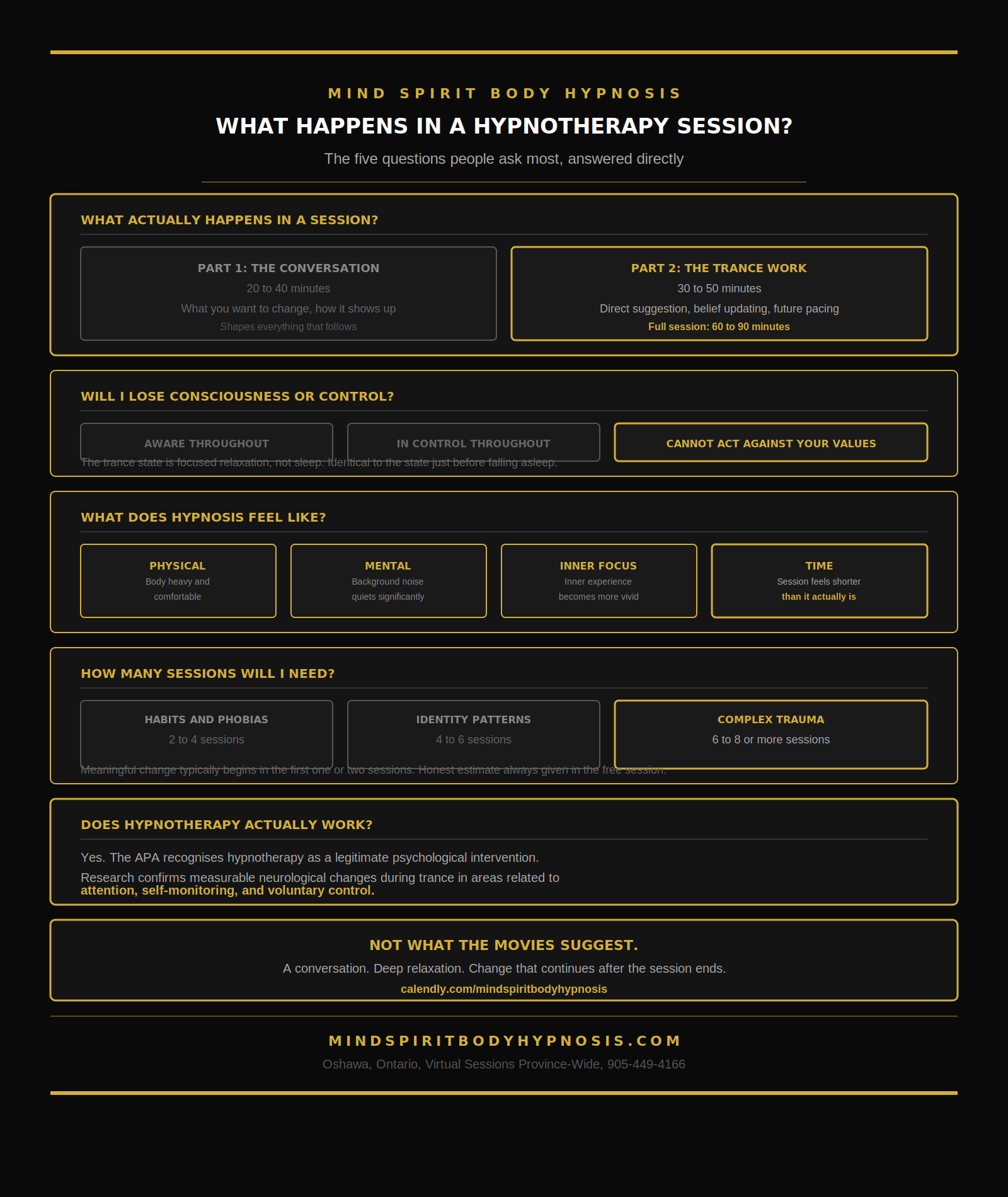
Every session at Mind Spirit Body Hypnosis has two parts: a conversation and the trance work. Neither can be done well without the other.
Part one: the conversation.
The first session always begins with a thorough intake conversation. This is not a brief check-in. It is a substantive discussion that typically takes between 20 and 40 minutes, depending on the complexity of what you want to work on.
In this conversation, I focus on understanding the specific shape of the presenting issue for you. Not the generic description of the problem, but the particular way it shows up in your life. When does it happen? What triggers it. How long it has been present. What has already been tried. What you want to be different specifically, not just in general.
This conversation matters because the trance work that follows is built from it. Generic hypnotherapy produces generic results. The work at Mind Spirit Body Hypnosis is precise because the intake is thorough.
For returning sessions (sessions two, three, and beyond), we begin with a check-in on what has shifted since our last session, what you have noticed, and what the focus of this session will be.
Part two: the trance work.
Once the conversation has established the map, the trance work begins. I guide you into a relaxed, focused state through a combination of breathing, physical relaxation, and directed attention. This process is called an induction, and it takes between five and fifteen minutes.
Within the trance state, different types of work happen depending on what is being addressed:
Direct suggestion. New patterns, beliefs, and responses are suggested directly to the subconscious in the receptive trance state. These are not affirmations to be consciously evaluated. They are precise, carefully constructed suggestions that the subconscious receives as direct experience rather than as information to assess.
Parts work and reframing. Parts of you that have been in conflict the part that wants to change and the part that has been maintaining the pattern are addressed and brought into alignment. The positive intention behind even a problematic behaviour is honoured before alternatives are offered.
Metaphor and imagery. Therapeutic metaphors are used to communicate with the subconscious in its native language not logical argument, but story, image, and felt sense.
Regression and origin work. For issues rooted in formative experiences, the session may access the original event and address it directly, revisiting it with adult resources to update the subconscious conclusion formed there.
Future pacing. You are walked through future situations in which the changed pattern is already operating, experiencing the new response as expected reality rather than hoped-for possibility.
The trance work typically runs between 30 and 50 minutes. At the end, I gently reorient you back to full waking awareness through a count-up and a brief closing.
A full session, including the conversation and the trance work, typically runs between 60 and 90 minutes.
⭐ Pro Tip: The most useful preparation for a first session is not research about hypnosis. It is clarity about what you want to be different. Not why the problem exists. Not its history in detail. But specifically: what would change if this work succeeded? What would you do differently? What would you feel differently? What would be available to you that is not available now? The more specific and vivid this answer, the more precisely the session can be built to produce it.
Will I Be Unconscious or Lose Control?
No, and this is the question that holds more people back from booking than almost any other.
The popular image of hypnosis involves someone losing consciousness, having no memory of what happened, and being made to do things against their will. This image comes from stage hypnosis, which is a form of entertainment that has almost nothing in common with clinical hypnotherapy.
In clinical hypnotherapy:
You are aware throughout. The trance state is not sleep and not unconsciousness. It is a focused state of relaxed attention. Most clients describe feeling very calm, very comfortable, and very present, more aware of their inner experience than usual, not less. The thinking mind becomes quieter, but it does not switch off.
You are in control throughout. If anything in the session produced genuine alarm or distress, you can open your eyes, speak, and end the session at any moment. This does not happen in practice, because I design every session to be safe and I always calibrate the pace to your comfort. But the control is always yours.
You cannot be made to do anything against your values or genuine wishes. The subconscious does not accept suggestions that fundamentally conflict with your core values. A suggestion to do something genuinely harmful or against your genuine wishes would simply not take. This is one of the most consistently confirmed findings in hypnosis research -- the subconscious is not a mechanism that can be hijacked to override the person's fundamental nature.
You will remember the session. Most clients recall the trance experience clearly. Some notice that certain sections felt more vivid or more distant than others, which is a normal feature of the trance state. Therapeutic amnesia deliberately forgetting specific content is a specialized technique used in specific clinical contexts, not a default feature of sessions.
What does change is the critical filtering function of the conscious mind, the evaluative layer that assesses, doubts, and rejects. In trance, this layer becomes less active, which is precisely what allows therapeutic suggestions to reach the subconscious directly rather than being filtered out before they can land.
What Does Hypnosis Feel Like?
This is the question clients most often report not having expected the answer to.
The trance state is not dramatic. It does not feel unusual in a disorienting way. Most people, when they experience it for the first time, report something along the lines of: it felt like deep relaxation, but I was very aware the whole time.
More specifically, what clients commonly describe:
Physical heaviness. The body feels comfortable and heavy in a pleasant way. There is no impulse to move. The muscles release tension that you often did not know you were holding.
Mental quietness. The ordinary background noise of the thinking mind the to-do list, the running commentary, the self-monitoring becomes much quieter. Not absent, but quieter. There is more space.
Heightened inner focus. While the outer world becomes less intrusive, the inner experience becomes more vivid. Images, sensations, and feelings are more present and more accessible. The session feels like moving closer to something rather than further away.
Time distortion. This is one of the most consistent and most surprising features of trance for first-time clients. What feels like fifteen minutes is often forty-five. Time passes differently in trance, consistently faster than expected. Most clients are surprised by how long the session has been when they reorient.
The threshold feeling. Many clients describe a particular quality of awareness just before the trance deepens, similar to the feeling just before falling asleep, where the body is heavy, and the mind is loose but still aware. This hypnagogic state is familiar to everyone; it is simply accessed more deliberately and for longer in hypnotherapy.
After the session, most clients describe feeling calm, clear, and lighter than when they arrived. Some notice a mild tiredness, the kind that follows genuine relaxation rather than effort. The changes from the session often continue to emerge in the days following, as the subconscious integrates the new material.
⭐ Pro Tip: If you find yourself in the first session wondering whether you are actually hypnotized, this is completely normal and does not mean the session is not working. The trance state feels so natural that many people expect it to feel more dramatic than it does. The absence of drama is not a sign of failure. It is a sign that the trance state is exactly what it is: a natural state, not a special effect.
How Many Sessions Will I Need?
This depends on what is being addressed, and an honest answer is always given in the free strategy session. Here is the general framework used in my practice:
Single-session presentations. Some specific, well-defined habit patterns or phobias respond to a single comprehensive session. This is relatively uncommon; most presentations benefit from a series, but it does occur, particularly with specific phobias that have a clear structure and no complex roots.
Short series (two to four sessions). Most habit change work falls here. Smoking cessation, specific anxiety presentations, phone addiction, sleep improvement, and focused confidence work typically run two to four sessions. The first session establishes the subconscious foundation. Subsequent sessions deepen and consolidate the change.
Medium series (four to six sessions). Perfectionism, fear of failure, people-pleasing, emotional eating, and other patterns with identity-level roots and multiple life domains typically run four to six sessions. The first sessions address the nervous system and the immediate pattern. Later sessions address the belief and identity layer.
Longer programmes (six to eight sessions or more). Complex trauma, deeply rooted self-worth issues, and presentations involving multiple interacting patterns benefit from a longer programme. These are not the norm but also not unusual for presentations that have been present for decades and are woven through multiple areas of your life.
The most important thing to understand about the session count question is that meaningful change typically begins in the first one or two sessions and that the number of sessions is a guide, not a fixed prescription. Progress is assessed at every session, and the programme is adjusted accordingly.
Does Hypnotherapy Actually Work?
Yes, and the evidence base for this has become substantially stronger in recent years.
Hypnotherapy has a body of research support that is often underestimated by people who associate it with stage entertainment. A 2019 meta-analysis of hypnotherapy for anxiety found significant positive effects, with improvements superior to many commonly used interventions. Research on hypnotherapy for smoking cessation, irritable bowel syndrome, chronic pain, and PTSD has produced consistent positive findings across multiple independent studies.
The American Psychological Association recognizes hypnotherapy as a legitimate psychological intervention with an established evidence base. The British Psychological Society reached similar conclusions as early as 2001, noting that hypnosis is a genuine psychological phenomenon with a range of therapeutic applications.
Beyond the formal research, the clinical reality is straightforward. In my practice, people who arrive having tried multiple other approaches years of talk therapy, medication, CBT, willpower-based interventions and who have not achieved the change they were looking for frequently experience a meaningful shift through hypnotherapy in a relatively short number of sessions. Not because hypnotherapy is magic, but because it addresses the subconscious level where the pattern is actually operating, the level that the other approaches were not directly reaching.
Hypnotherapy is not a replacement for medical care or psychiatric treatment. It is a complementary approach that works alongside other care. For many presentations, it is the most direct available route to the subconscious where the relevant material is stored.
Research published in the American Journal of Clinical Hypnosis confirms that hypnotherapy produces measurable neurological changes during trance, including shifts in activity in areas of the brain associated with attention, self-monitoring, and the perception of voluntary control, providing a biological basis for the therapeutic effects that clinical practice consistently observes (Raz & Shapiro, 2002).
For more on how the clinical approach at Mind Spirit Body Hypnosis addresses specific presentations, the hypnotherapy for anxiety and stress pillar page and the EMDR and trauma therapy page cover the mechanisms and evidence base in detail.

What to Expect at Mind Spirit Body Hypnosis
The free 30-minute strategy session is exactly that: a conversation. No trance work in the strategy session. No pressure to commit. Just a thorough conversation about what you want to change, whether hypnotherapy is the right approach for your specific situation, and what a realistic programme would look like.
All sessions are delivered virtually, province-wide, using a secure video platform. The virtual format works as well as in-person for most presentations; the trance state is not affected by the medium, and many clients find the familiar comfort of their own space an asset rather than a limitation.
Sessions are available to clients aged 10 and older across Ontario. No referral is required.
More about the full approach, credentials, and programme options is available on the about page.
What My Clients Say
"I began seeing Fanis after a long battle with trauma and grief. I suffered from severe anxiety, panic attacks, insomnia and self harm. After 3 months of weekly hypnotherapy sessions done online, I no longer suffer from panic attacks, insomnia, or self harm and have learned how to better regulate my emotions and find peace. Fanis helped me process many childhood traumas and confront my overwhelming grief. I am eternally grateful to Fanis and his wonderful work."
Sara V. | Trauma and Grief | Five Stars
"I cannot say enough about how amazing Fanis is! He has truly changed my life. I was always an anxious person and always overthinking everything. After seeing Fanis I feel like a completely different person. The anxiety is gone and my mind is actually quiet for the first time in my life. I am forever grateful."
Amanda B. | Anxiety and Overthinking | Five Stars
FAQ
What actually happens in a hypnotherapy session? A detailed intake conversation, followed by a trance state in which direct suggestion, parts work, metaphor, origin work, and future pacing are used to produce change at the subconscious level. The full session runs 60 to 90 minutes.
Will I lose consciousness or be out of control? No. You are aware throughout, in control throughout, and cannot be made to do anything against your values. The trance state is natural, focused relaxation, not unconsciousness.
What does hypnosis feel like? Physical heaviness, mental quietness, heightened inner focus, and a pleasant time distortion in which the session passes faster than expected. Most people describe it as the deepest relaxation they have experienced.
Will I remember the session? Yes. Most clients remember the trance experience clearly. Some sections may feel more vivid or more distant, which is normal. Deliberate therapeutic amnesia is a specific technique used in specific contexts, not a default.
How many sessions will I need? It depends on what is being addressed. Specific habits and phobias often resolve in two to four sessions. Identity-level patterns typically take four to six. Complex trauma may require six to eight or more. An honest estimate is always given in the free strategy session.
Does hypnotherapy work? Yes. There is a substantial and growing evidence base for hypnotherapy across anxiety, trauma, habits, pain, and behavioural change. The American Psychological Association recognizes it as a legitimate psychological intervention.
Can hypnotherapy be done virtually? Yes. All sessions at Mind Spirit Body Hypnosis are delivered virtually across Ontario. The trance state is not affected by the medium.
Is hypnotherapy safe? Yes. It is gentle, non-invasive, and medication-free. You are in control at all times. For complex psychiatric presentations, I assess suitability in the intake.
How do I get started? Book a free 30-minute virtual strategy session at calendly.com/mindspiritbodyhypnosis. No referral needed.
Ready to Take the Next Step?
The session is not what the movies suggest. It is a conversation, followed by the deepest relaxation most people have experienced, followed by change that often continues to emerge in the days that follow.
I offer a free 30-minute virtual strategy session for new clients across Ontario. No pressure. No trance work in the strategy session. Just an honest conversation about what you want to change and whether this is the right approach.
Book your free session: calendly.com/mindspiritbodyhypnosis
Call or text: 905-449-4166
Email: info@mindspiritbodyhypnosis.com
Visit: mindspiritbodyhypnosis.com
Serving clients virtually across Ontario, including Durham Region, Toronto, Ontario and beyond.
Disclaimer: This article is for informational purposes only and does not constitute medical or psychological advice. Hypnotherapy and NLP are complementary approaches and are not a substitute for diagnosis or treatment by a qualified healthcare provider. Results vary by individual.
Written by Fanis Makrigiannis | Certified Hypnotherapist and NLP Master Practitioner | Mind Spirit Body Hypnosis.