Can hypnotherapy help with health anxiety?
Hypnotherapy for Health Anxiety in Ontario: Your Questions Answered
TL;DR: Health anxiety is not hypochondria, and it is not weakness. It is the anxiety system doing what it was designed to do: scanning for threat but aimed relentlessly at the body instead of the external world. The worry is real. The fear is real. The physical sensations it produces are real. And the pattern that drives it the scan, the Google search, the momentary relief, the return of doubt is a subconscious loop that can be changed. At Mind Spirit Body Hypnosis in Oshawa, Ontario, the five questions people ask most about health anxiety and hypnotherapy are answered here, directly.
Quick Answer
Health anxiety is a pattern of persistent worry about physical symptoms and illness that continues despite reassurance, clear test results, or the absence of evidence of serious disease. It is driven by the same subconscious threat-detection system that underlies all anxiety but with the body as the primary object of the threat scan. The worry produces real physical sensations, which the scan picks up as further evidence of threat, which increases the worry. The loop is self-reinforcing and difficult to exit through reassurance or rational argument alone, because it is operating below the level where reassurance and rational argument reach. Hypnotherapy addresses health anxiety by working directly with the subconscious threat assessment and the body-scanning habit at the level where they operate. At Mind Spirit Body Hypnosis in Oshawa, Ontario, I offer virtual sessions province-wide for clients of all ages.
Questions This Article Answers
Why do I always think something is wrong with my body?
Why does googling symptoms make health anxiety worse?
Is health anxiety all in my head?
Why does reassurance only help for a few minutes?
Can hypnotherapy help with health anxiety?
In This Article:
The pattern is exhausting in a very specific way. It is not constant fear; it is constant monitoring. A background scan running at all times, checking. A headache becomes a question. A skipped heartbeat becomes an hour of research. A new sensation anywhere in the body becomes an unwanted investigation that produces more questions than answers and leaves the person more anxious than when they started.
And the worst part is the loop. The worry produces physical symptoms: muscle tension, changes in heart rate, digestive disruption, shortness of breath. The scan picks those symptoms up. And the worry intensifies.
People with health anxiety are not imagining things. The sensations are real. The worry is real. What is not accurate is the interpretation the subconscious is placing on those sensations, and that interpretation is where the work goes.
Why Do I Always Think Something Is Wrong With My Body?
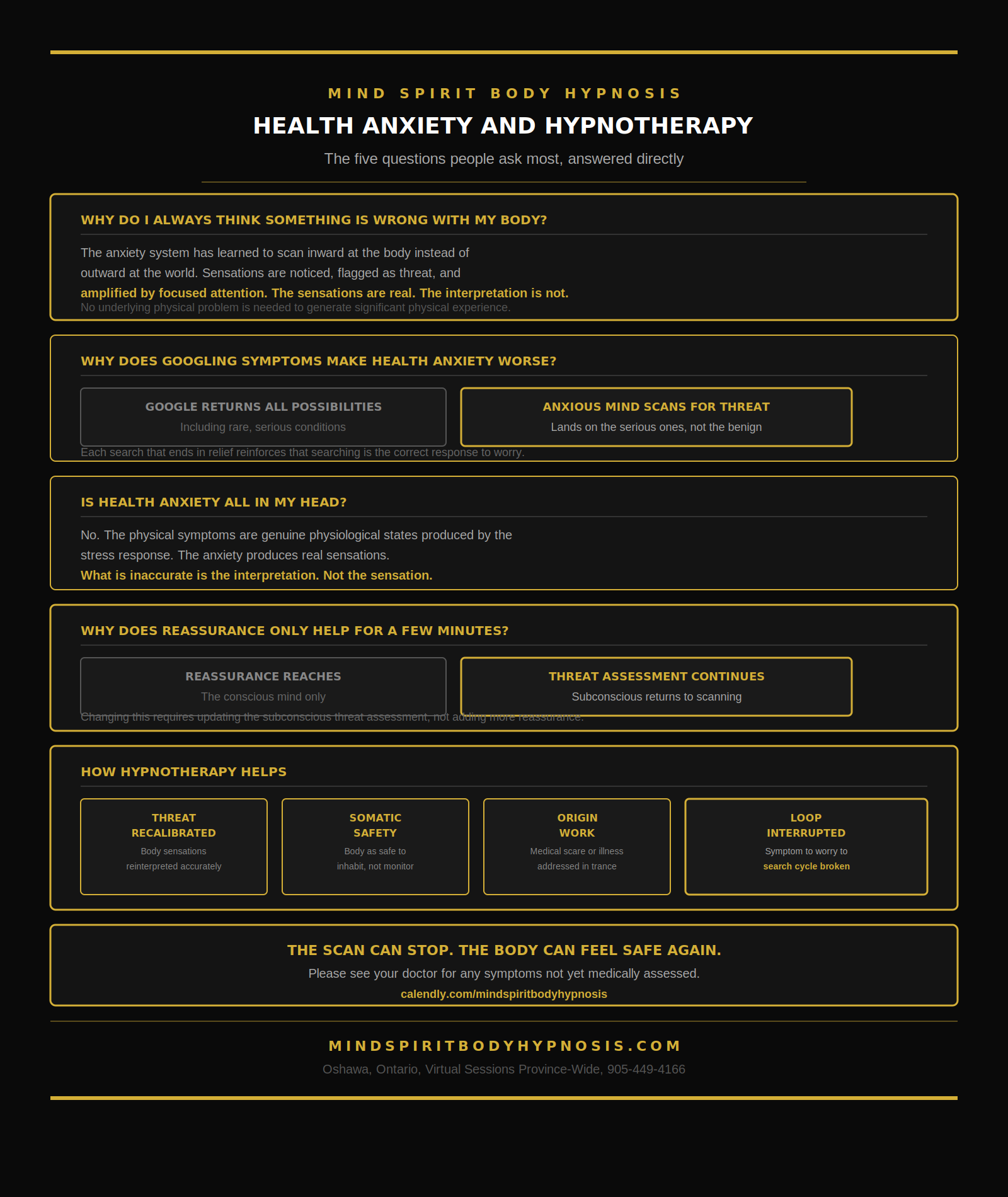
Because the anxiety system has learned to use the body as its primary threat object, and once that pattern is established, it runs automatically, below conscious awareness.
All anxiety involves the same core mechanism: the subconscious scanning for threat and activating the stress response when it finds a match. In most anxiety presentations, the threat scan is directed outward toward social situations, performance, conflict, or uncertainty about the future. In health anxiety, the scan has turned inward. The body becomes the environment being monitored for danger.
This shift usually develops from one of several origins. A significant illness or medical scare, personal or in someone close, that left the nervous system in a heightened state of physical vigilance after the acute event had passed. A period of unexplained symptoms that produced genuine fear before a diagnosis or resolution arrived. A family environment in which illness was treated as a significant and frightening event, establishing the association between bodily sensation and danger early. Or sometimes a single experience of feeling genuinely ill and genuinely frightened that the body has never fully filed as resolved.
Once the inward scan is established, it becomes automatic. The subconscious notices sensations it would previously have processed as background noise and flags them as requiring attention. The attention amplifies the sensation; this is a well-documented mechanism called somatic amplification, in which focused attention on a physical sensation increases its perceived intensity without any change in the underlying physical state. The amplified sensation produces more concern. The concern produces more scanning. The scan finds more sensations.
This cycle does not require any underlying physical problem to generate significant physical experience. The anxiety itself is a potent physical state, and the body running under chronic low-level anxiety produces a consistent range of genuine physical sensations that are real but are produced by the nervous system rather than by disease.
⭐ Pro Tip: One of the clearest ways to understand whether a physical sensation is anxiety-driven is to notice what happens to it when attention is redirected. Sensations produced by structural or physiological problems tend to persist regardless of where attention is focused. Anxiety-driven sensations, which are real but produced by nervous system activation and somatic amplification, tend to shift, move, or change in quality when attention is genuinely redirected to something engaging. This is not a diagnostic tool and is not a substitute for medical assessment. But it is a useful piece of self-observation for someone trying to understand the relationship between their attention and their physical experience.
Why Does Googling Symptoms Make Health Anxiety Worse?
Because Google is optimized for completeness, not reassurance and the anxious mind is optimized for threat detection, not balanced assessment.
When someone with health anxiety googles a symptom, they are entering a search environment that is designed to surface all medically relevant information about that symptom, including the serious and rare conditions that produce it. The algorithm does not know that this person's prior probability of having a rare serious illness is low. It returns the full range of medical possibilities, from the trivial to the catastrophic.
The anxious mind then does what it is trained to do: it scans the results for threat. It moves past the common, benign causes and lands on the serious, rare ones. It reads the serious ones in detail. It finds the symptoms that match. It notes the ones that do not match, and the anxiety generates explanations for why those non-matching symptoms might still be present in this case.
By the end of the search, the person is more frightened than when they started, not because they have found evidence of serious illness, but because the search has provided new material for the threat-detection system to work with, and the threat-detection system has processed it selectively, as it always does.
The search also provides a temporary sense of doing something about the worry of taking action, gathering information, being responsible. This is its own reinforcement. The search feels like it should help. The temporary engagement with the search provides momentary relief from the passive anxiety of not knowing. And then the results arrive, and the anxiety is worse.
This is why reassurance-seeking behaviours googling, checking, seeking medical opinion repeatedly provide relief that is brief and incomplete. They address the conscious experience of uncertainty without changing the subconscious threat assessment that is generating the uncertainty.
⭐ Pro Tip: The rule that most people with health anxiety eventually discover, and most find genuinely difficult to implement, is this: the search rarely ends the anxiety. It feeds it. Every search that ends in reassurance reinforces the subconscious pattern that searching is the appropriate response to the worry -- which means the next worry will trigger the same response with the same result. Reducing the searches is not about being in denial. It is about withdrawing the behaviour that is reinforcing the cycle.
Is Health Anxiety All in My Head?
No, and this is one of the most unhelpful things people with health anxiety are told, usually by people who mean well.
The physical symptoms of health anxiety are genuine physical symptoms. Muscle tension, headaches, gastrointestinal disturbance, heart palpitations, shortness of breath, dizziness, and tingling sensations all of these are real, measurable physiological states produced by the activation of the stress response. The nervous system does not distinguish between a threat that is external and present and a threat that is anticipated or imagined. The same stress chemistry is released in both cases. The same physiological effects follow.
What is happening in health anxiety is not that the person is imagining symptoms. It is that the anxiety system is producing real symptoms, which the scanning habit then interprets as further evidence of physical threat, which intensifies the anxiety, which produces more symptoms.
The symptoms are real. The interpretation being placed on them is where the inaccuracy lies.
This distinction matters enormously for how the work is approached. Telling someone with health anxiety that their symptoms are not real, or that they are all in their head, is both inaccurate and unhelpful. It dismisses a genuine physical experience and adds shame to an already distressing pattern. It also does not address the subconscious threat assessment that is generating the symptoms in the first place.
The accurate framing is this: the symptoms are real, and they are being produced by anxiety rather than by the disease the person fears. The work is to address the anxiety that is generating them, both the subconscious threat assessment and the body-scanning habit that is amplifying them.
For more on how the anxiety system produces genuine physical symptoms and how that is addressed through hypnotherapy, the hypnotherapy for anxiety and stress pillar page covers the nervous system mechanisms in detail.
Why Does Reassurance Only Help for a Few Minutes?
Because reassurance operates at the conscious level, and the threat assessment driving health anxiety operates at the subconscious level.
When a doctor gives a clear result, or a trusted person says that everything is going to be fine, or a search finally lands on a reassuring source, the conscious mind registers the reassurance and the anxiety reduces temporarily. The person feels better. The worry quiets.
But the subconscious threat assessment has not changed. It was not party to the reassurance. It is still running the body scan. Within minutes or hours, it finds something new a sensation, a thought, a memory of a worrying fact and the worry returns, often at the same intensity as before.
This is why people with health anxiety can receive a clear test result, feel genuine relief, and be just as anxious three days later about a different symptom. The conscious mind received the reassurance. The subconscious threat system did not.
It is also why repeated reassurance-seeking is ultimately counterproductive. Each reassurance that provides temporary relief reinforces the subconscious pattern: worry produces seeking, seeking produces brief relief, relief confirms that seeking was the right response to worry. The next worry triggers the same sequence, more powerfully.
Genuinely changing the reassurance-seeking pattern requires changing the subconscious threat assessment that drives it, not adding more reassurance to a system that has already demonstrated it cannot hold it.

Can Hypnotherapy Help With Health Anxiety?
Yes, and for the same reason it works well with all anxiety presentations: it operates directly at the subconscious level where the threat assessment and the scanning habit are both maintained.
Here is how I work with health anxiety at Mind Spirit Body Hypnosis:
Threat assessment recalibration. In trance, the subconscious threat assessment around bodily sensations is directly addressed. The nervous system is helped to update its understanding of what a sensation means, moving from automatic threat interpretation toward a more proportionate and accurate response. The body-scanning habit, which is the behavioural expression of the threat assessment, is interrupted at the subconscious level where it is triggered.
Somatic safety installation. Genuine physical safety in the body a felt sense of the body as a place that can be inhabited without constant monitoring is installed and anchored in trance. For people who have been living in a state of chronic physical vigilance, this experience is often profound and unfamiliar. Repeated across sessions, it begins to update the nervous system's relationship with physical sensation.
Origin work. Where health anxiety has a specific origin a medical scare, a significant illness, a period of genuine physical uncertainty that experience is visited in trance with adult resources. The nervous system is updated with the understanding that the acute threat is resolved, and that the current body is not the body that was in danger at that time.
Reassurance-seeking pattern interruption. The automatic behavioural loop of symptom → worry → search → brief relief → return of worry is identified and interrupted at the level of the trigger. An alternative automatic response is installed: a grounding practice, a genuine internal check-in, something that addresses the felt anxiety without feeding the loop.
In my practice, health anxiety work typically runs between three and five sessions, depending on the depth of the origin and the range of triggering symptoms and situations. All sessions are delivered virtually, available to clients aged 10 and older across Ontario. More about my approach is available on the about page.
Health anxiety frequently co-occurs with specific fears about particular conditions or medical procedures. For more on how specific fears and phobias are addressed, the hypnotherapy for fears and phobias pillar page covers the approach in detail.
What My Clients Say
"I cannot say enough about how amazing Fanis is! He has truly changed my life. I was always an anxious person and always overthinking everything. After seeing Fanis I feel like a completely different person. The anxiety is gone and my mind is actually quiet for the first time in my life. I am forever grateful."
Amanda B. | Anxiety and Overthinking | Five Stars
"Working with Fanis has changed my life. After years of therapy for anxiety and confidence issues, I wanted to try something different. This experience has transformed me from the inside out and continues to have an effect even after our sessions. I am now able to be myself, face my fears, surround myself with those who care about me and live a fulfilling and happy life. So grateful."
Kristen W. | Anxiety and Confidence | Five Stars
FAQ
Why do I always think something is wrong with my body? Because the anxiety system has learned to use the body as its primary threat object. Once the inward scan is established, it runs automatically, noticing sensations, flagging them as potential threats, and amplifying them through focused attention. The loop is self-reinforcing and does not require any underlying physical problem to generate significant physical experience.
Why does googling symptoms make health anxiety worse? Because Google returns all medically relevant information, including rare serious possibilities, and the anxious mind scans results for threat rather than balance. The search also reinforces the subconscious pattern that searching is the appropriate response to worry, which means the next worry triggers the same behaviour with the same result.
Is health anxiety all in my head? No. The physical symptoms of health anxiety are genuine physiological states produced by the stress response. What is inaccurate is the interpretation the subconscious places on those sensations, not the sensations themselves. Dismissing them as imaginary is both inaccurate and unhelpful.
Why does reassurance only help for a few minutes? Because reassurance reaches the conscious mind, not the subconscious threat assessment that is generating the worry. The subconscious does not update from reassurance. It returns to scanning within minutes or hours, finding new material for the worry cycle.
Can hypnotherapy help with health anxiety? Yes. I work at the subconscious level where the threat assessment, the body-scanning habit, and the reassurance-seeking loop all operate, recalibrating the threat system, installing genuine somatic safety, addressing origins where they exist, and interrupting the automatic reassurance-seeking pattern.
How many sessions will I need? In my practice, health anxiety work typically runs three to five sessions, depending on the depth of the origin and the range of triggering situations. An honest estimate is always given in the free strategy session.
Should I still see a doctor? Yes, always. Hypnotherapy is a complementary approach for the anxiety pattern, not a substitute for medical assessment of physical symptoms. If you have physical symptoms that have not been medically evaluated, please see your doctor. The work I do addresses the worry pattern that continues after medical assessment, not instead of it.
Can I do sessions virtually from anywhere in Ontario? Yes. All sessions are delivered virtually, province-wide, with no referral required.
How do I get started? Book a free 30-minute virtual strategy session at calendly.com/mindspiritbodyhypnosis. No referral needed.
Ready to Take the Next Step?
If the scan is always running, if every new sensation becomes a question, every question becomes a search, and every search leaves you more worried than when you started, this is an anxiety pattern. And anxiety patterns can change.
I offer a free 30-minute virtual strategy session for new clients across Ontario. No pressure. Just an honest conversation about what the worry has been costing you and whether this is the right approach.
Book your free session: calendly.com/mindspiritbodyhypnosis
Call or text: 905-449-4166
Email: info@mindspiritbodyhypnosis.com
Visit: mindspiritbodyhypnosis.com
Serving clients virtually across Ontario, including Durham Region, Toronto, Ontario, and beyond.
Disclaimer: This article is for informational purposes only and does not constitute medical or psychological advice. If you have physical symptoms, please see your doctor. Hypnotherapy and NLP are complementary approaches for self-improvement and stress management and are not a substitute for medical assessment or treatment. Results vary by individual.
Written by Fanis Makrigiannis | Certified Hypnotherapist and NLP Master Practitioner | Mind Spirit Body Hypnosis.