Hypnotherapy for sleep and insomnia
Hypnotherapy for Sleep and Insomnia in Ontario: Your Questions Answered
TL;DR: The questions people ask before their first sleep hypnotherapy session are almost always the same. Does it actually work? Why can't I sleep even when I am exhausted? How is it different from the meditation apps that have not helped? Will I fall asleep during the session? How many sessions will I need? This article answers all five directly, with the honest treatment of the evidence that the promotional content elsewhere does not give you.
Quick Answer
Hypnotherapy for sleep and insomnia addresses the conditioned arousal, nervous system hyperactivation, and anticipatory anxiety patterns that sustain sleeplessness by retraining the subconscious association between bedtime and threat and providing tools for genuine physiological downregulation. Research on hypnotherapy for sleep is genuinely mixed in quality, but the clinical mechanism is well-supported, and the outcomes in practice are significant. At Mind Spirit Body Hypnosis in Oshawa, Ontario, Fanis Makrigiannis, a Certified Hypnotherapist and NLP Master Practitioner, offers virtual sessions province-wide for clients of all ages who have tried everything else and are still not sleeping.
Questions This Article Answers
Does hypnotherapy actually work for insomnia and sleep problems?
Why can't I sleep even when I am completely exhausted?
How is hypnotherapy different from sleep meditation apps?
Will I fall asleep during a hypnotherapy session?
How many sessions will I need for sleep problems?
In This Article:
You are lying in bed, completely exhausted. Your body is heavy. Your eyes are tired. Every signal suggests that sleep should arrive. And it does not.
Instead, the mind activates. The review of today's events. The rehearsal of tomorrow's conversations. The calculation of how many hours remain before the alarm. The awareness that you are aware of all of this, which is the problem, which makes you more aware, which makes the problem worse.
This is the insomnia paradox: the harder you try to sleep, the more awake you become. And the more nights this pattern repeats, the more the bedroom itself becomes associated with failure, dread, and wakefulness rather than rest.
In my practice, clients who come for sleep work have almost always tried the obvious things. The sleep hygiene protocols. The consistent bedtime. The no-screens rule. The white noise. The magnesium. The meditation apps. Often they have also tried CBT-I, the cognitive behavioural treatment for insomnia, which is the evidence-based first-line approach. And they are here because something in the pattern is not responding to any of it.
That something is almost always the conditioned subconscious association between bedtime and threat. And that is what hypnotherapy addresses.
Does Hypnotherapy Actually Work for Sleep and Insomnia?
This question deserves an honest answer rather than a promotional one, so here is what the evidence actually shows.
The research on hypnotherapy specifically for insomnia is mixed in quality. A 2015 review of 24 studies found generally positive results but noted that the studies were methodologically heterogeneous and most had small sample sizes, making firm conclusions difficult. A more skeptical 2022 analysis found that hypnotherapy was not consistently superior to sham hypnotherapy in head-to-head comparisons, though it acknowledged that the sham controls used in sleep studies are among the most difficult to design credibly.
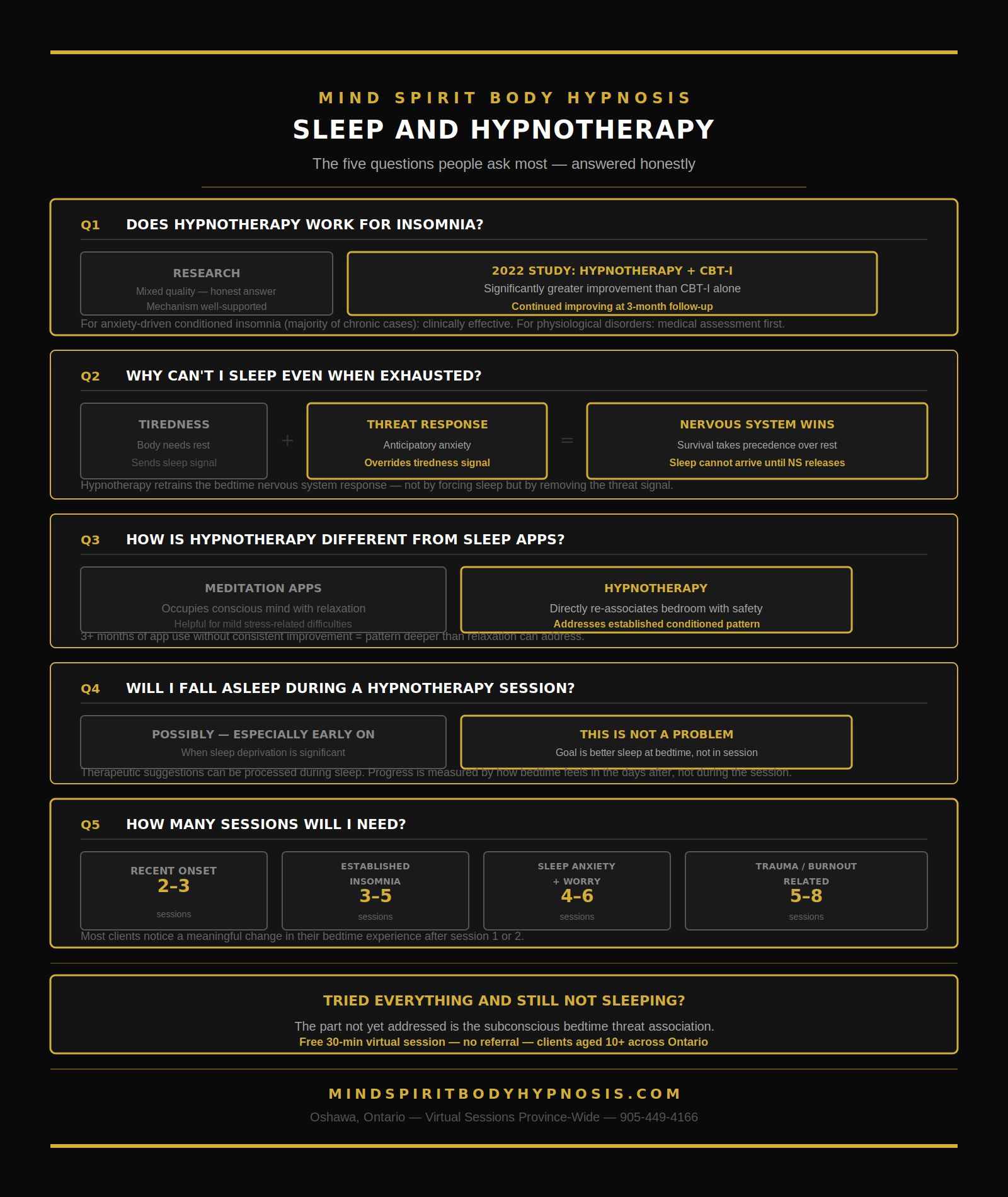
What the research does consistently support is the underlying mechanism. Hypnotic induction produces measurable and significant shifts toward parasympathetic nervous system dominance, reduced cortisol, and decreased amygdala activation the precise physiological changes that the insomniac nervous system needs and cannot produce on its own at bedtime. A 2022 study published in the Journal of Clinical Sleep Medicine found that combining hypnotherapy with CBT-I produced significantly greater improvements in sleep onset latency and sleep efficiency than CBT-I alone, with the hypnotherapy group showing continued improvement at three-month follow-up (Jiang et al., 2022).
In clinical practice, the picture is clearer than the mixed research suggests. Sleep difficulties that are primarily driven by conditioned arousal, anticipatory anxiety, and the specific sleep-effort paradox, which is the majority of chronic insomnia presentations in working-age adults, respond well to hypnotherapy. Sleep difficulties that are primarily physiological in origin, including sleep apnoea, restless leg syndrome, and circadian rhythm disorders, require medical assessment and are not primarily treated with hypnotherapy.
The honest answer is: for anxiety-driven and conditioned insomnia, hypnotherapy is clinically effective and often significantly so. For physiological sleep disorders, it is not the primary intervention. In the free strategy session, the distinction is always clarified before any programme begins.
⭐ Pro Tip: The most reliable signal that your sleep problem is primarily conditioned and anxiety-driven, rather than physiological, is the sofa test. If you fall asleep easily in front of the television or in other non-bedroom environments but become wide awake the moment you move to bed, the bedroom itself has become a conditioned trigger for wakefulness. This is a subconscious association, not a physiological condition. And it is one of the most reliably responsive presentations in hypnotherapy practice.
Why Can't I Sleep Even When I'm Exhausted?
This is the question that captures the particular cruelty of chronic insomnia: the body is clearly tired, all the signals are there, and sleep still will not come.
The answer is that sleep is not primarily determined by physical tiredness. It is determined by the state of the nervous system. Specifically, by whether the nervous system is in a state of physiological safety and parasympathetic dominance or in a state of alertness and threat response sympathetic dominance.
Physical tiredness is a signal that the body needs rest. But if the nervous system is running a threat response at the same time, the threat response takes precedence. The brain's survival system does not allow sleep when it believes there is a danger requiring attention. It does not matter that the danger is not physical. The perceived threat of another sleepless night, the anticipatory calculation of how the next day will go, the monitoring of whether sleep is arriving, all of these activate the sympathetic nervous system in a way that is physiologically incompatible with sleep.
This is why the insomnia paradox is so persistent. The thought I need to sleep is not restful. It is an effortful, monitoring thought that signals to the nervous system that something important needs to happen. The nervous system responds by activating rather than downregulating. Tiredness says sleep. The nervous system says not yet. The nervous system wins.
Hypnotherapy interrupts this cycle not by making sleep happen but by changing what the nervous system does when bedtime arrives. When the bedroom no longer signals threat, when the approach of sleep is no longer accompanied by anticipatory dread, and when the person has a practised internal process that produces genuine physiological downregulation rather than effortful monitoring, sleep can arise on its own terms.
Research published in the International Journal of Clinical and Experimental Hypnosis found that hypnotherapy for insomnia significantly reduced sleep onset latency and improved sleep quality scores, with the authors noting that the mechanism appeared to be nervous system recalibration rather than simple relaxation suggestion (Lam et al., 2018).
For more on the conditioned arousal mechanism and how hypnotherapy addresses it specifically, the hypnotherapy for sleep and insomnia pillar page covers the foundational clinical approach.
How Is Hypnotherapy Different From Sleep Meditation Apps?
This is one of the most practically searched questions about sleep hypnotherapy in 2026, as app fatigue has grown among the significant proportion of insomnia sufferers who have used meditation and sleep apps for months or years without achieving durable improvement.
The distinction is important, and the honest answer is that they are genuinely different in mechanism, depth, and target.
Sleep meditation apps: Provide guided relaxation, breathing exercises, sleep stories, and ambient sound. They are helpful for general stress reduction and mild sleep difficulties. They work by occupying the conscious mind with a pleasant, low-demand experience, which reduces the effortful monitoring quality of ordinary pre-sleep wakefulness. They do not directly address the subconscious conditioned associations between the bedroom and threat, the thought-action fusion patterns that give sleep anxiety its power, or the identity-level beliefs about being someone who cannot sleep.
Hypnotherapy: Works in the focused relaxation state that the app may partially induce, but then uses that state as a platform for specific, targeted subconscious work. The conditioned bedroom threat association is directly re-associated with safety. The anticipatory dread pattern is identified and interrupted at the subconscious level. The sleep-effort habit is dissolved and replaced with a genuine release. And a personalized self-hypnosis protocol is installed that the person can use independently at bedtime not to produce sleep but to produce the state from which sleep naturally arises.
In practical terms: meditation apps tend to help people feel more relaxed at bedtime without changing the underlying pattern that drives the sleeplessness. Hypnotherapy changes the pattern. For mild, stress-related sleep difficulties, the app is often sufficient. For established conditioned insomnia that has persisted despite sleep hygiene and app use, hypnotherapy addresses what the app cannot reach.
⭐ Pro Tip: If you have been using sleep meditation apps for more than three months without achieving consistently better sleep, this is a reliable indicator that the issue is deeper than general relaxation can address. The app has not failed. The sleep problem has a more established subconscious pattern than the app was designed to address. This is the point at which direct subconscious work through hypnotherapy typically produces the change that consistent app use has not.
Will I Fall Asleep During a Hypnotherapy Session?
This is one of the most common practical questions about sleep hypnotherapy and one of the most important to answer clearly.
The short answer is: you might, and it is not a problem if you do.
The hypnotic trance state and the pre-sleep state share physiological similarities. Both involve slowed breathing, reduced muscle tone, lowered heart rate, and a softening of the critical, analytical quality of ordinary wakefulness. For people with significant sleep deprivation, which includes most chronic insomnia sufferers, the relaxed quality of the trance state sometimes produces genuine sleep, particularly in early sessions.
If you fall asleep during a session, the therapeutic work is not wasted. Research confirms that suggestions and therapeutic content delivered during sleep can be processed and integrated at the subconscious level, though the depth of integration varies. The more important outcome is what happens in the subsequent days: do the bedtime patterns change, does the anticipatory dread reduce, does the approach of sleep feel different from how it felt before?
In later sessions, as the sleep pattern improves and the nervous system is less depleted, clients typically remain in a lighter trance state, aware of what is being said, responsive to suggestions, and able to remember the session content afterwards. This progression is itself a sign that the work is producing the intended change.
The aim of the hypnotherapy is not to produce sleep during the session. It is to change the subconscious pattern so that sleep becomes available at bedtime. A client who falls asleep in the session and then sleeps better at night is progressing exactly as intended.
How Many Sessions Will I Need?
Here is a specific, honest breakdown rather than a vague reassurance.
Stress-related sleep difficulties of recent onset: Two to three sessions. Short-duration sleep problems that have not yet developed into deeply conditioned patterns respond quickly to hypnotherapy and nervous system regulation work.
Established conditioned insomnia (six months or more): Three to five sessions for most clients. The conditioned bedroom threat association and the anticipatory dread pattern require more systematic work, but they are among the most reliably responsive presentations in the practice.
Sleep anxiety with significant worry or rumination component: Four to six sessions. When the pre-sleep period involves significant mental activity and the suppression of anxious thoughts is a major feature, additional sessions address the worry pattern directly alongside the sleep work.
Sleep difficulties alongside trauma, grief, or significant life disruption: Five to eight sessions. When the sleep difficulty is secondary to significant emotional material, that material needs to be addressed for the sleep pattern to shift durably.
Burnout with associated sleep disruption: Four to six sessions, addressing both the nervous system dysregulation and the sleep pattern.
Most clients notice a meaningful change in their bedtime experience a reduction in anticipatory dread, a different quality to lying in bed, a greater sense that sleep is something that can happen rather than something they are failing at -- after the first or second session. The full programme consolidates and deepens these changes. All sessions are delivered virtually, available to clients aged 10 and older across Ontario.
For more on how anxiety drives the sleep patterns that hypnotherapy addresses, the hypnotherapy for anxiety and stress pillar page covers the nervous system mechanisms.

What to Expect at Mind Spirit Body Hypnosis
The first session is a conversation. When did the sleep difficulty begin? Is there a specific event or period that started it? What does the bedtime experience feel like now? When does the dread begin, what happens in bed, and how does the following day feel? What has already been tried? And what would it mean, practically and emotionally, to sleep again?
The trance work begins with nervous system regulation. For many sleep clients, the first session is the first time they have experienced the deeply downregulated physiological state that sleep requires without either sleeping or monitoring. That experience itself is valuable; it demonstrates to the subconscious that the state is available, which is frequently a revelation for people who have spent months believing they no longer know how to relax.
A personalized self-hypnosis bedtime protocol is taught and anchored early in the programme, so clients have a practical independent tool from the second session onwards. More about the full programme approach at Mind Spirit Body Hypnosis is available on the about page.
What My Clients Say
"I had been dealing with racing thoughts every single night for over two years. I would lie there for hours going over everything in my head and nothing helped. After three sessions with Fanis I was falling asleep within 20 minutes. It felt like someone had finally given my brain an off switch. I cannot recommend him enough."
Dan B. | Sleep and Anxiety | Five Stars
"I began seeing Fanis after a long battle with trauma and grief. I suffered from severe anxiety, panic attacks, insomnia and self harm. After 3 months of weekly hypnotherapy sessions done online, I no longer suffer from panic attacks, insomnia, or self harm and have learned how to better regulate my emotions and find peace. Fanis helped me process many childhood traumas and confront my overwhelming grief. I am eternally grateful to Fanis and his wonderful work."
Sara V. | Trauma and Grief | Five Stars
FAQ
Does hypnotherapy work for insomnia? The research is mixed in quality, but the clinical mechanism is well-supported. Hypnotherapy produces measurable parasympathetic shifts and reduced amygdala activation. A 2022 study found combining hypnotherapy with CBT-I produced significantly greater improvements than CBT-I alone. For anxiety-driven and conditioned insomnia, which is the majority of chronic insomnia in working-age adults, hypnotherapy is clinically effective.
Why can't I sleep even when I am exhausted? Because sleep is determined by nervous system state, not physical tiredness. If the nervous system is running a threat response at bedtime from conditioned arousal, anticipatory anxiety, or sleep effort, it prevents sleep regardless of how tired the body is. Hypnotherapy retrains the nervous system's bedtime response rather than adding more effort to the already effortful process of trying to sleep.
How is hypnotherapy different from meditation apps? Apps provide guided relaxation that occupies the conscious mind. Hypnotherapy works in the focused relaxation state to directly address the subconscious conditioned associations and anticipatory patterns driving the insomnia. Apps help with mild stress-related sleep issues. Hypnotherapy addresses established conditioned patterns that relaxation alone cannot change.
Will I fall asleep during a hypnotherapy session? Possibly, particularly in early sessions when sleep deprivation is significant. This is not a problem. Therapeutic content can be processed during sleep. As the programme progresses and sleep improves, clients typically remain in lighter, more aware trance states. The aim is not to produce sleep in the session but to change the pattern so sleep becomes available at bedtime.
How many sessions will I need for sleep problems? Recent-onset stress-related sleep difficulties: two to three sessions. Established conditioned insomnia: three to five. Sleep anxiety with significant worry: four to six. Sleep alongside trauma or burnout: five to eight. Most clients notice a meaningful shift in their bedtime experience after the first or second session.
What if I have already tried CBT-I? CBT-I is excellent for the behavioural components of insomnia and is the evidence-based first-line treatment. Hypnotherapy complements it by addressing the conditioned arousal and subconscious anxiety components that CBT-I's behavioural protocols do not directly target. Many clients find that hypnotherapy resolves the residual pattern that CBT-I alone could not fully address.
Is there anything hypnotherapy cannot help with for sleep? Yes. Physiological sleep disorders including sleep apnoea, restless leg syndrome, and circadian rhythm disorders require medical assessment and treatment. If your sleep difficulties include significant snoring, breathing interruptions, or persistent leg discomfort, please see your GP before pursuing a hypnotherapy programme.
Can I do sessions virtually from anywhere in Ontario? Yes. All sessions are delivered virtually, province-wide, with no referral required. The virtual format is particularly valuable for sleep work because you can transition directly to your own bedroom after the session.
How do I get started? Book a free 30-minute virtual strategy session at calendly.com/mindspiritbodyhypnosis. No referral needed.
Ready to Take the Next Step?
If you have tried everything and the pattern has not broken, the part that has not yet been addressed is the subconscious conditioned association between bedtime and threat. That is what hypnotherapy changes.
I offer a free 30-minute virtual strategy session for new clients across Ontario. No pressure. Just an honest conversation about what has been happening at night and what approach is most likely to help.
Book your free session: calendly.com/mindspiritbodyhypnosis
Call or text: 905-449-4166
Email: info@mindspiritbodyhypnosis.com
Visit: mindspiritbodyhypnosis.com
Serving clients virtually across Ontario, including Durham Region, Toronto, Ontario, and beyond.
Disclaimer: This article is for informational purposes only and does not constitute medical advice. Physiological sleep disorders, including sleep apnoea, restless leg syndrome, and circadian rhythm disorders, require medical assessment. Hypnotherapy and NLP are complementary approaches and are not a substitute for medical care. Please consult your doctor if you have not had your sleep difficulties medically assessed. Results vary by individual.
Written by Fanis Makrigiannis | Certified Hypnotherapist & NLP Master Practitioner | Mind Spirit Body Hypnosis.