Can Hypnotherapy help you quit vaping?
Can Hypnotherapy Help You Stop Vaping?
TL;DR: Vaping is not simply a nicotine problem. It is a habit loop that combines chemical dependence with deeply conditioned emotional triggers, and the subconscious has learned to reach for the vape before any conscious decision is made. At Mind Spirit Body Hypnosis in Oshawa, Ontario, Fanis Makrigiannis uses hypnotherapy and NLP to address both the subconscious habit architecture and the emotional drivers of vaping, helping clients of all ages across the province stop for good rather than white-knuckling through cravings that eventually win.
Quick Answer
Hypnotherapy to stop vaping is a subconscious-focused approach that addresses both the nicotine-craving habit loop and the emotional and situational triggers that sustain vaping behaviour by rewiring the subconscious associations between the vape and the states it produces. A Cochrane review and subsequent meta-analyses support hypnotherapy as an effective cessation approach with no identified adverse effects. Fanis Makrigiannis, a Certified Hypnotherapist and NLP Master Practitioner at Mind Spirit Body Hypnosis in Oshawa, Ontario, offers virtual sessions across the province for clients of all ages ready to put the vape down for the last time.
Questions This Article Answers
Can hypnotherapy help you stop vaping?
Why is vaping so hard to quit?
How is vaping addiction different from smoking addiction?
What are the emotional triggers behind vaping?
What is the best way to stop vaping for good?
In This Article:
You have tried to stop. Maybe more than once. You threw the vape out. You switched to a lower nicotine level. You told yourself you would only vape outside, or only after work, or only on weekends. And at some point, one of those limits quietly dissolved, and you were back where you started.
That is not a willpower failure. It is the subconscious running a habit loop that is faster and more powerful than any conscious resolution. The part of you that wants to stop is conscious. The part that reaches for the vape is not.
In my practice, clients who come to stop vaping often arrive having already quit cigarettes, sometimes years ago, through genuine effort and sometimes through switching to vaping in the first place. They know they are capable of change. What they have discovered is that the vaping habit has a different character from cigarettes: more constant, more socially invisible, and more deeply woven into every part of the day.
Why Is Vaping So Hard to Quit?
Vaping is difficult to quit for several compounding reasons that go beyond nicotine dependence alone.
Nicotine delivery is faster and more convenient. Modern vaping devices deliver nicotine to the bloodstream within seconds, producing a rapid dopamine response that is more immediate than that of most cigarettes. The reinforcement cycle is therefore tighter and faster, making each puff a highly efficient reward signal.
The habit is socially normalized and physically unobtrusive. Unlike smoking, vaping can be done indoors, at desks, in cars, and in many social contexts without obvious social consequence. The habit has fewer natural environmental barriers, meaning it has been reinforced more frequently and in more varied contexts than smoking typically was.
The perceived harm is lower. Vaping was marketed as a harm reduction tool, and many people who vape carry a residual belief that it is not really that bad. This belief reduces motivational urgency and makes the subconscious less compelled to classify it as something requiring genuine effort to stop.
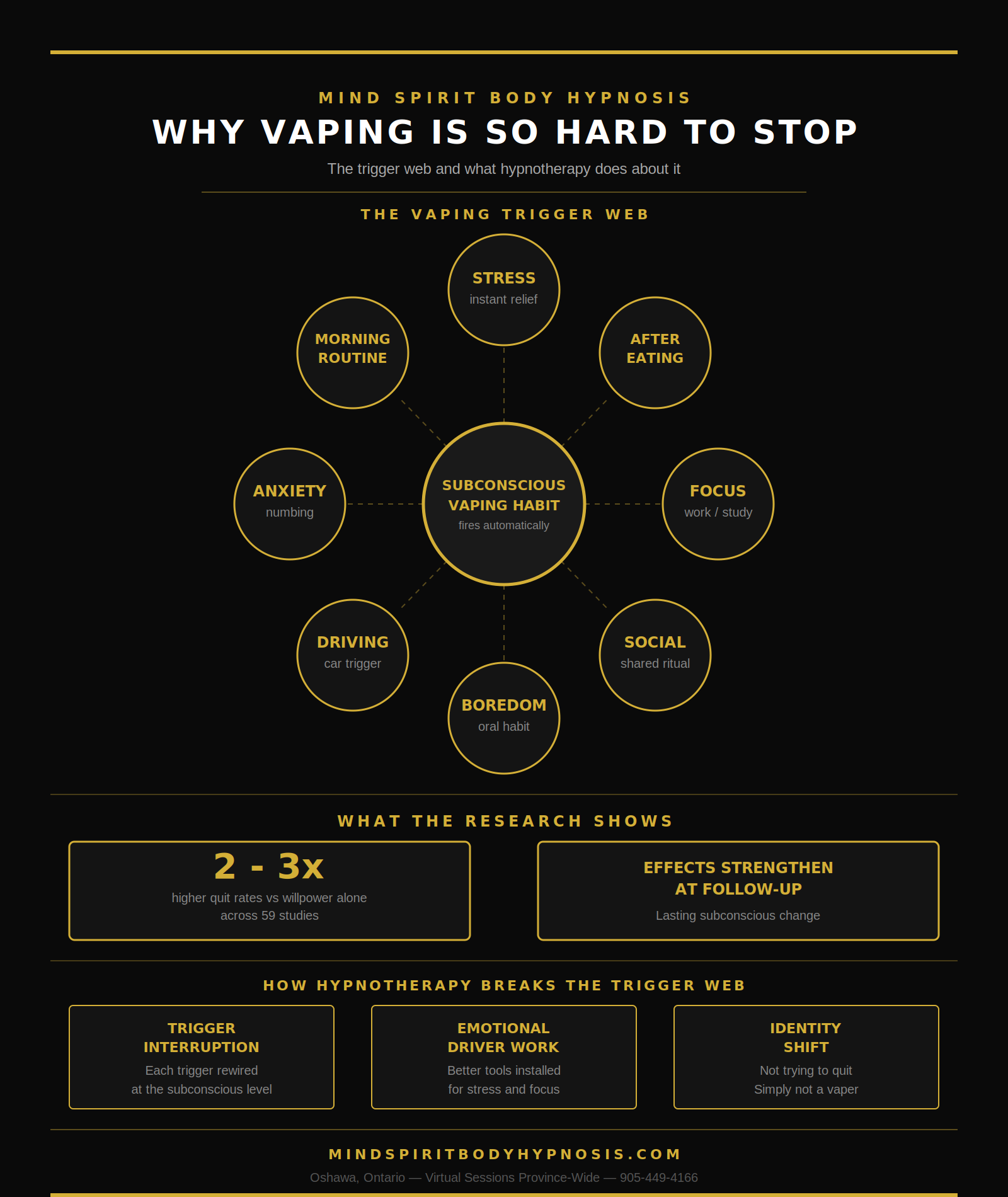
The triggers are everywhere. Because vaping has been paired with so many different contexts, the conditioned triggers that prompt the automatic reach are numerous: after eating, while working, during stress, while driving, after exercise, when bored, when socializing. Each of these associations is a separate habit loop that the subconscious has to unlearn.
According to Health Canada, approximately 20 percent of Canadians aged 15 to 24 reported current vaping in 2023, with rates significantly higher in Ontario than in most other provinces. Among adults who vape, 40 percent report wanting to quit but finding it difficult to do so without support.

How Is Vaping Different From Smoking?
Understanding the differences between vaping and smoking matters because the two habits have somewhat different subconscious architectures, even though both involve nicotine.
Frequency of use is typically higher with vaping. Smokers generally smoke at defined points in the day, often between tasks or in designated spaces. Vapers frequently use their device almost continuously, meaning the habit has been reinforced many more times per day and is more deeply integrated into the moment-to-moment fabric of the day.
The sensory experience is different. Smoking involves a specific sensory ritual: the lighting, the smell, the distinct physical sensation. These rituals are themselves triggers and anchors. Vaping is more uniform and device-driven, which means the trigger is often more emotional or situational than sensory.
Identity is different. Many smokers carry a social identity around smoking that is itself part of the habit. Vapers more often describe the habit as purely functional, a tool for stress management, focus, or comfort, which makes the identity dimension of the work different.
Research published in Tobacco Control found that among people who had previously quit smoking successfully, those who had switched to vaping as a cessation tool showed significantly higher rates of ongoing nicotine dependence at one year compared to those who had quit using non-nicotine methods, suggesting that vaping may delay rather than resolve the underlying addiction pattern (Hitchman et al., 2015).
For more on how hypnotherapy addresses nicotine habits at the subconscious level and how it is applied at Mind Spirit Body Hypnosis, the hypnotherapy for quitting smoking page covers the foundational approach in detail.
What Are the Real Drivers Behind the Vaping Habit?
For most people, vaping is not primarily about nicotine. It is about what the nicotine and the vaping ritual do.
Stress regulation. The most common driver I see in my practice. Vaping produces a rapid shift in nervous system state, providing brief relief from tension, anxiety, or mental overwhelm. The subconscious has learned that the vape is the fastest available tool for stress regulation. Until a more effective tool is installed, the craving will continue to fire in every stressful situation.
Focus and concentration. Many vapers describe the vape as a focus tool, particularly for work, study, or creative tasks. The nicotine-stimulated dopamine release genuinely does enhance short-term concentration, which reinforces the habit and makes stopping feel like a performance risk.
Social comfort and belonging. For younger vapers especially, the habit has a social dimension. Vaping is a shared activity, a conversation point, a way of fitting into a particular social environment. Stopping can feel like a loss of social ease or belonging.
Emotional numbing. For some clients, vaping serves a similar function to many other habits: reducing emotional intensity, providing a pause in the face of difficult feelings, and creating a brief sensory experience that interrupts whatever emotional state was present.
Boredom and oral fixation. The consistent physical habit of having something in the hand and mouth is itself a pattern that the subconscious has reinforced thousands of times. The subconscious does not distinguish between the nicotine reward and the physical ritual, making the physical habit as embedded as the chemical one.
For more on how habits and addictions are maintained by the subconscious and how hypnotherapy addresses the root, the hypnotherapy for habits and addictions pillar page at Mind Spirit Body Hypnosis covers the foundational mechanisms.
How Hypnotherapy Addresses Vaping at the Subconscious Level
As a certified hypnotherapist trained through the American Board of Hypnotherapy, I approach vaping cessation as a habit pattern with both chemical and subconscious components. The work addresses both simultaneously, which is why the results are more durable than willpower-based approaches alone.
Trigger mapping and interruption. Before the trance work begins, sessions map the specific triggers that most reliably activate the urge to vape. After eating. During stress. At the desk. In the car. Once mapped, the automatic connection between each trigger and the reach-for-the-vape response is interrupted in trance and replaced with a new automatic response. The trigger fires. The craving does not follow.
Emotional driver work. The session identifies what vaping is actually doing for the person. If it is stress regulation, the anxiety that the vaping is managing is addressed directly in trance. If it is a focus, better internal focus tools are installed. If it is emotional numbing, the emotional material being avoided is gently approached and processed. When the subconscious has a better tool for the job, vaping loses its function.
Nicotine identity shift. One of the most important dimensions of the work is at the identity level. The session installs a new subconscious identity: not someone who is trying to quit vaping, but someone who simply does not vape. This shift in how the self is represented internally changes the automatic behaviour in a way that willpower cannot.
Aversion and indifference installation. Using guided suggestion in trance, the subconscious experience of the vape is changed. The vape loses its compelling quality. Rather than representing relief, focus, or comfort, it becomes associated with something the person has genuinely moved past. Many clients describe this as the vape simply losing its appeal rather than needing to resist it.
A meta-analysis of 59 studies published in the Journal of Applied Psychology found that hypnotherapy produced quit rates two to three times higher than unaided willpower and significantly higher than nicotine replacement alone, with effects that strengthened rather than faded at follow-up (Viswesvaran & Schmidt, 1992). The mechanism, as the researchers noted, was the combination of direct suggestion with the subconscious receptivity of the trance state.
NLP Techniques That Break the Vaping Habit Loop
NLP offers targeted tools for dismantling the specific habit architecture of vaping. Clients I work with in Ontario find these particularly useful as portable tools between sessions.
The swish pattern. A rapid NLP technique that interrupts the automatic trigger-to-vape sequence and replaces it with a new automatic response. Particularly effective for the habitual vaping that fires at specific times or in specific contexts. After one or two applications in a session, the technique can be used the moment a craving fires independently.
Submodality works on the craving. The internal experience of a vaping craving has a specific structure: a location in the body, a quality, a pull. Changing those qualities directly reduces the urgency of the craving. Clients can learn to do this independently in under two minutes, transforming the experience of a craving from compelling to manageable.
Anchoring a vape-free state. A state of calm, focused, free-feeling wakefulness experienced during trance is anchored to a physical cue. When a craving fires in daily life, activating the anchor provides an immediate alternative internal state that does not require the vape to produce.
Parts integration. Most people trying to stop vaping have a genuine internal conflict: the part that wants to stop and the part that still wants to vape. NLP parts integration resolves this conflict, creating internal alignment so the person is no longer fighting themselves every time the urge fires.
The full NLP and hypnotherapy approach used at Mind Spirit Body Hypnosis is outlined on the about page.
What to Expect in a Session
The first session is a conversation. When do you vape most? What does it give you? What has already been tried? How long have you been vaping? Has there been a period when you stopped successfully, even briefly, and what was different then?
These questions map the subconscious architecture of the habit before the trance work begins. The induction is gentle, and most clients reach a deeply relaxed state within minutes. The core work then targets the specific triggers, emotional drivers, and identity patterns identified in the conversation.
Most vaping cessation programmes at Mind Spirit Body Hypnosis run between two and four sessions. Some clients stop completely after the first session. Others reduce significantly and stop altogether in the second. The timeline depends on how many emotional drivers are involved and how deeply the habit is conditioned.
All sessions are delivered virtually and are available to clients aged 10 and older across Ontario from the comfort of their own homes.
What My Clients Say
"Fanis has done so much for me in such a short period of time — helped me quit smoking, and also helped me to believe and love myself. So professional and patient like no one I have ever met. He has given me hope and strength I have been needing for a long time. I could never thank him enough. Today I believe in myself!"
Natasha C. | Quit Smoking | Five Stars
FAQ
Can hypnotherapy help you stop vaping? Yes. Hypnotherapy addresses both the subconscious habit loop and the emotional triggers driving vaping behaviour. A meta-analysis found hypnotherapy produced quit rates two to three times higher than unaided willpower and significantly higher than nicotine replacement alone, with effects that strengthened at follow-up.
Why is vaping so hard to quit? Vaping is difficult to quit because it combines rapid nicotine delivery with a habit that has been reinforced in dozens of daily contexts, in many cases continuously throughout the day. The triggers are numerous, the perceived harm is lower than that of a cigarette, and the subconscious has built an efficient, well-practised habit loop that willpower alone struggles to interrupt.
How is vaping addiction different from smoking addiction? Vaping typically involves a higher frequency of use, fewer social and environmental barriers, a lower perceived harm, and a more diffuse set of triggers than smoking. The habit has often been conditioned more thoroughly into daily routines than smoking was, making the subconscious architecture of the habit broader and more varied.
What are the emotional triggers behind vaping? The most common emotional drivers are stress regulation, focus enhancement, social comfort, emotional numbing, and boredom. For most vapers, nicotine is the chemical mechanism, but the emotional function is the deeper driver. Addressing the emotional driver directly produces more lasting results than targeting the nicotine alone.
What is the best way to stop vaping for good? Approaches that address the subconscious habit loop and emotional drivers produce the most lasting results. Hypnotherapy and NLP work at exactly that level, rewiring the trigger-to-vape association and installing better internal tools for the emotional needs that vaping was meeting. At Mind Spirit Body Hypnosis, the approach combines both for a comprehensive result.
How many sessions will I need? Most vaping cessation programmes at Mind Spirit Body Hypnosis run between two and four sessions. Some clients stop after the first session. Others reduce significantly and stop in the second. The timeline depends on the complexity of the emotional drivers and how broadly the habit has been conditioned.
Is this suitable for younger clients? Yes. Mind Spirit Body Hypnosis works with clients aged 10 and older. Vaping among younger clients, including teenagers and young adults, is a significant and growing concern in Ontario. Hypnotherapy and NLP are gentle, medication-free, and non-invasive.
Can I do sessions virtually from anywhere in Ontario? Yes. All sessions are delivered virtually, province-wide, with no referral required.
What if I have tried to stop before and failed? Previous attempts that failed typically relied on willpower alone or nicotine replacement, neither of which addresses the subconscious habit loop and emotional triggers driving the behaviour. Hypnotherapy works at the level where the habit actually lives, which is why it produces results that previous approaches often could not sustain.
How do I get started? Book a free 30-minute virtual strategy session at calendly.com/mindspiritbodyhypnosis. No referral needed.
Ready to Take the Next Step?
If vaping has become the habit you keep meaning to stop, and every attempt has eventually circled back to the same starting point, the subconscious root has not yet been addressed.
I offer a free 30-minute virtual strategy session for new clients across Ontario. There is no pressure, just a conversation about what has been maintaining the habit and how hypnotherapy or NLP may help you stop for good
Book your free session: calendly.com/mindspiritbodyhypnosis
Call or text: 905-449-4166
Email: mindspiritbodyhypnosis@gmail.com
Visit: mindspiritbodyhypnosis.com
Serving clients virtually across Ontario, including Durham Region, Toronto, Ottawa, and beyond.
Disclaimer: This article is for informational purposes only and does not constitute medical or psychological advice. Hypnotherapy and NLP are complementary approaches and are not a substitute for medical advice or nicotine dependence treatment from a qualified healthcare provider. If you are experiencing withdrawal symptoms that require medical management, please consult your doctor. Results vary by individual.
Written by Fanis Makrigiannis | Certified Hypnotherapist & NLP Master Practitioner | Mind Spirit Body Hypnosis.